Israeli Soldiers Enforce Closure of Al Aqsa

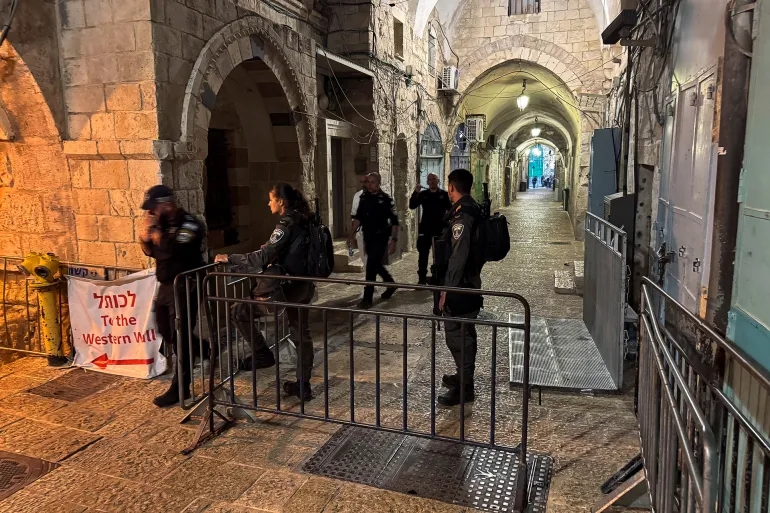
Israeli occupation authorities continued their closure of the Al-Aqsa Mosque compound on Sunday, marking the 16th consecutive day of closure. As the 27th night of Ramadan approached, they transformed the area surrounding the mosque into a military zone.

The Palestinian Jerusalem Governorate stated that occupation forces had turned the Old City of Jerusalem into a military barracks, deploying hundreds of soldiers around it.

It added hundreds of Jerusalemites performed the Isha and Taraweeh prayers in the Bab al-Sahira and Bab al-Amud areas and in the streets, as the Old City and the Al-Aqsa Mosque remained closed “amid a siege by Israeli forces.”

These Israeli reinforcements coincided with calls on social media to break the siege of the Al-Aqsa Mosque and observe Laylat al-Qadr (Night of Power) within its precincts or wherever possible.

Since the start of the US-Israeli attack on Iran on February 28, the occupation authorities have closed the Al-Aqsa Mosque under the pretext of declaring a state of emergency and preventing gatherings.

Palestinians observe the 27th night of Ramadan (Laylat al-Qadr) by observing i’tikaf (seclusion for worship) in mosques, praying, supplicating, and reciting the Quran until dawn. Last year, approximately 180,000 people observed it at Al-Aqsa Mosque.

According to the Jerusalem Governorate, dozens of Jerusalemites performed the Isha and Taraweeh prayers near the Damascus Gate (Bab al-Sahira) on the northern side of the Old City of Jerusalem, amidst heavy military reinforcements and a large deployment of occupation forces.

The Wadi Hilweh Information Center for Human Rights stated that occupation forces erected checkpoints, stopped those entering the Old City, and prevented non-residents from entering.

The center noted the collapse of the Old City’s markets, which appear almost deserted, with most shops closed due to Israeli restrictions, during a season that merchants eagerly anticipate each year.

The Arab League, in a statement, condemned “in the strongest terms” the continued closure of Al-Aqsa Mosque and the prevention of prayers and religious rituals there, especially during the holy month of Ramadan and its last ten nights.

The university deemed this “provocative measure a flagrant violation of international law, international humanitarian law, and the existing legal and historical status quo at the Al-Aqsa Mosque/Haram al-Sharif, an unprecedented provocation of the feelings of two billion Muslims worldwide, and an undermining of freedom of worship and unrestricted access to places of worship.”

It emphasized that “Israel, the occupying power, has no sovereignty over the Palestinian territory occupied in 1967, including the occupied city of Jerusalem and its Islamic and Christian holy sites.”

It called upon the international community, including the Security Council, to assume its responsibilities and adopt a firm international stance that compels Israel, as the occupying power, to cease its violations and practices, lift all restrictions imposed on Palestinian access to Jerusalem, and respect freedom of worship. J024

CrossFireArabia

CrossFireArabia
Dr. Marwan Asmar holds a PhD from Leeds University and is a freelance writer specializing on the Middle East. He has worked as a journalist since the early 1990s in Jordan and the Gulf countries, and been widely published, including at Albawaba, Gulf News, Al Ghad, World Press Review and others.

Related Posts

Gaza, Srebrenica: Two Genocides Years Apart

Israel Turns Gaza Into a Death ‘Srebrenica’ Camp

Israel is legitimising and enforcing a systematic pattern of geographic siege on Gaza, extending beyond a comprehensive blockade to include forcible internal confinement. This traps Palestinians within a small, devastated area under conditions more severe and crowded than those in the Srebrenica enclave before its fall in 1995, when genocide occurred according to the Euromedmonitor.

The Srebrenica genocide serves as a clear historical warning about the deadly impact of besieging civilians and depriving them of protection and essentials for life, particularly when these actions are part of systematic behaviour that is a core component of ongoing genocide, as seen in Gaza the Euro-Mediterranean Human Rights Monitor added.

On the eve of Srebrenica’s fall in 1995, nearly 40,000 people were besieged within a roughly 150 km². Meanwhile, for most of Gaza’s approximately 2.1 million residents, the remaining habitable area has shrunk to just about 128 km².

Geographically and demographically, Gaza is now limited to an area about 15 per cent smaller than Srebrenica, but with a population over 50 times larger and a density roughly 60 times higher, all amidst rubble, waste, and a severe lack of basic living conditions.

Changing Gaza’s Landscape

Israel is changing the demographic and military landscape of the Gaza Strip by increasing its de facto control and imposing severe restrictions on roughly 65 per cent of the enclave. This action deprives over two million residents of essential resources, prevents their return to their lands and homes, and makes large parts of Gaza prohibited zones under Israeli military control. These measures effectively amount to an unlawful annexation and seizure of land the Geneva-based organization.

Israeli Prime Minister Benjamin Netanyahu’s announcement to expand military control over 70 percent of Gaza highlights an aim to further settler colonialism and expel the area’s native Palestinians, as this plan would leave only about 109 km² for residents. If this occurs, the per capita share of the remaining space would decrease to approximately 52 m², and the population density would increase to about 19,300 people per km², which is roughly 72 times higher than the density in Srebrenica in 1995.

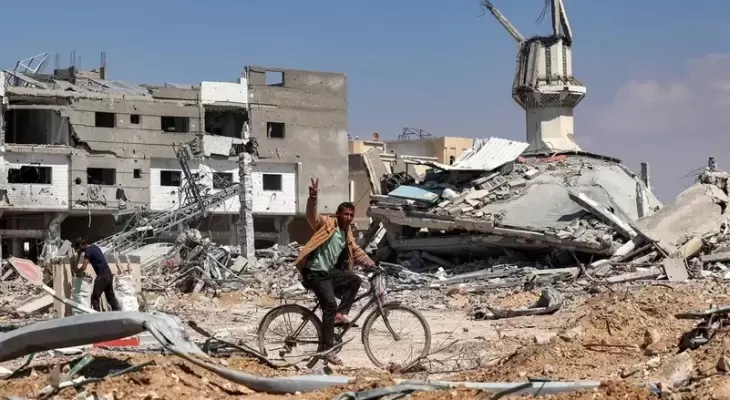
Although the numerical figures on population density are alarming, they do not fully reflect the harsh reality of the suffocating overcrowding residents face in the Gaza Strip. Much of the remaining land has been intentionally rendered uninhabitable through systematic destruction. This area is overwhelmed with large amounts of rubble from homes and civilian objects. It is filled with destroyed infrastructure and blocked roads, hindering movement, access, and humanitarian efforts. Additionally, waste, war remnants, water source contamination, sewage network collapses, and exposed land devoid of shelter or safe displacement sites further worsen the situation.

In addition to severe overcrowding, most residents live in either worn-out tents, which offer no shelter from summer heat, winter cold, or rain, or in heavily damaged houses that could collapse at any moment. These structures are at risk due to ongoing Israeli bombardments or natural elements like wind and rain the human rights organization goes on to say.

This situation poses numerous risks to hundreds of thousands of families, such as buildings collapsing on residents, fires erupting in overcrowded tent camps, and the spread of diseases due to poor sanitation, ventilation, and lack of clean water. It also deprives them of privacy and safety, particularly affecting women, children, and the elderly, as there are no safe housing options that could help residents escape this extreme overcrowding.

The residents of the Gaza Strip face a reality that deliberately subjects them to conditions intended to undermine the Palestinian population, either partially or entirely. This includes measures such as deportation or forced transfer, with efforts to legitimise and promote this displacement internationally under misleading terms like “freedom of movement” or “voluntary emigration.”

The ongoing killings, military operations, siege, and denial of sufficient food exemplify systematic actions that undermine civilian life. These include widespread destruction of civilian infrastructure, effective denial of return, military seizure of large land areas, restrictions on access to medical, health, and educational services, obstruction of reconstruction, and forcing residents into areas lacking basic survival needs. Collectively, these practices convert any choice into a consequence of physical and psychological coercion by Israeli authorities. Any departure of residents from the Gaza Strip under these conditions therefore cannot be regarded as voluntary but falls under forced displacement, which is prohibited under international law.

The attempts to forcibly transfer the population are a direct continuation of Israel’s settler-colonial approach, which has persisted for decades and is based on policies aimed at erasing Palestinian history, space, and demographics, along with the systematic seizure of land. This phase is characterised by its rapid pace and broad scope, aiming to reach over two million people suffering from ongoing genocide. These individuals have been deprived of legal protection and basic survival means for nearly three years.

These systematic coercive measures, along with the dehumanisation they entail, are deliberately designed to force residents into a stark choice: either face physical extermination or be forced out of their homeland. This is not a voluntary decision, but a compulsory condition for survival, highlighting the Gaza Strip situation as a well-documented example of mass deportation and forcible transfer in modern legal history.

Fourth Geneva Convention

The international community and all states must unequivocally oppose any plans to depopulate Gaza or force residents to leave using misleading terms like “voluntary emigration” or “freedom of movement.” Such population movements, without safe options and under ongoing physical and psychological pressure, are not genuinely voluntary but are crimes of forced displacement. These are prohibited by the Fourth Geneva Convention and the Rome Statute of the International Criminal Court. When this act occurs during an ongoing genocide, it triggers all states’ responsibilities to prevent and stop the crime, avoid recognising any illegal situation resulting from it, abstain from helping or supporting its continuation, and work together to end it and ensure those responsible are held accountable.

All states must implement prompt and effective punitive actions against Israel instead of merely issuing condemnation statements or broad calls. This includes applying diplomatic, economic, and military sanctions; suspending any agreements, privileges, or cooperation that enable ongoing crimes or provide political cover; enforcing a comprehensive embargo on the supply, transfer, purchase, or import of weapons, munitions, equipment, and military and security technology; freezing the assets of involved Israeli officials; and imposing travel bans on them. Maintaining normal relations with a state that commits genocide and forced displacement, or providing it with weapons, political, and economic support, can be seen as contributing to the ongoing unlawful situation. This may also violate states’ obligations to prevent and stop the crime and to avoid aiding or assisting in its commission.

The international community must act swiftly and decisively to dismantle Israel’s illegal system of control, detention, and apartheid over Palestinians, including those in the Gaza Strip. This involves forcing an immediate end to its military presence; removing barriers, buffer zones, and restricted areas that reduce the Strip’s land area and hinder residents’ access; and ensuring the prompt, unconditional return of displaced individuals to their original homes. These steps are essential to prevent de facto annexation, settler colonialism, and the forced displacement of Palestinians.

Euro-Med Human Rights Monitor urges immediate international action to lift the unlawful blockade on Gaza and establish safe, sustainable humanitarian access. This includes opening UN-supervised humanitarian corridors to allow the free flow of food, medicine, fuel, medical supplies, and shelter materials without arbitrary restrictions. The deployment of independent international monitors is crucial to verify compliance and ensure that aid and essential services are not used as tools of genocide.

Additionally, donors, states, and international organisations should move beyond merely managing the disaster through temporary relief. They need to act immediately to offer safe, dignified shelter solutions for residents, including permitting shelter materials and essential supplies to enter without restrictions, and urgently repairing health facilities, water and sewage networks, and critical infrastructure. A genuine path toward reconstruction cannot exist without lifting the blockade, ending Israeli restrictions on materials and equipment entry, ensuring residents can return to their areas, and stopping the ongoing destruction of civilian structures.

Reconstruction efforts should not replace accountability or serve to normalise the consequences of the Israeli crimes. Instead, it must compel Israel to take legal responsibility for the extensive destruction and ensure victims’ rights to reparation, compensation, and the restoration of safe living conditions on their land.

States with universal jurisdiction courts must issue arrest warrants for Israeli political and military leaders involved in the ongoing genocide and initiate legal proceedings to fulfil their international legal obligation to prosecute serious crimes and combat impunity. They must also hold accountable their citizens found to have committed violations against Palestinians, in line with their national and international legal obligations and within their territorial or personal jurisdiction.

Relevant UN agencies should urgently conduct an independent assessment of the Gaza Strip to identify the areas that are truly safe for habitation and human use. This will reveal the Israeli misrepresentation that considers nominal geographic zones as habitable. Euro-Med Monitor emphasises the importance of legally and practically distinguishing between the theoretical geographic regions still available to residents and the zones genuinely suitable for living or for safe displacement centres, which must be free of rubble, environmental and health risks, unexploded ordnance, and war remnants, EuroMed concluded.

Continue reading

You Missed

Gaza, Srebrenica: Two Genocides Years Apart

Gaza, Srebrenica: Two Genocides Years Apart

The Gaza Holocaust

The Gaza Holocaust

25 Palestinians Spent a Quarter-Century in Israeli Prisons

25 Palestinians Spent a Quarter-Century in Israeli Prisons

Israeli Bulldozers Demolish Two Homes in Palestinian Town

Israeli Bulldozers Demolish Two Homes in Palestinian Town

Gaza Death Toll Tops 73,000 With 173,571 Injured

Gaza Death Toll Tops 73,000 With 173,571 Injured

Gaza City: 8 Bodies Recovered From The Rubble

Gaza City: 8 Bodies Recovered From The Rubble