CrossFireArabia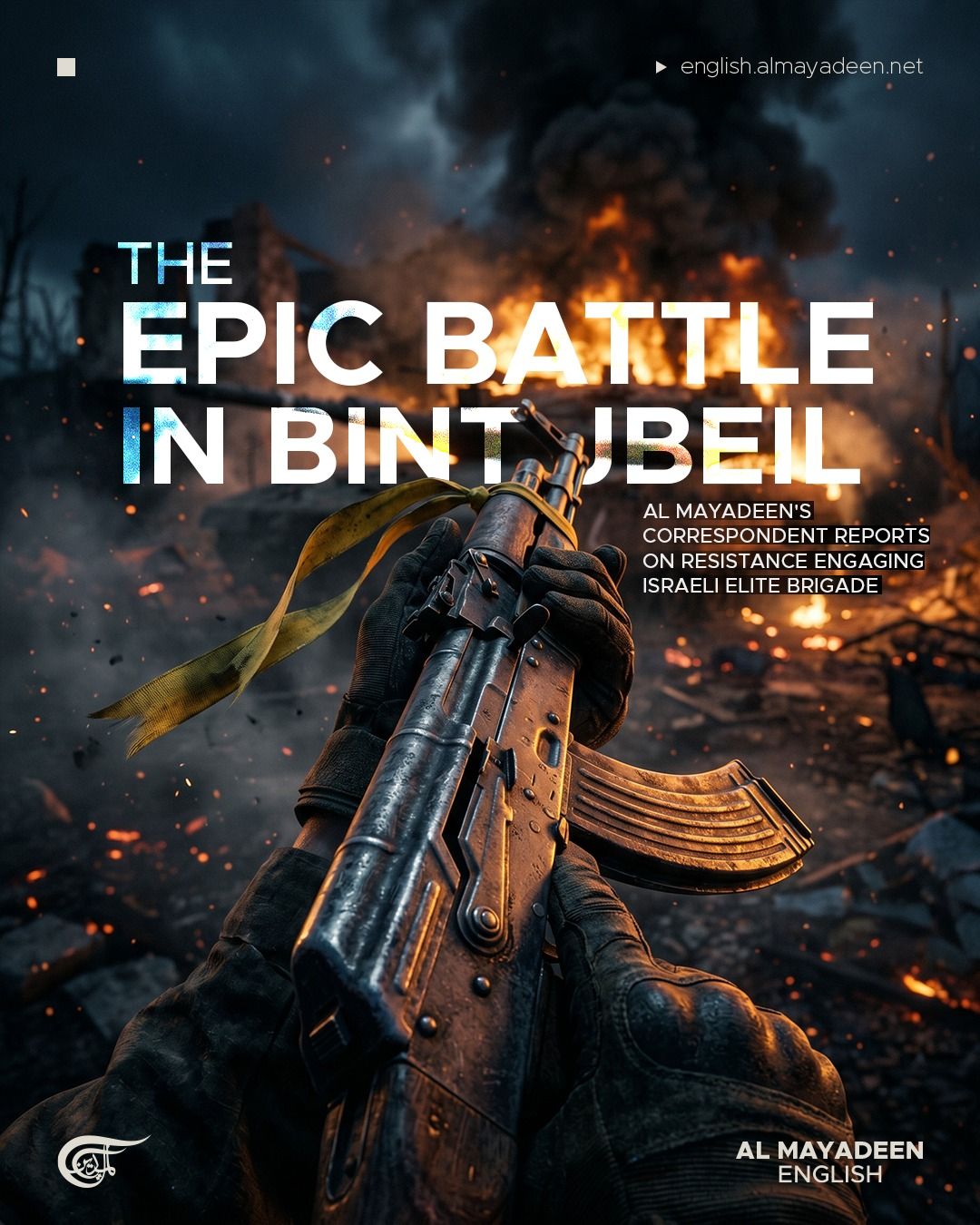
The southern Lebanese city of Bint Jbeil has become a direct battleground between Israeli forces and Hezbollah fighters with the later employing new attrition tactics and reflecting a shift in the nature of ground operations and which signals a protracted and costly battle for both sides.
For a week now, clashes have continued in the town at “point-to-point range” fighting. The Israeli army is attempting to advance into the town, while Hezbollah fighters repelling them through ambushes and direct targeting.
Hezbollah fighters are focusing on disrupting the supply lines of the advancing soldiers and targeting their movements within the neighborhoods, particularly around the municipal stadium and the Al-Baraka district according to the official Lebanese National News Agency. This fighting style relies on hit-and-run tactics rather than traditional entrenchment.
Meanwhile, Israel’s Channel 12 has revealed an army plan to establish 15 permanent military bases in Lebanese border villages, reflecting a trend towards establishing a long-term on the ground presence, as the Israeli army has received instructions to intensify its operations and achieve maximum gains.
Between Israel’s pursuit of a swift military victory and Hezbollah’s reliance on attrition strategies, the battle of Bint Jbeil appears poised to become a pivotal point to the confrontation, as everyone awaits the outcome of parallel diplomatic efforts led by Washington to reach a ceasefire agreement.
Geographical and Symbolic Political Significance
Retired-Brigadier General Naji Malaeb, a military expert, told Anadolu Agency the city is vitally important to Israel asides from its military dimension, speaking of a moral dimension to do with a “deterrence equation” following the withdrawal of Lebanese army forces from southern Lebanon.
He explained Bint Jbeil lies within an area that Israel seeks to transform into an 8-kilometer-deep buffer zone, making its control a central objective in any future ground operation.
The retired-Brigadier noted Israeli forces attempted to encircle the city from several directions before storming it, but they encountered fierce resistance that hindered their advance, transforming the battle into an open confrontation within the city’s neighborhoods.
Bint Jbeil, located just 3 kilometers from the border with Israel, is one of the most prominent cities in southern Lebanon, not only for its geographical location but also for its political and military symbolism since the 2006 war.
Its sits at an altitude of approximately 770 meters above sea level and is about 122 kilometers from Beirut, holding strategic importance due to its position in the central section of the Lebanese-Israeli border within the Nabatieh Governorate.
Following Israel’s withdrawal from southern Lebanon in 2000, the former Secretary-General of Hezbollah, Hassan Nasrallah, delivered a speech in a stadium in Bint Jbeil, stating that “Israel, despite possessing nuclear weapons and the strongest air force in the region, is weaker than a spider’s web.” This underscores the symbolic significance of the area.
Israeli media outlets rebroadcast the speech after the Israeli army besieged Bint Jbeil and launched its attacks while publishing images showing Israel bombing the stadium where Nasrallah delivered his speech.
Shift in Combat Tactics
In his analysis of field operations, the military expert noted that Hezbollah developed a significant shift in its combat strategy with its fighters no longer relying on fixed defensive lines as in previous confrontations, but instead adopted a “flexible defense” model.
Malaeb explained the new approach focuses on attrition tactics rather than completely preventing the advance of attacking forces through mobile ambushes, targeted strikes on supply lines, and redeployment within villages.
The military expert believes this approach explains the continued fighting in areas Israel has declared under its control, such as the town of Khiam, where clashes persist today.
He also pointed out that the presence of civilians in some areas, despite the bombardment, reflects the continued partial control of local forces within those regions.
Israeli Response and the Limits of Power
In contrast, expert Malaeb, observed that Israel relies heavily on its air power, escalating its airstrikes on civilian areas, adding the strikes tend to be more about exerting pressure on the ground than having direct military objectives.
This is whilst warning this pattern could lead to further escalation, especially given the rising number of casualties, placing Lebanon in a complex humanitarian and security situation.
In previous statements to Anadolu Agency, a security source explained Israeli army forces were observed in the towns of Naqoura, Bayada, Qouzah, Beit Leef, Yaroun, Adaysseh, Qantara, Mays al-Jabal, and Deir Siryan al-Khiam, in addition to other southern villages.
On Wednesday, 13 people were killed and at least six others were wounded in 24 Israeli airstrikes targeting several areas in southern Lebanon.
Since March 2, the Israeli army has continued its intense attacks on Lebanon, resulting, as of Wednesday, in 2,167 deaths and 7,061 injuries.
Operational Hub
Retired Brigadier General Hisham Jaber, a strategic affairs researcher, spoke to Anadolu Agency about the operational significance of Bint Jbeil, which he described as an “operational hub” encompassing key roads connecting several battlefronts in the south. He explained that the city forms a link between the town of Khiam, the Western Bekaa Valley, and the central sector, making its control essential for any Israeli advance towards the Litani River.
He emphasized that bypassing Bint Jbeil without capturing is “militarily impossible,” given the threat it poses to any advancing forces.
Open-Ended War of Attrition
Jaber predicted that Bint Jbeil would become a protracted war of attrition. He pointed out that the nature of urban warfare, especially in cities with widespread destruction, enhances the effectiveness of guerrilla warfare for the defenders, allowing them to carry out ambushes and engage at very close range, thus increasing the losses of the attacking forces.
He added that the fighters are prepared to wage long-term battles, even under siege, drawing on previous experience in this type of combat.
In assessing the progress of the operations, Jaber noted that the Israeli advance “remains slow, despite the mobilization of a large force estimated at tens of thousands of soldiers.”
He said that the Israeli forces have advanced only a few kilometers in recent weeks and the slow pace of operations reflects the “difficulty of achieving a rapid breakthrough given the terrain and the adopted combat tactics.”
This slowness “contradicts what is expected from conventional operations, where reaching the Litani River was supposed to take a much shorter time.”
The Battlefield and Politics
Amid this backdrop, military operations intersect with rapidly evolving political moves. Last Tuesday, Washington hosted talks between Lebanon and Israel for the first time in 43 years. At the conclusion of these talks, the two sides agreed to begin peace negotiations, the location and timing of which will be determined later.
On Wednesday evening, the Israeli Security Cabinet convened to discuss a US request for a ceasefire with Hezbollah.
The Israeli Broadcasting Corporation reported that the Cabinet is currently discussing the US ceasefire request, and several ministers have expressed their opposition to it.
The corporation quoted an unnamed Israeli source as saying “advanced negotiations are underway for a temporary ceasefire between Israel and Hezbollah,” at the request of the United States.
The source added “a ceasefire is likely to take effect in the coming days.”
He further stated Israel “does not reject the US request for a temporary ceasefire, in exchange for a commitment to resume fighting if no agreement is reached with Iran, and on the condition that Hezbollah ceases fire.”
There was no immediate comment from Hezbollah, which has been attacking Israeli targets with rockets and drones in response to Tel Aviv’s continued attacks.