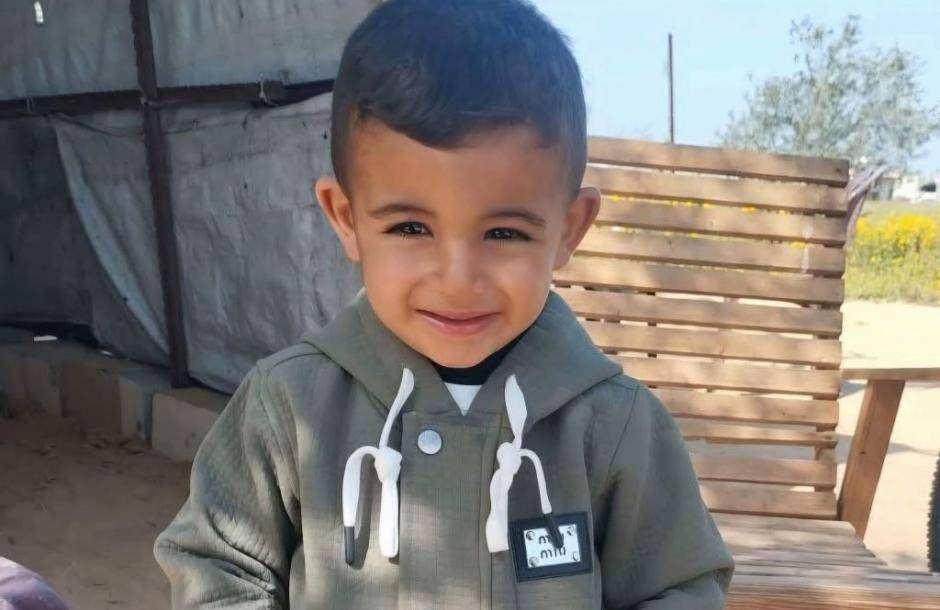
Three-year-old Rayan Shot Point-blank

Three-year-old Rayan Bahaa Abu Al-Ajeen had no idea that returning home with his father from a family visit in east of Deir al-Balah would be his last journey.

On Sunday evening, the road home became the scene of another crime. A young child was shot in the head by Israeli forces while in the arms of his father. The wounded father was also detained by Israeli soldiers for hours before dumping next to his son’s body on a main road in the central Gaza Strip.

Journey Ending in Tragedy

According to his family, the father, 32-year-old Bahaa al-Din Jaber Abu Al-Ajeen was returning Sunday afternoon from visiting relatives in the Wadi al-Salqa area east of Deir al-Balah, accompanied by his son Rayan and his father-in-law Khaled Hassan Abu Gharaba; they were on their way to the Abu Al-Ajeen area east of the city.

Family relative Nawaf Abu al-Ajeen, said that Israeli soldiers stationed inside a house overlooking the road of their neighborhood suddenly emerged and opened fire directly at civilians without any warning or attempt to stop them.

Fatal bullet

The gunfire resulted in the shooting of little Rayan in the head while in his fathers’ arms. He sustained critical injuries that later proved fatal.

In a press statement, the family relative explained the bullet caused a severe head injury to the little boy, while his father sustained a wound to his right leg.

The family confirmed the father at the time was holding the toddler when bullets struck them both, turning the scene into a human tragedy in seconds.

Injured Father and Child Arrested

The incident did not end with the shooting. The family reported the occupation forces arrested the father and his injured child, (both in critical condition) with the grandfather, and transferred them to a military site near the area.

According to the same account, the father and son were detained for many hours despite their injuries, without receiving the necessary medical care. The child was bleeding profusely, while his father limping with a severe wound.

Dumped on the road after midnight

The family relative added that the Israeli occupation forces released the father after approximately six hours of detention, dumping him and his son on the Salah al-Din Street near the Abu Holi intersection after midnight, without bothering to notify the Red Cross or any other of the relevant authorities.

He added the soldiers merely bandaged the father’s injured leg before leaving him and his child on the side of the road. The father-in-law however remained in Israeli custody.

After hours of searching, residents found the father and son and transported them to Al-Aqsa Martyrs Hospital in Deir al-Balah. There, little Rayan, was pronounced dead from his injuries, while his father received treatment for his wounds.

Later, the family held a funeral procession for the child and buried him in the local cemetery amidst widespread grief and anger among the residents.

Contradictory Israeli Narrative

Following the incident, Israeli media outlets, including Channel 14, put a completely different spin on what happened. They claimed Israeli soldiers stopped a “resistance ambush” in the central Gaza Strip, alleging the killing of one Palestinian, the arrest of another, and the wounding of a third during the operation.

However, the facts surrounding the incident and the family testimonies reveal those shot were civilians: Father, child, and father-in-law. This is just one example of how the narrative is twisted time-and-again by the Israelis.

This crime comes amidst the ongoing Israeli attacks in the Gaza Strip, despite the so-called ceasefire agreement that is really ink-on-paper. According to data from the Gaza Ministry of Health, the violations recorded since the agreement came into effect have resulted in the deaths of nearly 1000 Palestinians and with the injuries of thousands more, amidst continuous warnings of the deteriorating humanitarian and security situation in the Strip.

The story of the child, Rayan Abu al-Ajeen, remains one of the most tragic incidents: A short outing with his father ended with his death from a bullet that struck him in the head while he was in his father’s arms.

This news story by Dr Marwan Asmar is based on a report from the Palestine Information Center and reprinted in crossfirearabia.com, and countercurrents.org

CrossFireArabia

CrossFireArabia
Dr. Marwan Asmar holds a PhD from Leeds University and is a freelance writer specializing on the Middle East. He has worked as a journalist since the early 1990s in Jordan and the Gulf countries, and been widely published, including at Albawaba, Gulf News, Al Ghad, World Press Review and others.

Related Posts

World Cup Through Gazan Eyes

Despite the heavy burden of war, displacement, loss, and deprivation they have endured for nearly three years, many Gazans, especially the youth, have not relinquished their passion for football and following the World Cup matches. They have become a temporary escape from the harsh reality of war.

With the start of the Arab teams’ matches in the world’s most important football tournament, displacement camps in the Gaza Strip have been transformed into something resembling “popular caravans” or open-air cafes, where hundreds of displaced people gather in front of large screens or televisions to watch the matches and cheer on their favorite teams.

In the Nuseirat camp in the central Gaza Strip, hundreds of Gazans gathered in the main square of the Nuseirat market in front of a giant screen to watch the match between the Egyptian national team and their Belgian counterparts, which ended in a 1-1 draw. Cheers and popular songs filled the air during the match, a scene that brought a measure of vitality back to faces worn down by war.

In the Khan Younis area of ​​southern Gaza, some of the tents housing displaced people have been transformed into makeshift cafes. Young men sit on wooden benches in front of televisions to watch matches of the Arab teams participating in the tournament. Some tents are decorated with Egyptian flags, and several young men drape the flags over their shoulders while watching the games.

During major sporting events, Gazans typically make a point of showing their support for the Arab teams, expressing the cultural and social ties that bind them to the Arab world and emphasizing their shared sense of solidarity and belonging.

For many residents of the Gaza Strip, these gatherings represent a rare opportunity for recreation and a break from the pressures of daily life. They also offer a temporary space for joy and engagement with a global event, away from the constant bombardment, displacement, and suffering.

However, watching the World Cup in Gaza is not as easy as it is in other parts of the world. In addition to the dire humanitarian situation and economic collapse, residents face financial, technological, and security challenges that make watching the matches a difficult task.

High Subscription Costs

The high subscription cost of beIN SPORTS channels, the exclusive broadcaster of the tournament, stands out as one of the most significant obstacles, in addition to the large time difference, as most matches are held in the early morning hours due to the United States, Canada, and Mexico co-hosting the tournament.

In an attempt to alleviate this crisis, the sports channels’ agent in Gaza managed to obtain a special exemption from the network’s headquarters in Qatar, allowing the reactivation of older equipment within the Gaza Strip, taking into account the exceptional circumstances faced by the residents. This exemption was granted for monthly subscriptions ranging between 350 and 420 shekels (US$120-150), providing some cafes and fans with a limited opportunity to watch the matches.

Alternatives, but Not Enough

Other alternatives are no more readily available. Free Turkish or Iranian channels may broadcast some matches, but they lack the Arabic commentary that has become a cherished part of the Arab public’s experience with major tournaments.

On the other hand, IPTV services rely on a stable internet connection, which has become virtually impossible given the extensive damage inflicted on the telecommunications infrastructure during the war.

Security Concerns Over Renewed Israeli Bombing

The suffering of Gazans is not limited to material and technical aspects; it also extends to security concerns. Gathering in cafes or public squares to watch matches has become fraught with danger due to the ongoing Israeli bombardment, prompting many to avoid going out at night. Despite this, some cafes continue to broadcast matches at night, even with the possibility of renewed Israeli attacks.

Despite all these challenges, football remains a rare outlet for many Gazans and a way to cling to life, a temporary attempt to postpone the pain of war and engage, even for a few hours, in a collective joy that restores some semblance of normalcy.

Since October 8, 2013, Israel, with American and European support, has committed genocide in the Gaza Strip, including killing, starvation, destruction, displacement, and arrests, ignoring international appeals and orders from the International Court of Justice to cease its actions.

The genocide has left more than 246,000 Palestinians dead and/or wounded, most of them children and women, and more than 11,000 missing, in addition to hundreds of thousands of displaced people and with a famine that claimed the lives of many, most of them children, as well as widespread destruction and the erasure of most of the cities and areas of the Gaza Strip from the map. Quds Press

Continue reading
The A, B, C of a Post-Sanctions Iran

As the Iran-US agreed to a new peace deal on Sunday, questions are being raised on the lifting of sanctions and long-standing restrictions on Tehran.

US President Donald Trump announced on Sunday that an agreement with Iran had been finalized and that he was authorizing the reopening of the Strait of Hormuz and the removal of a US naval blockade.

The announcement triggered swift diplomatic reactions from European allies, with the UK, Germany, and Italy saying they would continue working closely with Washington, Tehran, and regional partners to maintain momentum toward a longer-term settlement.

They also signaled a willingness to ease relevant sanctions if Iran takes “clear, verifiable steps” regarding its nuclear program, stating in a joint statement that the country must never “acquire a nuclear weapon.”

According to an Iranian draft of the agreement reported by Mehr News Agency, the framework includes the suspension of sanctions on Iranian oil exports, petrochemicals, and related products, along with provisions granting Tehran access to financial proceeds from sales.

The draft also reportedly calls for the release of around $24 billion in frozen Iranian assets during an initial 60-day negotiation period, with half of the funds to be unlocked before formal final talks begin.

The final agreement would include the full lifting of US primary and secondary sanctions, as well as the termination of relevant UN Security Council and International Atomic Energy Agency Board of Governors resolutions.

While no details of sanctions relief have been officially released, US sanctions on Iran currently span several areas, including oil exports, banking, shipping, military activities, and nuclear-related programs.

According to the US government, the country has imposed restrictions on activities with Iran since 1979. It blocks Iranian government assets in the country, bans all trade with Iran, and prohibits foreign assistance and arms sales.

The US says that its sanctions are “the most extensive and comprehensive set of sanctions” that it maintains on any country, with thousands of persons, including Iranian and non-Iranian, designated for sanctions.

Apart from the primary sanctions, the US also maintains secondary sanctions, which target non-US companies and individuals that conduct business with Iran.

Oil and energy sanctions

The most economically significant restrictions target Iran’s oil industry, the country’s primary source of foreign currency revenue.

In 2012, then-US President Barack Obama imposed the tightest sanctions against Iran’s oil industry. These included Iranian crude exports, shipping networks, insurance providers, and foreign entities that purchase or transport Iranian oil.

In 2024, the Stop Harboring Iranian Petroleum Act, or the SHIP Act, was enacted, leading to sanctions against foreign persons that knowingly transport, process, refine, or otherwise deal in petroleum and petroleum products.

It was enacted to cripple Iran’s energy export revenues by targeting foreign entities and networks that transport, process, or sell Iranian oil.

Since the Iran war started on Feb. 28, the US has imposed a number of restrictions targeting the Iranian energy industry.

Its recent sanctions in May included eight vessels involved in ​transporting Iranian crude oil and petroleum products to global markets.

Earlier in April, the US Treasury Department said it sanctioned more than two dozen individuals, companies, and vessels connected to the network, as well as an alleged financier involved in exchanging Iranian oil for Venezuelan gold to benefit the Lebanese group Hezbollah and Iran’s Islamic Revolutionary Guard Corps (IRGC).

Financial restrictions & frozen assets

In 1995, then-US President Bill Clinton, under an executive order, established a comprehensive ban on all US investment and trade with Iran.

Due to US sanctions, Iran remains largely cut off from the global financial system due to US sanctions on major Iranian banks and financial institutions. In 2012, the US imposed unilateral sanctions against the Central Bank of Iran.

Iranian officials have repeatedly identified access to frozen funds as a key objective in negotiations.

While the exact amount of Iran’s frozen assets is unclear, official Iranian reports and experts have set the total amount of frozen Iranian assets overseas at more than $100 billion.

If the sanctions are relaxed, this could include restoring access to international banking channels, easing restrictions on cross-border transactions, and allowing the release of frozen Iranian assets held abroad.

Shipping and trade

US sanctions are also imposed on additional sectors of Iran’s economy, including shipping, construction, mining, textiles, automotive, and manufacturing.

In 2019, sanctions were imposed against Iran’s minerals and metals sectors.

According to the US government, the property of any person determined by the secretary of the Treasury and the secretary of state to be conducting business operations in the “iron, steel, aluminum, or copper sector of Iran” is blocked.

On Jan. 10, 2020, sanctions were imposed, targeting Iran’s construction, mining, manufacturing, and textile sectors, including asset freezes and denial of entry into the US for those operating in or providing support for these sectors.

Western sanctions also affect Iranian shipping companies, ports, and logistics networks.

Restrictions on maritime transport have complicated Iranian exports and imports, including non-oil trade.

The reopening of the Strait of Hormuz and the possible lifting of related maritime restrictions were highlighted by both US and Iranian officials following the announcement of the framework agreement.

Nuclear-related sanctions

Since 2005, the US has designated Iranian individuals, companies, and organizations for involvement in nuclear proliferation and ballistic missile development.

US sanctions on Iran also include arms trade to or from Iran, and many components of Iran’s government, including the former supreme leader and IRGC, as well as entities that conduct transactions with or otherwise support them.

The Joint Comprehensive Plan of Action (JCPOA) in 2015 had temporarily lifted nuclear-related economic restrictions in exchange for limits on enrichment. However, when the Trump administration withdrew from the JCPOA, it reimposed the sanctions.

However, significant differences remain between Washington and Tehran over what obligations Iran would undertake.

US officials have suggested the agreement could involve dismantling elements of Iran’s nuclear program, while Iranian officials have insisted that Tehran has not accepted any new nuclear commitments and that nuclear issues would be discussed in a separate phase of negotiations.

Continue reading

Leave a Reply

Your email address will not be published. Required fields are marked *

You Missed

Three-year-old Rayan Shot Point-blank

Three-year-old Rayan Shot Point-blank

World Cup Through Gazan Eyes

World Cup Through Gazan Eyes

Yaffa 1934

Yaffa 1934

The A, B, C of a Post-Sanctions Iran

The A, B, C of a Post-Sanctions Iran

The Orange Seller

The Orange Seller

Taleb Al-Rifai No Longer a Kuwaiti

Taleb Al-Rifai No Longer a Kuwaiti