The Child, Tree and The Dark
By Ibrahim Isam
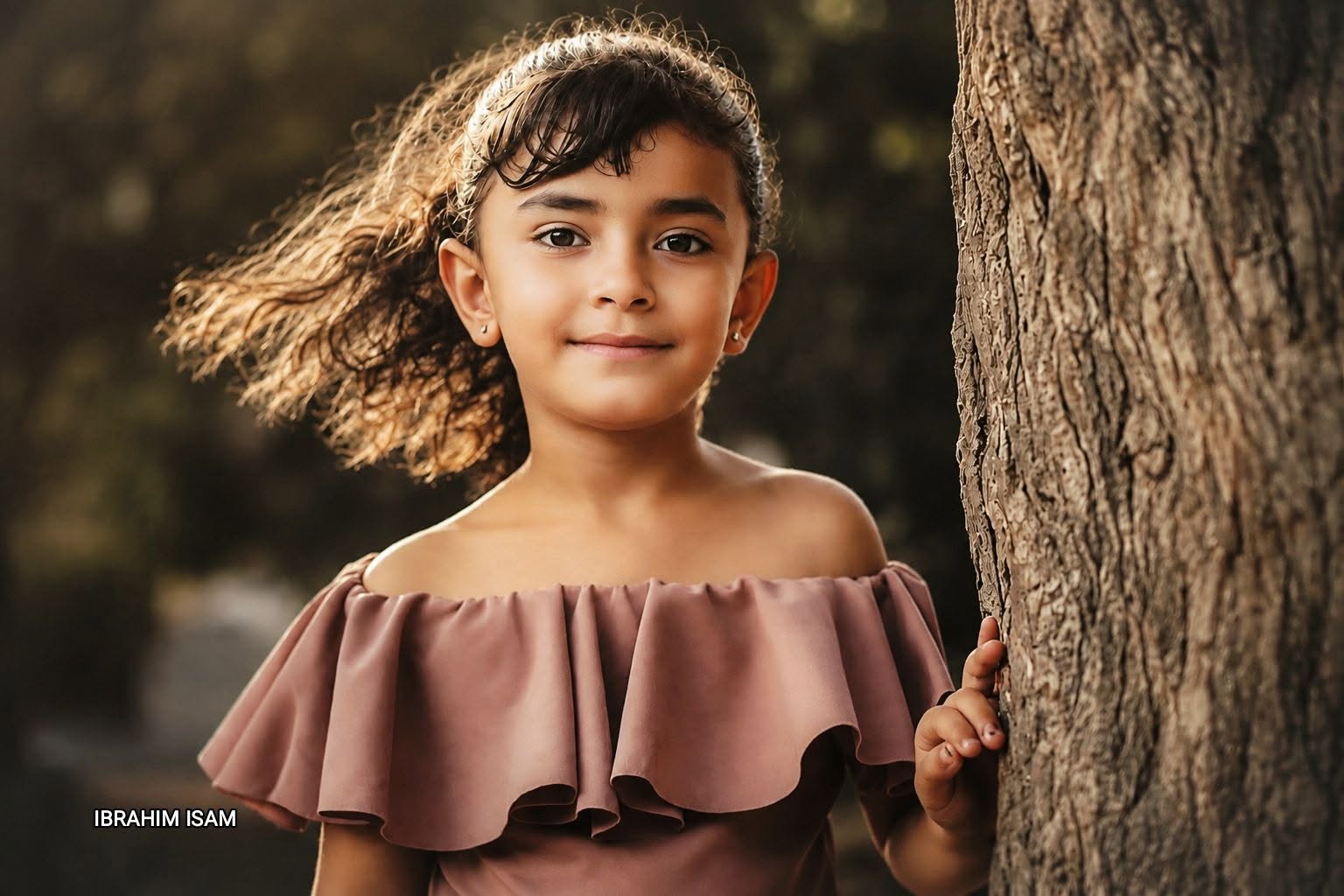
The tree had been there long before she arrived, perhaps waiting for her through a time she could never know. Its ancient trunk carried the scars of seasons upon its skin, as though the years had not simply passed through it, but had written themselves there, layer upon layer. When the little girl placed her hand against its roughness, it felt as though a hand from the future had touched an old memory—or as though childhood itself had come to rest a hand upon the shoulder of time and whisper: Do not be afraid. There is still room for Spring.
She looked at me without asking for anything. There was no answer in her eyes, but that simple question grown-ups have never learned how to answer: Why can the world not be a safe place for every child?
And yet, her gaze was not sad.
There was something beyond sorrow in it; something like the first faith, before a human being learns that tomorrow is something to fear. She looked as though the light approaching was not a promise of some distant future, but something her soul had known since birth.
The wind moved gently through her hair, while the trees around her received the last light of day. In her eyes, that light was reflected as though it had finally found a place worthy of holding it. And for a moment, I felt that light does not always come from the sky. Sometimes it is born in the eyes of a child, and from there finds its way into the darkness of the world.
Perhaps this is why I love children.
They have not yet learned how to justify cruelty, how to turn suffering into a truth, or how to persuade themselves that ruin is inevitable. A child is not born carrying the history of hatred. They arrive with empty hands, a heart that has not yet learned how to hate, and eyes still capable of seeing the world before we teach them how to look at it.
Her hand remained upon the tree, and I wondered if there was a secret between them that I could not understand.
She was at the beginning of the journey; the tree, somewhere near its end. She had not yet known the seasons, while the tree had known enough of them to fall silent. And still, they seemed strangely alike: both standing quietly before time, both knowing, in their own way, that life does not need much to begin again. Sometimes it needs only a little light, a small hand, and a gaze that still believes tomorrow is possible.
Perhaps the tree was not protecting the child from anything.
Perhaps the child was giving the tree another reason to remain.
In that moment, I did not see a photograph of a child beside an old tree. I saw two ages standing beside one another: one that had already passed, and one that had not yet begun. Between them was that quiet light which announces nothing, yet changes everything.
And in her eyes I saw what I have been searching for all this time—not hope itself, but the innocence that makes hope possible.
Perhaps one day this child will grow older, and her heart will become burdened with things no heart should have to carry. Perhaps she will discover that the world is not the way it seemed in her first gaze.
But I hope that, when that day comes, somewhere within her eyes, that first light will still remain. I hope she will remember that once, beside an old tree, the world was—if only for a moment—beautiful enough to believe in.
Perhaps the world does not need a great miracle to be saved.
Perhaps it only needs us to leave childhood its childhood.
And to stop, even for a little while, extinguishing the light that children bring with them.

 CrossFireArabia