Israel Kills Off Gaza Journalists One by One

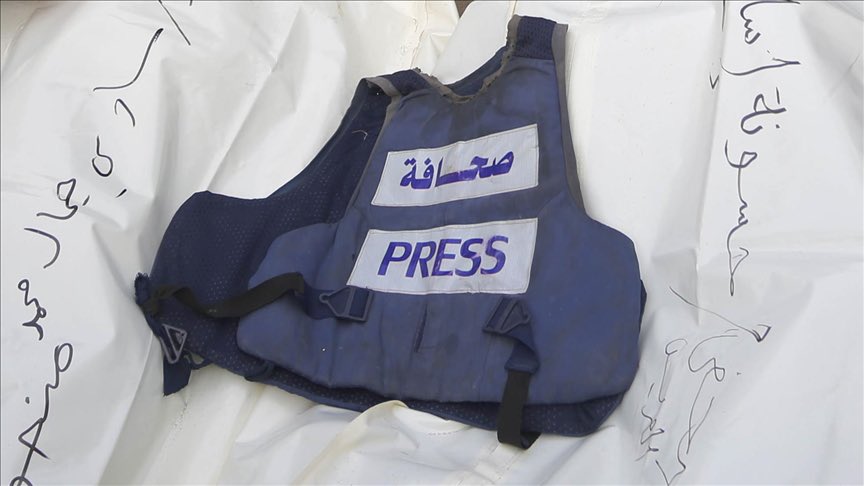
The latest journalist to be killed in Gaza is Mohammad Abu Sharia. News of his death hikes the number of journalists to be killed by Israeli warplanes and army since 7 October to 153.   

Abu Sharia, a media man with the local Shams News agency, was seriously injured in a strike targeting his home, Saturday, and succumbed to his wounds on Monday, Gaza’s government media office stated according to the Anadolu.

The killing of journalists in Gaza has been systematic over the past months as part of Israel’s “muzzling policy to silence the voice of the truth,” stated one tweet online.  

The Israeli army has deliberately targeted journalists and media institutions in Gaza to try and cover up their atrocities in different parts of the Gaza Strip that resulted in the mass killing of civilians and the destruction of the homes, houses, buildings and headquarters of the Gaza Strip.

PressTV reported that Abu Sharia headed the editorial department in the Shams agency and lived in the Sabra neighborhood, south of Gaza City before the Israelis bombed his house.

Abu Sharia was initially taken to the Al-Ahli Baptist Hospital in central Gaza City, before he was transferred to the Indonesian Hospital due to the seriousness of his injuries, Press TV reported but didn’t make it there.

The killing of journalists in Gaza has been the biggest number in recorded history of any conflict, says one British journalist. The New York-based Committee to Protect Journalists (CPJ) said the war in Gaza has become “the deadliest for journalists” since it began documenting journalist killings worldwide in 1992.

A salute must be made also to the women journalists covering one of the deadliest wars ever experienced in Gaza, the Palestinian territories and the region. One writer points to such local names as Maha Husseini, Hind Al Khoudary, Bisan Owda and more. They are reporting under extreme extreme conditions of “bombardment, displacement, grief and trauma,” in pursuit of getting out the word to the world.

These names of such journalists like Hanneen Harara reporting on the killing of her 12-member family in Nuseirat, Shurooq al-Aila,  Nafith Okasha, Sari Mansour, Hassouna Saleem, Mahammed Abu Hatab, Salem Abu Tayur, Ayat Khudoura are just few of those who were killed in line of active duty of reporting.

Strange in this war is that the journalists were local people, born and bred. We have been receiving news about the Gaza genocide and ethnic cleansing through their eyes and no one else’s. It is they, and up till now who are reporting on the war against Gaza and its people.

No western journalist has been able to enter Gaza and cover this war independently. Of the few that were allowed to enter Gaza for a short while, did so as embedded journalists with the Israeli army which meant they were heavily censored and were not allowed to report on their own free will.

Ayat Khudoura, a young journalist from Biet Lahia in north Gaza may have predicted her death in the last video she made because of the terrible bombardment that the north was being subjected to.

 “…I am still alive, but it’s only a matter of time for us in Gaza, there is no safe place here…. We are humans like everyone else in the world, we had big dreams. This might be my last video. Today, the occupation fired phosphorus at Biet Lahia and terrifying sound bombs. Me and a few members of my family stayed at home. This is very scary, It’s terrifying and very difficult. God have mercy.”

Alas, Khudoura was right. That was her last video. She was killed in an Israeli airstrike with her grandmother, her brother Ayoub, her sister Souad, and her brother Adham.

If journalists are not targeted on their own, they are targeted with their families with the express aim to shoot, bomb and kill and rob them of their lives and livlihoods.

Like the case with Abu Sharia, Muhamed Yaghi was targeted and killed with his wife and daughter last February. He was journalist no. 131 to be killed with his family and so continued the killing spree.

If journalists were not directly targeted for the time being then their families were. Before being forced out of Gaza, Al Jazeera’s bureau chief Wael Al Dahdouh was targeted and before that they killed his son, wife and daughter.

He was among many other journalists to have suffered. Abu Tayur was killed with his son but with journalist Mahmoud Abu Salama, the Israelis targeted his sister and her child, while journalist Abu Hatab lost 10 members of his family through an Israeli airstrike.

And the numbers keep growing by the day. Journalists and their families appear to be targeted through a controversial AI Levander system used by the Israeli army to identify what are termed as suspected militants and has been the cause of such killing and bombings that wiped out whole squares of houses and homes in communities of people.

They were seen as militants and therefore legitimate targets regardless of political affiliations. The AI Lavender, essentially a wide database, generated quick “kill lists” that jumbled people together and extended the militants with ordinary people and women and children.

Thus, journalists and their families, relatives and friends, and because of the datebase that was generated daily and instantly, served as targets for Israeli warplanes and target bombing and that explains why so many journalists have been killed in this war; and with the targeting likely to continue till

CrossFireArabia

CrossFireArabia
Dr. Marwan Asmar holds a PhD from Leeds University and is a freelance writer specializing on the Middle East. He has worked as a journalist since the early 1990s in Jordan and the Gulf countries, and been widely published, including at Albawaba, Gulf News, Al Ghad, World Press Review and others.

Related Posts

Volunteers Collect Stones From Destroyed Mosque To Rebuild it in The Future

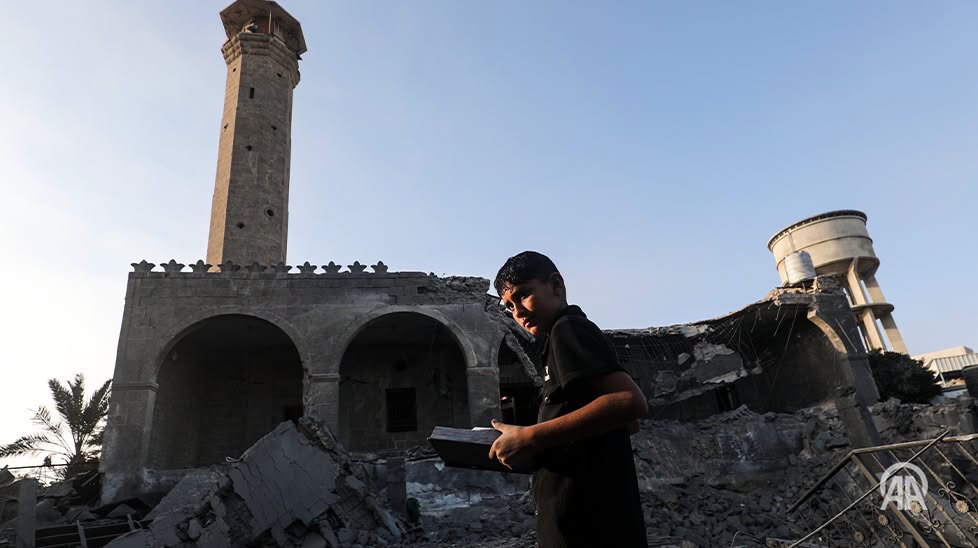
Piece by piece, volunteers in the central Gaza Strip are retrieving stones and historic marble columns from the rubble of the Abu Salim Mosque, preserving what survived an Israeli strike in hopes that it can one day help restore the landmark.

The mosque in Deir al-Balah was struck on Aug. 24, causing extensive damage to the courtyard and part of its main structure.

Days later, volunteers from the Guardians of Heritage team began clearing debris from the mosque and its surroundings, collecting scattered stones and marble columns and moving them to a safe location, an Anadolu correspondent at the scene reported. The Guardians of Heritage is a volunteer group clearing rubble and recovering damaged books from the historic mosque.

The campaign was organized by the Mayasir Association for Culture and Arts, in cooperation with the heritage team, with the recovered pieces set aside for possible reuse in future restoration work.

Saving what survived

Mayor Khalil Abu Samra told Anadolu that the Abu Salim Mosque was built in 1951 at the expense of Hajj Mohammed Abu Salim and designed in an Ottoman architectural style.

“We preserved this mosque for many years,” Abu Samra said, voicing hope that the landmark would be restored “by the hands of the Guardians of Heritage and the Guardians of the Homeland” and return to its former appearance.

Shaimaa al-Natour, coordinator of the Guardians of Heritage campaign, said the team moved to the mosque shortly after it was struck to begin what she described as “preventive conservation measures.”

The first phase focuses on recovering scattered stones and historic marble columns and storing them safely, she said, with later stages expected to focus on restoring the mosque.

Al-Natour said the initiative forms part of broader efforts to protect Gaza’s archaeological and cultural heritage despite extensive damage to historic sites during the Israeli war.

Landmark struck before

Built on elevated ground in Deir al-Balah known locally as Al-Hadba Al-Qibliya, the mosque is one of the city’s prominent religious and architectural landmarks.

It underwent restoration in 2010 that preserved many of its original architectural features.

Israeli shelling also struck the upper section of the minaret in 2014 and damaged its facade, which was later restored in cooperation with the Riwaq Center for Architectural Conservation and the Iwan Center for Heritage Architecture.

The Aug. 24 Israeli strike caused far more extensive damage, with Anadolu footage showing widespread destruction inside and around the mosque.

The damage comes amid a much broader toll on Gaza’s places of worship.

Israel has destroyed 1,050 mosques and partially damaged 191 since the war began, out of 1,275 mosques that stood in the enclave before the war, according to Gaza’s Ministry of Endowments.

As many as 1,313 Palestinians have been killed and 4,361 injured in Israeli violations since a ceasefire was signed last October, according to Gaza’s Health Ministry. Overall, Israel’s war on Gaza since October 2023 has killed at least 73,449 people and injured 174,472. Anadolu

Continue reading
Destitution Gaza: Girl With The Child


By Ibrahim Isam

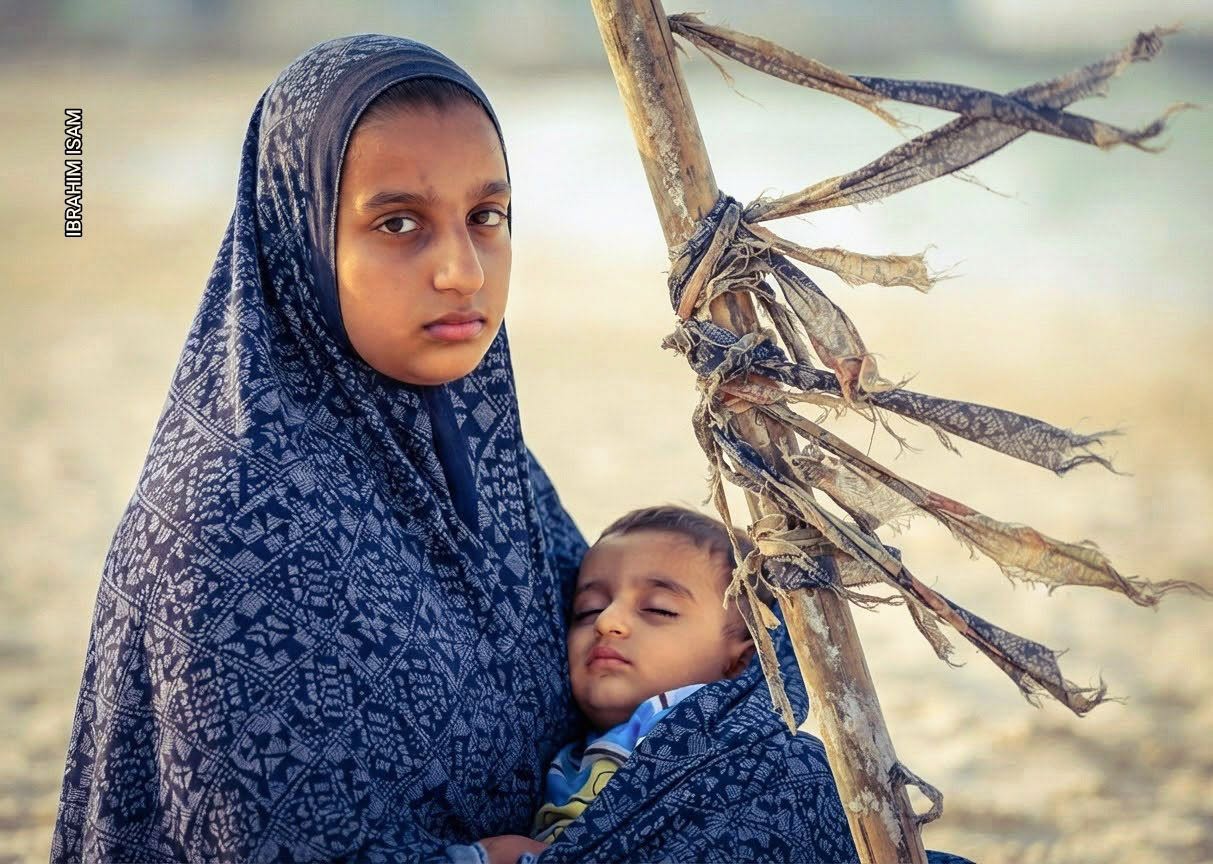
I hesitated for a long time before sharing this photograph.

I opened it, closed it, then returned to it again.
Each time, I felt that words, no matter how carefully chosen, would betray what I had seen.
I do not know who this woman is to the little girl—her mother, her sister, her neighbor, or simply another woman brought together with her by the tent and by the same fate.
I do not know what was in her eyes when she looked at me, nor what filled the child’s dreams as she slept, sheltered against a woman who herself had nothing left to shelter her from a merciless day.
I know only one thing:
They are human beings.
Human beings asking life for something that should never have been a demand in the first place:
A night without fear.
A roof that does not tremble above their heads.
Water.
Bread.
An embrace.
And a morning in which no one has to ask, Where do we go now?
Ever since I took this photograph, I have been asking myself:
What can a photograph say when pain becomes larger than language?
And those of us looking from the other side of a screen—do we truly see what we believe we are seeing?
Or do we see only a tiny fragment of another human being’s life, and then simply continue with our own?
How was her night?
What did she dream of while she slept?
And what will her eyes know when they open tomorrow?
Who will one day tell her why she had to know a tent before she ever knew a home?

Perhaps I have no answer.
Perhaps I do not even have the right words.

But I know this:

The child sleeping somewhere tonight does not need us to choose a side for her in this world.

She needs only for us to give her back the world that should have been hers from the beginning.
To be alive.
To be safe.
To grow.
And, one night, to fall asleep without ever knowing what fear means.
And that is why, finally, I am sharing this photograph.

Not because I have found the words,
but because I have not found enough of them.

Continue reading

You Missed

Volunteers Collect Stones From Destroyed Mosque To Rebuild it in The Future

Volunteers Collect Stones From Destroyed Mosque To Rebuild it in The Future

Destitution Gaza: Girl With The Child

Destitution Gaza: Girl With The Child

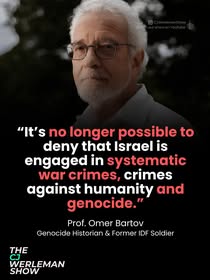
Omer Bartov: ‘Its Genocide’

Omer Bartov: ‘Its Genocide’

Existence…

Existence…

The Girl With The White Horse

The Girl With The White Horse

Ben-Gvir Mocks Palestinian Prisoners in Their Cells

Ben-Gvir Mocks Palestinian Prisoners in Their Cells