Media Cries Foul: CBJ Removes 20 Martyred Palestinian Journalists From its Records

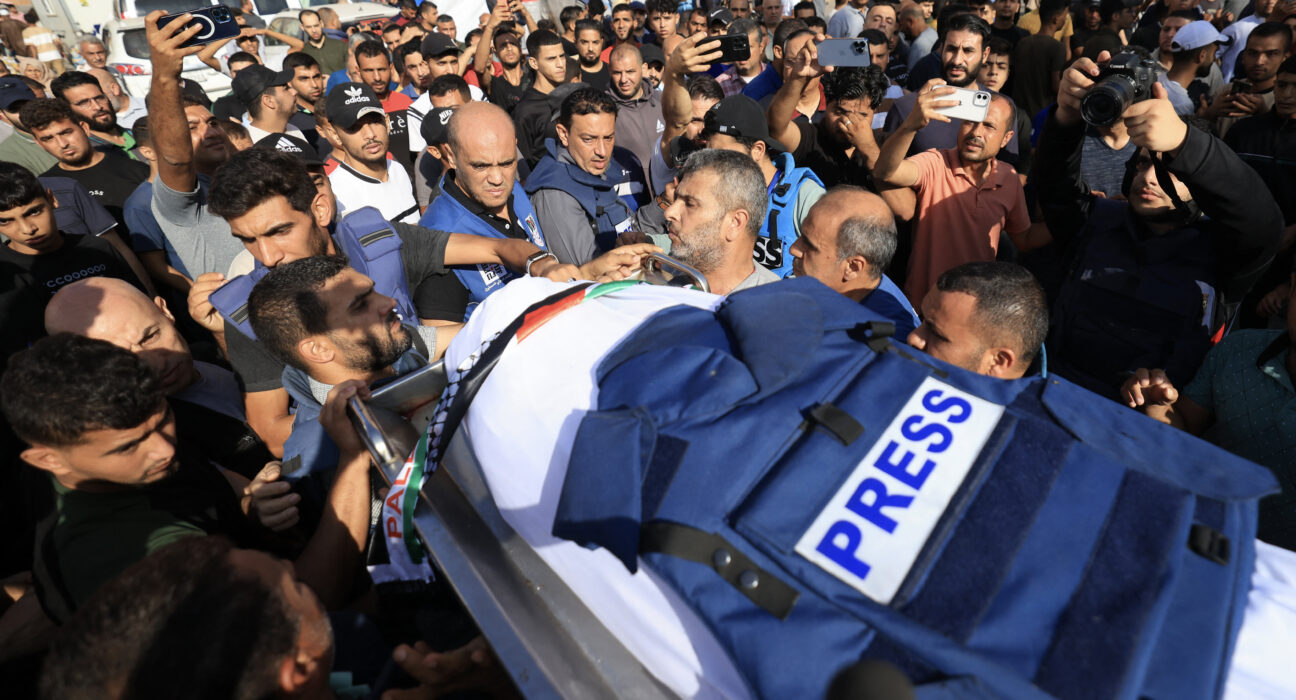
The ‘Palestinian Journalists Bloc’ states that it is condemning with anger the decision by the Committee to Protect Journalists (CBJ) to amend its definition of who qualifies as a journalist, and which resulted in the removal of martyred Palestinian journalists from its records. Journalists say this decision is a dangerous precedent and a professional and ethical violation, providing the Israeli occupation with further cover to justify its crimes against Palestinian journalists.

In a statement received by Quds Press, Wednesday evening, the Bloc added that the Committee based its decision on Israeli allegations claiming that some Palestinian journalists are affiliated with military entities, despite the absence of any legal or professional evidence to substantiate these claims. It pointed out the CBJ, in contrast, ignored its own established standards for dealing with journalists in other countries who accompany their militaries or work for media outlets affiliated with their governments, without revoking their journalistic status. This, according to the statement, is a double standard and a targeting of Palestinian journalists.

The Palestinian journalists note the committee’s announcement of removing 20 names from the list of martyred Palestinian journalists, while offering explanations for only eight of them, raises serious questions about the basis for its decision and undermines its credibility as a body that is supposed to defend press freedom and protect journalists, not adopt the narrative of the occupying power.

The bloc emphasized that the martyred Palestinian journalists were performing their professional duty of reporting the truth and documenting the genocide committed against the Palestinian people. It stressed that the removal of their names from the committee’s records does not negate their journalistic status, erase the truth, or absolve the Israeli occupation of its responsibility for deliberately targeting and killing them.

The bloc warned that this step constitutes a dangerous precedent that could open the door to justifying the targeting of journalists in conflict zones based on political claims, thus undermining the principle of international protection for journalists and weakening efforts to combat impunity.

And hence, the Palestinian bloc is demanding that the CBJ’s board of directors immediately reverse its decision and reinstate all Palestinian journalists killed in action on its official lists, and issues an apology for this bias, which is damaging the credibility and mission of the committee.

It is calling on the international press and human rights organizations and media unions to reject the latest decision, adhere to unified professional standards in dealing with journalists, and work to hold the Israeli occupation accountable for its crimes against Palestinian journalists, instead of adopting its narrative.

The bloc concluded its statement by affirming that the blood of Palestinian journalists will remain a testament to the truth, and that all attempts to erase their sacrifices or strip them of their professional status will fail.

This statement was translated from a report translated from Quds Press and appeared in crossfirearabia.com

CrossFireArabia

CrossFireArabia
Dr. Marwan Asmar holds a PhD from Leeds University and is a freelance writer specializing on the Middle East. He has worked as a journalist since the early 1990s in Jordan and the Gulf countries, and been widely published, including at Albawaba, Gulf News, Al Ghad, World Press Review and others.

Related Posts

Palestinian School Year Starts 6 September

CROSSFIREARABIA – The Palestinian Ministry of Education and Higher Education officially announced, Thursday, that the new 2026-2027 academic year will begin on Sunday, 6 September, in all schools. However, all administrative and teaching staff will begin work on 1 September, 2026, preparation. This is despite the restrictions and closures imposed on the West Bank. And because of the catastrophic situation in Gaza, the Ministry is considering resuming in-person classes in the Gaza Strip, starting with high school seniors, with the format of the academic year to be determined by mid-month. This comes as the UNRWA staff union proposes a plan to salvage the educational process by vacating only three schools in each governorate currently housing displaced people.

Continue reading
Tel al-Zaater: 50 Years On! Memory of a Massacre

The Tel al-Zaatar Massacre: An Unforgettable Palestinian Wound.

On August 12, 1976, the Tel al-Zaatar camp fell after a 52-day siege, opening one of the bloodiest and most painful chapters in the history of the Lebanese Civil War.

Tel al-Zaatar was more than just a refugee camp.

It was a temporary home for Palestinians uprooted from their land after the Nakba. They carried the keys to their homes and the memories of their villages, trying to build new lives in exile.

But the war reached them.

52 Days Under Siege


In the summer of 1976, the camp was besieged amidst the escalating Lebanese Civil War and the conflict between Lebanese and Palestinian factions, complicated by regional interventions.

For long days, the camp’s residents lived under bombardment and siege, suffering from severe shortages of water, food, and medicine.

Children, women, the elderly, and the sick were among those trapped. Hunger gnawed at bodies, fear filled homes, and the bombardment transformed daily life into a constant wait for death.

As the days passed, the siege was no longer merely a military operation; it had become a humanitarian catastrophe.

https://www.facebook.com/reel/1363859902542025

August 12th… The Day the Camp Fell


On August 12th, the camp’s defenses collapsed, and the attacking forces entered Tel al-Zaatar.

Widespread killings of residents took place, and a large number of civilians were killed.

Historical sources differ in their estimates of the number of victims; some speak of hundreds, others of thousands killed during the siege, the battles, and the fall of the camp, while the fate of many missing persons remains unknown.

Some civilians were also killed while attempting to leave the camp, despite arrangements being made to evacuate the residents.

Here, the numbers are not the whole story.

Behind every number is a human being.

Behind every name is a mother waiting for her son.

Behind every picture is a child who never had the chance to grow up.

Behind every destroyed house is a family that lost its place, its memories, and its security.

A Camp Destroyed… But a Memory Remains

After the fall of Tel al-Zaatar, the camp was destroyed, and its remaining residents were displaced.

The survivors scattered to different parts of Lebanon and beyond, but they carried with them something the war could not destroy:

Memory.
Memory of the siege.
Memory of the hunger.
Memory of the bombing.
Memory of those who left and never returned.

And the memory of the camp that was once a home, then became a witness to one of the war’s most horrific tragedies.

Tel al-Zaatar is not just a page from the past.

The Lebanese Civil War may have been complex, involving Lebanese, Palestinian, Syrian, and regional factions, and during which massacres and violations against civilians from various groups occurred.

But understanding the complexities of war never means forgetting the victims.

Nor does it mean reducing history to cold, hard numbers.

Tel al-Zaatar was a human tragedy.

And its victims were human beings with names, faces, dreams, and families.

That is why, every August 12th, the memory returns to the camp. We remember those who were killed.

We remember those who lost their loved ones.

We remember the survivors who lived the rest of their lives carrying the scars of those days.

And we remember Palestine, which the refugees carried with them to the camp, and then carried what remained of when they were forced to leave again.

From the Nakba to the camp, and from the camp to the diaspora… the Palestinian has always carried his memory with him.

And Tel al-Zaatar is one of those memories that must never be erased.

We don’t need hatred to remember.

We need the truth.

We don’t need revenge for the past.

We need not to forget.

May God have mercy on the martyrs of Tel al-Zaatar, and protect the survivors and their descendants, and may mercy be upon all the martyrs of war and displacement in Lebanon and Palestine.

Tel al-Zaatar remains in our memory… and memory never dies.

Tel_al_Zaatar

Tel_al_Zaatar_Massacre

August_12

Tel_al_Zaatar_Memory

Palestine

Lebanon

Nakba

Continue reading

You Missed

Palestinian School Year Starts 6 September

  • By marwan
  • August 13, 2026
  • 8 views
Palestinian School Year Starts 6 September

Tel al-Zaater: 50 Years On! Memory of a Massacre

  • By marwan
  • August 13, 2026
  • 11 views
Tel al-Zaater: 50 Years On! Memory of a Massacre

To Evelyn: The Baramki Home in Jerusalem

  • By Heba
  • August 13, 2026
  • 9 views
To Evelyn: The Baramki Home in Jerusalem

Palestinian House, Palestinian Architecture

Palestinian House, Palestinian Architecture

UN Reports Grave Israeli Violations of Gaza Returnees

  • By marwan
  • August 13, 2026
  • 11 views
UN Reports Grave Israeli Violations of Gaza Returnees

The Gaza Inferno

  • By marwan
  • August 13, 2026
  • 7 views
The Gaza Inferno