Turkish President Recep Tayyip Erdogan lambasted Israeli Prime Minister Benjamin Netanyahu on Tuesday for Israel’s attack on the Hamas negotiation team in Qatar last week, saying, “Ideologically, Netanyahu is like a relative of Hitler.”
“Just as Hitler could not foresee the defeat that awaited him, Netanyahu will face the same ultimate fate,” he added while returning from Doha, where he attended an emergency Arab-Islamic summit following the Israeli airstrike according to Anadolu.
Erdogan called the attack on the Hamas negotiation team “a blatant challenge to international order and international law” and said Israel’s leadership has “turned their radical mindset into nothing more than a murderous network built on fascist ideology.”
The Turkish president also addressed Western countries’ recognition of Palestine, saying it would put further pressure on Israel and pledging to raise the issue again at the United Nations.
He expressed hope that “the front of humanity will gain broader support” at the upcoming UN General Assembly.
Lastly, Erdogan also addressed Türkiye’s diplomacy in Libya, emphasizing the protection of the country’s sovereignty and unity. “We are committed to safeguarding Libya’s sovereignty, territorial integrity, and political unity, and all our actions are guided by these objectives,” he said.
He noted that Türkiye has supported the legitimate Tripoli government from the outset, while recent policies have also sought to open diplomatic channels with eastern Libya. “This reflects Türkiye’s multidimensional diplomatic efforts, regional vision, and commitment to achieving peace,” Erdogan said.
He added that the Benghazi administration’s approval of the maritime jurisdiction agreement signed between Türkiye and Tripoli would be a “significant gain under international law.”
Erkul’s illustrations blend satire with activism, highlighting injustice of the Palestinians. Whether addressing war, disaster, or political hypocrisy, Erkul’s art amplifies the voices of the silenced.
By Yusuf Kamadan
A slice of watermelon pierced by knives. A faceless figure in a suit, draped in the American flag, steering a cart off a cliff and into the flames. A set of scales, balancing Hitler on one side, Netanyahu on the other. A shapeless globe, caught in the grip of a monstrous, many-limbed octopus.
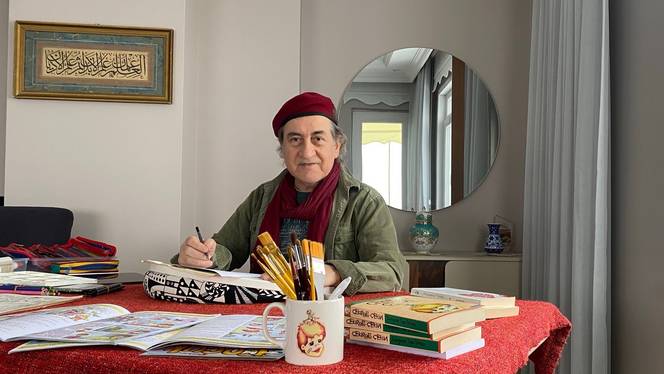
These are the unmistakable images of Muammer Erkul, the Turkish illustrator and journalist whose work—at once bold, unflinching, and darkly satirical—has spread widely across the social media. His drawings do not whisper; they speak loudly.
The satire is biting, but the implications are serious. At a time when many artists sidestep controversy, wary of political consequences, Erkul embraces it.
“I have an idea and I want to convey it to the other party. I want to pass on my feelings. One of the most effective ways to do this is to draw a cartoon,” he says.
His illustrations have become a kind of visual journalism, a counter-narrative to the political abstractions that often obscure the human cost of war.
With sharp lines and unflinching commentary, Erkul captures the resilience of Palestinians amid oppression.
Since the 1970s, Erkul has carved out a space for himself in Turkish newspapers and magazines, his work known for its wit, precision, and unrelenting social critique.
His drawings do not merely document suffering; they bear witness.
Scenes of bombed-out homes, grieving mothers, children clutching stones — his work captures the devastating realities of occupation while also portraying the quiet, stubborn resilience of a people who refuse to be erased.
“Millions of Palestinians have lost everything — their homes, their families, their lives,” Erkul says. “More than 150,000 bodies have been destroyed, and 50,000 of them have been martyred—most of them children and women.”
His words, much like his art, do not flinch from the brutal arithmetic of war. Beyond his artistic talent, Erkul has always used his work as a platform to address important issues.
Erkul’s art merges satire with activism, amplifying the voices of the oppressed through powerful imagery.
Why cartoons?
For Erkul, caricature is more than just a humorous art form; it is a means of resistance.
“Caricature is the easiest and most effective way to explain some things,” Erkul says. “A cartoon is drawn in a day and understood in an instant. It’s like the longest-range missile, and it sticks to its target.”
In an age of social media, where information moves at a breakneck pace, this immediacy is crucial. A single drawing, shared widely, can cut through the noise in ways that editorials and essays often cannot.
“I have an idea, and I want to convey it,” he says simply. “One of the most effective ways to do this is to draw a cartoon.”
Erkul has long been engaged in magazine publishing, serving as the editor-in-chief of Divanyolu, a cultural and literary magazine, until 2018.
Following the devastating 2023 earthquake, he shared his artwork on social media and made it freely available to magazines, believing that art can serve as a powerful tool for remembrance.
Reflecting on the disaster, Erkul described it as one of the most catastrophic earthquakes in history, emphasising its unprecedented scale and impact.
He recalled the initial shock and fear that gripped him, along with the overwhelming sense of helplessness. Wanting to contribute in a meaningful way, he turned to his art, realizing that while the disaster would eventually fade from public memory, visual documentation could ensure that future generations would not forget.
Early in his career, his cartoons blended humor with cultural commentary, but over time, his focus sharpened, his pen increasingly turned toward the struggles of the Palestinian people.
A single cartoon can convey what words cannot — Erkul’s work strikes at the heart of injustice with visual precision.
“Art is not neutral; it must take a side”
Erkul is not just chronicling injustice, he is building solidarity.
His illustrations are not just critiques; they are rallying cries. Erkul’s work does more than capture the suffering of Palestinians — it interrogates the machinery that sustains it.
His cartoons often expose the uneasy entanglements between Western nations and Israeli aggression.
“Everyone knows the closeness of the US and Israel,” he says. “But never in any period of history has this secret game been played so openly. It’s a chicken-and-egg story — an Israeli egg hatches from an American chicken, an American chick hatches from an Israeli egg, grows up, and lays Israeli eggs again.”
He believes artists have a responsibility to engage, to use their platforms to amplify the struggles of the voiceless. In his view, art is not neutral. It must take a side.
For Erkul, that side has always been clear: art is not just a means of entertainment; it is an act of defiance against injustice.
Art is not neutral; Erkul uses his pen as a tool of defiance against global injustice.
In his view, every artist has a responsibility to stand for justice and use their craft to fight against oppression.
His work is particularly significant in an era where digital media spreads messages rapidly, ensuring that his depictions of Palestinian suffering and resilience reach a global audience.
His legacy is not just one of artistic achievement, but of moral conviction.
His pen, like the voices of Palestinian poets, filmmakers, and musicians, is a tool for preserving memory, for fighting erasure. He firmly believes that the more artists engage with these issues, the stronger the message becomes.
“The more cartoonists and artists we have, the stronger our ideas will be,” he says.
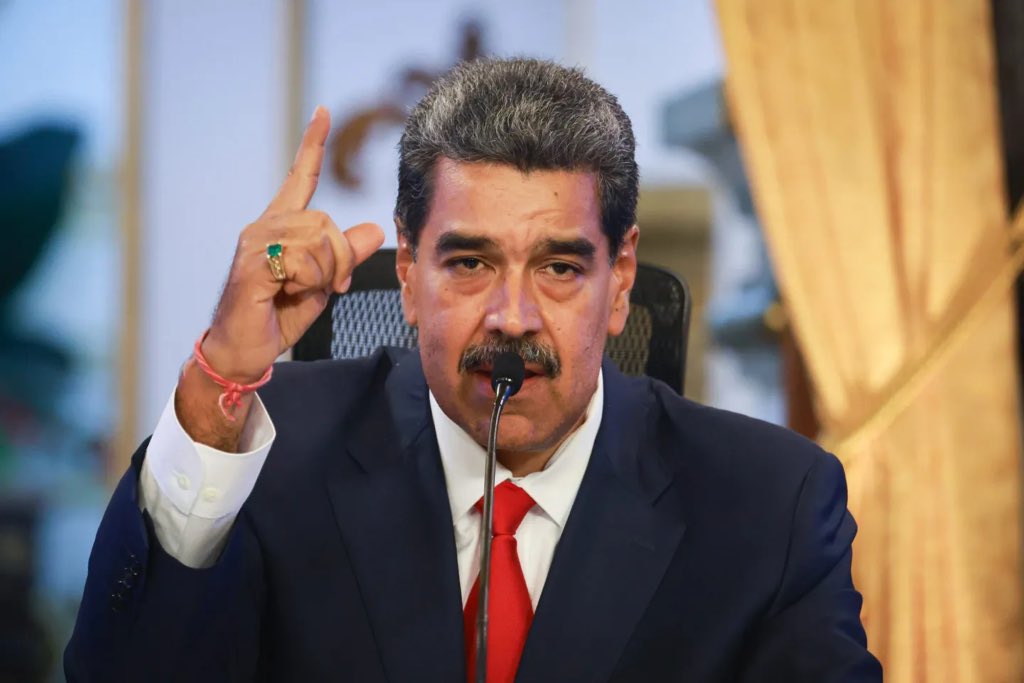
Israeli Prime Minister Benjamin Netanyahu is a “monster created by the European Union and the US Empire,” and he is committing genocide against Palestine and Lebanon, Venezuelan President Nicolas Maduro said on Monday.
Netanyahu “still has the audacity” to give orders to the United Nations to withdraw peacekeeping forces from southern Lebanon, Maduro said, referring to Israel’s call to UN chief Antonio Guterres to move the UN Interim Force In Lebanon (UNIFIL) from the Lebanese side of the border.
Five UN troops were injured in a series of incidents last week, the latest of which involved the UN force accusing Israeli troops of forcibly breaching a gate and entering one of their positions, as Israel continues its aggression across Lebanon, killing more than 1,300 people since September 23.
The Venezuelan president described Netanyahu as “the monster created by the European Union and the US Empire,” adding that even Nazi dictator Adolf Hitler did not dare to do what the Israeli Prime Minister is currently doing.
Maduro said what is happening in the Middle East today “is not a conflict, but a colonial project by the United States, the United Kingdom, and Europe aimed at controlling the region.”
“Netanyahu bombed hospitals, schools, mosques, and refugee camps in Gaza. Is this a war? This is genocide,” the Venezuelan President said.
In late September, Maduro strongly condemned the Israeli assassination of Hezbollah leader Hassan Nasrallah, denouncing Netanyahu as “Hitlerish” and criticizing world leaders for their silence.
He expressed Venezuela’s solidarity with the people of Lebanon and Gaza, also drawing comparisons between the Israeli Prime Minister and Hitler.
“We are witnessing the actions of a murderer who only reminds us of Hitler,” he said according to the Quds News Network.


 CrossFireArabia