Israel Destroys 10 UNRWA Buildings in 4 Days

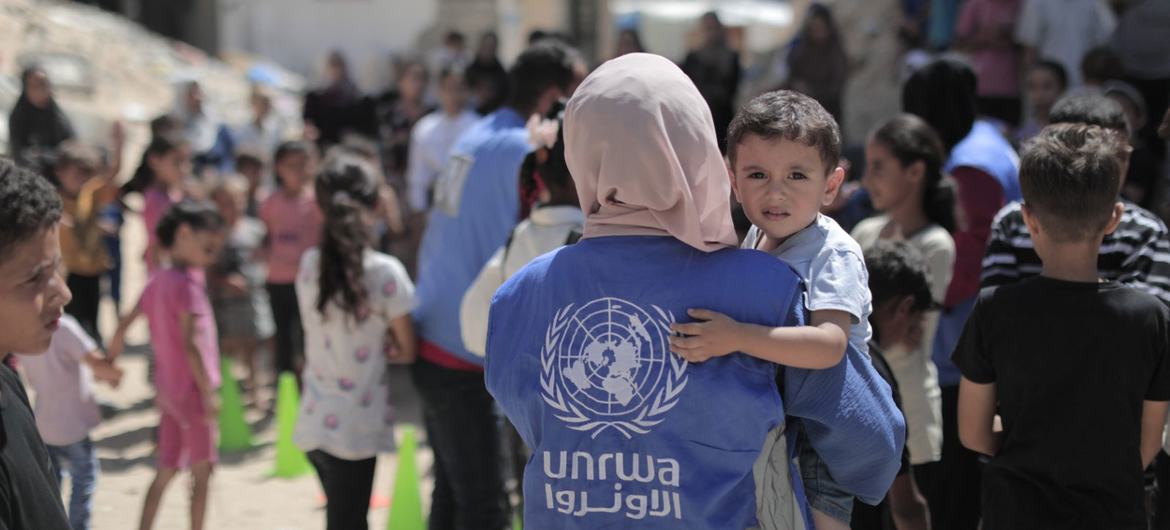
Israeli strikes destroyed 10 of the UN agency for Palestinian refugees’ (UNRWA) buildings in Gaza City over the past four days, including seven schools and two clinics serving as shelters for thousands of displaced Palestinians, the agency’s commissioner-general said Sunday.

“No place is safe in Gaza. No one is safe. Airstrikes in Gaza City and the north are intensifying. More and more people are forced to leave, disoriented and uncertain, heading into the unknown,” Philippe Lazzarini wrote on the US social media company X’s platform according to Anadolu.

Lazzarini noted that UNRWA was forced to suspend health care at the Al-Shati refugee camp.

“We were forced to stop health care in Beach (Al-Shati) Camp, the only health care available north of Wadi Gaza. Our vital water and sanitation services are now only at half capacity,” he said.

“Our teams – 11,000 in total – continue to provide critical services in other parts of northern Gaza and the rest of the Gaza Strip,” he added, praising their determination to serve communities under “inhumane circumstances.”

Lazzarini concluded by saying: “How much longer until action is taken to reach a ceasefire?”

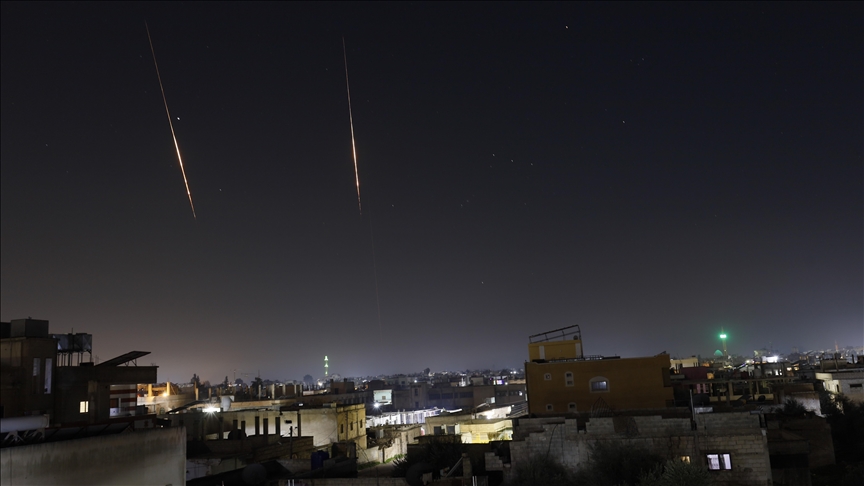
The Israeli army has been targeting high-rise buildings across Gaza City as part of its ongoing offensive to occupy Gaza City, ordering residents to move southward to a “safe humanitarian zone” in Al-Mawasi, Khan Younis, which has come under Israeli fire more than 100 times, killing hundreds of civilians.

According to Gaza’s Government Media Office, the Israeli army has destroyed 1,600 towers and residential buildings in Gaza City since Aug. 11, in addition to 13,000 tents, displacing more than 100,000 Palestinians.

The vast majority of Gaza City’s residents are now crowded into its western neighborhoods, which have witnessed concentrated and intense Israeli bombing since Friday.

Israel’s ongoing war on Gaza has killed nearly 65,000 Palestinians since October 2023 and devastated the enclave, which faces famine.

Israel is facing a genocide case at the International Court of Justice over its war on the territory.

Continue reading
Killing Gaza Slowly

By Tarek Bae  

OPINION - Slaughter dressed up as humanitarian aid: So-called Gaza Humanitarian FoundationFile Photo

“Gaza is on the verge of economic and humanitarian collapse. People live day to day, always at risk from hunger and disease,” notes a UN report. Yet these words were written not in 2025, but by the Independent UN Commission of Inquiry on Gaza in 2019.

Israel has enforced a blockade on the Gaza Strip since 2007. No one and nothing enters or leaves without Israeli permission, including at the crossing to Egypt. Every import and every exit requires an application to Israeli authorities. Human Rights Watch has repeatedly called Gaza the world’s largest open-air prison. Between 2017 and 2021, Israel blocked materials needed to maintain the water system. In 2017, the UN stated that 97% of Gaza’s water was undrinkable. Oxfam concluded the same year that Gaza was the most water-scarce place on earth.

From 2023 onward, Gaza became the target of genocide. From the first days, the blockade on essentials was radically expanded. On Oct. 8, 2023, then-Israeli Defense Minister Yoav Gallant announced there would be “no electricity, no food, no fuel,” because Israel was fighting “human animals.” The total blockade, combined with unprecedented bombardment, turned Gaza into the greatest humanitarian crisis of the 21st century.

During this genocide, international agencies, especially the UN, struggled to keep civilians alive. More than 400 distribution points tried to provide the bare minimum. Political pressure was needed again and again. There were 11 UN resolutions in all, 4 by the Security Council, 5 by the General Assembly and 2 by the Human Rights Council, calling on Israel to enable sufficient humanitarian aid. Israel dismantled every channel through which aid could be delivered. More than 900 humanitarian workers have been killed in Gaza since the genocide began. Never before in any war has the toll on aid workers been so high.

Netanyahu’s starvation strategy

By March 2025, the total blockade hardened into an open starvation strategy. “We have decided to stop all deliveries into Gaza, including food, water and aid,” Prime Minister Benjamin Netanyahu declared on March 2, 2025.

Barely two months later, in May, Israel and the US rolled out the so-called Gaza Humanitarian Foundation (GHF). This, Israeli officials said, would be the new and only route for humanitarian aid. Rumors of a new distribution mechanism had circulated since February, a design Israel was planning with US partners. Coverage of those plans was overshadowed by Donald Trump’s “Gaza Plan.” In a joint press conference with Prime Minister Netanyahu in Washington on Feb. 4, 2025, Trump publicly declared the intention of the US to “take over” the Gaza Strip. That the GHF sits inside this vision follows from statements by GHF officials. In June 2025, Executive Chairman Johnnie Moore Jr. said: “The United States will take full responsibility for the future of Gaza.”

It is not a purely American venture. Logistical coordination at the GHF is led by Israeli Brigadier General Yaakov Baruch. Despite its name, the GHF is not a foundation; it is a political-military organization. Alongside the Israeli military, mercenaries from the US are involved. According to The Times of Israel, Jared Kushner, son-in-law of Trump, is the chief architect of the idea. The US initially put €30 million ($35 million) into the project, with further pledges. In July 2025, Trump complained that no one had expressed gratitude. But what exactly should anyone thank the GHF, Israel, or the US for? GHF spokesperson Shahar Segal offers an answer. “It is frustrating to see people constantly blaming Israel, when in reality it is Israeli logistics that ensure humanitarian food reaches those who desperately need it. The GHF model is saving lives.”

Is that true? No. Among the familiar set of claims used to relativize the genocide is the allegation that allowing international aid only helps Hamas. Again and again, the line is that aid never reaches civilians. Another claim is that Hamas steals humanitarian supplies. The conclusion is clear: this is propaganda. Videos of armed guards on trucks or of lootings by armed gangs have been presented by Israel, in a misleading fashion, as Hamas seizures.

A review by the United States Agency for International Development examined 156 incidents of loss or theft of US-funded aid between October 2023 and May 2025. It found not a single piece of evidence that any of those incidents could be attributed to Hamas. In 44 cases, there were links to Israeli military activity. Reuters reported that Israeli military offices had produced no evidence of systematic theft by Hamas. The New York Times cited sources inside Israel’s government who acknowledged they had none either.

From 400 aid points to 4 militarized sites

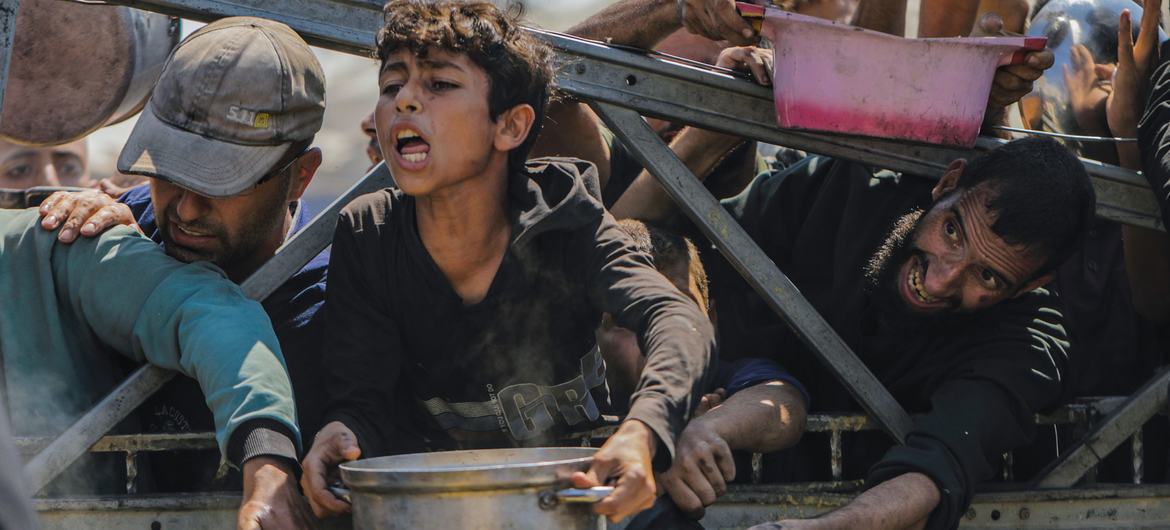
Is the GHF more effective at distributing aid? Not at all. Instead of the 400 international distribution points that once existed, Israel’s blockade and the imposition of the GHF have left only 4 highly militarized sites, with just 1 in the densely populated north. The UN calculates that Gaza’s basic humanitarian need amounts to around 600 truckloads a day. By its own account, the GHF moves at most 26 truckloads daily, roughly 4% of what is required. In a territory facing acute hunger, such an amount is not small—it is nothing.

According to the IPC Famine Review Committee, the whole of Gaza has been in IPC Phase 5 since July, the highest alert, a catastrophic food emergency. People in this phase are at immediate risk of starvation. More than 700,000 people have gone days without any food. The UN special rapporteur on the right to food, Michael Fakhri, was blunt: “Israel has made clear its intention to starve everyone in Gaza.”

What Israel and the US call a distribution mechanism and a foundation is, in the words of Doctors Without Borders, “slaughter dressed up as humanitarian aid.” Starving civilians are forced to walk up to 40 kilometers (25 miles) under the burning sun to reach GHF sites. Arrival does not guarantee help. More than 1,881 starving civilians have been killed at or near GHF distribution sites. The Israeli army regularly fires indiscriminately into the waiting crowd.

Philippe Lazzarini, Commissioner-General of UNRWA, calls the GHF “an alibi for the systematic starvation of Gaza.” For him, the logic is clear. Israel destroyed the humanitarian infrastructure in order to replace it with a facade organization under military control. OCHA spokesperson Jens Laerke sees in the GHF a “distraction.”

What does it distract from? Netanyahu has said the plan out loud. On May 11, according to the Israeli outlet Maariv, he tied aid to permanent expulsion. Those who receive aid at a given place should never see that place again and must evacuate. “The residents of Gaza whom we are expelling will not return. They will no longer be there. We will control the place. There is no other war aim. All other goals are mere eyewash.”

By the Israeli government’s own account, the GHF is a means to drive Palestinians out of Gaza or to let them die, by deliberately starving them, denying supplies, and cutting off humanitarian aid.

*The author is the editor-in-chief of the German journal itidal.de. The opinions expressed in this article are the author’s own and do not necessarily reflect Anadolu.

Continue reading
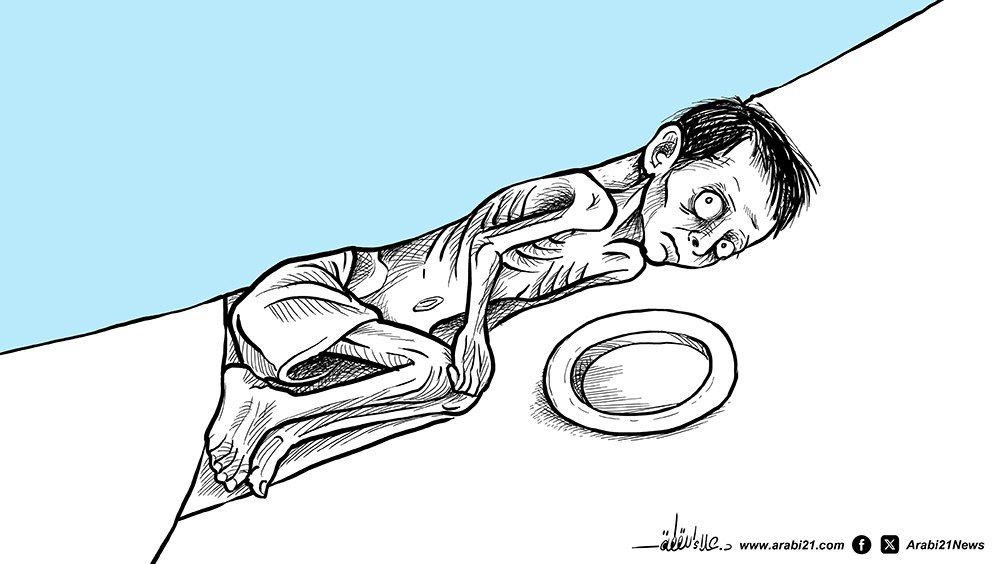
Gaza is Being Starved

All of Gaza is being starved by the Israeli occupation.

This is a cartoon by Alaa Laqta

The UNRWA Commissioner-General Philippe Lazzarini stated that: The famine in Gaza is the result of a deliberate attempt to replace the UN System of distribution with the so-called “Gaza humanitarian mechanism”.

The current aid mechanism is politically driven and is responsible for the deaths of around 1,400 starving people in Gaza. The situation has worsened as UNRWA has been prevented from bringing any aid into Gaza for the past five months.

The marginalization and weakening of UNRWA has nothing to do with allegations of aid being diverted to armed groups. The deliberate weakening of UNRWA is aimed at exerting collective pressure and punishing Palestinians simply for remaining in Gaza.

Continue reading
Airdrops No Solution to Starvation

The head of the UN agency for Palestinian refugees (UNRWA) on Saturday called proposed humanitarian airdrops over the Gaza Strip a “distraction” and “screensmoke” aimed at diverting attention from the catastrophic humanitarian situation in the besieged enclave.

Philippe Lazzarini made the remarks in response to a Western media report claiming that Israel would allow airdrops by Western countries for two days starting Friday.

No airdrops, however, have been observed until now.

“Airdrops will not reverse the deepening starvation. They are expensive, inefficient and can even kill starving civilians,” the UNRWA commissioner-general said.

“Driving aid through is much easier, more effective, faster, cheaper, and safer. It’s more dignified for the people of Gaza.”

“A manmade hunger can only be addressed by political will. Lift the siege, open the gates and guarantee safe movements and dignified access to people in need,” Lazzarini continued.

“At UNRWA, we have the equivalent of 6,000 trucks in Jordan and Egypt waiting for the green light to get into Gaza,” he added.

On Saturday, Gaza’s Health Ministry said five more Palestinians, including two children, died from hunger and malnutrition in the last 24 hours, pushing the death toll since October 2023 to 127, including 85 children.

Gaza’s government media office warned of a mass-death risk threatening over 100,000 children under the age of 2 due to the depletion of milk and nutritional supplements amid Israel’s ongoing blockade.

UN and local organizations have warned that continued Israeli restrictions on aid access could lead to widespread child fatalities amid a complete collapse of Gaza’s healthcare system.

Since March 2, Israel has closed all border crossings with Gaza, blocking hundreds of trucks and worsening humanitarian conditions in the enclave.

Rejecting international calls for a ceasefire, the Israeli army has pursued a brutal offensive on Gaza since Oct. 7, 2023, killing over 59,700 Palestinians, most of them women and children. The relentless bombardment has destroyed the enclave and led to food shortages.

Last November, the International Criminal Court issued arrest warrants for Israeli Prime Minister Benjamin Netanyahu and his former Defense Minister Yoav Gallant for war crimes and crimes against humanity in Gaza according to Anadolu.

Israel also faces a genocide case at the International Court of Justice for its war on the enclave.

Continue reading
Gaza: A Starvation Nightmare

UN humanitarian workers said that alarming reports of UN staff members in the Gaza Strip fainting from hunger and exhaustion over the past 48 hours have heightened fears for the lives of the population in the besieged enclave.

“Doctors, nurses, journalists, and humanitarian workers, including UNRWA staff, are suffering from hunger… fainting from hunger and exhaustion while carrying out their duties,” said Juliette Touma, Director of Communications and Public Information for the United Nations Relief and Works Agency for Palestine Refugees (UNRWA).

Speaking from Amman, Touma emphasized that the search for food has “become as deadly as the bombing.”

More than 1,000 Palestinians Killed


This development comes as the Office of the High Commissioner for Human Rights announced that more than 1,000 Palestinians have been killed by the Israeli army while trying to access food in Gaza since the so-called Gaza Humanitarian Facility began operating on 27 May.

“As of 21 July, we have recorded 1,054 people killed in Gaza while trying to access food; 766 of them near GHF sites, and 288 near UN and other humanitarian aid convoys,” said UNHCR spokesperson Thamin Al-Khaitan.

The US- and Israeli-backed organization began operating in the Strip on May 27, bypassing the UN and other established NGOs.

“Aid work is not for mercenaries”


“GHF’s so-called distribution scheme is a sadistic death trap, where snipers fire indiscriminately into crowds, as if they have been given a license to kill,” Ms. Touma said.

Quoting UNRWA Commissioner-General Philippe Lazzarini, Ms. Touma described the scheme as “a mass hunt for people with complete impunity.” She added: “This cannot be the new normal. Humanitarian assistance is not the work of mercenaries.”

The UNRWA spokesperson emphasized that the United Nations and its humanitarian partners have the expertise, experience, and resources available to provide safe, dignified, and large-scale assistance. “We have proven this time and again during the recent ceasefire,” she said.

Famine-like conditions
Living conditions in the Gaza Strip have reached a new low, with prices for basic goods increasing by nearly 4,000%. Gazans, who have lost their homes and been displaced multiple times, are left without income and are completely deprived of essentials.

Ms. Touma highlighted the testimony of a colleague on the ground who had to walk for hours to buy a bag of lentils and some flour, paying nearly $200 for it.

The World Food Programme has confirmed that a quarter of Gaza’s population is facing famine-like conditions, with nearly 100,000 women and children suffering from severe acute malnutrition and in need of urgent treatment.

Everyday staples such as diapers are scarce and expensive, costing around $3 each. Mothers have resorted to using plastic bags instead, while one father said he “had to cut up one of his last shirts to give his daughter sanitary pads,” Ms. Touma said.

Ms. Touma emphasized, “UNRWA has stockpiles of hygiene supplies, including baby and adult diapers, waiting outside the gates of Gaza.” She emphasized that the agency has 6,000 trucks loaded with food, medicine, and hygiene supplies waiting in Egypt and Jordan for entry into the Strip.

Urgent appeal for a ceasefire


She reiterated the UN’s calls for “an agreement that would achieve a ceasefire, release the hostages, and allow the regular flow of humanitarian supplies into Gaza under UN management, including UNRWA.”

For his part, World Health Organization spokesperson Tarik Jasarevic said that humanitarian operations in the Strip are being pushed into “an ever-shrinking space.” In a briefing to journalists in Geneva, he condemned three attacks on Monday on a building housing the organization’s staff in Deir al-Balah, central Gaza, as well as “the mistreatment of those present and the destruction of its main warehouse.”

“Staff and their families, including children, were exposed to grave danger and trauma after the airstrikes caused a fire and extensive damage,” said Mr. Jasarevic, adding that the Israeli military entered the building, “forcing women and children to evacuate on foot” toward the coastal area of Mawasi amidst intense fighting.

UN staff member detained…searched at gunpoint


A WHO spokesperson said that staff and their family members were “handcuffed, stripped, and subjected to immediate interrogation and searches at gunpoint.” Two staff members and two family members were also arrested. While three were later released, one WHO staff member remains in detention for unknown reasons.

Mr. Jasarevic called for the release of the detained staff member, emphasizing that “no one should be detained without charge or due process.”

Mr. Jasarevic added that the recent evacuation order for the area had affected many WHO buildings and weakened its field presence, “paralyzing efforts to maintain a collapsed health system and putting survival beyond the reach of more than two million people.”

According to health authorities in Gaza, approximately 1,500 health workers have been killed in the Strip since the war began in October 2023. Mr. Jasarevic said that approximately 94% of all health facilities have been damaged, and that half of Gaza’s hospitals are “completely non-functional.”

He emphasized that “the opportunity to prevent loss of life and reverse the massive damage to the health system is closing by the day.”

A Nightmare That Must End


UN High Commissioner for Human Rights Volker Türk described the nightmare facing the people of Gaza as worsening following the latest Israeli evacuation orders, followed by intensified attacks on southwest Deir al-Balah, which “added further misery to the suffering of starving Palestinians.”

He warned in a statement that the risk of unlawful killings and other serious violations of international humanitarian law is extremely high, “given the concentration of civilians in the area and the means and methods of warfare used by Israel to date.”

He continued: “Homes have already been destroyed, and thousands have been forced to flee the area once again. Their only option is to go to the ever-shrinking areas of Gaza, where hundreds of thousands are forced to congregate, making any attempt to deliver humanitarian aid difficult. Even these areas are not safe. I remind Israel that the permanent displacement of people living under its occupation would constitute an unlawful transfer, a war crime, and, under certain circumstances, may also constitute a crime against humanity.”

The High Commissioner said that Israel, as the occupying power, must ensure the provision of food, medicine, and other supplies to the population, and must immediately and unconditionally allow humanitarian aid to enter and be distributed to all those in need. He added: “Instead of launching round after round of new military attacks, the killing, destruction, and widespread violations of international law must stop immediately. More and more countries are joining the calls to extricate us from this nightmare.”

UN News

Continue reading