CrossFireArabia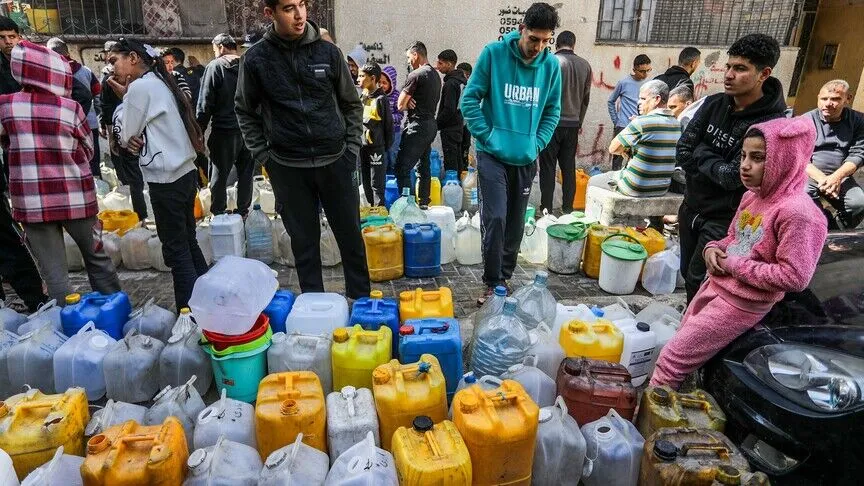
Dozens of Palestinians protested, Friday, in Gaza City against Israel’s destruction of a desalination plant that provided drinking water to residents of the Sheikh Radwan neighborhood and displaced people that came to the area; they are demanding it be reconstructed and made operational.
Children, women, and the elderly participated in the protest, some carrying empty water containers, while others held signs reading: “A drop of water equals life” and “Bring back the water.”
The protest comes amid a severe water crisis in the Gaza Strip. The United Nations Children’s Fund (UNICEF) stated, Friday, 70 percent of the water and sanitation infrastructure has been damaged, and 63 percent of Palestinians cannot access even six liters of drinking water per person per day.
The protest came four days after Israeli warplanes bombed the modern desalination plant in the Sheikh Radwan neighborhood, destroying it and damaging the surrounding tents of displaced people, according to an Anadolu Agency correspondent.
Despite the ceasefire agreement in effect since October 10, 2025, the Israeli army continues to launch attacks and fire operations in various parts of the Gaza Strip.
Displaced resident Abdul Hamid Mutawalli said the water station “gave life and hope,” after its construction and operation that took about two months to provide water to the area’s residents.
He told Anadolu that the area suffers from a severe water shortage despite its dense population of residents and displaced residents, and that the station’s operation gave them some hope for survival and resilience.
Mutawalli said that Israel bombed the station under the pretext that there was an arms depot underneath it, explaining the site was, according to him, “a furniture warehouse belonging to a company.”
He demanded the station be reconstructed again, saying: “This is a water desalination plant, not a missile or weapons depot. Let us live; we just want water.”
For his part, Imad Abu Na’ma, one of the organizers of the demonstration, said that the residents came out to demand “the most basic human right, which is access to water.”
He added that the station supplied water to hundreds of families before its destruction, warning of the worsening suffering of children due to the scarcity of drinking water.
The United Nations Office for the Coordination of Humanitarian Affairs (OCHA) reported on August 14 that 90 percent of the Gaza Strip’s population suffers from moderate to high levels of water insecurity, with the figure rising to 92 percent in Gaza City.
According to UN data as of the end of July, approximately 75 percent of Palestinians in the Gaza Strip rely on water tankers as their primary source of drinking water.