Gaza’s Kites Return — and Israel Katz Threatens Revenge
CROSSFIREARABIA — A handful of balloons and homemade kites drifting out of the Gaza Strip have managed to provoke an extraordinary response from Israel’s defence establishment, with Defence Minister Israel Katz threatening assassinations, forced evacuations and military strikes if the launches continue.
The objects at the centre of the latest confrontation are remarkably primitive.
Israeli media reported that several kites crossed from Gaza into Israeli communities surrounding the Strip in recent days. At least five have reportedly been detected, including one found in Kibbutz Kfar Aza over the weekend.
Significantly, the kites discovered so far were reported not to have been carrying explosives or incendiary material. Israeli reports said they did not pose a danger to residents according to the Jerusalem Post.
That has not stopped Katz from treating them as a major security threat. He announced Sunday he had instructed the army to respond “immediately and forcefully” to balloons, kites or drones crossing from Gaza.
Katz said Israel would regard every such launch as an act of war and made clear that, as far as the Israeli military response was concerned, there would be little distinction between a balloon, a kite and an unmanned aircraft.
“A balloon is treated like a kite, and a kite is treated like a drone, with or without explosives,” Katz said, according to Israeli media, the Israeli daily reported.
He went considerably further.
Katz threatened action against those Israel believes are responsible for launching the objects, including assassinations. He also raised the possibility of ordering Palestinians to evacuate residential neighbourhoods and of attacking areas Israel claims are being used as launching sites Anadolu Ajansı reported him as saying.
The threat potentially turns an object made from little more than plastic, sticks and string into justification for a much broader military response.
Gaza Disputes the Israeli Account
But there is another side to the story.
Gaza’s Government Media Office, Sunday, rejected the Israeli portrayal of the kites and balloons as organized hostile operations.
Ismail Al-Thawabta, director-general of the office, told the Palestinian Sanad News Agency that the Israeli allegations were unfounded and accused Katz of using them to prepare public opinion for another escalation against Gaza.
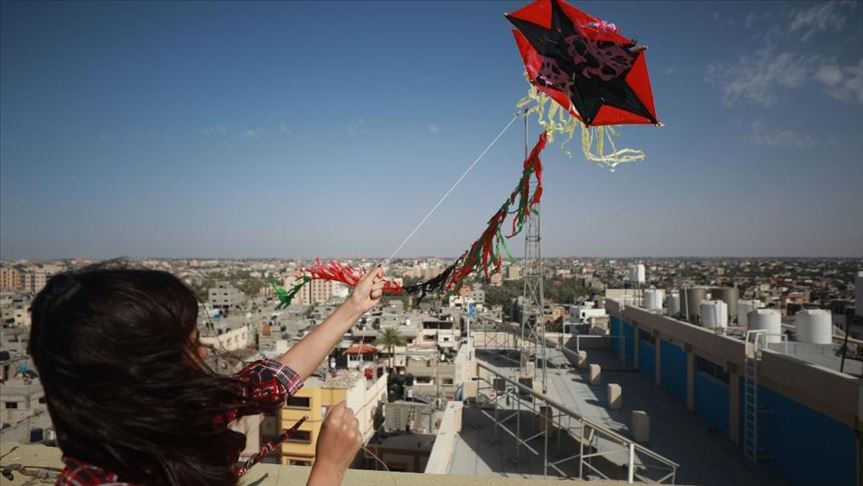
According to Al-Thawabta, what Israel is describing as acts of war are, in some cases, simply homemade kites constructed by Gaza’s children from nylon bags and pieces of wood.
Children fly them as one of the few forms of recreation still available amid the devastation and shortages inside Gaza, he said.
The Government Media Office argued that the crude kites largely follow the direction of the wind and cannot be precisely controlled over long distances as another local news agency pointed out.
That distinction is crucial.
Israel is alleging that objects are deliberately being dispatched across the boundary. Gaza officials are saying that children’s kites can simply be caught by the wind and carried beyond the Strip.
Neither claim should automatically be accepted without independent evidence establishing who launched each object and with what intention.
What is established from Israeli reporting, however, is that the kites discovered in recent days were not carrying explosives or incendiary devices as per the Shorouk Arabic website.
An Echo of 2018
The sight of kites crossing the Gaza boundary nevertheless carries powerful memories for Israelis.
During the Great March of Return protests beginning in 2018, Palestinians developed incendiary kites and balloons into an improvised form of protest and resistance. Some carried burning material across the boundary, starting fires in agricultural fields and nature reserves in southern Israel.
The devices were technologically simple but became a surprisingly persistent problem for the Israeli military.
Today’s situation is different in one important respect: The objects reported in the latest incidents have not been found carrying the incendiary or explosive payloads associated with some of the 2018 launches.
Yet the political and military reaction has been immediate.
Katz has effectively established a doctrine under which the distinction between a kite and a drone can disappear once either crosses from Gaza.
A Kite Becomes an “Act of War”
There is a striking imbalance in the language surrounding the episode.
Gaza remains devastated by years of warfare, displacement and destruction. Children there improvise toys from whatever materials can still be found.
Against that background, an object consisting of nylon, wood and string can cross the boundary on the wind and suddenly enter an entirely different world of military terminology: drone, launch site, operator, assassination, evacuation and act of war.
The Gaza Government Media Office says that is precisely the danger.
It argues that depicting children’s homemade kites as a significant military threat could provide Israel with a new justification for attacking civilians and residential areas according to Alray.
Israel, by contrast, says it cannot afford to wait for a kite or balloon to prove dangerous before responding. Katz’s position is that anything deliberately launched from Gaza toward Israeli communities must be treated as a hostile act.
That leaves one central question hanging over the latest confrontation:
Are these deliberate launches from Gaza, as Israel alleges, or are at least some simply children’s kites escaping into the wind, as Gaza officials maintain?
For the moment, publicly available evidence does not settle that question. What it does show is how little is now required to threaten another escalation around Gaza. No missile. No rocket. Not even an explosive.
Just a kite crossing the sky — followed by a defence minister promising assassinations, evacuations and force.
This article is based on information from AI and is reproduced in Crossfirearabia.com

 CrossFireArabia