Trending News:Remains of Journalist Doaa Al Sharaf Recovered After 3 YearsOn a 1932 US Passport: ‘Jerusalem, Palestine’Netanyahu, Mount Hermon and Arab SilenseDon’t Let The Flag DownArt in HistoryThe Dress of RamallahSalman Abu Sitta: Safeguarding Palestinian MemoryWoman From BethlehemFree PalestineWoman of The VineyardsTrumpaplooza! View from AmmanNAZA: When Israel’s Killing Machine Speaks in Its Own VoiceTents by The Sea!Pain…Israel Punishes Britain, a State that Led to its CreationBattle for Hormuz: How Iran Found America’s Achilles HeelPalestinians Slam Adidas For Pro-Israel PR CampaignThe Other Exodus: How War, Politics and Insecurity Are Driving Israelis AbroadIsrael Strikes at House, Kills Family of FourA Morning WhisperFares Odeh: Come on!Keys of Return and HopeA Palestinian Hospital in Yafa, 1933Gaza Underground – A NovelSilhouettes: On The BeachThe Dove, Woman and The Orange TreeAscend to The SkiesKilling Happiness!Israel Kills Schoolgirl, Her Dad in Gaza on First Day of SchoolIbrahimi Mosque Without ‘Call to Prayer’ For 76 DaysIsrael Orders Closure of The UK Consulate in East JerusalemPalestinian Ladies, Nazareth 1940‘Stolen Childhood’‘I am Still Alive’Soul of GazaWith Many Men Killed, 86,000 of Gaza Households Are Headed by Women – UN EstimatesPain, Dreams and HopeLost Kids of Gaza!Smotrich Calls For Expulsion of UK Ambassador in Tel AvivIn Gaza, Even the Tent Is Temporary: Families Who Have Fled 5, 10, 15 TimesGaza’s Widows: When Grief Becomes the Family’s Only BreadwinnerAutumn Papers: Palestinians Must Sieze The MomentHRF Files Criminal Complaint Against Israeli FM in SloveniaEx-Israeli PM: Burning Homes With Arabs Inside is “Terrorism”‘When Will They be Buried’? Families Search For Their Loved Ones Under The RubbleIraqi Book Fair: 600 Publishers From 28 CountriesKeeping The Palestinian Narrative Alive Via Its GenerationsExodus: 94% of Israeli Doctors Are LeavingSea Secrets: Water Among The RuinsMass Funeral: Gaza Buries 100 Martyrs76 Killed: 2026 Deadliest Year in The West BankBeautiful Tulkarem: Dreams Not For Dying‘Why Did You Kill Our Daughter’Children of JeninIsraeli Soldiers Tell Kindergarten Teacher ‘No School For You’Good Morning From The Sea of GazaIsraeli Forces Raid Two West Bank SchoolsAnother School Year: 846,000 West Bank Students Sit at Their Desks Again!Good Morning to The Toilers of Our Land!Miserable Year: Gaza Pupils Simply Have No Schools to Go to Thanks to IsraelKites Flown in 11 Dutch Cities For Kids in GazaHuckabee in Turmus Ayya, Calls Settler Attacks ‘Terrorism’Israel Forcibly Displaced Three Camps – UNIsraeli Officials Snub Trump’s Plan For GazaThe Firewood GathererThe Gaza Curse? Israel’s Water Crisis and the Pollution That Refuses to Respect BordersIsraeli Kills 5, Injures 24 in Strikes on LebanonPupils in Safad, 1944Searching For Water Amid The Rubble‘Every Face is a Story’So Many Kids, So Many Expressions!”1000 Martyrs Cup: Palestinian Football Back on The PitchPalestinian Women, Makers of HistoryAya Isleem: ‘We Are Tired of The War’‘These Are Your Israeli Soldiers’Welcome to Gaza: ‘We Are Not Leaving’A Woman From GazaBalcony of LifeWho is Afraid of Palestinian Revolutionary Art?In The Past: Za’atar Coffee Shop in JerusalemSweet Tooth in Damascus GateA Life After The War!Beit Sahour Family, 1930Civil Defense Recovers 55 Bodies Under Debris of Gaza BuildingGideon Levy on 7 OctoberJordan Appoints New Army ChiefKey of ReturnScene From GazaFighting For Water!A Tribute to a CartoonistMom, Kids in CharcoalHussam Abu Safiya: The Doctor HostageThe Girl, The Smile and The SlipperBlair Asked PA to Remove Palestine From TextbooksTeacher’s Cartoon Not to ForgetThe Broom SellerSummer MadnessMartyred After Engaging An Israeli ForceKids of The SeaPalestinian Dresses & Heritage
Trending News:Remains of Journalist Doaa Al Sharaf Recovered After 3 YearsOn a 1932 US Passport: ‘Jerusalem, Palestine’Netanyahu, Mount Hermon and Arab SilenseDon’t Let The Flag DownArt in HistoryThe Dress of RamallahSalman Abu Sitta: Safeguarding Palestinian MemoryWoman From BethlehemFree PalestineWoman of The VineyardsTrumpaplooza! View from AmmanNAZA: When Israel’s Killing Machine Speaks in Its Own VoiceTents by The Sea!Pain…Israel Punishes Britain, a State that Led to its CreationBattle for Hormuz: How Iran Found America’s Achilles HeelPalestinians Slam Adidas For Pro-Israel PR CampaignThe Other Exodus: How War, Politics and Insecurity Are Driving Israelis AbroadIsrael Strikes at House, Kills Family of FourA Morning WhisperFares Odeh: Come on!Keys of Return and HopeA Palestinian Hospital in Yafa, 1933Gaza Underground – A NovelSilhouettes: On The BeachThe Dove, Woman and The Orange TreeAscend to The SkiesKilling Happiness!Israel Kills Schoolgirl, Her Dad in Gaza on First Day of SchoolIbrahimi Mosque Without ‘Call to Prayer’ For 76 DaysIsrael Orders Closure of The UK Consulate in East JerusalemPalestinian Ladies, Nazareth 1940‘Stolen Childhood’‘I am Still Alive’Soul of GazaWith Many Men Killed, 86,000 of Gaza Households Are Headed by Women – UN EstimatesPain, Dreams and HopeLost Kids of Gaza!Smotrich Calls For Expulsion of UK Ambassador in Tel AvivIn Gaza, Even the Tent Is Temporary: Families Who Have Fled 5, 10, 15 TimesGaza’s Widows: When Grief Becomes the Family’s Only BreadwinnerAutumn Papers: Palestinians Must Sieze The MomentHRF Files Criminal Complaint Against Israeli FM in SloveniaEx-Israeli PM: Burning Homes With Arabs Inside is “Terrorism”‘When Will They be Buried’? Families Search For Their Loved Ones Under The RubbleIraqi Book Fair: 600 Publishers From 28 CountriesKeeping The Palestinian Narrative Alive Via Its GenerationsExodus: 94% of Israeli Doctors Are LeavingSea Secrets: Water Among The RuinsMass Funeral: Gaza Buries 100 Martyrs76 Killed: 2026 Deadliest Year in The West BankBeautiful Tulkarem: Dreams Not For Dying‘Why Did You Kill Our Daughter’Children of JeninIsraeli Soldiers Tell Kindergarten Teacher ‘No School For You’Good Morning From The Sea of GazaIsraeli Forces Raid Two West Bank SchoolsAnother School Year: 846,000 West Bank Students Sit at Their Desks Again!Good Morning to The Toilers of Our Land!Miserable Year: Gaza Pupils Simply Have No Schools to Go to Thanks to IsraelKites Flown in 11 Dutch Cities For Kids in GazaHuckabee in Turmus Ayya, Calls Settler Attacks ‘Terrorism’Israel Forcibly Displaced Three Camps – UNIsraeli Officials Snub Trump’s Plan For GazaThe Firewood GathererThe Gaza Curse? Israel’s Water Crisis and the Pollution That Refuses to Respect BordersIsraeli Kills 5, Injures 24 in Strikes on LebanonPupils in Safad, 1944Searching For Water Amid The Rubble‘Every Face is a Story’So Many Kids, So Many Expressions!”1000 Martyrs Cup: Palestinian Football Back on The PitchPalestinian Women, Makers of HistoryAya Isleem: ‘We Are Tired of The War’‘These Are Your Israeli Soldiers’Welcome to Gaza: ‘We Are Not Leaving’A Woman From GazaBalcony of LifeWho is Afraid of Palestinian Revolutionary Art?In The Past: Za’atar Coffee Shop in JerusalemSweet Tooth in Damascus GateA Life After The War!Beit Sahour Family, 1930Civil Defense Recovers 55 Bodies Under Debris of Gaza BuildingGideon Levy on 7 OctoberJordan Appoints New Army ChiefKey of ReturnScene From GazaFighting For Water!A Tribute to a CartoonistMom, Kids in CharcoalHussam Abu Safiya: The Doctor HostageThe Girl, The Smile and The SlipperBlair Asked PA to Remove Palestine From TextbooksTeacher’s Cartoon Not to ForgetThe Broom SellerSummer MadnessMartyred After Engaging An Israeli ForceKids of The SeaPalestinian Dresses & Heritage
EDITOR’S NOTE: I wrote this article “On Arabic” in 2008 and posted on hackwriters.com. I am reprinting it here for relvance and archival use
Compared with English, Arabic is an easy read if it is written well. When you look at English, the perception of the language, written and oral, took centuries of development from archaic structures associated with the old English of Geoffrey Chaucer, passing to Shakespeare and Christopher Marlow to George Elliot, Charles Dickens, Virginia Wolfe as well as many others and not mentioning the new contemporaries.
With Arabic it’s different. Although there may have been stages of development through out the centuries, it seems the clarity of the Arabic language was a one-time affair, represented in the Holy Koran brought down from the skies through Angel Gabriel to Prophet Mohammad in the 7th century and passed on to the Muslim community.
The Koran represented a basis for the Arabic language as it is spoken and written today. Unlike English, back in the 7th century Arabic was written in a clear, transparent, effective tone that involved action, and designed from every member of the social community, rich and poor, educated and illiterate, a source of knowledge and speech and continued to be so as it passed down through the centuries.
With English it was different. First if all, the language itself was derivative from other linguistic structures like Germanic, Latin, and French, many of which have said this is what made it stronger; Secondly English was helped by the issue of economic development as new inventions, processes and way of doing things required the development of new words, terminologies and syntax which evolved from the 17th century onwards.
Today some have been known to criticize Arabic for failing to be innovative, or developing to meet the needs of modernization and even globalization, with its inability to produce new words and terminologies to pace with the development going on in the region and the world.
However, one of the points that has to be clarified is that as these inventions came from the western countries and as communicated in English, the language proved more flexible in coming up with new words and terms, as opposed to the Arabic language that adopted a reactive approach with linguists from the region acting haphazardly in their word formations rather than following a methodical pattern.
In the process as well, we tend to get used to hearing the words and terminologies in say the English language and when we hear their equivalents in other languages such as Arabic, as there is a sense of word creation even in translations, it becomes odd and foreign simply because our ears have got used to the English pronunciation.
But this is a different view related to globalization, how much are we as Arabs integrated into the international system, how much we take from it, what do we take, what do we buy, our consumer habits and trends and indeed, how much do we produce and contribute to world society.
While this in turn becomes related to our language, its use, how much we mix words, English-Arabic, Arabic-English, the fact of the matter is that the language itself, spoken by about 300 million people in 22 Arab countries and about a 1.5 billion in Muslim countries who read the Koran in Arabic, says a great deal.
Arabic is a cogent force, its simple, attractive and gets the point across in as a logical manner as possible. It’s easy to read and to understand. It’s structure is less complex as say French and German which are grammatically more demanding than the English language.
However, just like any other language, writing in Arabic has to be learnt, it’s a professional skill; that’s why today there is an endless beating about the bush were getting the idea across is deliberately pumped and inflated and there is much hankering because of political considerations relating to ruler, government, state, security apparatuses and so on.
These considerations are over-riding and smack directly with the professionalism of writing and the way the writing of Arabic should be as passed on and continued through out the holy Koran which is sometimes used as a source of criticism by western writers and pedagogics who claim the Arabic language lacks the basis for producing new words as do the other languages.
But when Arabic is spoken and written as part of the social community there is a sense of modernist continuum as expressed in its words, expressions, figures of speech and syntax found in the structure of the language.
Nowhere is this more emphasized than it is in the Koran. Written in the 7th century, the Koran is timeless in its spiritual message, a modernist document in its approach with words, phrases and expressions that apply as much today as when it was handed down, memorized and collectively written.
Words and expression apply as much then as they apply today. The word “car” for instance is used in one of its Suras (chapters) to signify a caravan route whereas its use today implies a vehicle, and striking the reader as if you are reading a modern document about social relations, economy, authority, and kinship.
The style of language appears to be modernist as well and not with case as it is say with the Bible that is written in old English, not as old as the language used by Chaucer, but is hard to fathom just the same.
That has proved problematic for the Koran. When translated into English translators often use the kind of language that is employed by the Bible, which does not reflect the actual modernist style of the Koran for the lucidness of the holy document becomes lost and replaced by an archaic and medieval structure once found in the language, although English has moved on tremendously.
Dr. Marwan Asmar holds a PhD from Leeds University and is a freelance writer specializing on the Middle East. He has worked as a journalist since the early 1990s in Jordan and the Gulf countries, and been widely published, including at Albawaba, Gulf News, Al Ghad, World Press Review and others.
CROSSFIREARABIA – There are documentaries that expose a war by showing its victims, and there are films that attempt something altogether different: Entering the machinery that produces those victims.
NAZA, the disturbing new documentary by Israeli filmmakers Yuval Abraham and Rachel Szor, belongs firmly to the second category.
Premiered at the Venice International Film Festival on 10 September, NAZA does not principally take its cameras into Gaza’s shattered streets, hospitals or tent camps. Instead, Abraham and Szor turn their cameras towards Israel — specifically towards 24 Israeli intelligence officers and soldiers who participated in the systems of surveillance, target selection and killing that have shaped Israel’s war in Gaza.
It is this inversion that makes NAZA potentially one of the most consequential films yet made about the Gaza war.
The Palestinians are overwhelmingly the people who die. But for most of the film, the camera remains on the other side of the border, among people who helped determine who would be targeted and how.
The result, according to Peter Bradshaw’s review in The Guardian, is a profoundly unsettling film that casts a “chilling light” on what has happened in Gaza. The Guardian is not merely reviewing the documentary: it produced NAZA, which grew out of investigations undertaken by the newspaper together with the Israeli-Palestinian publication +972 Magazine and the Hebrew-language Local Call between 2023 and 2025.
A word that turns civilians into numbers
The horror begins with the title.
“NAZA” is described by the filmmakers as an Israeli military term for the civilian casualties expected in an attack.
Before a bomb falls, in other words, civilians may already exist inside the targeting calculation as a number.
This is perhaps the film’s most disturbing proposition because it moves the argument beyond the familiar dispute over whether civilians were accidentally killed during attacks on Hamas targets. NAZA asks a more uncomfortable question: What happens when civilian deaths become incorporated into the architecture of targeting itself?
The Israeli witnesses describe systems in which intelligence, artificial intelligence, mass surveillance and enormous quantities of personal data are combined to identify suspected targets.
According to testimony presented in the film, computer systems analysed telephone behaviour and other information to identify people suspected of connections to Hamas. Targets could then be attacked at their homes, sometimes at night, despite the presence of their families.
One witness refers to an error rate of around 15 percent. Another describes an expected “Naza” figure of roughly 20 civilians for an operation.
Other testimony goes considerably further.
The Guardian’s investigation accompanying the film reports accounts of neighbourhoods being destroyed even when Israeli forces estimated that significant numbers of residents remained inside, civilian homes being systematically burned and Palestinians being killed around food-distribution areas.
The effect is to transform the vocabulary of “collateral damage.” Collateral damage ordinarily suggests something unintended. NAZA suggests calculation.
The horror is 60 kilometres away
Abraham and Szor make an inspired visual decision.
The interviews take place at night on rooftops in Tel Aviv.
The witnesses’ identities must be protected. Faces remain largely in darkness and appearances and voices are digitally altered. Yet behind these anonymous figures another character gradually emerges: Tel Aviv itself.
Apartments glow.
Traffic moves.
People continue their ordinary lives.
And Gaza is only about 60 kilometres away.
Bradshaw draws particular attention to this juxtaposition in his Guardian review. The camera periodically leaves the intelligence officers and wanders across Tel Aviv’s illuminated apartment buildings, observing fragments of comfortable civilian existence while another civilian population, almost within geographical touching distance, has been subjected to extraordinary destruction.
This distance is central to NAZA.
Modern warfare permits killing without proximity.
The person gathering intelligence does not necessarily see the family beneath the bomb. The analyst studies a screen. An algorithm produces possibilities. Someone approves a target. Someone else presses another button.
Each individual performs one function. The system performs the killing.
It is therefore significant that Abraham and Szor say their film is not primarily concerned with individual “rogue soldiers.” Their subject is something larger: the orders, procedures, assumptions and language through which extraordinary violence becomes ordinary institutional activity.
They call it the story of “the system and its cogs.”
That may ultimately be the most important sentence attached to the film.
Not monsters, but technicians
One of NAZA’s unsettling qualities appears to be the ordinariness of the people speaking.
These are not cinematic villains.
They are technicians, intelligence officers and educated professionals. Some appear troubled by what they participated in. Others describe operations with a detachment that is arguably more disturbing than anger or hatred would have been.
One interviewee describes the experience as resembling a video game. Another recalls surveillance of two young sisters used to determine when their father, a suspected Hamas operative, was home. According to Screen Daily’s account of the film, an attack subsequently killed the girls and other members of the family — while the intended target was apparently not there. (Screen DailyError! Filename not specified.)
This is where NAZA enters territory familiar from Jonathan Glazer’s The Zone of Interest.
The connection is not accidental: Glazer is an executive producer of NAZA, alongside a production team associated with that Oscar-winning film.
The Zone of Interest explored horror through normality: Auschwitz existed beside a family home in which people gardened, ate meals and raised children.
NAZA constructs a contemporary and inevitably controversial echo.
Tel Aviv sleeps.
Screens glow.
Analysts work.
Gaza burns.
The significance of Israeli testimony
There is another reason this documentary matters.
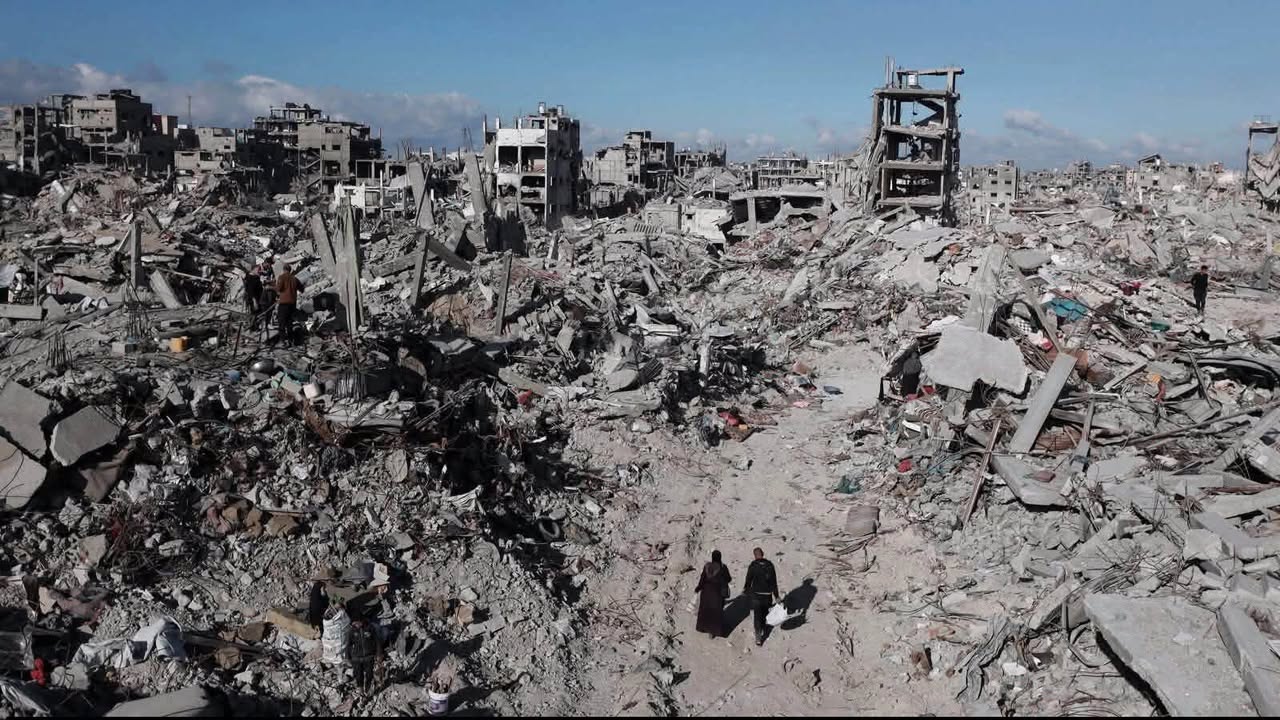
Palestinians have described the destruction of Gaza since October 2023 in extraordinary detail. Palestinian journalists have filmed dead children, flattened neighbourhoods, destroyed hospitals, displaced families and mass graves.
Palestinian testimony has never been absent.
The uncomfortable question is why another form of testimony — that of Israelis participating in the system — may carry greater weight with Western audiences.
Abraham and Szor themselves appear conscious of the contradiction.
They do not claim Israelis are required to reveal what Palestinians have somehow failed to reveal. The destruction is already visible. Instead, NAZA tries to document the institutional mechanisms behind what everyone can see.
This distinction matters.
The film is less concerned with proving that Gaza was destroyed than explaining how destruction became administratively possible.
The 24 witnesses describe the infrastructure behind the explosion: intelligence databases, surveillance, algorithms, targeting procedures, permissible civilian casualty calculations and the bureaucratic division of responsibility.
It is the anatomy of remote warfare.
From
No Other Land to NAZA
Abraham and Szor are particularly interesting filmmakers because NAZA follows directly from No Other Land, which they made with Palestinian filmmakers Basel Adra and Hamdan Ballal.
That film documented the destruction and displacement confronting Palestinian communities in Masafer Yatta in the occupied West Bank and won the 2025 Academy Award for best documentary.
The directors themselves see continuity between the two works.
In No Other Land, they have said, the filmmakers documented individual demolitions and acts of violence in order to reveal the larger structure behind them. In NAZA, the approach is similar: collect individual testimonies until the architecture of the system becomes visible.
But NAZA goes somewhere darker.
The West Bank film largely observed what occupation does to people.
The Gaza film asks the people operating the machinery to explain how it works.
The film’s weakness
Bradshaw nevertheless identifies an important problem.
All 24 witnesses are anonymous.
There are compelling reasons for this. They could face serious professional, legal and personal consequences. The filmmakers reportedly spent considerable effort technologically disguising their identities, and completion of that anonymisation process was one reason the film was announced unusually late for Venice.
Yet anonymity inevitably weakens testimony.
The viewer cannot independently judge who these people are, what positions they held or how much direct knowledge they possessed.
Bradshaw argues that having nobody prepared to attach a name and face to the allegations reduces their evidentiary impact, even while acknowledging the danger they would face by doing so.
It is a legitimate criticism.
Yet the cumulative nature of the film appears designed partly to answer it. There is not one anonymous voice but two dozen of them, while many of the systems they describe were previously investigated journalistically.
The film therefore asks to be judged not as a collection of isolated confessions but as a mosaic.
Where the Guardian review becomes debatable
There is one element of Bradshaw’s otherwise powerful review that deserves scrutiny.
When one of the Israeli interviewees reaches for an analogy with Nazism, Bradshaw resists it. Gaza, he argues, should not be equated with the Holocaust, suggesting Dresden as a more historically appropriate comparison.
His caution is understandable. Historical analogies can illuminate, but they can also flatten fundamentally different events. Yet perhaps the more interesting point is not whether Gaza “is” Auschwitz, Dresden or anything else.
It is who raises the comparison.
The discomfort comes from an Israeli participant in the military system looking back at European history and then looking at his own actions.
The film need not settle that comparison. The fact that an insider feels compelled to ask the question is itself part of the testimony.
A documentary about distance
Ultimately, NAZA appears to be about several kinds of distance. There is the physical distance between Tel Aviv and Gaza. There is technological distance between the person operating a computer and the human being beneath an aircraft. There is bureaucratic distance between collecting intelligence and dropping a bomb.
There is linguistic distance between saying “civilian” and saying “Naza.”
And there is moral distance — the extraordinary ability of a modern society to continue eating dinner, watching television and going to work while devastating violence is being inflicted only kilometres away.
That is why the nighttime Tel Aviv setting may be the film’s most effective image. The lights continue burning in the apartments. The intelligence officers sit in darkness. And beyond the horizon lies Gaza.
When the perpetrators provide the evidence
NAZA will inevitably generate political controversy. Some will challenge the testimony. Others will challenge the filmmakers’ terminology and conclusions. Israel has consistently argued that it targets Hamas rather than civilians and that Hamas’s operations within populated areas place civilians in danger.
But NAZA changes the nature of that debate.
Its central witnesses are not Hamas officials, Palestinian activists or foreign campaigners. They are Israelis who say they participated in the system.
And Abraham and Szor’s achievement is apparently not to force these people into dramatic confessions but simply to allow them to describe their work.
That may explain why the film sounds so disturbing. There are no screaming interrogations.
No theatrical confrontations. No need for them. The men and women behind the screens explain the algorithms, surveillance, intelligence and calculations.
Gradually the vocabulary of technology gives way to something painfully simple.
Every “Naza” was a person. Someone’s daughter. Someone’s father. Someone asleep inside an apartment.
Someone waiting for food.
And perhaps that is the lasting importance of NAZA. After nearly three years in which Gaza’s destruction has repeatedly been presented through arguments over numbers, military necessity and proportionality, Abraham and Szor take the audience behind those numbers.
They show us the people who calculated them.
And they ask what happens to a society when human beings can first be converted into numbers — and then those numbers become acceptable.
NAZA does not merely document the devastation of Gaza. It documents the bureaucracy that made devastation possible.
Two Palestinian amputee athletes from the Gaza Strip condemned the global sports equipment company Adidas for using an Israeli soldier as an advertising figure for its products, describing the move as “a blatant bias toward the Israeli killers and a whitewashing of the crimes of genocide.”
The two athletes, speaking to Anadolu, said they had decided on a “comprehensive boycott and abandonment of the company’s products” and called on the Arab and Muslim sporting community and free people around the world to support them and stop buying its products.
Former Israeli soldier Shalev Biton, who participated in the Israeli aggression against the Gaza Strip in 2021, appeared in a local campaign promoting the Single Shoe service launched by Adidas.
The service allows amputees, or those who need only one shoe, to purchase it for 50% of the price of a full pair.
The campaign sparked widespread international, Arab and Palestinian discontent, amid the suffering of thousands of amputees in the Gaza Strip due to a shortage of prosthetic limbs and the raw materials needed to manufacture them.
‘Whitewashing the image of the killers’
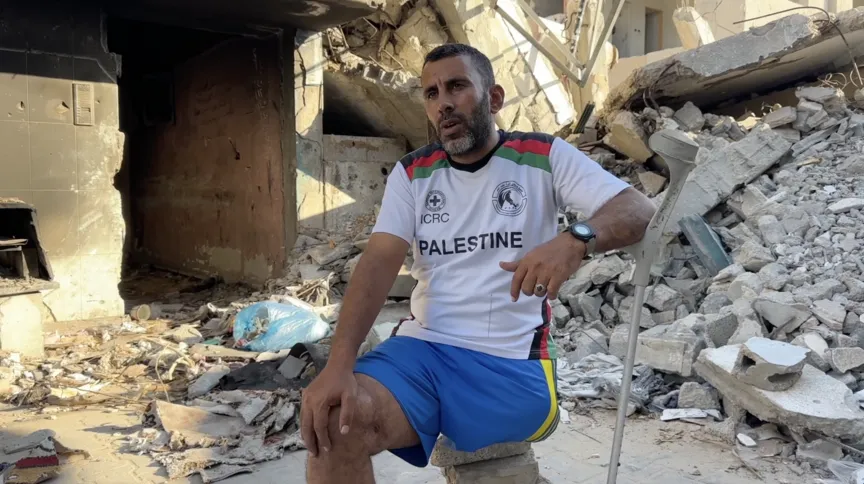
Ahmed Abu Nar, an amputee football player in Gaza, said that Adidas, a company of its size, using an Israeli sniper who participated in the war on the Strip was “a provocative act and a deliberate attempt to whitewash the image of those committing war crimes against civilians.”
Abu Nar, who lost his left leg as a result of direct fire from an Israeli sniper, expressed his astonishment at “using an Israeli soldier to advertise and market this shoe, at a time when it could have used many other people.”
He added: “The company has expertise and specialized teams to study every step, and what happened was not a mere coincidence, but a calculated decision to ignore the victims and celebrate the killer.”
Abu Nar criticized the company’s handling of the controversy and its decision to limit the apology and removal of the advertisement to pages directed only at the Middle East, noting that “the company’s global page did not address the matter.”
Under pressure and amid calls to boycott it, the German sportswear company Adidas apologized Monday through its Arabic-language Instagram account for launching an advertising campaign featuring an Israeli soldier.
The Adidas Arabia account has relatively limited reach, with only 1.4 million followers, a figure that is dwarfed by the more than 29.6 million followers of its global account.
Abu Nar confirmed that he had made a firm decision to boycott Adidas and dispose of all its sports equipment, saying: “This decision is irreversible for us as athletes in Gaza.”
He added: “The company applies double standards, between us being victims and being exposed to death, bombing and destruction at every moment, while on the other hand they said the war had stopped, and to this day it has not stopped. On our way to the field, we are at any moment afraid that a bombing may occur.”
Since Oct. 8, 2023, Israel has been committing genocide in Gaza, leaving more than 73,000 Palestinians dead, more than 174,000 wounded, and destruction affecting 90% of the infrastructure.
Bias toward the occupation
For his part, Hassan Abu Karim, 43, a board member of the Palestine Amputee Football Association, denounced what he described as “racial discrimination and double standards” practiced by global companies in their handling of the Palestinian issue.
Abu Karim, who lost his foot to an Israeli shell in 2006 during an incursion into the Maghazi area, said: “At a time when our association has struggled since its establishment in 2018 to provide the most basic necessities, including shoes and crutches for amputee athletes, we find the global company opening its doors and providing its capabilities and sponsorship to a soldier who participated in massacres against our people.”
“This greatly affects the sporting situation in Palestine, particularly people with amputations who had been waiting for international institutions and companies to sponsor them or stand by their side,” he added.
Abu Karim, a former player for Maghazi Services Club who participated in international sporting initiatives for amputees, explained that it would be more appropriate for global companies to show solidarity with victims living under siege and bombardment and to safeguard the rights of people with disabilities.
He continued: “As an athlete, when I saw this advertisement, it became clear to me that they had ignored the suffering of people with disabilities or amputees in Gaza.”
He considered the use of the Israeli soldier as an advertising figure to be “abhorrent racial discrimination,” calling on Adidas “not to be racist and not to side with the occupation and killing.”
Abu Karim called on Arab and Muslim athletes and sporting institutions around the world to stand alongside Palestinian athletes and confront what he described as “racist policies” through a broad boycott of the company’s products until it “complies with humanitarian values and justice.”
Days after the advertisement was published, criticism escalated across social media platforms as accounts supportive of the Palestinian cause republished images of the campaign, pointing out that Biton had lost his leg while participating in the Israeli aggression against the Gaza Strip in 2021.
Israel’s Channel 15 said posts that recirculated the advertisement received millions of views, while a hashtag calling for a boycott of Adidas spread, accompanied by thousands of calls to boycott the company.
Users compared the Israeli soldier with the thousands of Palestinians whose limbs had been amputated during the genocide, accusing Adidas of ignoring their suffering.
More than 5,000 amputation cases
The figures concerning amputees in the Gaza Strip reveal the extent of the contrast highlighted by Adidas’ critics.
According to World Health Organization estimates issued in May 2026, the Strip recorded between 5,161 and 6,710 limb amputations since October 2023.
The organization indicated that around 43,000 people in Gaza sustained injuries likely to permanently change their lives, including approximately 10,000 children.
It noted that the number of serious limb injuries had reached around 22,000 cases by May, while the total number of injuries at that time had reached approximately 172,000 since Oct. 8, 2023.
In a related context, figures reported by the UN Office for the Coordination of Humanitarian Affairs (OCHA) on Aug. 14, 2026, confirmed that children account for around 18% of amputation cases in Gaza, while specialized rehabilitation services for children are unavailable in the Strip.
The suffering of amputees does not end with the loss of their limbs, as it is followed by a long process of surgical operations, physical therapy, rehabilitation and the search for a suitable prosthetic limb. Anadolu

 CrossFireArabia

 marwan
 Heba
Heba