Lebanon: Women Forced to Deliver on Roads

As the UN Secretary-General touched down in Beirut on Friday in solidarity with the people of Lebanon, UN agencies highlighted the dangers for civilians and particularly pregnant women and migrant workers, amid ongoing airstrikes and rocket fire between Hezbollah fighters and Israel. 

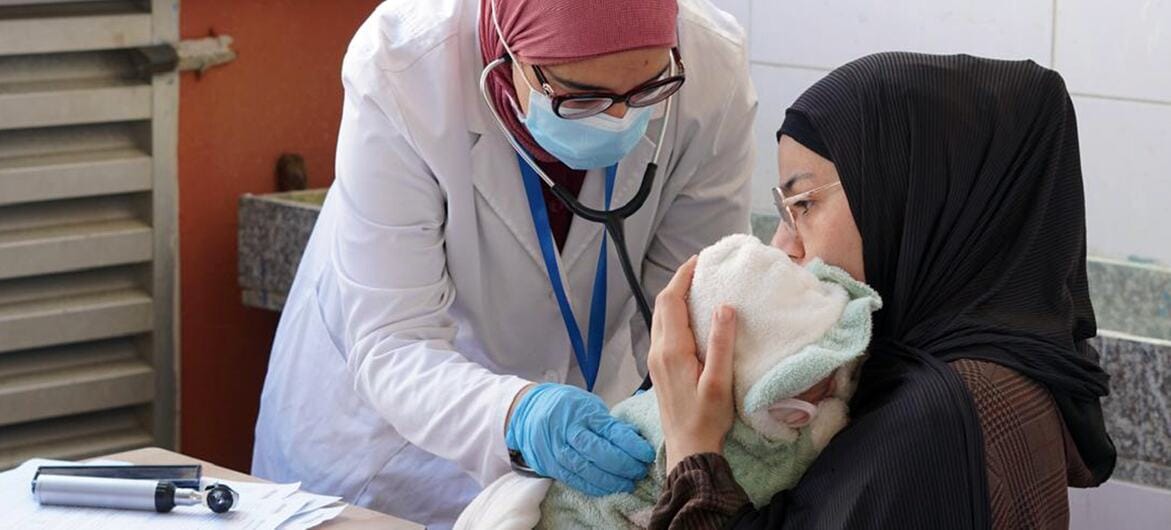
“There’s 11,600 pregnant women who are affected, 4,000 are anticipated to give birth over the next three months,” said Anandita Philipose, Lebanon Representative for the UN population fund, UNFPA

Many of these women have been forced from their homes, cut off from essential health services and forced to give birth in dangerous conditions, some even by the side of the road.”

The situation across Lebanon has escalated dramatically – and notably in the south, Beirut, Mount Lebanon and the Bekaa Valley – since war erupted across the Middle East, sparked by Israeli-U.S. strikes in Iran on 28 February, Iranian counterstrikes in many Gulf States, Hezbollah rocket fire into Israel and Israeli airstrikes in response.

Health care hit

According to UNFPA, 55 hospitals and clinics have been forced to close, either because they are in zones impacted by Israeli mass evacuation orders, “or because there’s been direct damage to them”, Ms. Philipose added.

The UN peacekeeping mission in Lebanon, UNIFIL, has recorded daily rocket, missile and drone attacks on Israel and the occupied Golan from Lebanon and artillery fire, air and drone strikes by Israeli soldiers, who have made “ground incursions up to seven kilometres (4.3 miles) into Lebanon”, said Kandice Ardiel, UNIFIL spokesperson.

Speaking via video from the force’s headquarters in Naqoura close to the Blue Line separating Lebanon from Israel, Ms. Ardiel highlighted a significant escalation on Wednesday evening. That involved more than 100 projectiles “fired from Lebanese territory and over 100 projectiles fired right back from Israel, as well as seven airstrikes within our area of operations”.

Nonetheless, “things have been more quiet yesterday. We haven’t seen so much activity, and I haven’t seen any numbers from today, but I’ll say here in Naqoura, it’s been fairly quiet…nonetheless, it’s a very volatile situation and anything can change at any moment.”

Migrant vulnerability

As the violence continues, the UN migration agency, IOM, warned that more than 822,000 people have been displaced so far inside Lebanon alone, with migrants “particularly vulnerable” and with “nowhere to go”, said Mathieu Luciano, IOM Chief of Mission in Lebanon.  

“Lebanon hosts 200,000 migrants. They come here for work and they’re particularly vulnerable,” he said from Beirut. “They come from Ethiopia, from Sri Lanka, from Kenya, Sudan, Bangladesh and other countries and most of them were working in agriculture, construction, also domestic workers, and the crisis has hit them hard. It left many with nowhere to go and relying on community organizations, churches, their embassies and NGOs for safety.”

According to the UN refugee agency, UNHCR, more than 4.1 million people have been internally displaced in Afghanistan, Iran, Lebanon and Pakistan since the beginning of the escalation.

Help to leave Iran 

Inside Iran, IOM said that it has already assisted migrants to return home from Iran. “We have requests to assist others. Right now, the barrier is resources to be able to do so,” said David John, Director of Movement, Resettlement and Labour Pathways at the agency.

“So far, the numbers that are being mentioned are that some 11,400 Iranians have crossed into Türkiye, while over 24,600 Afghans have returned from Iran back into Afghanistan. Both figures are remaining currently within the daily average crossings,” UNHCR spokesperson Babar Baloch told journalists in Geneva.

The UN agency has found work-arounds to counter supply chain disruption caused by the war. “Despite ongoing airspace closures and many time disruptions, UNHCR has been able to respond quickly,” Mr. Baloch explained. “Essential relief items are pre-positioned across the region, including Termiz in Uzbekistan, strategically close to Iran and several country-level warehouses.” UN News

  • CrossFireArabia

    CrossFireArabia
    Dr. Marwan Asmar holds a PhD from Leeds University and is a freelance writer specializing on the Middle East. He has worked as a journalist since the early 1990s in Jordan and the Gulf countries, and been widely published, including at Albawaba, Gulf News, Al Ghad, World Press Review and others.

    Related Posts

    Israel Kills 200 Lebanese Children – UNICEF

    More than four children have been killed or injured every day on average in Lebanon in the first 25 days of a temporary ceasefire with families still unable to return to their homes, said Save the Children.

    New data from Lebanon’s Ministry of Health on Tuesday showed that 22 children have been killed and 89 injured since the temporary ceasefire started on 17 April. This brings the number of children killed in Israeli strikes since renewed escalation in hostilities in Lebanon on 2 March to almost 200 with about 2,900 people killed.

    The violence and renewed displacement orders have forced more than one million people – or one in six of the population – from their homes with many now living with relatives, in host communities or in collective shelters.

    The number of families living in collective shelters has increased 5% since the conditional ceasefire due to renewed displacement orders by Israeli forces and as families return home to find destroyed houses and damaged farmland so move back the collective shelters. There are now 44,800 children among about 125,000 people in collective shelters.

    Thousands of children have been living in collective shelters for over two months in overcrowded conditions with inadequate water, sanitation and hygiene facilities leading to reports of scabies and growing health concerns.

    Parents are reporting widespread behavioural changes among children living in collective shelters due to a lack of routine and reduced school engagement including loss of appetite and trouble sleeping. Many children are struggling to continue learning with some schools used as collective shelters and also difficulties accessing online learning due to limited electricity, and poor connectivity.

    Tala*, 10, has been living in a collective shelter after being displaced from southern Lebanon, said:

    “I just want the war to end so I can go home to my village and sleep in my own bed. I really miss school, I want to see my teachers and be with my friends, and study and play again.”

    Nora Ingdal, Save the Children’s Lebanon Country Director, said:

    “This ‘so called’ ceasefire that still sees more than four children killed or injured every day is not a ceasefire for children. Attacks on civilians have not stopped – it has simply continued under another name. Colleagues have told me that the airstrikes feel more intense in some areas than they ever did before. Children are not safe until there is a permanent and definitive ceasefire with no violations.”

    With further peace talks set to take place on Thursday to determine next steps between Lebanon and Israel, Save the Children is calling on the international community to urgently work toward a permanent and definitive ceasefire and ensure flexible and sustained funding to protect children and allow families to return home to resume their lives.

    Save the Children has worked in Lebanon since 1953. In collaboration with partners and local authorities, we are distributing essential items in hard-to-reach areas in the south, provide psychosocial support for children, educate families and children about the risks of unexploded ordnance, ensure access to safe water and sanitation facilities, and distribute essential items for those displaced.

    ENDS:

    Sources:

    Lebanon Ministry of Health

    Israeli strikes have killed 380 in Lebanon since truce: Health ministry

    Lebanon Ministry of Health

    Lebanon-Emergency-Sitrep-23-2026.pdf

    Continue reading

    You Missed

    Jordan 2007! Elections and Hiccups: Looking Backwards

    Jordan 2007! Elections and Hiccups: Looking Backwards

    Iran is Writing The Final Chapter!

    Iran is Writing The Final Chapter!

    Gaza Fishermen Dream of Life Prior to 7 Oct

    Gaza Fishermen Dream of Life Prior to 7 Oct

    Giant Phillippines Volcano Shows no Rest!

    Giant Phillippines Volcano Shows no Rest!

    The Chinese Fortune Cookie and The “Thucydides Trap”! A  View From Amman

    The Chinese Fortune Cookie and The “Thucydides Trap”! A  View From Amman

    Israel Kills 200 Lebanese Children – UNICEF

    Israel Kills 200 Lebanese Children – UNICEF