CrossFireArabia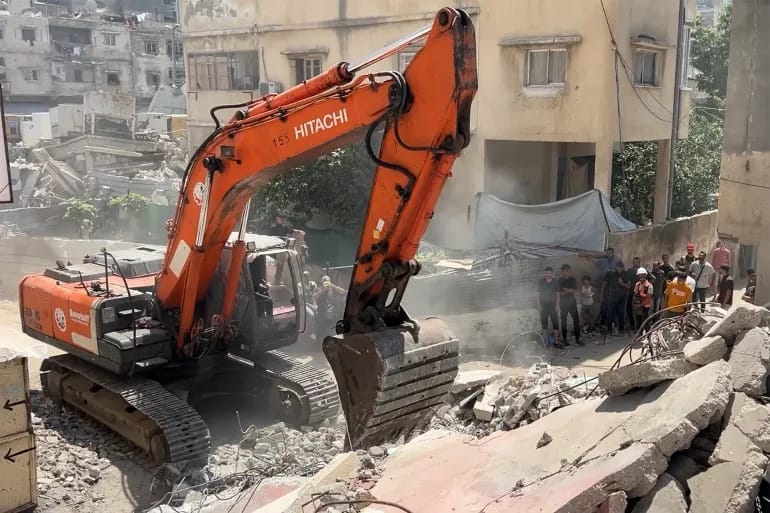
CROSSFIREARABIA – 12-year-old Mohammed Riyad Ghabboun isn’t waiting for a new house atop the rubble of his family’s home in the Sabra neighborhood of Gaza City. Instead, he’s waiting for the remains of family members who have been buried under the rubble for the last eight months, hoping Civil Defense teams will finally dig them up and place them proper graves.
Just steps away, a single excavator is working tirelessly, searching for approximately 8,500 bodies and remains under the rubble of homes destroyed by the Israeli occupation army during its genocidal war on the Gaza Strip. Civil Defense teams, with support from the International Committee of the Red Cross, resumed recovery operations on Saturday with extremely limited resources, amid warnings that continuing at this pace would take years.
The recovery of bodies in Gaza had repeatedly stopped over the past months due to shortages of fuel and heavy equipment.
The last announcement by the civil defense teams in Gaza regarding the recovery of bodies from under the rubble was on 12 May. But this Saturday, its teams began searching for eight missing members of the Ghabboun family at this very spot.
The Israeli war of annihilation on the Gaza Strip, which ended with a ceasefire accord on 10 October, 2015, left more than 73,000 Palestinians dead and over 173,000 wounded. It also caused widespread destruction, affecting approximately 90% of the civilian infrastructure, which exacerbated the limited capabilities of the Civil Defense Department and hampered the efforts of its teams to gain access to thousands of victims trapped under the rubble and huge chunks of debris.
Amid the ruins of the Ghabboun family home in the Sabra neighborhood, Civil Defense teams began their search for the bodies of eight martyrs buried beneath the debris of the house, which was bombed by Israel in October 2025.
Difficult and Slow Operations
Mahmoud Bassal, spokesman for the Civil Defense in Gaza, told Anadolu Agency that the recovery operations are proceeding very slowly due to significant difficulties stemming from a lack of resources and heavy equipment. He added about 8,500 bodies and remains are still buried under the rubble of destroyed homes in many areas of the Gaza Strip, noting there are numerous obstacles hindering the work, including a shortage of equipment and potential field hazards.
“We are issuing a humanitarian appeal to all relevant parties to assume their responsibilities, as the available resources are insufficient to deal with the enormous number of victims and missing persons under the rubble,” he continued.
Basal called for “providing the necessary heavy machinery, excavators, and specialized recovery equipment so that we can completely resolve this issue.”
“Continuing to work at this slow pace will take many years, as we are currently operating with only one excavator, which could break down at any time,” he explained, pointing out that if heavy machinery were provided, “the work would not exceed three months.”
The Civil Defense’s capabilities have been severely damaged in the war, and its available resources now are wholly inadequate for the scale and extent of the destruction in the Gaza Strip. Removing the rubble requires specialized excavators, machinery, and technical teams, he stressed.
That is why the work is so painfully slow and moves haphazardly in fits-and-starts. Under the first phase of the ceasefire agreement in effect in Gaza since October 10, 2015, Israel was supposed to allow the entry of the necessary heavy equipment and machinery, but it has not done so, according to governmental and factional sources in Gaza.
Meanwhile and amidst the search operations, 12-year-old Mohammed Ghaboun stands anxiously awaiting the recovery of the remains of several family members he lost eight months ago.
He, a former survivor of an Israeli airstrike that killed eight members of his family months ago, says, “I have mixed feelings of longing and sadness as the operation to recover the bodies of my family members gets underway.”
“Since the operations started I have been in a state of anticipation and anguish, and I hope that I will be able to see their bodies and bury them in their graves,” he told the Anadolu Agency.
Painful Memories
The absence of equipment not only delays the recovery of bodies but also exacerbates the suffering of the families of the missing, who remain unable to bury their loved ones. Meanwhile, rescue teams face significant difficulties and dangers in the field, particularly at sites of destruction.
For his part, the elderly Youssef al-Zaharneh recalls the moment his house was bombed during the war. “It was sheltering approximately 45 displaced people, mostly women and children,” he recollects.
“The five-story building was bombed without warning, killing some of its residents and injuring others,” Al-Zaharneh told Anadolu Agency, explaining three of his sons were killed in the bombing. “The bodies of two were recovered in pieces, while the third remains missing under the rubble.
As a grieving father, my feelings at this moment are incredibly difficult as I wait for my son’s body to be recovered from under the rubble. All I want is to find a part of his remains or bones so I can bury him and give him a grave I can visit,” he pleads.
“The pain inside me is intense, and I await relief from God,” al-Zaharneh continued.
The volume of rubble resulting from the widespread destruction in the Gaza Strip is estimated at between 50 and 68 million metric tons, according to United Nations estimates and experts.
This enormous amount of rubble covers vast areas of residential and civilian areas, making the search for victims and the recovery of bodies a complex task that could take years, given the limited resources and equipment currently available.
This article, originally appeared in the Palestinian Information Center, is reprinted in crossfirearabia.com