Sea of Tragedy and Life
By Ibrahim Isam
They did not go to the sea in search of pleasure.
They went because water—the simple thing we once turned on at the tap without giving it a thought—had become, somehow, too precious to be spent on the body. Every drop had acquired its own reckoning, every washing its own question, and cleanliness itself had become an act of life.
The sand became the loofah, the sea became the water, and their hands became all that was missing.
A person rubs the sand against their body, not merely to rid themselves of the day’s fatigue, but as though trying to erase from their skin the mark of a heavy age that has clung to it. Then they wash with whatever seawater they can bear, salty or cold, as though the body, after all it has endured, asks no more of life than to be left, for a little while, clean.
Perhaps the sea understands these things better than we do.
It does not ask those who come to it: Who are you? What have you lost? Where have you come from?
It simply takes the body as it is, and washes it.
Since the earliest days, humankind has known water as something more than water. It was seen as a threshold between two states; a small death followed by rebirth, a passage from darkness into another darkness, slightly less deep. In ancient stories, water washed away sin and returned something of its clarity to the soul, until it sometimes seemed that a person did not enter the water merely to cleanse the body, but to remember who they were before life grew heavy upon them.
Here, in the sea of Gaza, the baptism seems to continue.
But this is a baptism without a church, without a priest, without any preserved ritual.
The sea alone is the priest.
And the children are the ones who know the secret.
They enter it as one enters the presence of something before which there is nothing left but silence. They allow the water to pass over their bodies, and emerge carrying the salt of the sea—and something else the camera cannot see: the small, quiet feeling that, despite everything, they are still capable of doing something for themselves.
To wash.
To wipe the dust of the day from their bodies.
To choose, if only for a little while, how they wish to be.
Perhaps this is why the sea in Gaza seems so strange these days; not merely beautiful, but wise.
Like an old man who does not speak much, but knows that however tightly the world may close around a human being, they still need somewhere to return to themselves.
The wave comes and goes.
Then another comes.
And so, since the moment humanity first came to know water, it has repeated the same ritual: washing its hands, its face, its body, and then trying to wash something deeper that water cannot reach.
Memory.
Fear.
The night.
And all that has clung to the soul from days that refuse to end.
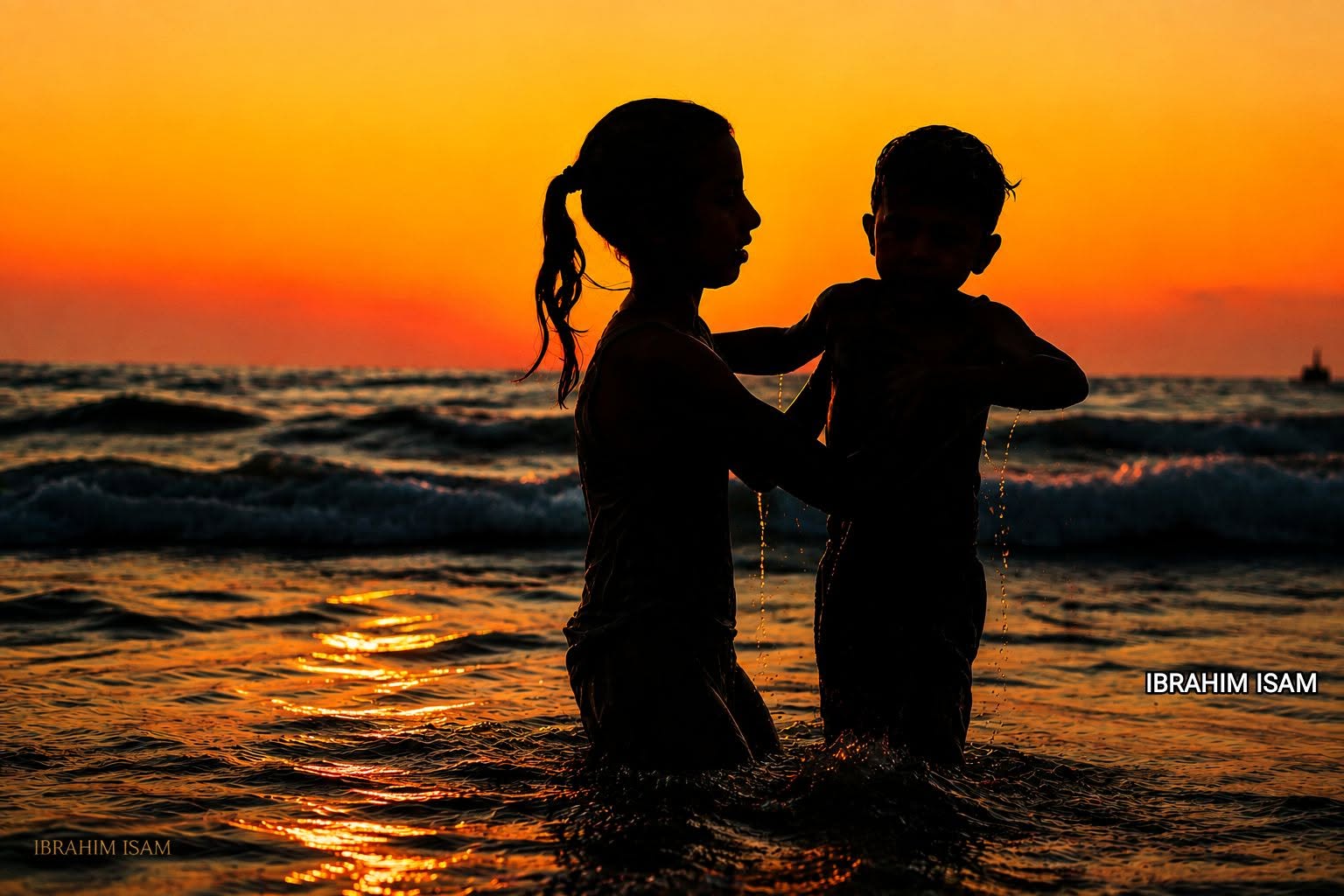
Perhaps this is the secret of the children in the photograph.
They are not merely bathing.
Without knowing it, they are restoring to the world one of its oldest truths: that purity is not always found in the water we possess, but in the desire that makes us search for it.
In a world where water has become a privilege, washing becomes an act of philosophy.
And in an age that seeks to make human beings accustomed to filth, keeping the body clean becomes a quiet form of defiance.
And the sea remains there.
Salty. Vast.
Unable to give them fresh water, yet offering them something they may have needed even before water itself:
the feeling, if only for a moment, that their bodies still belong to them.
And that the sky, despite everything that has happened beneath it, has not entirely closed its door.
That is why I choose to believe that every wave reaching the shore of Gaza carries with it something of the ancient promise:
Wash yourselves, then return to life.
For water does not always save the body.
Sometimes, it is enough for it to remind the body that it is still alive.

 CrossFireArabia

 marwan