Living With The Dead: Gazan Families Forced to Make Homes Among The Graves
In Gaza, even the cemeteries are no longer reserved for the dead.
CROSSFIREARABIA – In Gaza, even the cemeteries are no longer reserved for the dead.
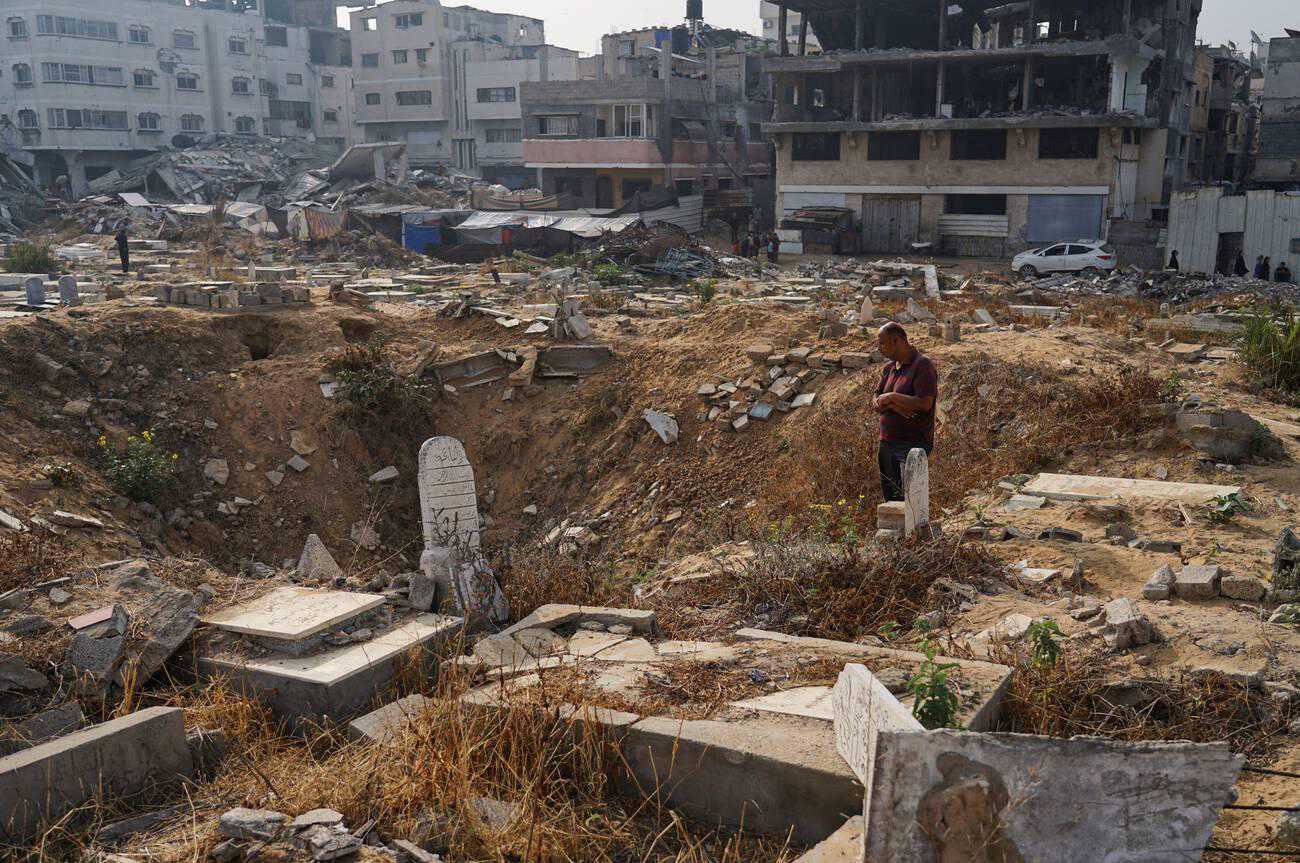
Between headstones and freshly turned earth, Palestinian families have stretched sheets, driven wooden poles into the ground and erected makeshift tents. Children carry water through rows of graves. Mothers cook whatever food they can find beside burial plots. Washing hangs between tombstones. At night, families retreat behind thin pieces of cloth, surrounded by graves because, after repeated displacement, they say there is simply nowhere else to go.
The extraordinary sight is now part of Gaza’s displacement crisis: Living families making temporary homes in places built for the dead.
In Khan Younis, Deir al-Balah and elsewhere in the Gaza Strip, cemeteries and their surroundings have become last-resort shelters for Palestinians whose homes were destroyed or who were ordered to leave areas where they had already sought refuge.
The Palestine Information Center documented the Abu Samak family sleeping on the ground between graves in Al-Sawarha cemetery in Al-Zawayda, central Gaza, after they were forced from their home east of Deir al-Balah. The family said areas to which displaced people had been directed were already packed, leaving them with few choices. Father Adham Abu Samak summed up the family’s predicament with a question heard repeatedly across Gaza: Where are we supposed to go?
Another displaced woman, Ibtisam Abu Amra, told the Palestine Information Center that her family fled from Abu Arif east of Deir al-Balah and eventually ended up in a cemetery in the centre of the city. She described displacement as taking the children, elderly relatives and whatever possessions could be carried and heading towards an unknown destination. When every alternative was exhausted, she said, the cemetery was what remained.
Ten Children Living Among the Graves
One of the clearest recent examples comes from the Al-Namsawi area of Khan Younis.
In July 2026, Al Jazeera documented the family of Mazen Younis, who, with his wife and children, had been living inside a cemetery in the Mawasi area of Khan Younis for around a year and a half.
The family had originally lived in the Al-Manara neighbourhood before successive displacement forced them elsewhere. Eventually they reached the cemetery.
Their “home” consisted largely of fabric screens erected between graves.
There was no normal kitchen, reliable water supply or the basic infrastructure associated with a house. Younis, who suffers from heart disease, relied on his young daughters to bring water to the family, even when the available water was not suitable for drinking.
Instead of attending school, the girls spent part of their day fetching water and walking to a takiyya, or community food kitchen, to collect meals.
Even that food, the family said, was insufficient.
Younis’s wife said there was no cooking gas or many of the other necessities normally found in a household. The children travelled daily for food and water while the family endured the heat, insects and the psychological strain of living surrounded by graves. The report also described rodents and scorpions as part of the family’s surroundings.
It is an existence reduced to its most basic components: Something overhead for shade, something beneath the body for sleeping, a container in which to carry water, and, when available, a pot in which to heat or cook food.
A Tent Becomes the Entire House
Reporting by the Gaza-based Safa News Agency provides another window into what happens when a family’s entire domestic life is compressed into a tent.
Displaced Palestinian Mardai Shahada described the tent as simultaneously the family’s house, bedroom and kitchen — their whole existence confined to cloth and plastic incapable of properly protecting them from the summer heat or winter cold. , Safa, the Palestine Press Agency has documented families patching worn tents with nylon and thread simply to keep some protection between themselves and the weather.
Other Safa reporting describes displaced people sitting beside plastic tents, storing water in buckets and improvising shelters from whatever materials they can obtain. During extreme heat, tents can become almost impossible to remain inside during daytime, while insects and even snakes have been reported around sleeping areas.
Winter presents the opposite problem.
Gaza’s Civil Defence told Safa that 1,542 tents were flooded by rain in just two days around the beginning of January 2025, with water rising above 30 centimetres in some locations. Bedding and personal belongings were soaked and some displaced people suffered severe shivering from the cold.
For families living in cemeteries, these same problems are compounded by the environment around them. There are few proper drainage systems, bathrooms or established water points designed for hundreds of people to live there.
Cooking Beside Graves
Life continues because it has to.
Families collect drinking and washing water in plastic jerrycans and buckets. Food comes from humanitarian assistance when available, community kitchens, relatives or whatever can be purchased at increasingly difficult prices.
Cooking is often improvised.
With kitchens destroyed and fuel scarce, displaced families across Gaza have relied on small fires and makeshift cooking arrangements beside their tents. Safa described families in displacement camps gathering around fires at night during cold weather.
Inside the cemeteries, domestic objects consequently appear in surroundings where they would once have seemed unimaginable: Cooking pots, plastic bowls, mattresses, blankets, clotheslines, water containers and children’s belongings sitting beside gravestones.
A cemetery ceases to function exclusively as a burial ground. It becomes a neighbourhood — but one without the services of a neighbourhood.
Toilets Are Another Problem
Sanitation is among the least visible but most serious difficulties.
There are generally no household bathrooms for families who pitch tents inside or beside burial grounds. Displaced people depend on whatever communal facilities exist nearby, improvised latrines or rudimentary pits.
The shortage of proper sanitation can create another danger.
In July 2026, Al Jazeera reported that a displaced Gaza resident trying to enlarge an absorption pit for wastewater beside his tent in Gaza City’s Sheikh Radwan neighbourhood unexpectedly uncovered the body of a child who had previously been buried there when the area was being used as an improvised wartime burial site.
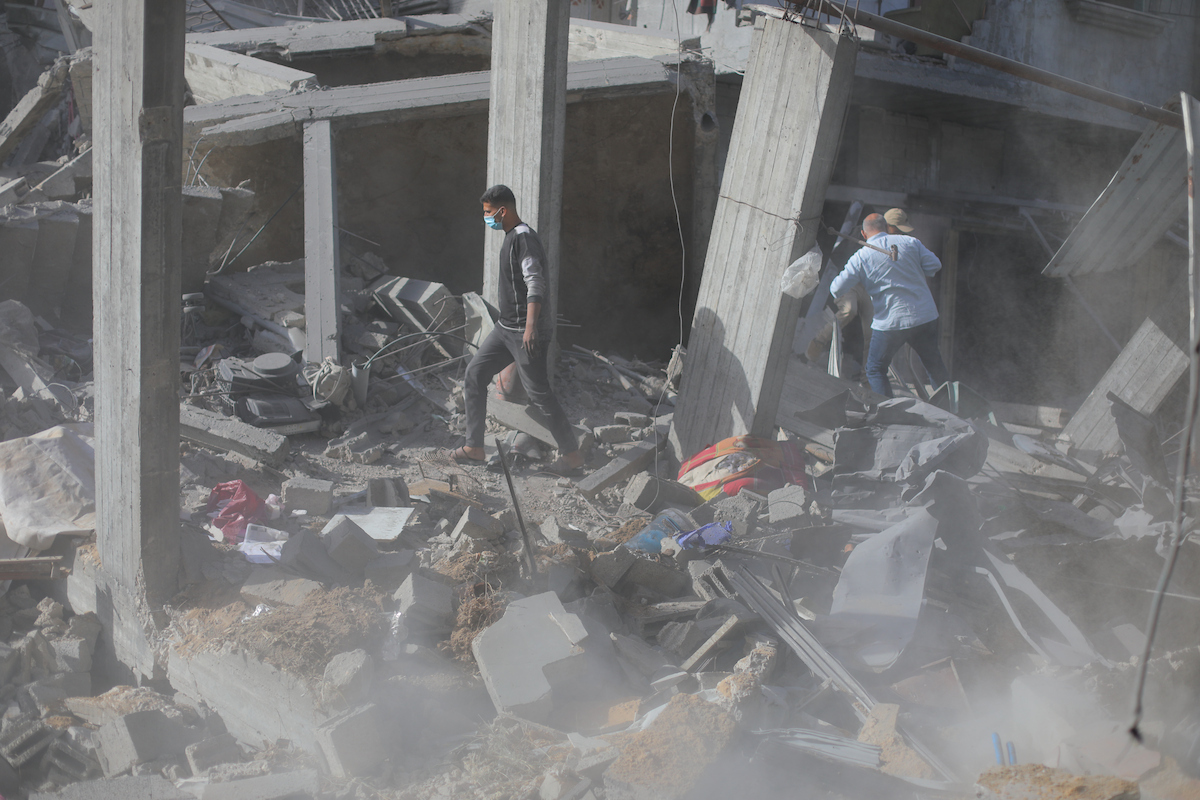
The incident illustrates the extraordinary overlap that has developed between displacement and burial in Gaza: People are sometimes living on land where emergency graves were dug during earlier stages of the war.
Cemeteries Within Cemeteries
The crisis is made more complicated because Gaza’s burial system itself has been transformed.
Sanad News Agency, citing the Euro-Med Human Rights Monitor, reported in September 2024 that around 29 major improvised mass burial locations containing more than 3,000 bodies had been identified, while more than 120 smaller improvised mass graves containing three or more people had been created across Gaza since October 2023.
Sanad has subsequently reported efforts to remove bodies from some of these temporary wartime burial grounds and rebury them in established cemeteries. In December 2025, for example, Gaza Civil Defence said 94 bodies were removed from an improvised cemetery in Sahaba Street in Gaza City as part of a wider effort that had involved moving the remains of thousands of people previously buried in emergency locations.
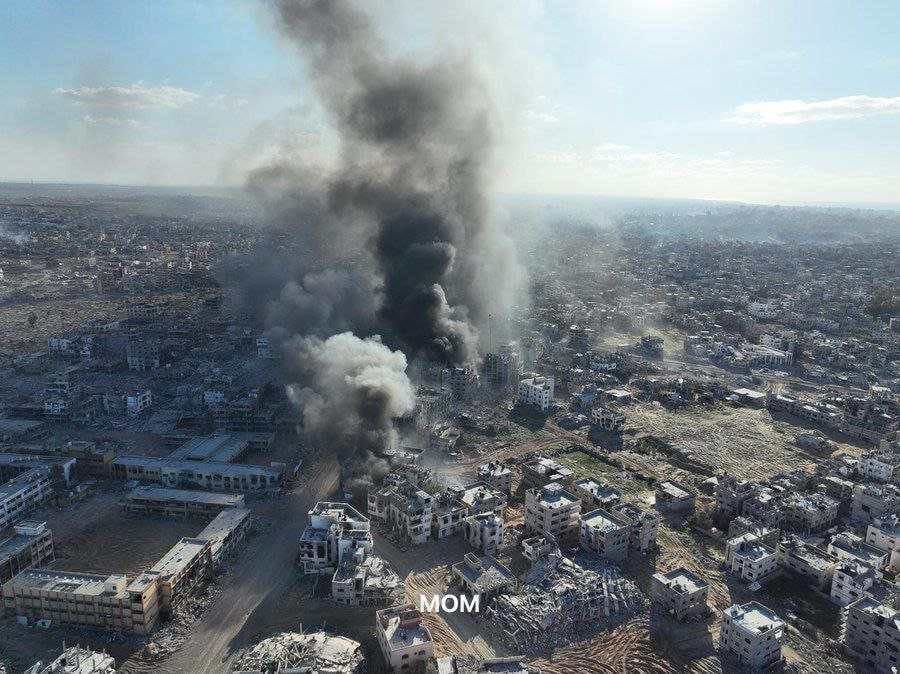
The result is a landscape in which the distinction between residential space, displacement camp and burial ground has repeatedly been erased.
Hundreds of Families Around One Khan Younis Cemetery
There is no reliable, comprehensive figure for how many Palestinians are currently living inside cemeteries across the entire Gaza Strip. Numbers vary according to location and repeated displacement, and families may enter or leave a site after evacuation orders, attacks or changes in military control.
It would therefore be misleading to put forward one precise Gaza-wide number.
What can be documented, however, is that the phenomenon extends well beyond a handful of isolated families.
The Palestine Information Center reported that an area around the Turkish cemetery west of Khan Younis contained hundreds of displaced Palestinian families. During an Israeli military incursion in July 2025, many fled again, leaving behind fragile tents and small quantities of food and possessions. The same report described torn tents, scattered belongings and burned food after the troops withdrew according to the Palestine Information Center.
Al Jazeera reported in July 2026 that hundreds of displaced families had erected tents in and around cemetery areas in Khan Younis, while its correspondent referred more broadly to thousands of families being driven towards cemetery areas during successive waves of displacement.
The distinction is important: Hundreds of families have been specifically documented at individual cemetery locations, but there is no authoritative census establishing the total number of people sleeping in cemeteries throughout Gaza.
Even the Cemeteries Are Not Safe
Seeking shelter among graves does not guarantee protection.
In July 2025, the Palestine Information Center reported an Israeli ground incursion around the Turkish cemetery, slaughterhouse area and outskirts of Mawasi in Khan Younis. Tanks, artillery and bulldozers entered an area where hundreds of displaced families had been sheltering, forcing people to flee once again. Residents later returned to find tents destroyed and possessions scattered.
The same report cited Gaza’s Ministry of Religious Endowments as saying around 40 cemeteries had at that stage been completely or partly damaged during the war. More recent reporting by the Palestine Information Center, citing Euro-Med Human Rights Monitor, said in March 2026 that its analysis of 62 official cemeteries found 39 completely destroyed and another 19 partially damaged, leaving only four without documented damage — figures attributed to the rights organisation.
That makes the choice of a cemetery as shelter particularly bleak.
Families do not move there because they believe a graveyard is comfortable or safe. They move there because a cemetery may contain one of the few remaining pieces of ground on which nobody is demanding rent and where a tent can still be squeezed between other displaced families.
Living Beside Death
For adults, living among graves carries its own psychological burden.
For children it can be worse.
They play where bodies are buried. They walk between graves to fetch drinking water. After sunset, darkness, stray dogs, insects and the presence of the dead can turn the surroundings frightening.
Yet by morning the ordinary routines begin again.
Someone searches for water.
Someone goes to the community kitchen.
A mother washes clothes or dishes with the small amount of water available.
A fire is lit.
Children emerge from tents.
Blankets and mattresses are rearranged.
And families who once lived in houses try to reproduce the smallest elements of home in a place never intended for the living.
Gaza’s cemetery dwellers are therefore not simply another image of displacement. They represent something more disturbing: The exhaustion of alternatives.
When homes disappear, schools become shelters, shelters are overcrowded or attacked, rent is unaffordable and every supposedly safer area fills with tents, eventually even land belonging to the dead becomes valuable living space.
For some Palestinians in Gaza, the question is no longer whether anyone should have to live in a cemetery.
It is much simpler.
Where else can they go?
The above feature article is written with the help of AI based on specific information fed about Gazans being forced to seek shelter in cemetries. It’s posted on crossfirearabia.com with full links and references.

 CrossFireArabia