CrossFireArabia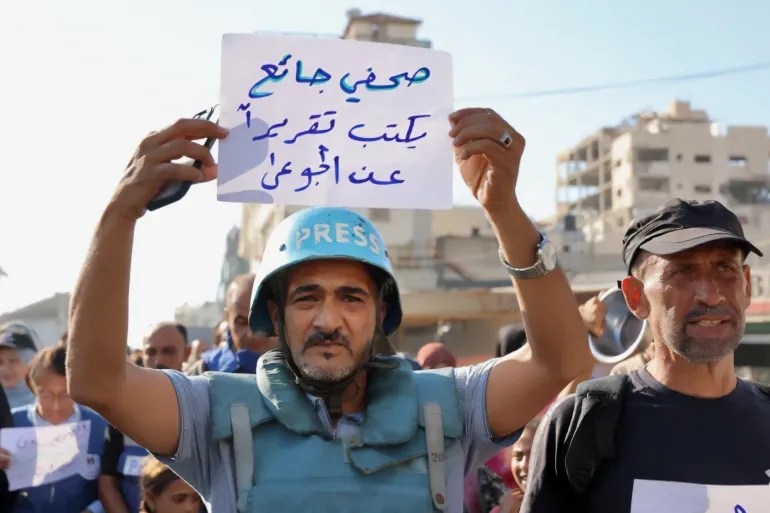
Agence France-Presse (AFP) expressed fear its correspondents in the Gaza Strip may starve to death amid the catastrophic conditions of suffering Palestinians in the Strip amidst the Israeli war.
The agency said in a statement on its X platform: “We have been working with a freelance copywriter, three photographers, and six freelance videographers in the Gaza Strip since the departure of its permanent journalists in early 2024.”
The agency, founded in 1944, added: “Today, they, along with a few others, are the only ones still covering what is happening inside the Gaza Strip, after international media outlets were banned from entering the territory for nearly two years.”
The French news agency explained Bashar, who worked with the agency since 2010, “started as a field assistant, then as a freelance photographer, and since 2024 has become the main photographer.” The agency added on Saturday, July 19, he managed to post a message on Facebook saying: “I no longer have the strength to work in the media. My body is thin and I can’t work anymore.”
Bashar, 30, works in conditions similar to those of all Gazans, moving from one refugee camp to another depending on the Israeli bombardment.
“For more than a year, he has been living in abject poverty and continues his work amid grave risks.” AFP added “hygiene has become a major problem for him. He suffers from severe diarrheal illnesses, and since February, he has been living in the ruins of his home in Gaza City with his mother, his four brothers and sisters, and the family of one of his brothers.”
The Agency continued: “His house is devoid of furniture, electricity, and water, and he lives on what some of his relatives provide. On Sunday, he reported that his older brother had fallen due to… Hunger.”
Although these journalists receive a monthly salary from the French agency, it barely covers, or does not cover, the skyrocketing market prices. The banking system is broken, and the intermediary who transfers funds from foreign accounts to the Gaza Strip takes a commission of nearly 40%.
The agency explains that it “cannot provide its team with equipment or even enough fuel to travel to do their work,” noting that “traveling by car is tantamount to risking becoming a target for Israeli airstrikes.” Therefore, its correspondents travel “on foot or on donkey carts.”
Ahlam, for her part, confirms that “the biggest problem she faces is the lack of food and water.” The journalist, who lives in the southern Gaza Strip, adds: “Every time I leave the tent to cover an event, conduct an interview, or document an incident, I don’t know if I’ll return alive.”
We see them collapsing.
The agency says: “They are young and their strength is fading, and most of them no longer have the physical ability to move within the Gaza Strip to do their work. Their calls for help, torn apart, have become daily.”
She adds: “A few days ago, we realized from their text messages that their strength was no longer sufficient, that they were no longer even able to deliver news to us, so let them tell you the truth from there.”
Bashar is quoted as writing, Sunday: “For the first time, I feel defeated. More than three years of hell, and we no longer find the words to explain to the world that we live daily between death and hunger. I hope that Mr. Macron will help me escape this hell.”
His colleague Ahlam says: “I am trying to continue my work, to give a voice to the people, to document the truth despite all attempts to silence it.” Resistance is not an option, but a necessity.
More than 225 journalists have been martyred in Gaza since the beginning of the Israeli aggression on October 7, 2023, as part of the Israeli occupation’s plans, using all means at its disposal, to obscure the truth, change the image, and prevent foreign journalists from entering Gaza.
Since its founding in 1944, Agence France-Presse, despite its permanent presence in conflict zones, has not witnessed the death of any of its employees from starvation.
The Ministry of Health in Gaza confirmed that the Israeli starvation policy has led to the deaths of more than 900 Palestinians—including 71 children—due to hunger and malnutrition, in addition to 6,000 wounded among those seeking a livelihood since the beginning of the Israeli war of extermination on the Gaza Strip.
Palestinian and international organizations have warned that the Gaza Strip is currently experiencing the worst stages of famine as a result of the Israeli starvation policy as reported in Jo24.


 marwan