Arabs Condemn Netanyahu’s Comments

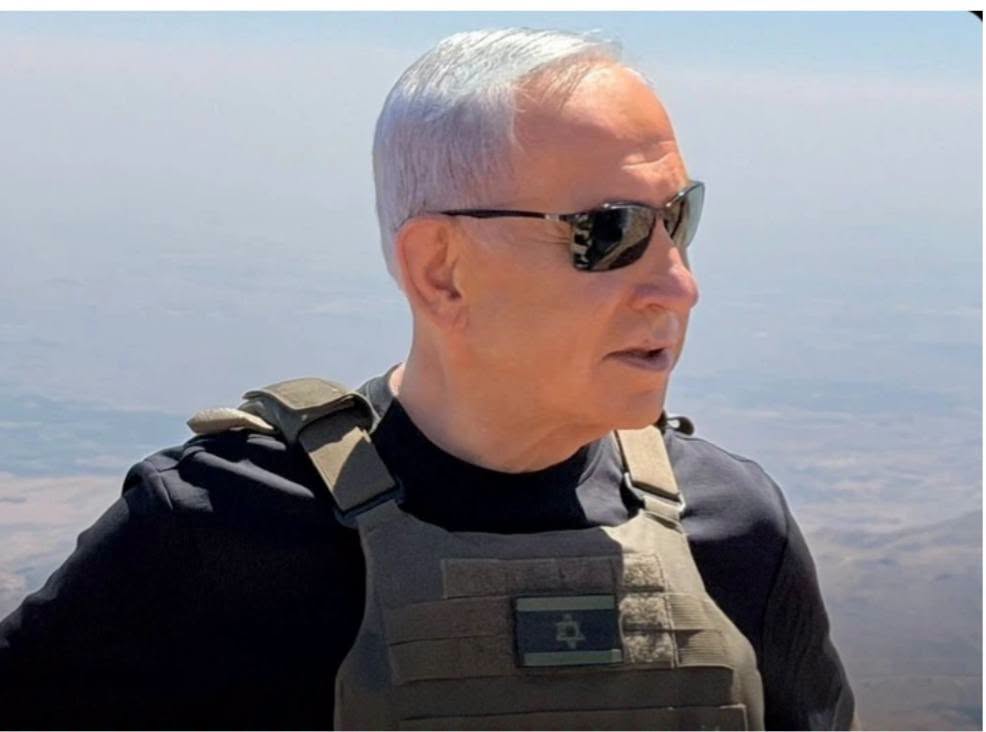
Several Arab countries on Wednesday denounced remarks by Israeli Prime Minister Benjamin Netanyahu that he is attached to the vision of a “Greater Israel,” calling them a “threat to the sovereignty of states.”

Netanyahu told news channel i24 on Tuesday that he feels “very attached” to the vision of a Greater Israel. He said he considers himself “on a historic and spiritual mission” which “generations of Jews that dreamt of coming here and generations of Jews who will come after us.”

Greater Israel is a term used in Israeli politics to refer to the expansion of Israel’s territory to include the West Bank, Gaza and Syria’s Golan Heights, with some interpretations also including Egypt’s Sinai Peninsula and parts of Jordan.

In a statement, Egypt asked for clarifications about the comments, as “they fuel instability and show rejection of peace in the region.”

The comments “contradict the aspirations of regional and international parties that value peace and seek to achieve security and peace for all the peoples of the region,” a Foreign Ministry statement said.

“The only path to peace is through a return to negotiations and ending the war on Gaza, leading to the establishment of a Palestinian state.”

The Jordanian Foreign Ministry called Netanyahu’s comments “a dangerous and provocative escalation, a threat to the sovereignty of states, a violation of international law and the UN Charter.”

“These delusional claims, which are reflected in the statements of Israeli officials, will not affect Jordan and the Arab states and will not diminish the legitimate and inalienable rights of the Palestinian people,” it added in a statement.

“These claims and delusions adopted and promoted by the extremists of the Israeli government encourage the continuation of cycles of violence and conflict” in Gaza and the West Bank, the ministry said.

Jordan called on the international community to take immediate action to stop Israel’s “provocative measures and statements that threaten the stability of the region and international peace and security.”

The Palestinian Authority called Netanyahu’s comments “a disregard of the legitimate rights of the Palestinian people” and “a dangerous provocation and escalation that threatens the security and stability of the region.”

It reaffirmed its commitment to the international principles regarding the establishment of an independent Palestinian state based on the 1967 borders with East Jerusalem as its capital.

Yemen’s Foreign Ministry in a statement described the remarks as “a blatant violation of international legitimacy resolutions and international law, and a clear challenge to the will of the international community.”

The ministry warned that “the continuation of these Israeli policies would push the region toward further tension and instability.”

Serious threat

Qatar’s Foreign Ministry decried the remarks as “an extension of the (Israeli) occupation’s approach based on arrogance, fueling crises and conflicts and blatantly infringing on the sovereignty of states, international law.”

The ministry affirmed Qatar’s full support for “all efforts aimed at achieving a just, comprehensive and sustainable peace in the region.”

The Saudi Foreign Ministry rejected the “expansionist ideas and projects” pursued by Israeli officials and reaffirmed “the historical and legal right of the brotherly Palestinian people to establish their independent, sovereign state on their lands.”

In a statement, the Arab League denounced Israel’s “aggressive and expansionist tendencies,” calling it “a serious threat to collective Arab national security,” according to Anadolu.

The Organization of Islamic Cooperation (OIC) stressed in a statement that the statements “are an attempt to evade Israel’s international obligations as the occupying power and to continue violating the legitimate rights of the Palestinian people, foremost among them their right to self-determination and to establish an independent state on the 1967 borders with East Jerusalem as its capital.”

It warned “of the dangers of this colonial, expansionist rhetoric, which poses a threat to regional and international peace and security, fuels the cycle of violence, and prolongs and expands the conflict in the region.”

The Palestinian group Hamas said Netanyahu’s comments “clearly underscore the danger this fascist entity poses to all the countries and peoples of the region and its expansionist plans that spare no state.”

The Israeli army has pursued a brutal offensive against Gaza since October 2023, killing over 61,700 Palestinians, almost half of them women and children.

The International Criminal Court issued arrest warrants last November for Netanyahu and his former Defense Minister Yoav Gallant for war crimes and crimes against humanity in Gaza.

Israel also faces a genocide case at the International Court of Justice for its war on the enclave.

  • CrossFireArabia

    CrossFireArabia

    Dr. Marwan Asmar holds a PhD from Leeds University and is a freelance writer specializing on the Middle East. He has worked as a journalist since the early 1990s in Jordan and the Gulf countries, and been widely published, including at Albawaba, Gulf News, Al Ghad, World Press Review and others.

    Related Posts

    Israeli Army: 18 Soldiers Dead, 910 Injured in Lebanon

    The Israeli army revealed, Tuesday, its total casualty figures in the ongoing battles with the resistance movement in southern Lebanon since fighting resumed in 2 March, 2026

    The army reported in an official statement that the deaths of 18 officers and soldiers, along with 910 that were wounded, during the continued clashes in southern part of the country and as reported by the the Palestinian Information Center.

    The fierce battles in south Lebanon have been unexpected because of their intensity. The Israeli army noted that 190 officers and soldiers were wounded just in the past two weeks; it specified that 114 soldiers sustained moderate injuries, while 52 others were in serious condition.

    However, the Israeli army put on a stiff upper lip. It claimed to have destroyed Hezbollah missile launchers, which it said were aimed at occupied Palestine and its forces were in forward deployment mode in southern Lebanon.

    It also claimed to have killed 15 Hezbollah members, alleging they posed a “threat” to its forces, and announced the discovery of a weapons cache in the town of Rashaf, according to its statement released Tuesday evening.

    The Israeli occupation army continues its intensive attacks on Lebanon as part of an ongoing aggression that has resulted in thousands of martyrs and wounded, in addition to the displacement of more than 1.6 million people.

    Despite the fragile ceasefire that came into effect on April 17, the occupation forces continue their incursions into southern Lebanon, along with carrying out systematic demolitions and destruction of homes and buildings, and forcibly displacing residents from dozens of villages, under the pretext of targeting what they describe as “military infrastructure and Hezbollah elements.”

    Continue reading
    Watch Out: Israel is Secretly Filling The West Bank With Settlements

    DEIR AMMAR, Occupied West Bank—Mustafa Badaha drove along the edge of his land, past rows of olive trees he could no longer access. A red string put up by Israeli settlers demarcated the border of what was stolen from him in Deir Ammar, a Palestinian town around 17 kilometers northwest of Ramallah in the occupied West Bank. The settlers had recently established a new outpost in the area named Ramataim Zofim.

    “Everything is legal—I have permits—but it makes no difference. A settler comes and simply says, ‘This is my land. You have no place here,’” Badaha told Drop Site. For years, he cultivated the land, building a small summer home where his family would gather. “Now, no one can go there—if we try, we are attacked,” he said. “What was once my joy is now my greatest fear.”

    A red string put up by Israeli settlers on Mustafa Badaha’s land in Deir Ammar in the occupied West Bank demarcating the land they took over. April 30, 2026. Photo by Naqaa Hamed.

    Settlers began routinely attacking Palestinians in the area back in August 2025. “They came here armed, created problems with the youth and the families, and even fired live ammunition,” Badaha said. He contacted the Palestinian Authority, who reached out to Israeli authorities. “The attacks kept increasing day after day. At first, the settlers were about 500 meters away, then gradually they kept getting closer until they reached the houses,” he said. “Every day there are provocations. They block the road, and with the youth we reopened it several times. Recently, there was another major attack and they blocked the road again.” After contacting the Israeli police, the Israeli military eventually arrived and detained Palestinians from the community instead of the settlers.

    “The youth were insulted, detained for over an hour, searched, and had their IDs checked. I asked the officer, ‘What are we supposed to do? You tell us not to react, but settlers are the ones attacking,’” Badaha exclaimed. “We are living under constant attacks. This is our home, our land—we have water, electricity, internet—everything. Yet there is no safety.”

    Ramataim Zofim is one of 34 settlements secretly approved by the Israeli security cabinet in late March, a decision that was only revealed in Israeli news reports last month. It marked the largest number of settlements approved by any Israeli government at one time. The decision to officially approve new settlements or to legalize outposts allows for the establishment of water and electricity infrastructure, further entrenching their presence on Palestinian land.

    The 34 new settlements established by the Israeli security cabinet join 68 settlements the current government has approved since its formation a little over three years ago. By comparison, only six new settlements were formally approved by Israel in the 30 years between the signing of the Oslo Accords in 1993 and the establishment of the current government. Over the past three decades, thousands of additional housing units have been approved within existing settlements, like Ma’ale Adumim which lies just east of Jerusalem and is home to up to 40,000 Israeli settlers.

    “This represents an unprecedented pace and scale of expansion,” Amir Daoud, director of Publishing and Documentation at the Colonization and Wall Resistance Commission, told Drop Site. Until the establishment of the current Israeli government there were 127 official settlements in the West Bank, according to the Israeli group Peace Now. Adding over 100 new official settlements represents an increase of nearly 80%.

    “These new sites are distributed across the West Bank in what can be described as a fragmented but comprehensive pattern, effectively targeting the entire territory,” Daoud said. “Overall, this wave of approvals reflects a clear race against time to impose as many facts on the ground as possible, in order to achieve long-standing strategic goals.”

    A map of the 34 newly approved Israeli settlements approved in March 2026. Credit: Peace Now.

    All 34 of the new settlements are located in Area C, a technical designation established under the Oslo Accords that divided the West Bank into three sections. Area A is technically under Palestinian civil administration and security control; Area B is under Palestinian civil administration but shares security control with Israel; and Area C is under full Israeli control.

    The International Court of Justice, UN Security Council resolutions, and international law experts agree that all Israeli settlements in the occupied West Bank are illegal under international law.

    “Consistent with long-standing settlement policy, these new sites contribute to the fragmentation of Palestinian areas while simultaneously creating territorial continuity between settlements,” Daoud said. “This is especially evident in central parts of the West Bank, where settlement placement further disrupts Palestinian geographic cohesion.”

    Five of the newly approved settlements are in the governorate of Al-Khalil (Hebron) in the south of the territory and home to the largest Palestinian city in the West Bank. One of the settlements, which lies southwest of the city of Al-Khalil, named Meged, has affected land that Fahed Qawasmi and his family have cultivated for generations.

    “My sister and I lost about three dunams [about 0.75 acres] of our land,” Qawasmi told Drop Site. “We only realized what was happening from neighbors—they had already taken around 300 to 400 dunams [about 74 to 100 acres] before reaching our land…We rushed there, but settlers attacked my brother on the land.”

    The establishment of a new settlement has geographical ripple effects far beyond the actual settlement itself. “If a settlement is built, it won’t just take the land it stands on. It will expand around it, turning the surrounding areas into closed military zones,” Qawasmi said. “That means more land lost, more restrictions, and no access—not just for us, but for nearby homes and fields as well.”

    Qawasmi said that grapevines more than 100 years old and police trees planted by his father were all uprooted. “This land is extremely valuable to us—not in money, but because it was passed down through generations. My father inherited it from his father, and so on. We were even offered to sell it before, but we always refused. This land is not for sale,” he said. “To lose it like this, without any right, is devastating. It destroys you emotionally.”

    In the north of the West Bank, six of the newly approved settlements form a semi circle around Jenin, surrounding the Palestinian city from the west, south, and east.

    “The land involved here is around 500 dunams [around 123 acres], and what’s happening now—through road construction and gradual takeover—means this entire area could effectively be confiscated,” Mohammad Arqawi, the head of the village council of Al-Arqah village in Jenin, told Drop Site. “And when 500 dunams are affected, it doesn’t just impact one group. It affects farmers, traders, workers, shepherds—the entire local community.”

    A staggering 40,000 Palestinians have been displaced across the West Bank since the beginning of 2025 by demolitions, settler attacks, and access restrictions, according to a statement by the Deputy Spokesman for the UN Secretary-General Farhan Haq. Meanwhile, violence by Israeli settlers and soldiers against Palestinians in the West Bank and East Jerusalem has skyrocketed to unprecedented levels. According to the United Nations, between October 7, 2023 and April 23, 2026, at least 1,088 Palestinians—including 238 children— have been killed. Forty-two of them have been killed since the beginning of 2026. The UN said that the first four months of 2026 have seen the most violent start to a year since monitoring of settler violence and harassment began in 2013.

    “This is just the beginning—the impact will grow,” Arqawi said. “Every time settlers attack, the army is present. The situation has become almost routine—settlers and army operating together on a daily basis.”

    * Sharif Abdel Kouddous contributed to this report which is published in the Drop Site website

    Continue reading

    You Missed

    An Egyptian House in a German Town

    An Egyptian House in a German Town

    Nakba Art

    Nakba Art

    Palestinian Population Tops 15.5 Million

    Palestinian Population Tops 15.5 Million

    ‘All I Want is to Bury My Family in Dignity’  

    ‘All I Want is to Bury My Family in Dignity’  

    Israeli Army: 18 Soldiers Dead, 910 Injured in Lebanon

    Israeli Army: 18 Soldiers Dead, 910 Injured in Lebanon

    Watch Out: Israel is Secretly Filling The West Bank With Settlements

    Watch Out: Israel is Secretly Filling The West Bank With Settlements