Art, Dark Satire, and a Voice For Palestine

Erkul’s illustrations blend satire with activism, highlighting injustice of the Palestinians. Whether addressing war, disaster, or political hypocrisy, Erkul’s art amplifies the voices of the silenced.

Yusuf Kamadan

By Yusuf Kamadan

A slice of watermelon pierced by knives. A faceless figure in a suit, draped in the American flag, steering a cart off a cliff and into the flames. A set of scales, balancing Hitler on one side, Netanyahu on the other. A shapeless globe, caught in the grip of a monstrous, many-limbed octopus.

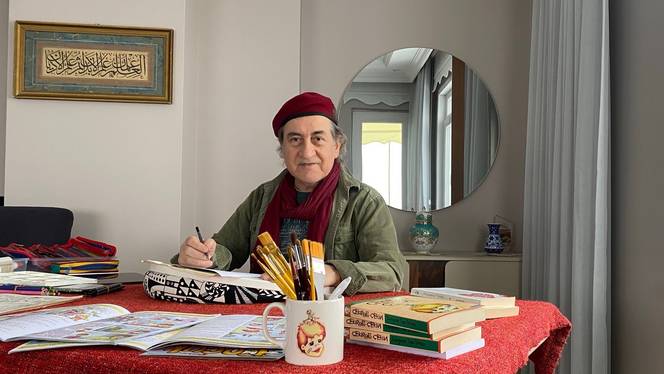
These are the unmistakable images of Muammer Erkul, the Turkish illustrator and journalist whose work—at once bold, unflinching, and darkly satirical—has spread widely across the social media. His drawings do not whisper; they speak loudly.

The satire is biting, but the implications are serious. At a time when many artists sidestep controversy, wary of political consequences, Erkul embraces it.

“I have an idea and I want to convey it to the other party. I want to pass on my feelings. One of the most effective ways to do this is to draw a cartoon,” he says.

His illustrations have become a kind of visual journalism, a counter-narrative to the political abstractions that often obscure the human cost of war.

With sharp lines and unflinching commentary, Erkul captures the resilience of Palestinians amid oppression.

Since the 1970s, Erkul has carved out a space for himself in Turkish newspapers and magazines, his work known for its wit, precision, and unrelenting social critique.

His drawings do not merely document suffering; they bear witness.

Scenes of bombed-out homes, grieving mothers, children clutching stones — his work captures the devastating realities of occupation while also portraying the quiet, stubborn resilience of a people who refuse to be erased.

“Millions of Palestinians have lost everything — their homes, their families, their lives,” Erkul says. “More than 150,000 bodies have been destroyed, and 50,000 of them have been martyred—most of them children and women.”

His words, much like his art, do not flinch from the brutal arithmetic of war. Beyond his artistic talent, Erkul has always used his work as a platform to address important issues.

Erkul’s art merges satire with activism, amplifying the voices of the oppressed through powerful imagery.

Why cartoons?

For Erkul, caricature is more than just a humorous art form; it is a means of resistance.

“Caricature is the easiest and most effective way to explain some things,” Erkul says. “A cartoon is drawn in a day and understood in an instant. It’s like the longest-range missile, and it sticks to its target.”

In an age of social media, where information moves at a breakneck pace, this immediacy is crucial. A single drawing, shared widely, can cut through the noise in ways that editorials and essays often cannot.

“I have an idea, and I want to convey it,” he says simply. “One of the most effective ways to do this is to draw a cartoon.”

Erkul has long been engaged in magazine publishing, serving as the editor-in-chief of Divanyolu, a cultural and literary magazine, until 2018.

Following the devastating 2023 earthquake, he shared his artwork on social media and made it freely available to magazines, believing that art can serve as a powerful tool for remembrance.

Reflecting on the disaster, Erkul described it as one of the most catastrophic earthquakes in history, emphasising its unprecedented scale and impact.

He recalled the initial shock and fear that gripped him, along with the overwhelming sense of helplessness. Wanting to contribute in a meaningful way, he turned to his art, realizing that while the disaster would eventually fade from public memory, visual documentation could ensure that future generations would not forget.

Early in his career, his cartoons blended humor with cultural commentary, but over time, his focus sharpened, his pen increasingly turned toward the struggles of the Palestinian people.

A single cartoon can convey what words cannot — Erkul’s work strikes at the heart of injustice with visual precision.

“Art is not neutral; it must take a side”

Erkul is not just chronicling injustice, he is building solidarity.

His illustrations are not just critiques; they are rallying cries. Erkul’s work does more than capture the suffering of Palestinians — it interrogates the machinery that sustains it.

His cartoons often expose the uneasy entanglements between Western nations and Israeli aggression.

“Everyone knows the closeness of the US and Israel,” he says. “But never in any period of history has this secret game been played so openly. It’s a chicken-and-egg story — an Israeli egg hatches from an American chicken, an American chick hatches from an Israeli egg, grows up, and lays Israeli eggs again.”

He believes artists have a responsibility to engage, to use their platforms to amplify the struggles of the voiceless. In his view, art is not neutral. It must take a side.

For Erkul, that side has always been clear: art is not just a means of entertainment; it is an act of defiance against injustice.

Art is not neutral; Erkul uses his pen as a tool of defiance against global injustice.

In his view, every artist has a responsibility to stand for justice and use their craft to fight against oppression.

His work is particularly significant in an era where digital media spreads messages rapidly, ensuring that his depictions of Palestinian suffering and resilience reach a global audience.

His legacy is not just one of artistic achievement, but of moral conviction.

His pen, like the voices of Palestinian poets, filmmakers, and musicians, is a tool for preserving memory, for fighting erasure. He firmly believes that the more artists engage with these issues, the stronger the message becomes.

“The more cartoonists and artists we have, the stronger our ideas will be,” he says.

TRTWorld

CrossFireArabia

CrossFireArabia
Dr. Marwan Asmar holds a PhD from Leeds University and is a freelance writer specializing on the Middle East. He has worked as a journalist since the early 1990s in Jordan and the Gulf countries, and been widely published, including at Albawaba, Gulf News, Al Ghad, World Press Review and others.

Related Posts

Top Writer Says ‘No’ to Berlinale

Top Indian writer Arundhati Roy has pulled out of the Berlin International Film Festival (Berlinale) after criticizing “unconscionable statements” by members of the festival jury, who said that art should not be political when asked about the Israeli genocide in Gaza.

Roy had been scheduled to attend a screening of her 1989 film In Which Annie Gives It Those Ones in the Classics section of Berlinale 2026.

In a strongly worded statement, Roy said the selection of the film had initially filled her with warmth and nostalgia. She noted that she had long felt disturbed by the positions of the German government and several cultural institutions on Palestine. Still, she said she had consistently received solidarity from German audiences when speaking about Gaza, which encouraged her to consider attending the festival.

However, Roy said she changed her decision after hearing comments from members of the Berlinale jury earlier that day.

“Like millions of people across the world, I heard the unconscionable statements made by members of the jury of the Berlin film festival when they were asked to comment about the genocide in Gaza,” Roy wrote.

She described labeling the genocide a political issue then insisting that art should remain separate from politics as “jaw-dropping.” She added that such framing shuts down urgent conversations about a crime against humanity.

Roy stated clearly in her message that she believes events in Gaza amount to genocide against Palestinians by Israel. She further added that the United States and Germany, along with several European governments, support and fund Israel and therefore share responsibility.

“If the greatest film makers and artists of our time cannot stand up and say so, they should know that history will judge them,” she wrote, adding that she felt “shocked and disgusted.”

Roy concluded her statement by confirming that, “with deep regret,” she would not attend the Berlinale.

The controversy emerged after journalists asked Berlinale jury members to comment on the genocide in Gaza and Germany’s support for Israel, which also funds the festival.

Polish producer Ewa Puszczyńska, a member of the jury, refused to answer.

“There are many other wars where genocide is committed, and we do not talk about that,” Puszczyńska said. She described the issue as “complex” and claimed that it was unfair to ask jury members to comment on government policies.

Roy’s withdrawal adds to rising tensions within European cultural spaces over the Israeli genocide in Gaza. Artists, writers, and filmmakers have increasingly debated whether cultural platforms should take political positions. – Quds News Network

Continue reading
Gaza Radio Station Returns to The Airwaves

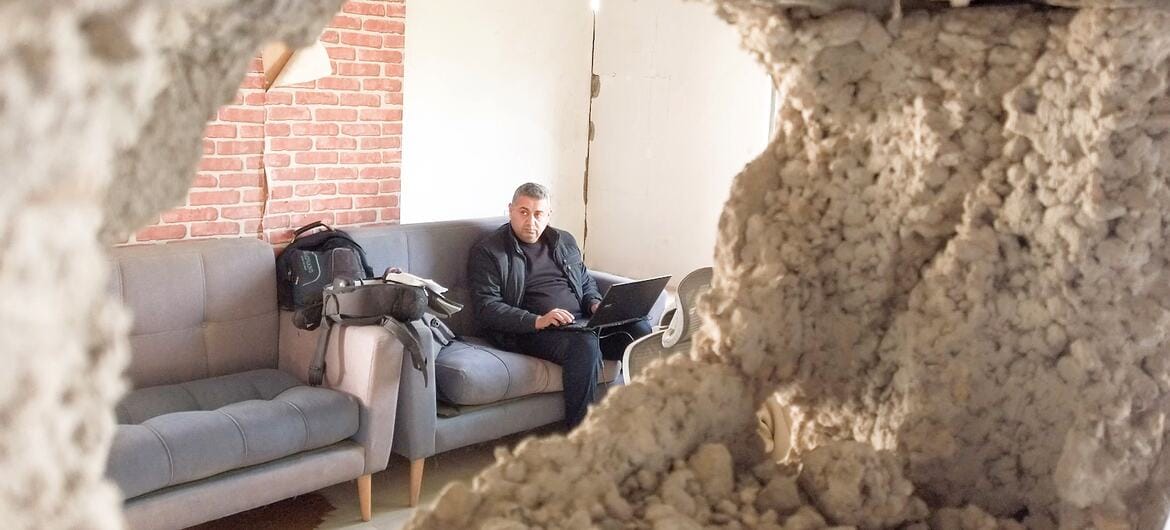
Broadcaster Rami Al-Sharafi works on a laptop inside the damaged Zaman FM radio station building in Gaza, marking what may seem an unlikely return to the airwaves amid the rubble of the deadly two-year Israel-Hamas war.

While 23 local radio stations were operating in Gaza before the conflict erupted, they were all destroyed and ceased broadcasting, he told UN News.

“Today, we are the only radio station broadcasting on FM from within Gaza after this widespread destruction,” he said. “We hope that other local radio stations will resume broadcasting, thus allowing competition in providing media services to the people of the Gaza Strip.”

Ahead of World Radio Day, observed on 13 February, the resumption of broadcasting comes at a time when Gaza’s media infrastructure still faces significant challenges amid local and international calls to support journalism as part of broader recovery and reconstruction efforts in the sector.

A journalist works at a desk in a damaged office in Gaza, viewed through broken pillars. Another person uses a laptop in the background.

UN News

A journalist works in the damaged office of Zaman 90.60 FM radio station in Gaza City.

Digging through the rubble

After a hiatus of nearly two years due to the war, some local radio stations in the Gaza Strip are transmitting again, in a move showing gradual efforts to revive the media landscape in the war-ravaged Strip – much of which has suffered widespread destruction of infrastructure and civilian institutions from Israeli attacks.

Zaman FM operates in the Tel al-Hawa neighbourhood of Gaza City, where Israeli attacks triggered a famine and left mountains of debris in the streets.

The cracked walls of the station’s building tell a story of immense destruction and the scene inside is unlike any other radio studio in the world. 

Employees dig through the rubble to keep the station broadcasting, working with minimal technical resources while behind them, awareness posters warn people of the dangers of dilapidated buildings.

On-air messages of hope

Local radio remains vital in Gaza as humanitarian crises persist, power outages continue and access to other media remains limited. This makes radio one of the most effective ways of getting key messages out to the public, along with health guidance and information about other services.

Gaza is in dire need of professional local radio stations capable of broadcasting awareness messages and guidance bulletins in light of the spread of diseases, the deterioration of the education system and the disruption of many basic services, said Mr. Al-Sharafi, director of the radio station and host of the morning programme, An Hour of Time.

“We need to deliver information to the population and guide them to the services that have stopped and are gradually being resumed,” he said, “especially in light of the difficult health conditions and the spread of epidemics.”

Amid the destruction all around, Mr. Al-Sharafi sits behind his dust-covered microphone and does just that. 

He sends morning greetings to Gaza residents and provides them with important information and updates, bringing some much-needed hope to the airwaves across a devastated landscape that has only just begun to recover – UN News

Continue reading

You Missed

IRGC says Iran started its Operation True Promise 26 by launching missiles and drones against Israel

IRGC says Iran started its Operation True Promise  26 by launching missiles and drones against Israel

Iran Halts Attacks on Neighboring States Unless…

Iran Halts Attacks on Neighboring States Unless…

Iranian govt spokesman: 30% of victims are children; 165 of them killed among 1300 civilians who died by US/Israeli bombing

Iranian govt spokesman: 30% of victims are children; 165 of them killed among 1300 civilians who died by US/Israeli bombing

White House: ‘We destroyed more than 30 Iranian ships and are moving to destroying the navy completely’

White House: ‘We destroyed more than 30 Iranian ships and are moving to destroying the navy completely’

White House: ‘We Have 4 to 6 Weeks to End The Military Operations in Iran’

White House: ‘We Have 4 to 6 Weeks to End The Military Operations in Iran’

IRGC: Iran Has Not Closed The Hormuz Strait Except to Ships Linked to Israel/USA

IRGC: Iran Has Not Closed The Hormuz Strait Except to Ships Linked to Israel/USA