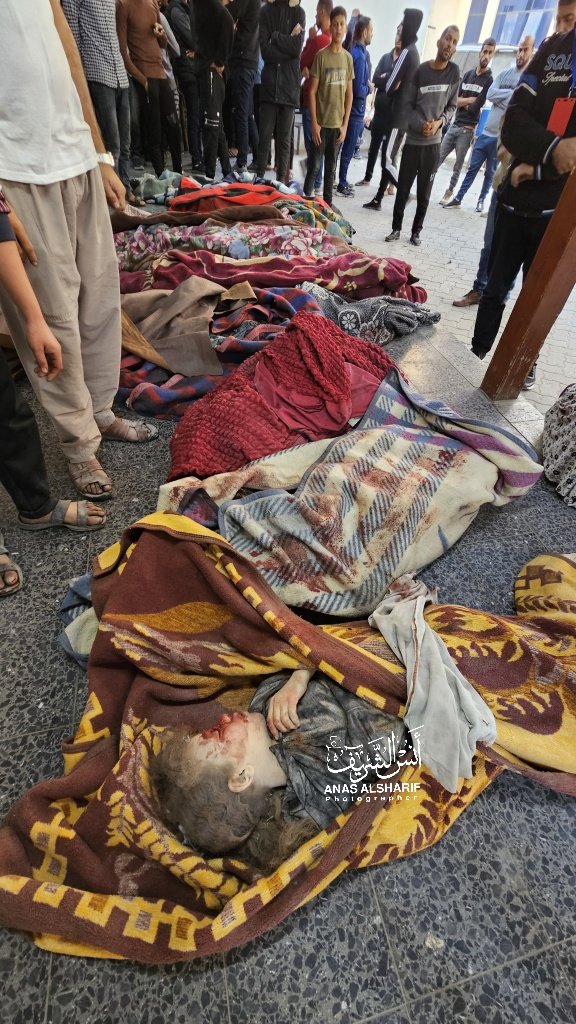
This is what Anas Al Sharif wrote:
“Good morning you unjust world….
This is the scene now from Jabalia Al Ballad (downtown).”
Continuing Israeli military strikes produces these scenes of death.

 CrossFireArabia
 This is what Anas Al Sharif wrote:
“Good morning you unjust world….
This is the scene now from Jabalia Al Ballad (downtown).”
Continuing Israeli military strikes produces these scenes of death.

 marwan
From the Arab 360 website
After three years beneath the rubble, the remains of the martyred journalist Doaa Sharaf and her child were recovered in Gaza, amidst the weeping of all present. The remains of Sharaf and her child, Ubaida, were retrieved after spending three years under the debris of the Al-Taj building in Gaza. Journalist Mohammed Haniyeh reported that their bodies were recovered alongside those of 37 other martyrs from the bereaved family. The building, located on Al-Yarmouk Street, was subjected to intense bombardment involving tons of explosives, causing the complete collapse of the entire residential block. Haniyeh described the moment the remains were found as a fresh source of pain, reviving the trauma of the massacre committed by occupation forces in the area.
The incident highlighted the immense, ongoing suffering of victims’ families as they search for their missing loved ones beneath the ruins of destroyed buildings across the Strip. The news sparked widespread, sorrowful reactions across digital platforms, accompanied by calls to halt the bloodshed and to honor the souls of the martyrs with a dignified burial.
CrossFireArabia
An American man was going through his grandmother’s old belongings when he stumbled upon a surprise that completely changed his perspective. He found his grandmother’s original passport, issued in 1932, which clearly stated: “Jerusalem, Capital of Palestine.” Overcome with shock, he grabbed his phone and began recording, his hands trembling as he said, “They lied to us… Palestine has always existed, and Jerusalem was its capital.”
This passport is genuine—a historical document over 90 years old. Documents and history do not lie.