How Do You Cope With Famine?

Palestinians are struggling with famine and trying to satisfy their hunger by eating tree leaves in the Gaza Strip, where Israel has been carrying out attacks for nine months.

Said Abu Abdo, who lives in Gaza City, is searching for ways to convince his son Majid, 8, and daughter Sara, 5, to eat mulberry tree leaves cooked with rice he tells Anadolu.

Abu Abdo tries to persuade the children, noting that they are similar to the grape leaves they used to eat before Israel began attacking.

But due to their bitter taste, the children refuse to eat.

The effects of famine, with the lack of necessities in the area, are clearly visible from the weak bodies, pale faces and tired expressions of Abu Abdo and his children.

“Famine is haunting Gaza City and the north once again. The situation is getting worse. With Israel closing the border crossings and blocking aid and supplies, we have resorted to eating tree leaves,” he told Anadolu.

Abu Abdo highlighted that Israel’s targeting of health services has exacerbated malnutrition, weakened immunity and the spread of infectious diseases due to an inadequate health care infrastructure and restricted access to aid and supplies.

He is concerned about his children, who have contracted contagious diseases like hepatitis and gastroenteritis multiple times because of the absence of proper and healthy food.

Israel’s control of border crossings and blocking humanitarian aid has caused famine to reappear in northern Gaza and Gaza City.

Palestinians are relying on canned food and wild plants for sustenance.

‘We’ve had to eat anything and everything imaginable to stave off hunger’

In Gaza City, Mahmood el-Bawab, 28, could not buy most of his family’s basic needs at the es-Sahabe market due to shortages.

Like other markets in the region, the market is also empty, and Palestinians, struggling with economic difficulties due to Israeli attacks, can hardly find anything to buy except some vegetables and products that have significantly increased in price.

Essential items like vegetables and fruits are scarce, causing prices to soar. Tomatoes are around $30 per kilogram (2.2 pounds), onions about $60 per kilogram, cucumbers $15 each and eggs $4 each.

“Prices have skyrocketed insanely and the available products are previously stored and low-quality. Due to limited cash, we can only buy these products in very small quantities,” he told Anadolu.

He said his family is trying to cope with the famine. “There’s nothing we can eat — no vegetables, fruits, meat, nothing. We’ve had to eat anything and everything imaginable to stave off hunger: animal feed, tree leaves, wild plants and expired food.”

People have been hospitalized due to illness and poisoning caused by unhealthy eating habits, he noted.

The director of the Kemal Advan Hospital in northern Gaza’s Beit Lahia, Husam Abu Safiye, also said that signs of famine have appeared in Gaza City and northern areas.

Abu Safiye said in the past week, four children have died from malnutrition upon arrival at the hospital, and in the last two weeks, 250 children were hospitalized for malnutrition and fluid loss.

Gaza journalists note hunger

“I am a journalist from the northern Gaza Strip. I am hungry, and my family has been away from me for eight months. I have lost more than 20 kilograms during the war,” said Mahmud El-Awadiyye, a journalist from the El-Meyadin television channel.

“I want to eat, but there’s nothing to be found. We haven’t had meat for months,” Awadiyye lamented on social media.

Mahmud el-Amudi, who works at Aksa’s Voice Radio posted on Facebook about his struggles. “I still haven’t had lunch because my stomach burns from eating bread, dukkah (a mix of nuts and spices), and powdered red pepper.”

One journalist said hunger surrounds him in Gaza.

“I am journalist Usame el-Asiy. My wife is pregnant and very hungry. I am very afraid for her because of her hunger. My family, friends, and neighbors are also hungry,” he said.

Israel, flouting a UN Security Council resolution demanding an immediate cease-fire, has faced international condemnation amid its continued brutal offensive on Gaza since an Oct. 7, 2023 attack by Palestinian group, Hamas.

More than 37,600 Palestinians have since been killed in Gaza, most of them women and children, and over 86,000 injured, according to local health authorities.

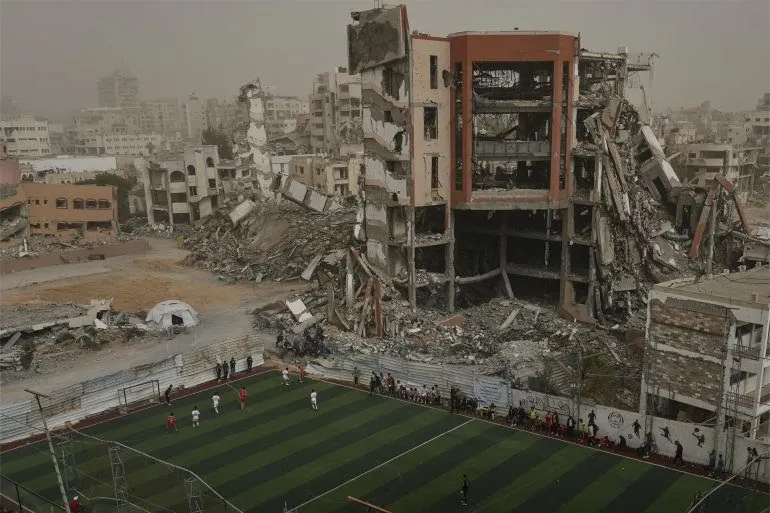
More than eight months into the Israeli onslaught, vast tracts of Gaza lie in ruins amid a crippling blockade of food, clean water and medicine.

Israel is accused of genocide at the International Court of Justice, whose latest ruling ordered Tel Aviv to immediately halt its military operation in the southern city of Rafah, where more than 1 million Palestinians had sought refuge from the attacks before it was invaded on May 6.

CrossFireArabia

CrossFireArabia

Dr. Marwan Asmar holds a PhD from Leeds University and is a freelance writer specializing on the Middle East. He has worked as a journalist since the early 1990s in Jordan and the Gulf countries, and been widely published, including at Albawaba, Gulf News, Al Ghad, World Press Review and others.

Related Posts

Palestinians Remember The Eveil Nakba

Dozens of Palestinian women at a displacement camp in central Gaza marked the 78th anniversary of the Nakba (Catastrophe) on Thursday, reliving scenes of displacement and loss they said continue to define Palestinian life decades after 1948.

Held at the Refaat Alareer camp in the Al-Zawaida area, the event linked memories of the historic Palestinian displacement with the reality of the ongoing Israeli war on Gaza, as participants said the suffering of exile and forced displacement had never truly ended.

The event was organized by the Sameer Project, a relief initiative led by Palestinians in the diaspora, and featured heritage performances, traditional dabke dancing and symbolic scenes highlighting Palestinian identity and the right of return.

Women and children raised Palestinian flags, symbolic keys, and images reflecting displacement and attachment to the land. Several participants wore traditional Palestinian dresses and chanted songs and national hymns invoking Palestinian memory and what they described as an ongoing Nakba.

Palestinians commemorate the Nakba every year on May 15 through marches, exhibitions and public events in the Palestinian territories and around the world, calling for rights, including the return of millions of refugees.

The Nakba refers to the mass displacement of Palestinians in 1948 during the events surrounding the creation of Israel, when hundreds of Palestinian towns and villages were emptied and their residents forced to flee.​​​​​​​

Reliving displacement

Ibtisam Abu Muailiq, a displaced Palestinian now living in Al-Zawaida, said Palestinians are still living through the Nakba today.

The current war, she told Anadolu, had brought back scenes of displacement and tent life that previous generations described after the events of 1948.

“Our home was destroyed, and we lost loved ones, some killed and others still missing, but we remain steadfast on the land of Palestine,” she said.

She called on people around the world to show compassion toward Palestinians and support them amid their suffering.

For Umm Mohammed Abdullah, the Nakba never ended.

Palestinians, she said, have endured repeated cycles of hunger, thirst, displacement and loss but continue to hold on to their land.

“No matter how severe the suffering becomes, we will not leave our homeland,” she added.

Steadfast despite war

Event coordinator Iman Al-Khatib said holding the event inside a displacement camp carried a message that Palestinians remain steadfast despite wars and catastrophes.

“We wanted to tell the world that Palestinians remain resilient and that the right of return will continue to live in the conscience of future generations,” she told Anadolu.

The Israeli army has killed more than 72,000 people, mostly women and children, and injured over 172,000 in a two-year war on the Gaza Strip since October 2023.

Despite a ceasefire that took effect on Oct. 10, 2025, the Israeli army has continued its attacks, killing at least 856 people and injuring 2,463 others, according to Gaza’s Health Ministry.

Continue reading
Palestinian Population Tops 15.5 Million

The Palestinian Central Bureau of Statistics (PCBS) said Tuesday that the number of Palestinians worldwide has reached about 15.5 million, including 7.4 million living in historic Palestine.

In a statement marking the 78th anniversary of the Nakba, a term used by Palestinians to mark Israel’s creation in 1948, the bureau said about 8.1 million Palestinians live in the diaspora.

It said more than two million Palestinians are displaced inside Gaza and the occupied West Bank as a result of Israel’s war on Gaza and continued settlement expansion.

Israel’s war on Gaza has displaced nearly two million Palestinians out of about 2.2 million who lived in the enclave on the eve of the war, the bureau said. Many now live in tents, shelters and schools.

About 40,000 Palestinians have also been displaced from refugee camps in the northern West Bank because of the ongoing Israeli military operations, the bureau added.

In the West Bank, illegal Israeli settlement activity continues to expand, the statement said, adding that the number of illegal settlements and military bases reached 645 by the end of 2025. The total includes 151 illegal settlements, 350 settlement outposts and 144 other sites.

Official figures show that the number of Israeli occupiers in the West Bank reached about 778,567 by the end of 2024, with 42.8% concentrated in occupied East Jerusalem.

The bureau said Israeli authorities seized more than 5,571 dunams (1,377 acres) of Palestinian land in 2025 through seizure orders, expropriation and declarations of “state land.”

It also documented more than 61,000 attacks by Israeli forces and occupiers in the West Bank between 2022 and 2025, which led to the uprooting and bulldozing of more than 81,000 trees, most of them olive trees.

Israeli authorities continue to impose strict restrictions on Palestinians through about 900 military checkpoints and gates across the West Bank, limiting residents’ movement and blocking access to large areas of agricultural and grazing land, the bureau said.

In Gaza, the bureau said Israel’s war has completely destroyed more than 102,000 buildings and fully or partially damaged more than 330,000 housing units, along with widespread destruction of infrastructure, health facilities and schools according to Anadolu.

The Israeli army has killed more than 72,000 Palestinians, mostly women and children, and injured over 172,000 others in a two-year offensive on Gaza since October 2023.

Continue reading

You Missed

Iran is Writing The Final Chapter!

Iran is Writing The Final Chapter!

Gaza Fishermen Dream of Life Prior to 7 Oct

Gaza Fishermen Dream of Life Prior to 7 Oct

Giant Phillippines Volcano Shows no Rest!

Giant Phillippines Volcano Shows no Rest!

The Chinese Fortune Cookie and The “Thucydides Trap”! A  View From Amman

The Chinese Fortune Cookie and The “Thucydides Trap”! A  View From Amman

Israel Kills 200 Lebanese Children – UNICEF

Israel Kills 200 Lebanese Children – UNICEF

Nakba – 78 Years of Occupation Misery

Nakba – 78 Years of Occupation Misery