Israel Uproots 100s of Olive Trees in Palestine

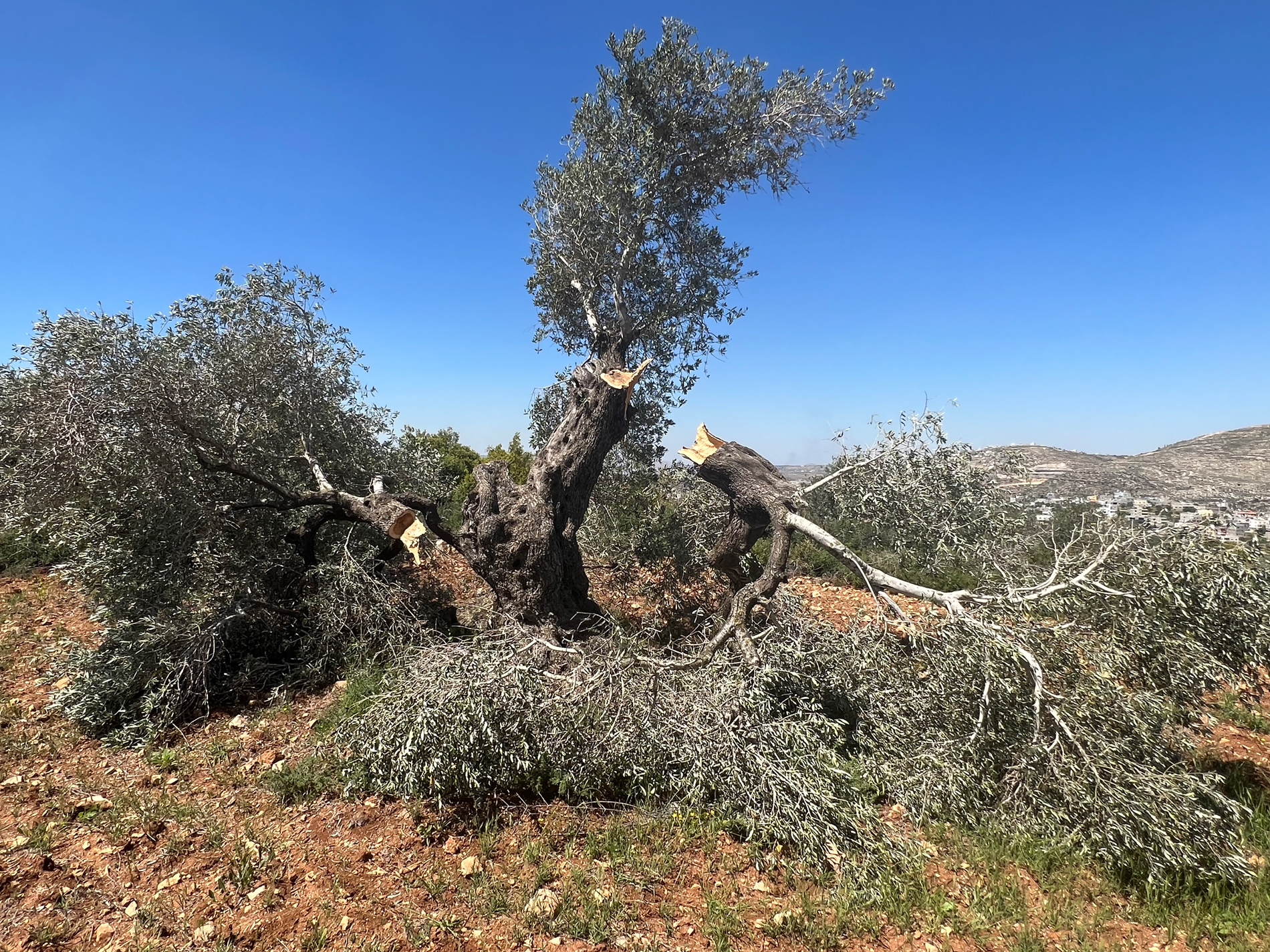
Israeli occupation forces uprooted hundreds of olive trees last Monday in the Wadi al-Hummus area near the town of Dar Salah and the village of al-Khas, east of Bethlehem, according to a local activist.

Activist Nidal Hazibi told WAFA that Israeli forces bulldozed nearly 50 dunums of land in the al-Buq‘a site of Wadi al-Hummus, uprooting hundreds of olive trees over 60 years old belonging to Palestinian residents of Bethlehem and the Sur Baher area, in addition to several forest trees.

Approximately a week ago, Israeli forces stormed the area and created an opening in the separation wall to facilitate upcoming land leveling.

According to the Colonization and Wall Resistance Commission, Israeli forces and colonists carried out a total of 1,965 attacks during February, in continuation of the ongoing series of terrorism by the occupying state against the Palestinian people and their property. Of these, the Israeli army carried out 1,454 attacks, while colonists carried out 511 attacks, primarily concentrated in the following governorates: Hebron (421 attacks), Nablus (340), Ramallah and al-Bireh (320), and Jerusalem (210).

The commission said that the attacks included direct physical assaults, the uprooting of trees, the burning of fields, the seizure of property, and the demolition of homes and agricultural structures. At the same time, vast tracts of Palestinian land remain inaccessible due to restrictions imposed by Israeli forces under the pretext of security, while colonists are allowed to expand into these areas.

  • CrossFireArabia

    CrossFireArabia
    Dr. Marwan Asmar holds a PhD from Leeds University and is a freelance writer specializing on the Middle East. He has worked as a journalist since the early 1990s in Jordan and the Gulf countries, and been widely published, including at Albawaba, Gulf News, Al Ghad, World Press Review and others.

    Related Posts

    Ghassan Kanafani: Israel Feared His Pen, And Assassinated Him

    Today we rid ourselves of an armed intellectual brigade
    who, with his pen, posed a greater threat to Israel
    than a thousand armed fighters… – This is what Israeli Prime Minister Golda Meir said
    upon the assassination of Ghassan Kanafani on 8 July, 1972

    Continue reading
    In Defense of Dr Mustafa Al Barghouti

    The media campaign targeting the Secretary-General of the Palestinian National Initiative Dr Mustafa Barghouti, sparked widespread political and national reactions after a clip was circulated and taken out of context relating to a speech, he delivered at a European meeting supporting Gaza. It was followed by accusations, doubts, and an escalation of rhetoric against him. Shortly after series of statements emerged rejecting the campaign against him, asserting it was a distortion, selective quoting, and misuse of his remarks.

    The controversy began after Barghouti, speaking as a physician, stated “Israel has brutally and criminally killed at least 22,000 Palestinian children in Gaza.” He added however, that in recent months, the lives of “82,000 newborns who are now alive” had also been saved, and that for him, this “is not merely a humanitarian act, but an act of resistance.”

    However, this statement was taken out of context and presented on some pages and accounts as a comparison between the number of martyred children and the number of births, which opened the door to a campaign accusing him of downplaying the tragedy in Gaza or dealing with it with insufficient sensitivity. In contrast, his defenders emphasized his remarks were about the Palestinian community’s ability to sustain life despite the annihilation, not about comparing death and birth.

    Statements of Condemnation

    The Hamas National Relations Department issued a statement condemning the media and incitement campaign against Barghouti, considering it to have been accompanied by “extraction, distortion, and misinterpretation of his statements to serve narratives and objectives that have no relation to the truth.”

    The statement added that “extracting statements from their true context and misinterpreting them only serves to deepen the division and fragment national efforts at a time when our people are most in need of unity, integrated roles, and a focus on confronting the occupation and its ongoing crimes against our people.”

    The department affirmed Barghouti “has been known for many years for his active national and political presence, and for his efforts in international forums to convey the Palestinian narrative and defend the rights of our people, in addition to his humanitarian, medical, and relief contributions,” considering this a “national asset that must be preserved and respected.”

    It stressed that “differences of opinion or political assessment should not be transformed into insults, questioning of intentions, or distortion of national positions,” emphasizing that responsible dialogue and objective criticism must be based on complete facts, far removed from distortion and misrepresentation.

    In the same context, the Palestinian National Commission for Popular Action issued a statement condemning the campaign. It stated that Barghouti is being subjected to “selective quoting and the distortion of his statements to serve narratives far removed from their true meaning.”

    It added that Barghouti “has become a prominent national figure with international standing and symbolic significance,” stressing that differences of opinion “should not devolve into smear campaigns targeting national figures, especially at this critical juncture which demands strengthening national unity and directing efforts toward confronting the occupation and its ongoing crimes against our people.”

    It also called for accuracy and objectivity, respect for political pluralism, and refraining from inflammatory rhetoric to preserve national unity and bolster the resilience of the Palestinian people.

    Writers and Commentators: The Campaign Has Crossed the Line of Criticism

    In addition to political statements, several Palestinian writers and commentators expressed their views, arguing that what happened to Barghouti crossed the line from criticism into deliberate destortion.

    Writer Ahmed Bani Shaqour, in an article titled “When the Clean Is Attacked for Being Clean,” wrote that he read “an unjust and harsh attack on Dr. Mustafa Barghouti on a pro-establishment page,” which prompted him to write in his defense.

    He said Barghouti “is not a political opportunist, nor a spokesperson for the authorities, nor a purveyor of slogans,” but rather “a son of the cause since the cost was high and privileges were nonexistent,” adding that he is “the doctor who did not abandon his profession for the first available position, the fighter who did not compromise his principles, and the Palestinian who did not change his compass.”

    Bani Shaqour believes that Barghouti “disturbed them because he did not enter the market of deals, worried them because he does not sell his silence, and confused them because he is not adept at the language of justification,” concluding his article by saying: “When the clean is attacked, know that the battle is against him because he is clean.”

    Background and Political Context of the Campaign

    According to information circulating among observers, the campaign did not begin as a spontaneous objection to a statement made during an international event. Rather, it originated from pages and accounts known in recent years for attacking resistance forces and questioning their discourse. These include pages and individuals such as Ismat Mansour and Jamal Nazzal, as well as pages described by observers as fake accounts operating on behalf of security agencies within the Palestinian Authority.

    In this context, the excerpted statement, according to these observers, became the entry point for a broader campaign that went beyond criticizing the wording to targeting Barghouti politically and morally.

    This does not negate, according to observers, the right of any party to discuss or express reservations about wording, but it places the campaign in a context that transcends mere linguistic debate or disagreement over a specific expression.

    From Criticizing the Statement to Targeting the Palestinian Voice

    Observers believe that the core of the debate is not so much about a specific statement as it is related to Mustafa Barghouti’s standing in the Palestinian political and media landscape.

    Since the outbreak of the war of annihilation on the Gaza Strip, Barghouti has emerged as one of the most prominent Palestinian figures in Arab and international media, combining his medical background with his political and rhetorical skills to deconstruct the Israeli narrative and defend the Palestinian narrative in a language that resonates with Western public opinion.

    Therefore, a number of observers believe that targeting him cannot be separated from the battle over the narrative itself; that is, the struggle over who has the ability to represent the Palestinian voice in international forums, and who succeeds in conveying the Palestinian narrative to a global audience.

    In this context, the selective use of a phrase from a speech that focuses primarily on the occupation’s crimes against the children of Gaza, and its subsequent transformation into a platform for accusing its author, reflects—according to these observers—a fundamental flaw.

    In terms of priorities, the debate shifts from the original crime to the person who exposes it.

    Ultimately, the campaign targeting Mustafa Barghouti reveals a highly sensitive internal Palestinian landscape, where narrative battles intertwine with political disputes, and where a single phrase taken out of context is enough to unleash a wave of doubt and incitement.

    While his critics argue that some of his statements warrant discussion and scrutiny, statements and positions defending him assert that what transpired went beyond mere criticism to a smear campaign based on extracting words from their context and repurposing them in an internal battle that only serves to deepen the division.

    Between the right to criticize and the duty of fairness, there is an urgent need to protect the national discourse from descending into accusations of treason and defamation, and to keep the focus on the core of the struggle: The occupation, the genocide, and the Palestinian narrative, which must be conveyed to the world in its entirety, not in a fragmented form according to Quds Press.

    Continue reading

    You Missed

    Ghassan Kanafani: Israel Feared His Pen, And Assassinated Him

    Ghassan Kanafani: Israel Feared His Pen, And Assassinated Him

    In Defense of Dr Mustafa Al Barghouti

    In Defense of Dr Mustafa Al Barghouti

    Gaza Lives Without Electricity

    Gaza Lives Without Electricity

    How Israel Destroyed Education in Gaza

    How Israel Destroyed Education in Gaza

    Ireland Passes Bill to Ban Imports From Israeli Settlements

    Ireland Passes Bill to Ban Imports From Israeli Settlements

    The Art of Mutilation

    The Art of Mutilation