Israeli Planes Bomb Baby 50 Meters Into The Sky!

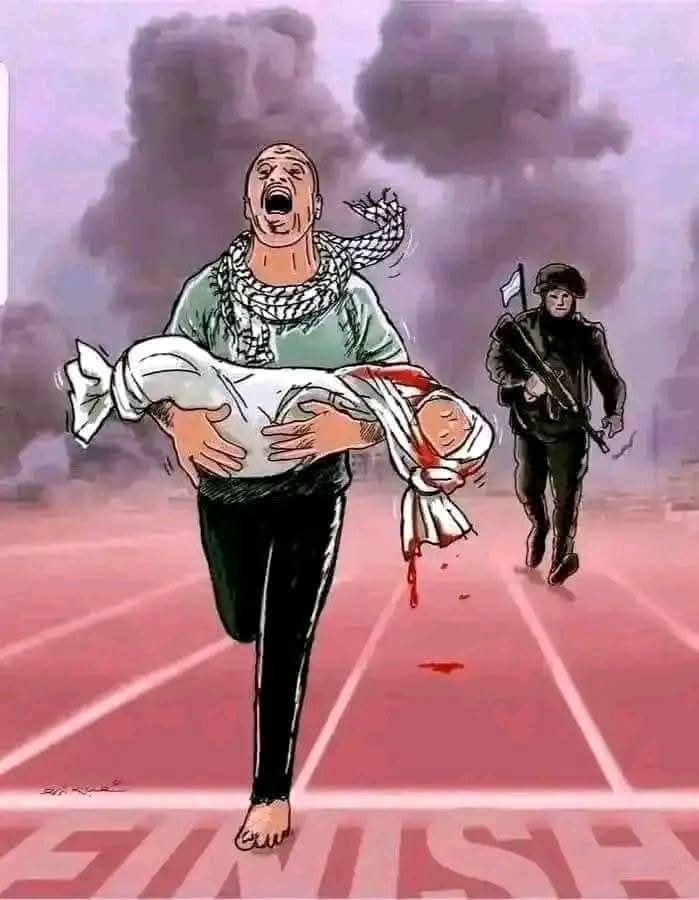
An Israeli missile suddenly hurls infant Enaam, 50 meters away from her home bombed by Israeli warplanes in the northern Gaza Strip writes Jihad Oweiss in Al Jazeera.

The baby flies up into the sky and miraculously lands on a nearby mattress, as if angels carried her and lowered her onto it, protecting her from certain death. She then sustains facial burns from the explosion of the first missile.

This scene is not a cinematic one: It is a true story that happened in early April and documented by Moroccan doctor Youssef Bouabdallah on his Instagram account. He is visiting Gaza to provide medical care to the wounded.

This bloody scenario is among dozens of scenes of ongoing slaughter, expertly orchestrated by Israel and supported by the United States, which has claimed the lives of more than 50,846 martyrs and injured 115,729 since 7 October, 2023.

Flying Bodies and Remains

If the world’s ears cannot comprehend the murderous scenarios being tested by the Israeli occupation army on the residents of the besieged Gaza Strip, the Dar al-Arqam School massacre in Gaza City is proof of this, adding to the open record of genocidal crimes.

Palestinian platforms documented the horrific massacre committed by the occupation army on 3 April and what they said showed the moment the bodies of residents blown to pieces by the violent shelling of a school housing displaced persons.

The people of Gaza, especially, cannot get over the sight of bodies being blown apart by the bombing, asserting what they are experiencing is not a war, but “a slow annihilation in which the apocalypse is being perpetrated on earth, without accountability, scale, or justice. While bodies are being torn apart and souls are being scattered, the world is content to count and remain silent.”

To emphasize this, activist Ahmed Al-Khalidi addresses “the complacent” who are surprised by the evacuations of Gaza’s residents by the bombing. He recounts some of the stories of those whose bodies were blown to the top of nearby buildings, those whose remains disappeared and were scattered into the unknown, those who were completely annihilated, and those who were blown away but survived.

Al-Khalidi says in his post: “We found the remains of our neighbors in our house after their six-story home was bombed. The explosion scattered everything: bodies, rubble, and memories.”

He adds: “I once asked a friend who was rescued alive from under the rubble of his house, ‘How did it feel?’ He replied, ‘When the missile exploded, I felt like I’d fallen into a deep hole, spinning violently, but I emerged alive and well.'” He confirms that the same person was later martyred along with his wife and children in a separate bombing.

Psychologist Dr. Saeed Al-Kahlout adds to similar stories, saying: “My martyred sister’s body flew away in one bombing, passing over two buildings and a street, while her husband was found two days later in a nearby neighborhood.”

He continues in a Facebook post: “At the beginning of the war, following a bombing on our neighbors’ house, the neighborhood residents found the body of a martyr, still lying on her bed, on the fifth floor of a building adjacent to the blind martyr’s house. People explained the event by saying, ‘Angels carried her and fled with her to a safe place. She was sound asleep.'”

The new phase of the Israeli war, since its resumption on 18 March, appears to be more bloody and criminal. The occupation army has killed 1,482 Palestinians and injured 3,688, according to data from the Ministry of Health in Gaza.

Gaza residents are witnessing more intense bombardment and a more intense rate of killing, as if the Israeli occupation army is using the Strip as a testing ground for its lethal military weapons, following its violation of the ceasefire agreement concluded with the resistance last January.

Al-Kahlout links the scenes of bodies of martyrs flying to the violent bombardment, saying: “The force of the explosions we are witnessing in this war makes me say that bodies are trying to save themselves by fleeing, even if they fly outside the circle of fire, to escape the hell… The sound of the explosion is as if the sky has split open in its wrath, shaking the ground beneath our feet and deafening our ears until we hear nothing but the howling of fear inside our heads.”

Fear and Panic

Blogger Abu Ghaith Yaghi calls on the world to talk about “dying Gaza” and the difficult nights the residents are experiencing, while “Israel is testing new types of bombs and missiles.”

While activist Mohammed Al-Akashiya asks on his account, “What are they (the occupation) throwing at us?” due to the sounds of shelling reverberating throughout the area, another asserts that the wave of explosions and shelling is terrifying and unprecedented.

Activist Mohammed Haniyeh believes that most of the missiles used after the renewed genocide are different from those before, and have a massive blast wave. He adds: “We now hear the echo of the explosion for a longer period of time. It doesn’t stop instantly, but rather the sound seems to extend and spread, coinciding with earthquakes that last for seconds.”

CrossFireArabia

CrossFireArabia
Dr. Marwan Asmar holds a PhD from Leeds University and is a freelance writer specializing on the Middle East. He has worked as a journalist since the early 1990s in Jordan and the Gulf countries, and been widely published, including at Albawaba, Gulf News, Al Ghad, World Press Review and others.

Related Posts

Wounders of Arabic

EDITOR’S NOTE: I wrote this article “On Arabic” in 2008 and posted on hackwriters.com. I am reprinting it here for relvance and archival use

Compared with English, Arabic is an easy read if it is written well. When you look at English, the perception of the language, written and oral, took centuries of development from archaic structures associated with the old English of Geoffrey Chaucer, passing to Shakespeare and Christopher Marlow to George Elliot, Charles Dickens, Virginia Wolfe as well as many others and not mentioning the new contemporaries.

With Arabic it’s different. Although there may have been stages of development through out the centuries, it seems the clarity of the Arabic language was a one-time affair, represented in the Holy Koran brought down from the skies through Angel Gabriel to Prophet Mohammad in the 7th century and passed on to the Muslim community.

The Koran represented a basis for the Arabic language as it is spoken and written today. Unlike English, back in the 7th century Arabic was written in a clear, transparent, effective tone that involved action, and designed from every member of the social community, rich and poor, educated and illiterate, a source of knowledge and speech and continued to be so as it passed down through the centuries.

With English it was different. First if all, the language itself was derivative from other linguistic structures like Germanic, Latin, and French, many of which have said this is what made it stronger; Secondly English was helped by the issue of economic development as new inventions, processes and way of doing things required the development of new words, terminologies and syntax which evolved from the 17th century onwards.

Today some have been known to criticize Arabic for failing to be innovative, or developing to meet the needs of modernization and even globalization, with its inability to produce new words and terminologies to pace with the development going on in the region and the world.

However, one of the points that has to be clarified is that as these inventions came from the western countries and as communicated in English, the language proved more flexible in coming up with new words and terms, as opposed to the Arabic language that adopted a reactive approach with linguists from the region acting haphazardly in their word formations rather than following a methodical pattern.

In the process as well, we tend to get used to hearing the words and terminologies in say the English language and when we hear their equivalents in other languages such as Arabic, as there is a sense of word creation even in translations, it becomes odd and foreign simply because our ears have got used to the English pronunciation.


But this is a different view related to globalization, how much are we as Arabs integrated into the international system, how much we take from it, what do we take, what do we buy, our consumer habits and trends and indeed, how much do we produce and contribute to world society.

While this in turn becomes related to our language, its use, how much we mix words, English-Arabic, Arabic-English, the fact of the matter is that the language itself, spoken by about 300 million people in 22 Arab countries and about a 1.5 billion in Muslim countries who read the Koran in Arabic, says a great deal.

Arabic is a cogent force, its simple, attractive and gets the point across in as a logical manner as possible. It’s easy to read and to understand. It’s structure is less complex as say French and German which are grammatically more demanding than the English language.

However, just like any other language, writing in Arabic has to be learnt, it’s a professional skill; that’s why today there is an endless beating about the bush were getting the idea across is deliberately pumped and inflated and there is much hankering because of political considerations relating to ruler, government, state, security apparatuses and so on.


These considerations are over-riding and smack directly with the professionalism of writing and the way the writing of Arabic should be as passed on and continued through out the holy Koran which is sometimes used as a source of criticism by western writers and pedagogics who claim the Arabic language lacks the basis for producing new words as do the other languages.

But when Arabic is spoken and written as part of the social community there is a sense of modernist continuum as expressed in its words, expressions, figures of speech and syntax found in the structure of the language.


Nowhere is this more emphasized than it is in the Koran. Written in the 7th century, the Koran is timeless in its spiritual message, a modernist document in its approach with words, phrases and expressions that apply as much today as when it was handed down, memorized and collectively written.

Words and expression apply as much then as they apply today. The word “car” for instance is used in one of its Suras (chapters) to signify a caravan route whereas its use today implies a vehicle, and striking the reader as if you are reading a modern document about social relations, economy, authority, and kinship.

The style of language appears to be modernist as well and not with case as it is say with the Bible that is written in old English, not as old as the language used by Chaucer, but is hard to fathom just the same.

That has proved problematic for the Koran. When translated into English translators often use the kind of language that is employed by the Bible, which does not reflect the actual modernist style of the Koran for the lucidness of the holy document becomes lost and replaced by an archaic and medieval structure once found in the language, although English has moved on tremendously.

© Marwan Asmar May 2008

Continue reading
Dad Digs For Family After Israel Bombs Their House

Hammad’s house in the Sabra neighborhood was destroyed Dec. 6, 2023, during heavy Israeli bombardment. He said a powerful bomb weighing around 2,000 pounds (907 kilograms) struck the building while the family was inside.

On a mound of sand and shattered concrete that once formed the foundation of his six-story home in Gaza City, Mahmoud Hammad digs methodically through the debris, searching for the remains of his wife and children killed beneath the rubble.

Armed with little more than a small shovel and a metal sieve, the 45-year-old father filters sand by hand, hoping to find bone fragments that would allow him to lay his family to rest.

“In the absence of machinery, this is what we have,” he said, holding up the sieve.

Home reduced to dust

Hammad’s house in the Sabra neighborhood was destroyed Dec. 6, 2023, during heavy Israeli bombardment. He said a powerful bomb weighing around 2,000 pounds (907 kilograms) struck the building while the family was inside.

He lost his wife, six children, his brother, his brother’s wife and their four children.

Hammad survived but sustained severe injuries, including multiple rib fractures and injuries to his shoulder and pelvis. After months of partial recovery, he returned to the site to begin searching for his family’s remains.

“I wanted to bury them properly,” he said.

With the help of neighbors, he managed to retrieve and bury his brother and his brother’s family. But the bodies of his wife and children remain under layers of hardened debris.

“I collect what I can, piece by piece,” he said.

Missing under the rubble

Nearly 9,500 Palestinians are missing beneath destroyed buildings across the territory, according to official estimates in Gaza.

Officials said recovery efforts are severely hindered by the lack of heavy equipment needed to clear the debris. Despite a ceasefire that took effect in October, authorities said the entry of large-scale machinery remains restricted, limiting the ability of rescue teams to reach buried bodies.

Civil defense crews have repeatedly warned that the longer debris remains uncleared, the harder it becomes to recover remains.

Private grief amid mass destruction

Hammad said his wife was pregnant and close to delivery when the strike occurred, as medical services across Gaza were collapsing under the strain of the war.

“She and our unborn child died together,” he said.

Since December, Gaza has been battered by repeated storms that further displaced families living in makeshift shelters after their homes were destroyed.

For Hammad, however, the focus remains on the ruins before him.

Each day, he returns to sift through dust and fragments of concrete, driven by what he describes as a simple duty.

“They deserve to be buried with dignity,” he said.

At least 591 Palestinians have been killed and more than 1,598 injured in Israeli attacks since a ceasefire deal took effect Oct. 10, according to Gaza’s Health Ministry.

​​​​​​​‏Israel’s war on Gaza, which began Oct. 8, 2023, and lasted two years, has killed more than 72,000 Palestinians and wounded over 171,000, most of them women and children, and destroyed about 90% of Gaza’s civilian infrastructure.

By Tarek Chouiref in Istanbul for Anadolu

Continue reading

You Missed

IRGC says Iran started its Operation True Promise 26 by launching missiles and drones against Israel

IRGC says Iran started its Operation True Promise  26 by launching missiles and drones against Israel

Iran Halts Attacks on Neighboring States Unless…

Iran Halts Attacks on Neighboring States Unless…

Iranian govt spokesman: 30% of victims are children; 165 of them killed among 1300 civilians who died by US/Israeli bombing

Iranian govt spokesman: 30% of victims are children; 165 of them killed among 1300 civilians who died by US/Israeli bombing

White House: ‘We destroyed more than 30 Iranian ships and are moving to destroying the navy completely’

White House: ‘We destroyed more than 30 Iranian ships and are moving to destroying the navy completely’

White House: ‘We Have 4 to 6 Weeks to End The Military Operations in Iran’

White House: ‘We Have 4 to 6 Weeks to End The Military Operations in Iran’

IRGC: Iran Has Not Closed The Hormuz Strait Except to Ships Linked to Israel/USA

IRGC: Iran Has Not Closed The Hormuz Strait Except to Ships Linked to Israel/USA