‘Journalist Khalil Trapped Under Rubble Left to Die’

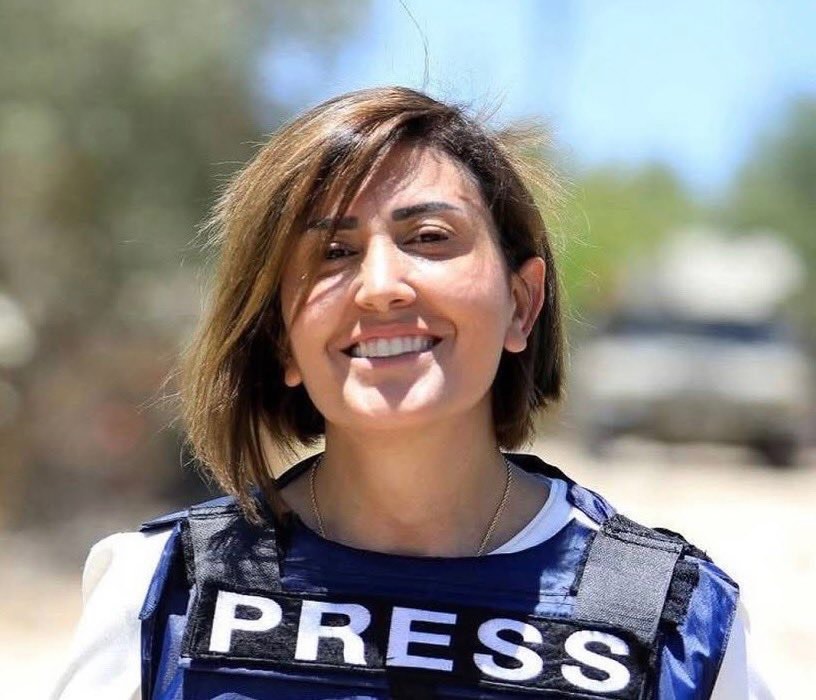
Prominent Lebanese journalist Amal Khalil was killed, Wednesday, by an Israeli targeted military attack in the town of Tyre in southern Lebanon. At the time she was on an assignment with her friend freelance photojournalist Zeinab Faraj reporting on recent attacks on the southern village of Bint Jbeil.

The Lebanese Arabic newspaper Al Akhbar daily confirmed  her death on Wednesday night.

Earlier they were covering the aftermath of an earlier terrorist Israeli drone strike in the town of al-Tiri that killed two civilians. After their vehicle was targeted, the journalists sought refuge in a nearby house which was subsequently bombed, trapping Khalil under the rubble.

Israeli gunfire and stun grenades ensued for several hours preventing the Lebanese Red Cross and army from reaching the site. Zeinab Faraj was eventually rescued in serious condition and taken to a hospital according to local reports and after a few hours, rescue teams recovered Khalil’s bodyfrom the debris.

Their killing is not an isolated act of Isaeli terrorism but is a calculated continuation of a decades-long pattern of targeting the press across Palestine and Lebanon. This history of Israeli terrorism against media workers serves a clear, systemic purpose: to assassinate the witnesses and silence the truthreporting on recent attacks on the southern village of Bint Jbeil wrote Mosab Abu Taha on facebook.

Jeremy Loffredo of Drop Site covered the news extensively and the time leading up to her killing. This is what he wrote: Khalil and Zeinab Faraj, a freelance photojournalist, were both on assignment in southern Lebanon, reporting on recent attacks on the southern village of Bint Jbeil. According to Al-Akhbar, which published a timeline of the events, the car they were driving behind was targeted by an Israeli drone at 2:45 p.m, killing two men inside. Khalil and Faraj took shelter in a nearby house.

At 2:50 p.m., Khalil contacted her editors and family, according to Lebanon-based journalist Courtney Bonneau. News of the incident quickly spread, prompting Lebanese President Joseph Aoun to put out a statement calling on the Red Cross to rescue the two journalists in coordination with the Lebanese Army and the United Nations.

At 4:27 p.m., the house where the two journalists were taking refuge was bombed by the Israeli military and contact with the journalists was lost, according to Al-Akhbar.

Israel did not respond to requests for access, obstructing any rescue operation, according to a Lebanese military official speaking to Al Jazeera. The Red Cross was eventually granted limited access to the site, according to the Committee to Protect Journalists, which remained under active fire.

They were able to evacuate Faraj, who reportedly sustained critical head injuries, and to recover the bodies of two other civilians who were killed. But they were forced to withdraw before finding Khalil because of continued shelling and the direct firing on rescue crews and vehicles. The Red Cross vehicle that transported journalist Faraj to Tubnin Governmental Hospital was hit by Israeli gunfire, with bullet marks visible on the vehicle, according to the state-run National News Agency.

The Red Cross was eventually able to return to the area after which Khalil was pronounced dead.

“The repeated strikes on the same location, the targeting of an area where journalists were sheltering, and the obstruction of medical and humanitarian access constitute a grave breach of international humanitarian law,” CPJ Regional Director Sara Qudah said in a statement.

The Israeli military did not immediately respond to a request for comment.

Referred to by Al-Akhbar as their “correspondent of the south,” Khalil grew up in Baysariyyeh, a coastal town in Saida district about a 45-minute drive from the Israeli border. She spent more than a decade and a half covering the cyclical wars and occupations of southern Lebanon by the Israeli military. Founded in 2006, Al-Akhbar’s editorial line is widely seen as supportive of Hezbollah and the Shiite resistance, and it identifies itself as a secular, independent progressive outlet.

Khalil had previously received explicit death threats on her phone in September 2024 from Gideon Gal Ben Avraham, a media commentator who runs a Middle East analysis channel on YouTube, appears on Israeli television, and describes himself as a retired military officer who continues to “help” Israeli intelligence. The messages told her to leave the country “if you want to keep your head on your shoulders” and asked whether her house was “still standing.”

When contacted by Drop Site on Wednesday before news of Khalil’s death emerged, Ben Avraham confirmed he sent the threats in 2024. “Send greetings to all journalists affiliated with Hezbollah, for anyone who works for the organization should know that they are destined for death,” he wrote, later clarifying that he considered Al-Akhbar “Hezbollah-affiliated” and that “only Hezbollah related should be afraid,” while Maronites and Sunnis should face no such threats.

It is not clear what—if any—formal relationship he has to the Israeli military. When pressed about Khalil’s predicament being trapped under the rubble of a house that was targeted by the Israeli military, he responded: “We don’t share our intel with journalists.” When asked directly whether he was a soldier when he sent the original threats to Khalil in 2024, Ben Avraham replied: “No comment.”

Last month, the Israeli military openly admitted to assassinating prominent Lebanese journalist Ali Shoeib, a correspondent for Al-Manar TV who had covered southern Lebanon for nearly three decades. The Israeli military falsely claimed that Shoeib was a Hezbollah intelligence operative. Also killed in the March 28 strike in the Jezzine district in southern Lebanon were Al-Mayadeen TV reporter Fatima Ftouni and her brother Mohammed, a video journalist. Their car, which was clearly carrying press equipment, was struck multiple times, with Ftouni initially surviving and attempting to flee, before she was targeted and killed in a strike by Israel.

Israel has killed at least 14 journalists, including Khalil, in Lebanon since October 2023, according to CPJ. In Gaza, the Israeli military has killed over 260 Palestinian journalists since October 2023, making it the deadliest war for journalists ever recorded.

CrossFireArabia

CrossFireArabia
Dr. Marwan Asmar holds a PhD from Leeds University and is a freelance writer specializing on the Middle East. He has worked as a journalist since the early 1990s in Jordan and the Gulf countries, and been widely published, including at Albawaba, Gulf News, Al Ghad, World Press Review and others.

Related Posts

Israeli Army: 18 Soldiers Dead, 910 Injured in Lebanon

The Israeli army revealed, Tuesday, its total casualty figures in the ongoing battles with the resistance movement in southern Lebanon since fighting resumed in 2 March, 2026

The army reported in an official statement that the deaths of 18 officers and soldiers, along with 910 that were wounded, during the continued clashes in southern part of the country and as reported by the the Palestinian Information Center.

The fierce battles in south Lebanon have been unexpected because of their intensity. The Israeli army noted that 190 officers and soldiers were wounded just in the past two weeks; it specified that 114 soldiers sustained moderate injuries, while 52 others were in serious condition.

However, the Israeli army put on a stiff upper lip. It claimed to have destroyed Hezbollah missile launchers, which it said were aimed at occupied Palestine and its forces were in forward deployment mode in southern Lebanon.

It also claimed to have killed 15 Hezbollah members, alleging they posed a “threat” to its forces, and announced the discovery of a weapons cache in the town of Rashaf, according to its statement released Tuesday evening.

The Israeli occupation army continues its intensive attacks on Lebanon as part of an ongoing aggression that has resulted in thousands of martyrs and wounded, in addition to the displacement of more than 1.6 million people.

Despite the fragile ceasefire that came into effect on April 17, the occupation forces continue their incursions into southern Lebanon, along with carrying out systematic demolitions and destruction of homes and buildings, and forcibly displacing residents from dozens of villages, under the pretext of targeting what they describe as “military infrastructure and Hezbollah elements.”

Continue reading
Watch Out: Israel is Secretly Filling The West Bank With Settlements

DEIR AMMAR, Occupied West Bank—Mustafa Badaha drove along the edge of his land, past rows of olive trees he could no longer access. A red string put up by Israeli settlers demarcated the border of what was stolen from him in Deir Ammar, a Palestinian town around 17 kilometers northwest of Ramallah in the occupied West Bank. The settlers had recently established a new outpost in the area named Ramataim Zofim.

“Everything is legal—I have permits—but it makes no difference. A settler comes and simply says, ‘This is my land. You have no place here,’” Badaha told Drop Site. For years, he cultivated the land, building a small summer home where his family would gather. “Now, no one can go there—if we try, we are attacked,” he said. “What was once my joy is now my greatest fear.”

A red string put up by Israeli settlers on Mustafa Badaha’s land in Deir Ammar in the occupied West Bank demarcating the land they took over. April 30, 2026. Photo by Naqaa Hamed.

Settlers began routinely attacking Palestinians in the area back in August 2025. “They came here armed, created problems with the youth and the families, and even fired live ammunition,” Badaha said. He contacted the Palestinian Authority, who reached out to Israeli authorities. “The attacks kept increasing day after day. At first, the settlers were about 500 meters away, then gradually they kept getting closer until they reached the houses,” he said. “Every day there are provocations. They block the road, and with the youth we reopened it several times. Recently, there was another major attack and they blocked the road again.” After contacting the Israeli police, the Israeli military eventually arrived and detained Palestinians from the community instead of the settlers.

“The youth were insulted, detained for over an hour, searched, and had their IDs checked. I asked the officer, ‘What are we supposed to do? You tell us not to react, but settlers are the ones attacking,’” Badaha exclaimed. “We are living under constant attacks. This is our home, our land—we have water, electricity, internet—everything. Yet there is no safety.”

Ramataim Zofim is one of 34 settlements secretly approved by the Israeli security cabinet in late March, a decision that was only revealed in Israeli news reports last month. It marked the largest number of settlements approved by any Israeli government at one time. The decision to officially approve new settlements or to legalize outposts allows for the establishment of water and electricity infrastructure, further entrenching their presence on Palestinian land.

The 34 new settlements established by the Israeli security cabinet join 68 settlements the current government has approved since its formation a little over three years ago. By comparison, only six new settlements were formally approved by Israel in the 30 years between the signing of the Oslo Accords in 1993 and the establishment of the current government. Over the past three decades, thousands of additional housing units have been approved within existing settlements, like Ma’ale Adumim which lies just east of Jerusalem and is home to up to 40,000 Israeli settlers.

“This represents an unprecedented pace and scale of expansion,” Amir Daoud, director of Publishing and Documentation at the Colonization and Wall Resistance Commission, told Drop Site. Until the establishment of the current Israeli government there were 127 official settlements in the West Bank, according to the Israeli group Peace Now. Adding over 100 new official settlements represents an increase of nearly 80%.

“These new sites are distributed across the West Bank in what can be described as a fragmented but comprehensive pattern, effectively targeting the entire territory,” Daoud said. “Overall, this wave of approvals reflects a clear race against time to impose as many facts on the ground as possible, in order to achieve long-standing strategic goals.”

A map of the 34 newly approved Israeli settlements approved in March 2026. Credit: Peace Now.

All 34 of the new settlements are located in Area C, a technical designation established under the Oslo Accords that divided the West Bank into three sections. Area A is technically under Palestinian civil administration and security control; Area B is under Palestinian civil administration but shares security control with Israel; and Area C is under full Israeli control.

The International Court of Justice, UN Security Council resolutions, and international law experts agree that all Israeli settlements in the occupied West Bank are illegal under international law.

“Consistent with long-standing settlement policy, these new sites contribute to the fragmentation of Palestinian areas while simultaneously creating territorial continuity between settlements,” Daoud said. “This is especially evident in central parts of the West Bank, where settlement placement further disrupts Palestinian geographic cohesion.”

Five of the newly approved settlements are in the governorate of Al-Khalil (Hebron) in the south of the territory and home to the largest Palestinian city in the West Bank. One of the settlements, which lies southwest of the city of Al-Khalil, named Meged, has affected land that Fahed Qawasmi and his family have cultivated for generations.

“My sister and I lost about three dunams [about 0.75 acres] of our land,” Qawasmi told Drop Site. “We only realized what was happening from neighbors—they had already taken around 300 to 400 dunams [about 74 to 100 acres] before reaching our land…We rushed there, but settlers attacked my brother on the land.”

The establishment of a new settlement has geographical ripple effects far beyond the actual settlement itself. “If a settlement is built, it won’t just take the land it stands on. It will expand around it, turning the surrounding areas into closed military zones,” Qawasmi said. “That means more land lost, more restrictions, and no access—not just for us, but for nearby homes and fields as well.”

Qawasmi said that grapevines more than 100 years old and police trees planted by his father were all uprooted. “This land is extremely valuable to us—not in money, but because it was passed down through generations. My father inherited it from his father, and so on. We were even offered to sell it before, but we always refused. This land is not for sale,” he said. “To lose it like this, without any right, is devastating. It destroys you emotionally.”

In the north of the West Bank, six of the newly approved settlements form a semi circle around Jenin, surrounding the Palestinian city from the west, south, and east.

“The land involved here is around 500 dunams [around 123 acres], and what’s happening now—through road construction and gradual takeover—means this entire area could effectively be confiscated,” Mohammad Arqawi, the head of the village council of Al-Arqah village in Jenin, told Drop Site. “And when 500 dunams are affected, it doesn’t just impact one group. It affects farmers, traders, workers, shepherds—the entire local community.”

A staggering 40,000 Palestinians have been displaced across the West Bank since the beginning of 2025 by demolitions, settler attacks, and access restrictions, according to a statement by the Deputy Spokesman for the UN Secretary-General Farhan Haq. Meanwhile, violence by Israeli settlers and soldiers against Palestinians in the West Bank and East Jerusalem has skyrocketed to unprecedented levels. According to the United Nations, between October 7, 2023 and April 23, 2026, at least 1,088 Palestinians—including 238 children— have been killed. Forty-two of them have been killed since the beginning of 2026. The UN said that the first four months of 2026 have seen the most violent start to a year since monitoring of settler violence and harassment began in 2013.

“This is just the beginning—the impact will grow,” Arqawi said. “Every time settlers attack, the army is present. The situation has become almost routine—settlers and army operating together on a daily basis.”

* Sharif Abdel Kouddous contributed to this report which is published in the Drop Site website

Continue reading

You Missed

An Egyptian House in a German Town

An Egyptian House in a German Town

Nakba Art

Nakba Art

Palestinian Population Tops 15.5 Million

Palestinian Population Tops 15.5 Million

‘All I Want is to Bury My Family in Dignity’  

‘All I Want is to Bury My Family in Dignity’  

Israeli Army: 18 Soldiers Dead, 910 Injured in Lebanon

Israeli Army: 18 Soldiers Dead, 910 Injured in Lebanon

Watch Out: Israel is Secretly Filling The West Bank With Settlements

Watch Out: Israel is Secretly Filling The West Bank With Settlements