Top Writer Says ‘No’ to Berlinale

Top Indian writer Arundhati Roy has pulled out of the Berlin International Film Festival (Berlinale) after criticizing “unconscionable statements” by members of the festival jury, who said that art should not be political when asked about the Israeli genocide in Gaza.

Roy had been scheduled to attend a screening of her 1989 film In Which Annie Gives It Those Ones in the Classics section of Berlinale 2026.

In a strongly worded statement, Roy said the selection of the film had initially filled her with warmth and nostalgia. She noted that she had long felt disturbed by the positions of the German government and several cultural institutions on Palestine. Still, she said she had consistently received solidarity from German audiences when speaking about Gaza, which encouraged her to consider attending the festival.

However, Roy said she changed her decision after hearing comments from members of the Berlinale jury earlier that day.

“Like millions of people across the world, I heard the unconscionable statements made by members of the jury of the Berlin film festival when they were asked to comment about the genocide in Gaza,” Roy wrote.

She described labeling the genocide a political issue then insisting that art should remain separate from politics as “jaw-dropping.” She added that such framing shuts down urgent conversations about a crime against humanity.

Roy stated clearly in her message that she believes events in Gaza amount to genocide against Palestinians by Israel. She further added that the United States and Germany, along with several European governments, support and fund Israel and therefore share responsibility.

“If the greatest film makers and artists of our time cannot stand up and say so, they should know that history will judge them,” she wrote, adding that she felt “shocked and disgusted.”

Roy concluded her statement by confirming that, “with deep regret,” she would not attend the Berlinale.

The controversy emerged after journalists asked Berlinale jury members to comment on the genocide in Gaza and Germany’s support for Israel, which also funds the festival.

Polish producer Ewa Puszczyńska, a member of the jury, refused to answer.

“There are many other wars where genocide is committed, and we do not talk about that,” Puszczyńska said. She described the issue as “complex” and claimed that it was unfair to ask jury members to comment on government policies.

Roy’s withdrawal adds to rising tensions within European cultural spaces over the Israeli genocide in Gaza. Artists, writers, and filmmakers have increasingly debated whether cultural platforms should take political positions. – Quds News Network
Continue reading
World States Say ‘No’ to Occupation

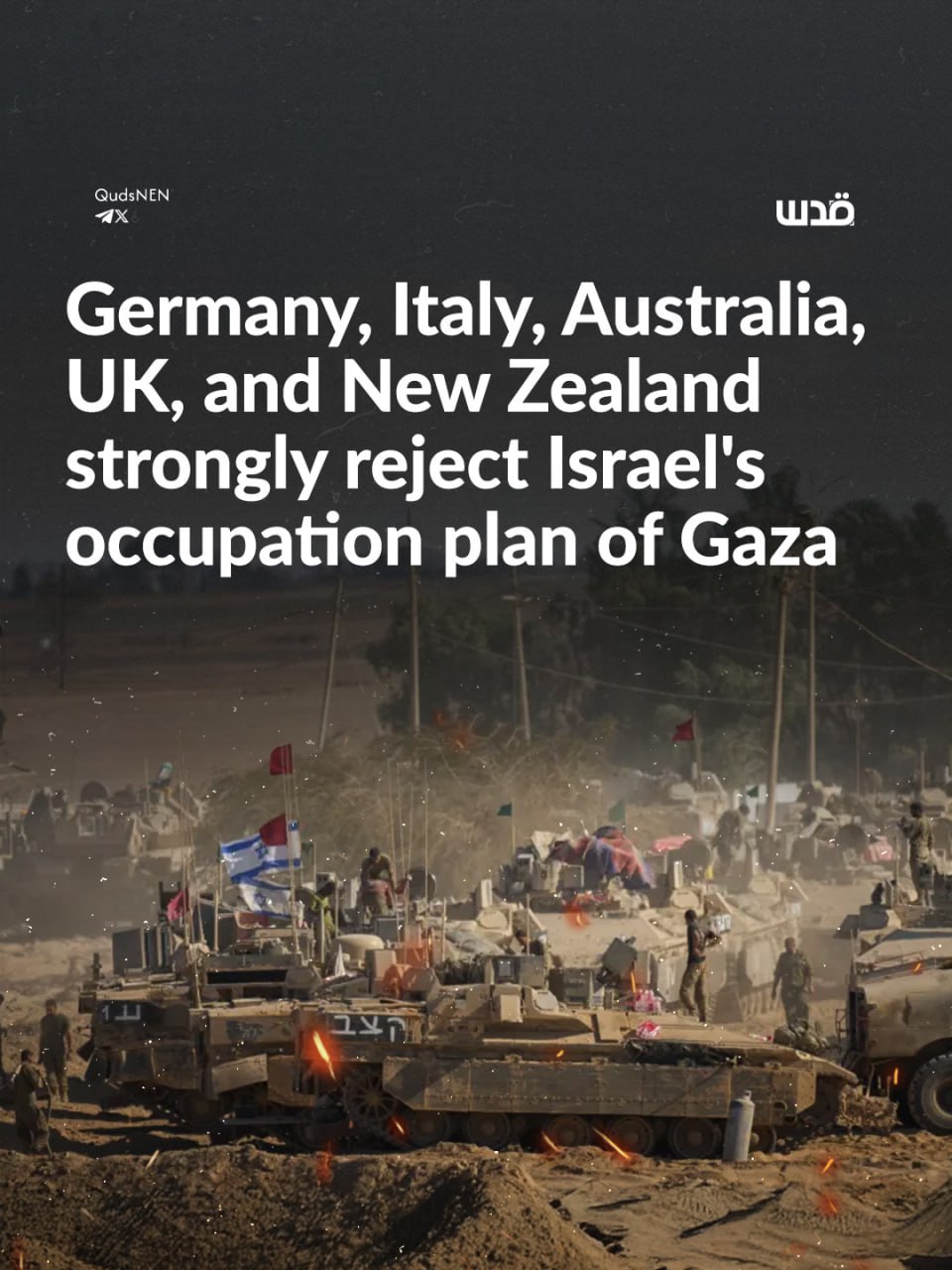
In a joint statement, the foreign ministers of Australia, Germany, Italy, New Zealand, and the United Kingdom strongly condemned Israel’s decision to occupy the Gaza City.

They warned that the move would exacerbate the already dire humanitarian crisis, endanger the lives of hostages, and increase the risk of mass civilian displacement.

The statement emphasized that any attempts at annexation or settlement expansion would constitute a violation of international law.


The ministers called for the immediate release of all captives by Hamas and urged Israel to take concrete steps to facilitate the delivery of humanitarian aid to those in need.

Continue reading
20 States Call on Israel to Lift Blockade on Gaza Aid

More than 20 countries and the EU have urged Israel to lift blockade of aid delivery into Gaza Strip and enable the UN and humanitarian organizations to work independently and impartially.

In a joint statement, foreign ministers of the countries including Australia, Canada, Japan and France, stressed that the population faces starvation and Gaza’s people must receive the aid they desperately need.

Recalling that Israel’s security cabinet is said to have approved a new model for delivering aid into Gaza, which the UN and our humanitarian partners cannot support, the statement stressed that humanitarian principles matter for every conflict around the world and should be applied consistently in every warzone.

“ Humanitarian aid should never be politicised, and Palestinian territory must not be reduced nor subjected to any demographic change,” the readout said.

“As humanitarian donors, we have two straightforward messages for the Government of Israel: allow a full resumption of aid into Gaza immediately and enable the UN and humanitarian organisations to work independently and impartially to save lives, reduce suffering and maintain dignity.”

The statement reiterated an immediate return to a ceasefire and working towards the implementation of a two-state solution, “the only way to bring peace and security to Israelis and Palestinians and ensure long-term stability for the whole region.”

The joint statement was signed by EU officials and the foreign ministers of Australia, Canada, Denmark, Estonia, Finland, France, Germany, Iceland, Ireland, Italy, Japan, Latvia, Lithuania, Luxembourg, the Netherlands, New Zealand, Norway, Portugal, Slovenia, Spain, Sweden and the UK.

Israel, which abandoned the Jan. 19 ceasefire with Hamas, has kept all crossings into Gaza closed to food, medical, and humanitarian aid since March 2, deepening an already severe humanitarian crisis in the enclave.

Israeli Prime Minister Benjamin Netanyahu’s office said Sunday that Tel Aviv will permit the entry of “a basic quantity of food” for Gaza’s population “to prevent the emergence of a hunger crisis.”

He said a famine “could jeopardize the continuation of Operation Gideon’s Chariot,” referring to a new phase of Israel’s ground offensive in northern and southern Gaza.

The Israeli army has pursued a brutal offensive against Gaza since October 2023, killing more than 53,000 Palestinians, most of them women and children according to Anadolu.

Continue reading
‘Zionism a Mistake’ – Israeli Historian Tom Segev

Tom Segev, one of Israel’s most renowned historians, has broken a decades-long silence. On his 80th birthday, he declared that Zionism—Israel’s founding ideology—was a mistake.

In a deeply personal interview with Haaretz, Segev said, “Zionism is not such a great success story. It also doesn’t provide security to Jews. It’s safer for Jews to live outside Israel.” He added that Zionism created myths instead of solutions.

Born in Jerusalem in 1945 to Jewish German parents who fled the Nazis, Segev has spent more than 50 years researching Israel’s history. His books include 1967, The Seventh Million, and Soldiers of Evil, all known for challenging Israeli narratives.

In the interview, Segev shared a painful truth about his father’s death. He grew up believing his father was killed by an Arab sniper during the 1948 war. “I was able to say that he was killed during the War of Independence and that I was a war orphan.”

But later, Segev’s sister revealed a different story. Their father had actually died in a freak accident—falling from a drainpipe while trying to deliver coffee to guards. He stated that he was brought up on a lie.

This moment of reckoning made him question everything—including the stories Israel tells about itself.

Segev now says the Zionist project was never meant for people like his parents. “My parents started to plan their return to Germany”, he revealed. “They were never Zionists and they wanted to go home. A month after the last letter my father wrote to a friend about how much he wanted to go back – he was killed.”

Despite growing up in Israel, Segev never fully embraced Zionist ideals. He stressed that much of what Israelis were told was myth.

In his academic work, Segev often turns to documents rather than oral testimonies. He famously challenged former Prime Minister David Ben-Gurion in a 1968 interview, questioning the idea that Ben-Gurion became Zionist at age three.

Segev believes the Holocaust has been politically weaponized. In The Seventh Million, he argued that instead of teaching democracy and human rights, Israel used the Holocaust to fuel fear and justify wars.

He also criticized internal discrimination within Israeli society. In his book 1949: The First Israelis, Segev exposed how Jewish colonial settlers from Arab countries were pushed into camps, while Europeans were given hotels.

Segev insists he isn’t ideological. “People have also said I am anti-Zionist, but I am not an ideologue and not a philosopher, and I don’t think in terms of ideologies,” he says. “It was said that I want to shatter myths. But that’s not true, either. I was not part of the ‘New Historians’ but rather of the ‘First Historians.’ With respect to the state’s establishment there was no history here – just mythology and a great deal of indoctrination. In the 1980s we opened documents in the archives and said, ‘Wow, this isn’t what we were taught in school.’”

“We need to remember that the majority of the Holocaust survivors did not come to live in Israel and that the majority of Jews in the world are not coming to Israel”, he stressed. “They can, but they don’t want to live in this country. So Zionism is not such a great success story. It also doesn’t provide security to Jews. It’s safer for Jews to live outside Israel,” as reported in the Quds News Network.

Continue reading
Germany Backs Egypt’s Gaza Reconstruction Plan

Germany on Friday expressed strong support for the Arab League’s reconstruction plan for Gaza, which stands as an alternative to US President Donald Trump’s proposed US takeover of Gaza.

“The German government welcomes the Arab League’s plan for the reconstruction of the Gaza Strip,” Chancellor Olaf Scholz’s spokesman Steffen Hebestreit told a news conference in Berlin.

“The plan includes many valuable elements we can build upon. Constructive discussions should begin immediately,” he said, adding that Berlin maintains that Gaza must not pose any security threat to Israel in the future.

At the same news conference, German Foreign Ministry spokesman Sebastian Fischer stated that the plan contributes significantly to a sustainable solution by addressing political and security concerns in the Gaza Strip.

“We also believe that it is appropriate to rely on the Palestinian Authority as a key player in this process,” Fischer said. “The plan supports the long-term goal of a two-state solution and also a resumption of direct negotiations between the Israeli and Palestinian sides. We also support this,” he added.

When asked about Germany’s position on other plans and proposals, such as the relocation of Palestinians to neighboring countries, Fischer firmly stated that “forced relocations and expulsions are always contrary to international law.”

Continue reading