Albanese: Israel, West Must Pay For Gaza Rebuild

The UN special rapporteur on the occupied Palestinian territories said Friday that Israel should pay for the reconstruction of Gaza together with the US and other main arms provider countries.

Speaking at an event in London on the situation of human rights in the occupied Palestinian territories, Francesca Albanese noted that there should be a full assessment of complicity over the genocide in Gaza, stressing that not just Israel but all the states aiding genocide should face sanctions.

“States must cut ties with Israel, must stop aiding and assisting a state that maintains an unlawful occupation,” said Albanese.

Touching on the accountability, the special rapporteur said that Israel should pay for the reconstruction of Gaza, together with the US, Germany, and Italy, who are the main weapons providers according to Anadolu.

She went on to say that there should be a robust investigation into the UK’s complicity with this genocide through its services that have been provided from Cyprus bases.

“If Israel do not want to be accused of colonial practices, it should not behave as a colonial power, as a colonial entity, taking land, displacing the people,” she added.

Saying that the two years of genocide in Gaza is “the combination of 60 years of impunity,” she noted that it is not going to stop “unless things change in London or in Rome, or in Berlin, or in Paris.”

‘No robust response against sanctions’

Touching on US sanctions against her, Albanese said that with the sanctions, Albanese herself, International Criminal Court (ICC) judges, or Palestinian human rights groups are “considered like criminals.”

“There has not been robust enough for response, or a robust enough response to this to have the sanctions lifted,” she said.

Saying that since she is banned from traveling to the US, she cannot present her reports to the UN General Assembly, while also adding that she also cannot open a bank account.

UN experts in August warned that US sanctions on Albanese threaten the human rights system, a month after the US announced it imposed sanctions on the special rapporteur for her “efforts to prompt” ICC action against US and Israeli officials.

In August, the US also sanctioned four ICC officials for authorizing the arrest warrants for Israeli Prime Minister Benjamin Netanyahu and former Defense Minister Yoav Gallant, accusing both officials of war crimes and crimes against humanity in the Gaza Strip.

About 250,000 families are currently living in displacement camps across the Gaza Strip, many facing cold weather and flooding inside fragile tents, according to the Civil Defense.

Although a ceasefire took effect on Oct. 10, living conditions in Gaza have not improved, as Israel continues to impose strict restrictions on the entry of aid trucks, violating the humanitarian protocol of the agreement.

Israel has killed more than 70,000 people, mostly women and children, and injured over 171,000 others in attacks in Gaza since October 2023, which have continued despite the truce.
Continue reading
London, Censorship and Banksy!

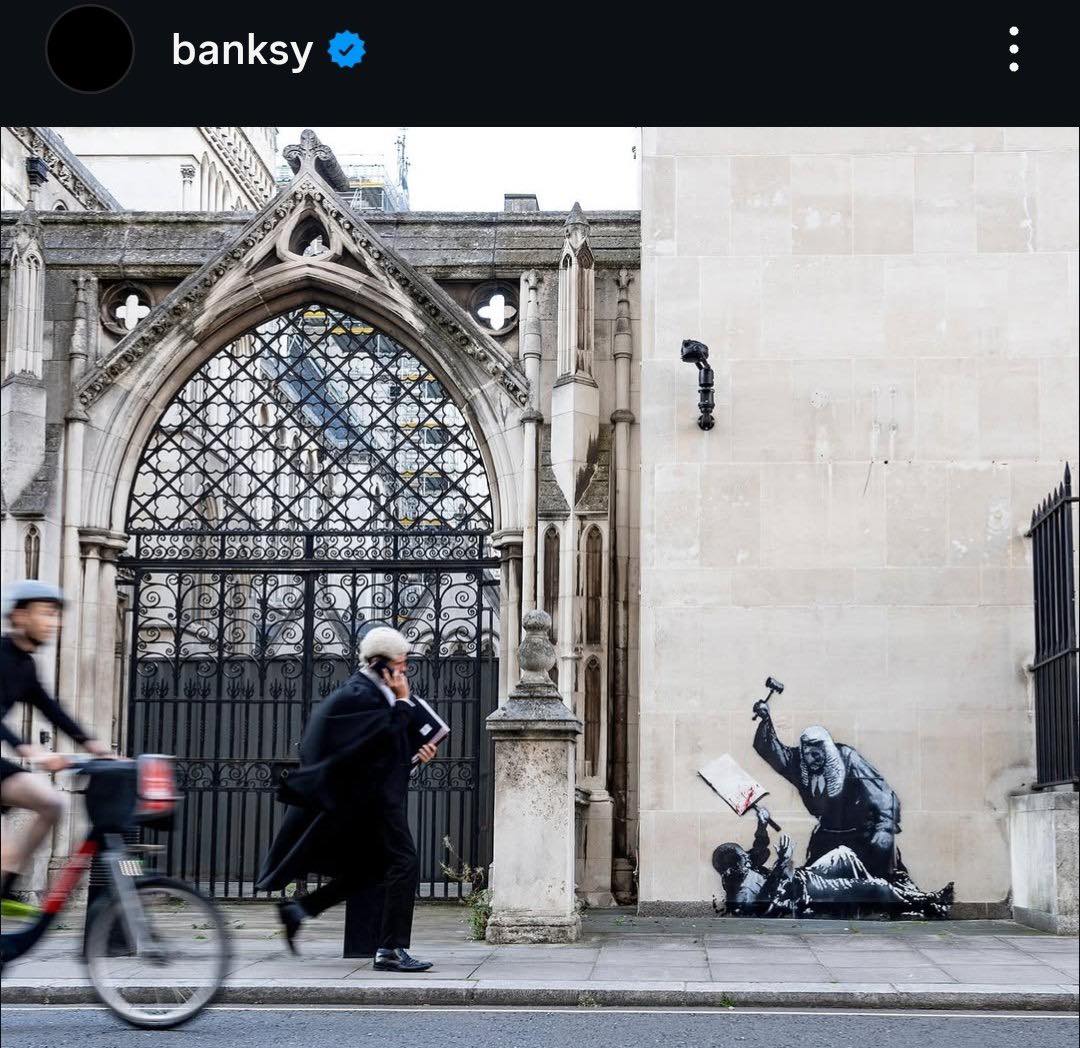
A new artwork by Banksy appeared on the walls of London’s Royal Courts of Justice on Monday. It showed a judge using a gavel to beat a defenseless protester. Within hours, guards covered it up, proving Banksy’s point.

Banksy confirmed the piece was his by posting a photo on Instagram. The image quickly went viral. But at the court itself, workers and guards rushed to block the public from seeing it.

Security guards stood in front of the wall as soon as the painting appeared. Witnesses said they tried to stop people from taking photos. Later, staff arrived with materials to cover it.

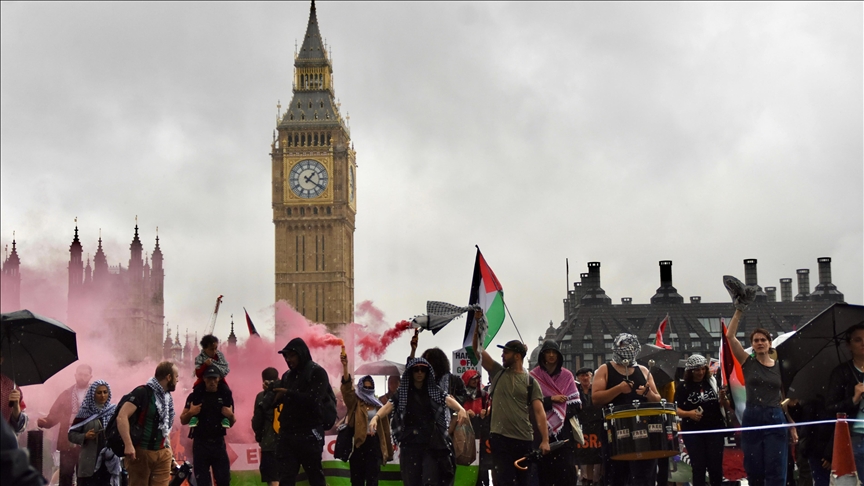
The image was believed to reference the state’s response to pro-Palestine demonstrations. Police detained nearly 900 people during Saturday’s protest against the banning of the peaceful activist group Palestine Action.

Defend Our Juries, a group opposing the crackdown, linked the artwork to growing anger over censorship and arrests. A spokesperson said:

“When the law is used as a tool to crush civil liberties, it does not extinguish dissent – it strengthens it. As Banksy’s artwork shows, the state can try to strip away our civil liberties, but we are too many in number and our resolve to stand against injustice cannot be beaten.”

The protester in Banksy’s work is shown lying on the ground, holding a white placard. A red smear on the placard looks like blood. In Banksy’s Instagram post, a lawyer and a cyclist pass by the scene without noticing.

The HM Courts and Tribunals Service justified the cover-up. They said the court is a listed building. Officials are “obliged to maintain its original character.”

But critics argue that the decision was not about heritage. They say it was a political act meant to silence a powerful message.

Banksy is no stranger to political art. The anonymous artist has painted on the Israeli apartheid wall in the occupied West Bank. His works often target injustice, war, and state violence.

In May, he posted an image from Marseille of a stenciled lighthouse alongside the words: “I want to be what you saw in me.” The work was immediately vandalized.

Continue reading
Palestinian State Out of Gaza Horrors?

It is hoped that the appeals for more recognitions of the Palestine state in the UN General Assembly in New York will increase pressure on Israeli Prime Minister Benjamin Netanyahu and his coalition partners to drastically change course and make the Palestinian state a reality.

Notwithstanding the US neutrality recognition, at least as things stand now, coupled with the increased efforts from the European Union, Israel stands to be ostracized in the international community.

One point remains rather curious however, is UK’s Premier Keir Starmer’s condition being that Britain will recognize a Palestinian state if Israel refuses to accept a ceasefire on Gaza.

For all intents and purposes, it seems what Starmer is interested in, is basically a ceasefire and then Palestinian state, but then again this is for the British government to ponder on in the face of the rolling train of recognitions.

But what does this recognition entails in practical terms? It basically means the stalled Oslo negotiations since 1993 are to be revived again, and if need be on different terms than what was envisioned before. Here one says different terms because the Oslo agreements were guaranteed by the world powers and nothing came out of them.

Indeed much more must be done by the world community, especially that now, we have a more difficult and intransigent Israeli government which needs above all else to accept, at least in principle, the two-state solution.

But also and at the same time time, the recognition of a Palestinian state entails the recognition of a Palestinian leadership with the ability and responsibility to represent the Palestinian people.

One supposes there is a general consensus on that now since the current PNA has become defunct and its current leadership obsolete in front of the immense responsibilities and tasks ahead.

In brief, it would be a mere rhetorical smokescreen to call on recognizing a Palestinian state without actually paving the way for the creation of such a state by totally changing the current PNA leadership via honest elections supervised by the international community and which represent the will of the Palestinian people.

Of course one cannot but insist, that the Arab role in the newly envisaged peace process is crucial. One also cannot help but think that the role of Saudi Arabia will be crucial for the next phase. For  start, the precondition of Saudi for any form of dealings with Israel, is for the latter to accept the principle of two-state solution, and in fairness it must be clarified that the French-Saudi initiative which led Emmanuel Macron to recognize a Palestinian state was supposed to be declared in in Paris.

But now due to this effort, it has become an international case at the UN. Israel has failed with all of its endeavors to normalize relations with Saudi Arabia without giving any concessions, mainly the acceptance of the precondition of the recognition of the two-state solution, and now it is facing both the pressure of the international community and the condition of the Saudis, especially they shift their strategy from the UAE to India, and without the Saudis they will have nothing in the Gulf.

But still there is the bleeding wound of Gaza, the wound which can never start to heal without a collective Arab effort led by the Saudis which takes back to the conundrum of Israel’s acceptance of the principle of Palestinian state. Only then can Saudi Arabia lead the Arab effort, to first of all disarm Hamas, give an amnesty to Hamas members, and exile its leadership out of Gaza, in the hope of rehabilitating the strip and start in earnest the reconstruction efforts.

Continue reading
Britain to Recognize Palestine, Israel Cries Wolf

Israel rejected a British government decision on Tuesday to recognize a Palestinian state in September unless Tel Aviv takes “substantive steps to end the appalling situation” in Gaza, calling the move a “reward for Hamas.”

“The shift in the British government’s position at this time, following the French move and internal political pressures, constitutes a reward for Hamas and harms efforts to achieve a ceasefire in Gaza and a framework for the release of hostages,” the Israeli Foreign Ministry claimed in a statement as reported by Anadolu.

British Prime Minister Keir Starmer said his government would move to recognize a Palestinian state at the UN General Assembly in September if Israel fails to take “substantive steps to end the appalling situation in Gaza, agree to a ceasefire and commit to a long-term sustainable peace, and revive the prospect of a two-state solution.”

Last week, French President Emmanuel Macron confirmed that Paris would officially recognize a Palestinian state during the UN General Assembly in September.

So far, 149 of the UN’s 193 member states have recognized Palestine – a number that has steadily risen since Israel began its war on Gaza in October 2023.

The British decision comes amid mounting domestic and international pressure on Israel to end its genocidal war in Gaza and allow humanitarian aid into the besieged enclave.

The Israeli army has pursued a brutal offensive on Gaza since Oct. 7, 2023, killing over 60,000 Palestinians. The relentless bombardment has devastated the enclave and led to food shortages.

On Monday, Israeli rights groups B’Tselem and Physicians for Human Rights-Israel accused Israel of committing genocide in Gaza, citing the systematic destruction of Palestinian society and the deliberate dismantling of the territory’s healthcare system.

Last November, the International Criminal Court issued arrest warrants for Israeli Prime Minister Benjamin Netanyahu and his former Defense Minister Yoav Gallant for war crimes and crimes against humanity in Gaza.

Israel also faces a genocide case at the International Court of Justice for its war on the enclave.

Continue reading
Hanthala Outlasts Naji Al Ali as He Predicted

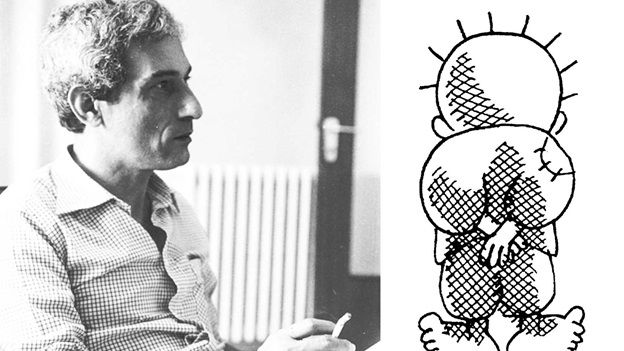
By the time he died on August 29, 1987, he had a collection of 40,000 cartoons. Naji Al Ali, the famous Palestinian cartoonist, had been in a coma for five weeks after being shot in the head by a gunman outside the London offices of Al Qabas newspaper on July 22.

Although till now nobody is certain of who killed him, Al Ali’s death was a result of decades of rebelliousness against the Arab status quo, his longing for change in Arab society, and the introduction of democracy.

He felt this would be translated into political strength to fight for the return of Palestine. Al Ali had the knack of weaving politics and culture together. His drawings had distinct messages: they were contextual, fighting against injustice and oppression in the Arab world.

Naji Al Ali was one of a kind. In few simple lines, he could depict the drama of a whole population and convey messages sometimes so sharp and rich in symbols that the viewer’s attention was effortlessly drawn to understanding the hidden meanings.

Though his messages were politically-driven, he always maintained he was apolitical and that politics did nothing for him.

This is despite the fact that his life had come to be dictated by a series of political actions. His expulsion, along with his family, to Lebanon in 1948, and ending up in Ain Al Hilweh camp, was but the first of these actions. Al Ali was only 10 or 11 when he was forced out of Shajara, a village of 400 that were destroyed by Israel.

Given a chance

In the 1950s, before being given the chance to go to Kuwait, his life was immersed in politics. He took part in demonstrations and served time in Lebanese jails. During this time, he started drawing on the walls of the camp and in prison.

“I felt within me a need for a different medium to express what I was going through,” he used to say. He often said he felt it was harder to censor a cartoon than an article. Al Ali’s talent was first discovered by Ghassan Kanafani, the Palestinian writer and activist killed by the Israelis in the early 1970s. He was visiting the camp at the time, came upon Al Ali’s work, took a sample and latter published them in Al Hurriya, the magazine he was working for.

This may have given Al Ali the opportunity to work in Kuwait in 1964 at the Al Talieh magazine, a now well-established weekly, representing the voice of the nationalists. There, he made his professional career as a cartoonist, though he did other things as well. In 1971 he returned to Lebanon where he worked in the well-respected Al Saffir.

It was in Lebanon he found the best and most productive years of his life, he would later write. “There, surrounded by the violence of many an army, and finally by the Israeli invasion (1982), I stood facing it all with my pen every day, I never felt fear, failure or despair, and I didn’t surrender. I faced armies with cartoons and drawings of hope and flowers, hope and bullets.”

But, contrary to this cheerful attitude, one also felt there was a degree of anger, mixed with cynicism and despair within Naji Al Ali that always prompted him in his cartoons; it was the failure of action, of ineptitude and the lack of Arab resolve.

That’s why he may have created the Hanthala cartoon that always came to appear in his sketches from the 1960s onwards. In fact, in an almost perceptive vision of his death, Ali would say Hanthala would outlast him and would live long after he was was dead.

Hanthala, whose name means bitterness in Arabic , represents the aspirations of the camp refugees and the right of return. We never see his face as he is never shown facing the reader.

Naji Al Ali described him as a bare-footed child with spiky hair, with his hands firmly clasped behind his back as a symbol of rejection to what happened to the Palestinians. He will only turn his head, when Palestine is regained. Hanthala will remain 10 years old until he returns to the homeland, when he will start growing up again.

After 1982, Naji Al Ali went back to Kuwait to work in Al Qabas, but there was no let down in his political message. In 1985, he was expelled, but continued to work in the newspaper’s London office.

His cartoons continued to appear in many daily newspapers across the region in Kuwait, United Arab Emirates, Egypt, Tunisia and Lebanon.

Did Al Ali’s untimely death at the age of 51, mean Hanthala will never turn his head, or will he wait for someone to redraw him.

Whichever the case, and in the spirit of his creator, he will continue with his back to the audience until Palestine is liberated.

This article, written by me, is reprinted here from the archives of Gulf News.

Continue reading