Palestinian State Out of Gaza Horrors?

It is hoped that the appeals for more recognitions of the Palestine state in the UN General Assembly in New York will increase pressure on Israeli Prime Minister Benjamin Netanyahu and his coalition partners to drastically change course and make the Palestinian state a reality.

Notwithstanding the US neutrality recognition, at least as things stand now, coupled with the increased efforts from the European Union, Israel stands to be ostracized in the international community.

One point remains rather curious however, is UK’s Premier Keir Starmer’s condition being that Britain will recognize a Palestinian state if Israel refuses to accept a ceasefire on Gaza.

For all intents and purposes, it seems what Starmer is interested in, is basically a ceasefire and then Palestinian state, but then again this is for the British government to ponder on in the face of the rolling train of recognitions.

But what does this recognition entails in practical terms? It basically means the stalled Oslo negotiations since 1993 are to be revived again, and if need be on different terms than what was envisioned before. Here one says different terms because the Oslo agreements were guaranteed by the world powers and nothing came out of them.

Indeed much more must be done by the world community, especially that now, we have a more difficult and intransigent Israeli government which needs above all else to accept, at least in principle, the two-state solution.

But also and at the same time time, the recognition of a Palestinian state entails the recognition of a Palestinian leadership with the ability and responsibility to represent the Palestinian people.

One supposes there is a general consensus on that now since the current PNA has become defunct and its current leadership obsolete in front of the immense responsibilities and tasks ahead.

In brief, it would be a mere rhetorical smokescreen to call on recognizing a Palestinian state without actually paving the way for the creation of such a state by totally changing the current PNA leadership via honest elections supervised by the international community and which represent the will of the Palestinian people.

Of course one cannot but insist, that the Arab role in the newly envisaged peace process is crucial. One also cannot help but think that the role of Saudi Arabia will be crucial for the next phase. For  start, the precondition of Saudi for any form of dealings with Israel, is for the latter to accept the principle of two-state solution, and in fairness it must be clarified that the French-Saudi initiative which led Emmanuel Macron to recognize a Palestinian state was supposed to be declared in in Paris.

But now due to this effort, it has become an international case at the UN. Israel has failed with all of its endeavors to normalize relations with Saudi Arabia without giving any concessions, mainly the acceptance of the precondition of the recognition of the two-state solution, and now it is facing both the pressure of the international community and the condition of the Saudis, especially they shift their strategy from the UAE to India, and without the Saudis they will have nothing in the Gulf.

But still there is the bleeding wound of Gaza, the wound which can never start to heal without a collective Arab effort led by the Saudis which takes back to the conundrum of Israel’s acceptance of the principle of Palestinian state. Only then can Saudi Arabia lead the Arab effort, to first of all disarm Hamas, give an amnesty to Hamas members, and exile its leadership out of Gaza, in the hope of rehabilitating the strip and start in earnest the reconstruction efforts.

Continue reading
French Rabbi Receives Israeli Death Threats

French Rabbi Delphine Horvilleur is facing death threats and intense backlash after criticizing Israeli ministers for justifying the starvation of civilians in Gaza.

Horvilleur, a leader of the Liberal Jewish Movement in Paris and editor of the Jewish magazine Tenou’a, wrote last week that “starving innocents or condemning children neither relieves pain nor avenges the dead.” Her comments targeted Israeli ministers who publicly defended blocking humanitarian aid to Gaza.

In her editorial, she wrote, “Without a future for the Palestinian people, there is no future for the Israeli people either.” Zionists swiftly responded with online abuse, including calls for her execution. Many threats were gender-based, claiming women shouldn’t speak or hold religious authority.

According to Haaretz, Horvilleur had been a prominent defender of Israel in French media, especially after the October 7 military operation. She said, “I’m too Zionist for some, not Zionist enough for others. I’m caught in the crossfire.”

She confirmed that French police are now monitoring her social media accounts due to the volume and severity of threats.

In a show of solidarity, 42 French intellectuals — both Jewish and non-Jewish — signed an op-ed in La Tribune du Dimanche. They denounced the Israeli government for eroding ‘democracy’, threatening detainees, expanding settlements, and preparing for the annexation of occupied territories.

However, Meir Ben Haim, French spokesperson for Israel’s Otzma Yehudit party, accused Horvilleur and her allies of “violating Jewish tradition.” He warned, “The price will be blood,” according to the Quds News Network.

Continue reading
France Condemns Re-occupation of Gaza

French foreign minister “firmly” condemned on Tuesday Israel’s new plan to fully occupy Gaza Strip.

“It is a very firm condemnation, because it goes against international law,” French Foreign Minister Jean-Noel Barrot spoke to the broadcaster RTL.

Barrot noted that Israel’s recently announced plan to fully occupy the Gaza Strip and take control of all humanitarian aid is “not acceptable.”

“The urgent priority is, of course, a ceasefire, but also the massive and unhindered access of humanitarian aid, because the Gaza Strip—the Palestinians living there—are lacking in a dramatic way,” he added.

Barrot reaffirmed that they are working to defend the international humanitarian law alongside other countries.

“Even when there is war, we respect a certain number of rules: we do not target civilians, we do not attack humanitarian workers, and we ensure that humanitarian aid can always reach the people,” he said, reiterating the need to respect the “integrity” of laws of war.

Barrot further highlighted the risk of famine in Gaza, calling for an access to humanitarian aid.

“France calls on Israel to implement a ceasefire, to allow humanitarian aid to reach the population within the enclave of Gaza,” he added.

Barrot also confirmed that France could recognize the State of Palestine once the other countries do the same and commitments are made according to Anadolu.

Continue reading
Paris Exhibit Itches Out GAZA

As Israel’s continues its devastating war and relentless humanitarian blockade, the ancient Gaza Strip – once a radiant Mediterranean hub of commerce, culture, and religious coexistence – now faces a deeper erasure: not just from maps, but from the world’s collective memory.

A new exhibition at the Institut du Monde Arabe in Paris, titled ‘Gaza’s Saved Treasures: 5,000 Years of History,’ seeks to resist that disappearance. Running from April to November this year, the show presents around 100 archaeological masterpieces that illuminate Gaza’s extraordinary legacy as a crossroads of civilizations – from the Bronze Age to modern times.

The exhibition is both a celebration and a lament: a tribute to Gaza’s millennia-old cultural wealth, and a sober reckoning with what has been lost to Israel’s deadly occupation.

Gaza’s strategic location has always made it a coveted prize for empires – Egyptian, Persian, Roman, and Ottoman – but it was also a channel for connection, where cultures and religions converged.

The exhibit – with amphorae, oil lamps, coins, statuettes, and mosaics on display – tells the story of Gaza as a vital Mediterranean port and cultural meeting point.

Its history – shaped by Canaanite, Egyptian, Philistine, Neo-Assyrian, Babylonian, Persian, Greek, Roman, Byzantine, Islamic, and Crusader influences – reveals a city that flourished at the heart of ancient trade and intellectual exchange.

Among the most striking items is a dazzling Byzantine mosaic from Jabaliya, part of an ecclesiastical complex reflecting Gaza’s early Christian heritage.

Nearby, amphorae once used in the wine trade testify to the city’s crucial role in Mediterranean commerce, while figurines blend Egyptian motifs with Hellenistic gods, echoing a world of syncretism and porous cultural boundaries.

Race against oblivion

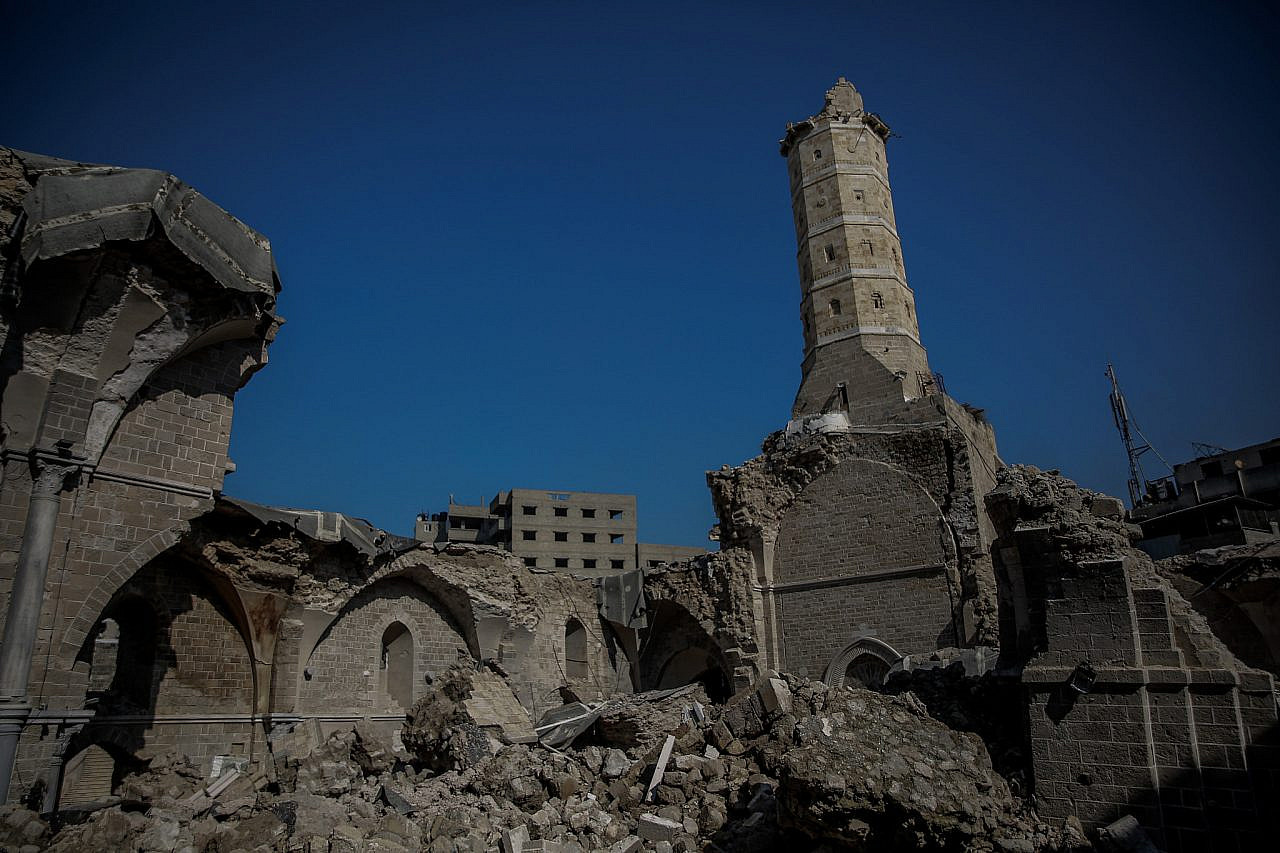
Since the start of Israel’s war on Gaza in October 2023, the territory’s cultural heritage has suffered catastrophic damage.

According to UNESCO, nearly 70 cultural sites have been destroyed or severely damaged, including the historic Greek Orthodox Church of Saint Porphyry – one of the oldest active churches in the world.

Where once stood mosaics, temples, and centuries-old tombs, there are now craters and rubble due to Israel’s ongoing bombardment. In this context, the exhibition in Paris becomes something urgent and defiant: a safeguard for memory, a museum in exile.

Much of the exhibition’s content is drawn from a trove of over 500 artifacts housed since 2007 at Geneva’s Museum of Art and History, entrusted to Switzerland by the Palestinian National Authority for safekeeping.

Many of the works stem from Franco-Palestinian excavations launched in 1995, supplemented by pieces from private collections – some of which are being shown publicly for the first time.

The curators have taken care not to separate Gaza’s ancient grandeur from the present-day suffering inflicted by Israel.

One dedicated section of the exhibition uses satellite imagery and field reports to map the devastation inflicted on cultural heritage since 2023.

French, Swiss, and Palestinian scholars have contributed rare documentation – including early 20th-century photographs of Gaza – that provide a visual archive of what once was and what may never return.

The exhibition makes no attempt to hide the political context. It explicitly refers to the destruction as part of “Israel’s brutal genocide,” anchoring the cultural annihilation in a broader system of occupation, blockade, and war.

By doing so, the Paris exhibition challenges the silence often surrounding cultural loss in war zones, raising questions about the responsibilities of international institutions and the politics of preservation as reported in Anadolu.

Continue reading
Destroyed Treasures of Gaza Speak of Muslim Heritage

 The ongoing war in Gaza, which started in October 2023, is the last phase of a long process of “eradicating Palestinian physical presence” in the Gaza Strip as well as erasing the Arab historical monuments, archaeological sites and sacral architecture. 

Gaza has been populated since the Bronze Age and it was an important commercial hub on a trade route that went from the southern tip of the Arabian Peninsula to the Mediterranean. The Gaza Port connected southern Europe and the Greco-Roman world with the incense trade from Hijaz.

Meanwhile, an exhibition opened last week at Paris’s Institut du Monde Arabe (IMA) that showcases a glimpse of Gaza’s archaeological heritage against the relentless warfare and destruction in the region. 

The event titled, “Rescued Treasures of Gaza: 5,000 Years of History,” will conclude on 2 November and it features over 130 objects that attest to the rich and complex history of Gaza as a crossroads of culture and commerce between Asia, Africa and Europe.

The density and distribution of its archaeological sites surveyed in 1944 at the end of the British Mandate and updated by the Palestinian Department of Antiquities in 2019 is eloquent.

A total of 130 sites to which should be added the remains of ancient cities and towns within the cities of Gaza, Khan Yunis, Dair Al Balah, Rafah and Bait Hanun, in tens of villages and in eight Palestinian refugee camps, noted a British-affiliated archaeologist Claudine Dauphin.

Bronze and Iron ages

Near the Wadi Gaza ford on the ancient coastal road linking Palestine and Egypt since the Bronze Age, the Way of Horus ancestor of the Roman Via Maris, lie two major Bronze Age sites. 

“Rescued from developers in 1997 and excavated by Pierre de Miroschedji on behalf of the French Centre National de la Recherche Scientifique [CNRS], Tel as-Sakan [3,400-2,350 BC] offered a 10 meter high stratigraphic section covering 1000 years of the Early Bronze Age and urban development under Ancient Egyptian impetus,” Dauphin explained.

The archaeologist added that excavated by the British Egyptologist Sir Flinders Petrie (1925-1942) in 1930-1934, Tel El Ajlun (1,900-1,200 BC) yielded in several Bronze Age buildings, including the “Palace”, five large deposits of gold jewelery (1,750-1,550 BC) ranking amongst the greatest Bronze Age finds in the Levant, now in the British Museum and the Rockefeller Museum in Jerusalem. 

In 1990 Professor Louise Steel of the University of Wales, Trinity St David’s, Lampeter sifted through the previously excavated soil, unearthing dozens of foundation cones stamped with the cartouche of Pharaoh Thutmosis III (1,481-1,425 BC). 

Excavations were resumed by a University of Gothenburg Swedish Mission directed by Peter Fisher in collaboration with Moain Sadeq of the Palestine Department of Antiquities in 1999 and 2000 focusing on Late Bronze Age levels, Dauphin underlined.

“Thus, from the 4th millenium BC ties were established with Egypt before it took Southern Palestine in the Early Bronze Age and ruled over the Egyptian Province of Canaan in the Late Bronze Age. Mentioned as ‘Hazattu’ in an Egyptian text dated to the reign of Pharaoh Thutmosis III [1,484-1,421 BC], Gaza itself was probably founded in the 3rd millennium BC,” Dauphin elaborated.

The archaeologist noted that its region was overseen by a pharaonic Egyptian agent, but the city itself was a kingdom whose ruler pledged allegiance to the pharaoh. 

Spectacular and also the earliest (Late Bronze to Early Iron Age, 13th-11th centuries BC) of that particular category of ancient coffins, were 50 anthropoid clay coffins found in 1973 in the excavations of a cemetery south of Dair Al Balah under Israeli occupation (1967-2005). 

Coil-built in local clay, the naturalistic face lids were moulded in relief displaying large Egyptian features- almond-shaped-eyes, arched eyebrows, straight noses and full lips, Dauphin said, noting that arms are often thin and stick like, crossed or holding objects such as lotus blossoms. 

Grotesque style coffins have eyes, eyebrows, nose, mouth, ears and beard that have been applied separately to the leather-hard clay, this being associated with the construction practices of the Philistines, the scholar underlined, adding that from the dates associated with the finds, it appears that the coffins originated with Egyptian influences in Canaan and were subsequently adopted by the Philistines. 

“These burials were typically associated with a large variety of expensive grave offerings: Cypriot, Cananite, Egyptian, Mycenaean and Philistine pottery storage jars, pithoi and cooking pots outside the coffin and smaller, higher quality Cypriot milk bowls, Egyptian alabaster cups, pilgrim flasks and juglets. flasks and juglets inside,” Dauphin highlighted. 

Endangering Gaza’s cultural heritage 

The cultural heritage of the Gaza Strip has been endangered both indirectly and directly continuously since the creation of Israel in 1948. 

It increased significantly during the Israeli occupation of the Gaza Strip (1967-2005) ; the June 2006 Israeli air raids and incursions in retaliations from 2008 until now. A danger to the cultural heritage of Gaza has been both indirect and direct. 

Indirect danger

Demographic growth in the Gaza Strip has led to the destruction of archaeological sites by bulldozers preparing the ground for building new homes for the growing population, widening main thoroughfares and providing sports ground for children and youths to evacuate stress, Dauphin said.

The archaeologist noted that, the damage inflicted from the air by Israeli bombs on a sports field at Mukheitin in the Northern Gaza Strip damaged a Byzantine ecclesiastical complex under the surface revealed revealed a small church.

“In the course of three excavation seasons [1998-2002], a three-aisled church, an offertory chapel, and a four-room building with a baptistery were uncovered. A 450 m2 mosaic pavement was restored by the Musée de l’Arles Antique [Museum of the Antique city of Arles in Provence],” the scholar said.

The archaeologist added that 17 Greek inscriptions from the 5th to the mid-8th century AD enabled the identification of this site with a funerary complex for a wealthy Christian family of Gaza. At Abu Baraqeh, the widening in 1999 of the coastal road in Dair Al Balaq revealed a small church on the shore. 

Its pavement was lifted by mosaic-restoration experts of the Museum of Arles in Provence and restored in France, the archaeologist added. 

Direct Danger

Direct danger is posed both by carpet-bombing and targeting. It is clear from the successive lists of destroyed cultural sites produced by UNESCO that IDF pilots have a predilection for targeting and deliberately target, which is more effective in radically destroying, as emphasized by Hamdan Taha, the founder of the Palestinian Department of Antiquities. 

“Since the start of the 2023-24 war on Gaza, Palestinian cultural heritage has undergone widespread destruction from Israeli targeting of ancient sites, historical and religious buildings, museums, cultural and academic buildings, public buildings, and infrastructure,” Taha said. 

“More than 100 archaeological sites, 256 historical buildings, many museums, hospitals, libraries, cemeteries, and over 100,000 archaeological objects, were destroyed” [“Destruction of Cultural Heritage in Gaza”, Jerusalem Quarterly 97, Spring 2024, 45-70],” Taha elaborated. 

Further damage leading to total eradication is caused by demolition, the movements of military vehicles and the installation of pumps, as at Anthedon (Tel Blakhiyyah) which had been listed on 2 April 2012 as a tentative World Heritage Site, Dauphin concluded.

Jordan Times

Continue reading