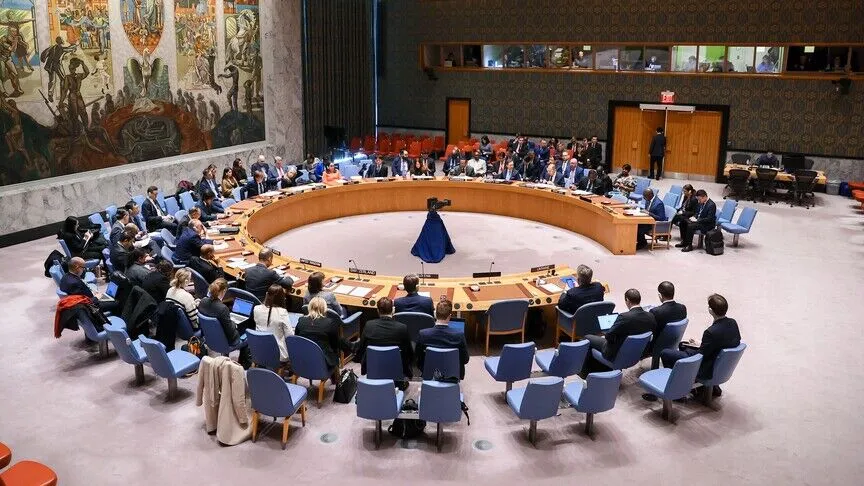
US Delegates Walk Out of a UN Meeting!

The US delegation walked out of the UN Security Council chamber during France’s remarks on Monday, accusing Paris of using the forum to deliver a politicized criticism over the US position on renewing UN High Commissioner for Human Rights Volker Turk’s mandate.

“I must point out that there is a member of this Council that will feign moral outrage and pretend to lecture the rest of us about every topic, whether it’s about the very conflict we’re discussing yet again today, or even those unrelated to international peace and security, like human rights,” US Representative to the UN Economic and Social Council Dan Negrea said.

Negrea criticized the French position on Turk’s mandate, saying: “This disingenuous grandstanding is tiresome, but we have tolerated it out of a sense of camaraderie and mutual respect as P5 members.”

“As such, we will not be affording them the benefit of listening to their politicized drivel until they renounce their condescending and disrespectful rhetoric and behave in a manner commensurate with their seat on this Council,” he added.

France’s UN envoy Jerome Bonnafont defended his country’s approach, saying: “We work to preserve this institution, its independence, its ability to act in service of the Charter and act to serve human rights and peace.”

The US delegation’s walkout protest came in response to a post on US social media platform X by the French mission in Geneva, saying: “The US used to be a beacon of human rights. Not anymore.”

Sharing the results of the voting for Turk’s mandate, the French mission argued that the US “stands alongside North Korea, Nicaragua, Mali & Russia, isolated. And the world no longer listens to it.”

Last week, the General Assembly approved Turk for a new term as UN high commissioner for human rights with 144 nations in favor and 13 abstentions. The US was among only 10 countries that voted against the appointment alongside Israel, Russia and Argentina. Anadolu

Continue reading
Albanese: ‘I Will Not Resign’

UN Special Rapporteur Francesca Albanese rejected calls for her resignation after French Foreign Minister Jean-Noël Barrot urged her to step down over her unwavering denunciation of Israel’s alleged war crimes.

She described the criticism as a smear campaign linked to her stance and affirmed that she will continue advocating for Palestinian rights despite mounting pressure.

Continue reading
Making Arabic The Future Language!

By Ali Abu Hablah

On December 18, 2025, the world celebrates World Arabic Language Day, an occasion that transcends mere celebration to touch upon the core of cultural and intellectual conflict in a rapidly changing world. This day commemorates the 1973 United Nations General Assembly resolution adopting Arabic as an official and working language of the UN system, in recognition of its historical and cultural significance.

This year’s celebration, organized by UNESCO at its headquarters in Paris, carries the theme:

“Innovative Pathways for Arabic: Policies and Practices for a More Inclusive Linguistic Future.” This theme reflects a growing awareness that the future of Arabic can no longer be secured through emotional rhetoric or historical glorification, but rather through public policies, educational strategies, and serious investment in technology and innovation.

Arabic is not simply a means of communication; it is the language of the Holy Quran, the language of the Prophet’s sayings (Hadith), and a repository of poetic, intellectual, and philosophical heritage. It is also a liturgical language for several Eastern churches. It is spoken today by more than 400 million people and is widespread throughout the Arab world and its surrounding regions, as well as in the diaspora across five continents. It is also one of the most influential languages ​​in the history of world languages.

For centuries, Arabic played a pivotal role as the language of science, politics, and administration. It contributed to the transmission of Greek and Roman knowledge to Europe and served as a bridge for dialogue between cultures along land and sea trade routes. However, this historical leadership is now met with a worrying paradox: Decline of Arabic’s presence in scientific research, higher education, and digital content, in favor of other global languages.

This decline is due to a complex set of factors, most notably the dominance of foreign languages ​​in universities, weak Arabization policies, a decline in translation activity, and the digital revolution, which Arabic has not adequately kept pace with. The widespread use of local dialects, especially through media and social media platforms, has also contributed to weakening the presence of Standard Arabic in the public sphere. This does not mean that the dialects themselves are responsible for the crisis, but rather that it reflects the absence of a balanced linguistic vision. In this context, the 2025 slogan acquires strategic significance, linking the future of Arabic to three fundamental paths:

First, language policies, as no language can be protected without clear legislation guaranteeing its presence in education, administration, and media.

Second, innovation and technology, given that the survival of a language today depends on its presence in artificial intelligence, software, search engines, and the digital content industry.

Third, linguistic inclusivity and equity, by making Arabic accessible to multilingual societies, supporting low-income groups, and promoting linguistic justice without compromising the integrity of the language or politicizing it ideologically.

UNESCO’s celebration of World Arabic Language Day constitutes a platform for global cultural dialogue, but at the same time, it places a heightened responsibility on Arab states and their educational and cultural institutions. The problem does not lie in a lack of international recognition, but rather in the absence of a comprehensive Arab linguistic project that restores Arabic to its role as a language of knowledge and production, not merely a language of heritage and celebration.

Ultimately, the Arabic language does not face an existential crisis, but rather a crisis of management and awareness. It must either be integrated into the core of the civilizational and developmental project, as a language of science, law, and technology, or it will remain confined to occasions and speeches. On World Arabic Language Day 2025, the question remains: Do we want Arabic to be the language of the past, or the language of the future?

Ali Abu Hablah originally wrote this article for the Arabic Addustour newspaper.

Continue reading
Break The Siege Yemeni-Jew Cries Out

A Yemeni-Jewish freelance journalist based in Paris has joined the 2025 Freedom Flotilla to Gaza, saying that “determination to do the right thing overrides fear” as she and fellow activists set sail to challenge Israel’s blockade of the enclave.

Noa Avishag Schnall said she identifies herself as “an anti-Zionist Arab Jew” and renounced the citizenship of “the European colony known as Israel, or ’48 Palestine.”

“I joined the 2025 Freedom Flotilla, both out of a sense of deep-rooted responsibility to my Palestinian siblings, currently enduring a genocide and ethnic cleansing at the hands of Israel, and as an escalation of decisive action to break Israel’s illegal siege of Gaza,” she told Anadolu.

Schnall criticized what she called the “neglect” of international obligations under the Geneva Conventions and the Universal Declaration of Human Rights, arguing that civilians are stepping in where governments have failed according to Anadolu.

“The real question is not why I joined, but rather why it’s left to civilians to act on the duties of nation-states,” she said. “Nation-states that are neglecting their clearly outlined obligations under the Geneva Conventions and the Universal Declaration of Human Rights.”

She accused governments of offering only “lip service to Palestinian sovereignty” and said that their “strongly worded statements” have failed to stop the ongoing violence in Gaza.

“In the past 24 to 48 hours, our comrades in the Sumud Flotilla have been illegally intercepted in international waters and subsequently kidnapped and taken to Israel or ’48 Palestine,” she said, referring to another humanitarian convoy stopped by Israeli forces.

Asked whether she feared for her safety, Schnall said: “Fear and worry are human responses, but determination to do the right thing overrides all of those things. What we might go through is nothing compared to what Palestinians go through every day.”

She described Israel as “an ethnostate with a racial and cultural hierarchy” and said Palestinians have faced “genocide and ethnic cleansing” for nearly eight decades.

“For people who are uncomfortable with the word genocide, I encourage them to read the key tenets of the definition,” she said, citing the Genocide Convention’s clauses on intent, bodily harm, and conditions of destruction.

She argued that the international community has a legal and moral responsibility to intervene before atrocities occur.

“States are obligated to act to prevent genocide before it actually happens, when there’s a plausibility that it’s apparent, which clearly there has been,” she said.

“So if people are uncomfortable with the term, I really ask them to reckon with what’s actually going on.”  

‘Mainstream media blackout’

Schnall said the flotilla also seeks to challenge what she described as a “mainstream media blackout” and amplify the voices of Palestinian journalists documenting the situation on the ground.

“We wish to break not only the legal Israeli siege on Gaza, but the mainstream media blackout on coverage,” she said. “Palestinian journalists are reporting on their own genocide.”

She concluded by calling on governments to enforce international law, halt arms deliveries to Israel, and end cooperation with what she described as “Israeli apartheid.”

“We want to stop arms deliveries to Israel by all countries that are themselves complicit,” she said.

“And we want to stop cooperation and support of any kind for Israeli apartheid and their genocide of the Palestinian people.”

Continue reading
Macron: Persona Non Grata in Israel

Israel signaled Thursday it will rebuff any visit by French President Emmanuel Macron over his country’s plan to recognize a Palestinian state.

Israeli Foreign Minister Gideon Saar said in a phone call with his French counterpart, Jean-Noel Barrot, that France’s move to recognize Palestinian statehood would “undermine stability in the Middle East and harm Israel’s national and security interests.”

“Israel seeks good relations with France, but France must respect Israel’s position when it comes to matters essential to its security and future,” Saar said during the call as cited by his office’s statement according to Anadolu.

He stressed that any visit by Macron “has no place” as long as France pursues the recognition move.

According to The Times of Israel news outlet, Prime Minister Benjamin Netanyahu has conditioned any visit by Macron on scrapping his move to recognize a Palestinian state.

There was no immediate French comment on Saar’s statement.

France and several European countries, including Belgium, the UK, Canada, and Australia, plan to recognize Palestinian statehood during the upcoming meetings of the UN General Assembly on September 8-23, joining 147 nations that already do.

Continue reading