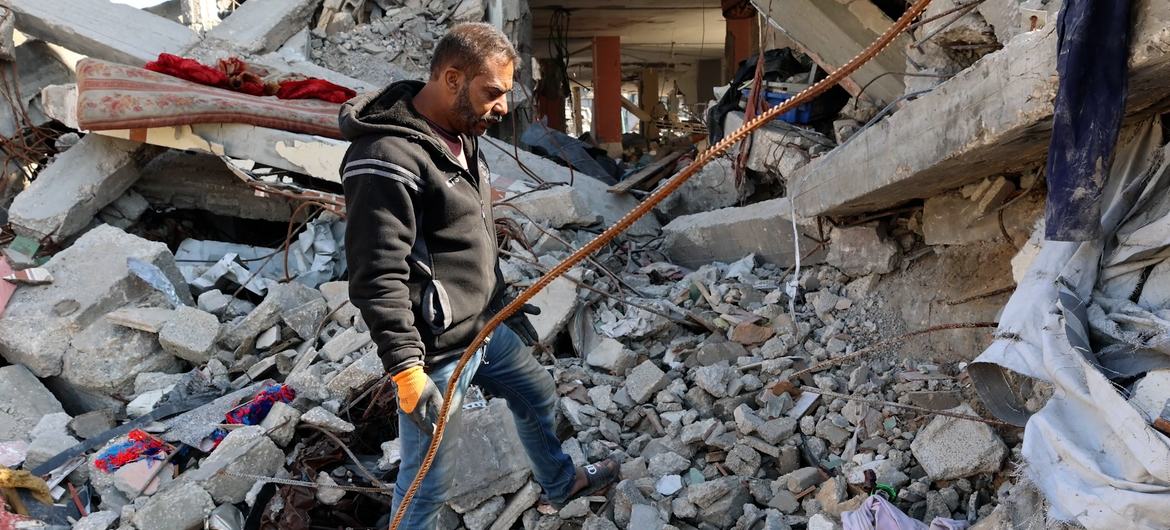
CROSSFIREARABIA – Only 726 bodies from under the rubble were uncovered in Gaza. This is a pitiful number since the Gaza ceasefire took effect four months ago on 10 October, 2025.
It is especially disheartening when it is estimated that between 8000 and 10,000 of civilians still lie under the mass tonnage rubble and debris destroyed by Israeli warplanes, tanks and armor.
The process of finding more bodies is especially hampered by Israel which refuses to allow heavy machinary such as excavators, bulldozers and cranes into the Gaza enclave.
These are essential to lift the massive concrete slabs of debris of destroyed high-rise buildings, homes and other civilian infrastructure. Civil defense teams often use rudimentary equipments like shovels, manual saws and their bare hands.
Figures are being revised all the time but the UNDP estimates that the Israeli mass destruction created 61 million tons of wreckage and debris that could take seven years to remove even under ideal conditions.
CROSSFIREARABIA – More than 9,500 Palestinians remain missing under the rubble of Gaza according to the Gaza Media Office.
This is while the Gaza Health Ministry stated Sunday, only 726 bodies were recovered since the 10 October, 2025 ceasefire deal was signed with Israel. This is because Israel refuses to allow equipment into the territory to help in the removal of the mass debris and rubble.
Local authorities are finding it very difficult to search for the bodies under the massive rubble created by Israel’s genocidal war on the strip that resulted in the killing of more than 72,000 Palestinians and the wounding of over 171,000 others.
The destructive war, started soon after 7 October, 2023 caused widespread destruction affecting 90% of the civilian infrastructure.
The UN estimates that approximately $70 billion would be required for the reconstruction of Gaza.
The UNDP estimates that Gaza lies in ruins at between 61 million to 68 million tons of rubble putting the enclave human development back by nearly 70 years.
The UN on Monday said it was encouraged by renewed Gaza ceasefire commitments, warning that recent violence risked undermining fragile progress, as recovery efforts – including a large-scale rubble removal project – slowly gain momentum across the war-ravaged enclave.
“We are encouraged that the parties have reaffirmed their commitments to implementing the ceasefire in Gaza and commend the steadfast efforts of the mediators,” said UN Spokesperson Stéphane Dujarric at the regular news briefing in New York.
“We do, however, remain concerned by all acts of violence in Gaza and the reported attacks and strikes that took place yesterday.”
Mr. Dujarric urged all sides to honour their obligations and avoid any action that could lead to renewed hostilities, reiterating the Secretary-General’s call for the release of the remains of all deceased hostages.
Over the weekend, Humanitarian Affairs chief Tom Fletcher wrapped up a visit to Gaza, where he met aid workers and inspected UN-supported projects, including a child nutrition centre, a hospital and a road clearance operation.
Debris removal underway
In Gaza City, the UN Development Programme (UNDP) has begun a major debris removal operation – the first phase of a comprehensive debris management plan aimed at restoring access to essential services such as hospitals and schools.
“Rubble represents a major challenge in Gaza, where the estimated amount is between 55 and 60 million tonnes,” said Jaco Cilliers, UNDP Representative in Palestine.
The UN agency taking the vital first step by clearing roads and recycling materials to pave new access routes and temporary facilities.
Dozens of diggers and other vehicles have been deployed along Al-Jalaa Street, where UNDP says it is working around the clock to open roads that have been blocked for months.
“This is a very arduous process and will take many years to complete,” Mr. Cilliers cautioned.
Aid crossings open
UN humanitarians also reported progress in aid delivery under the ceasefire, with the UN agency assisting Palestine refugees (UNRWA) expanding temporary learning spaces and partners resuming food parcel distributions in Deir al-Balah and Khan Younis.
“Over the weekend, we along with our partners continued to collect aid from the Kerem Shalom/Karem Abu Salem and Kissufim crossings. This included post-partum and hygiene kits, medical supplies, fuel, water and food,” Mr. Dujarric said.
He added that on Sunday, for the first time, Israeli authorities allowed the UN to deploy monitors at the Kissufim crossing.
“This is of course a welcome development, as it provides us with much-needed visibility into that segment of the pipeline,” Mr. Dujarric added according to UN News.
Around $70 billion will be needed to reconstruct Gaza and make it safe after two years of war, UN development experts said on Tuesday, while aid agencies reported that far too little aid is getting in to meet the needs of desperate Palestinians.
At just 41 kilometres long (25.4 miles) and two to five kilometres wide (1.2 to 3.1 miles), few places in the Gaza Strip had been left unscathed by the constant Israeli bombardment before the latest ceasefire came into effect haltingly last Friday.
According to the UN Development Programme Special Representative for the Palestinians, Jaco Cilliers, destruction across the enclave “is now in the region of 84 per cent. In certain parts of Gaza, like in Gaza City, it’s even up to 92 per cent.”
$20 billion needed now
Speaking from Jerusalem, the UNDP’s Mr. Cilliers highlighted the findings of the latest Interim Rapid Damage and Needs Assessment (IRDNA) on Gaza by the UN, the European Union and the World Bank, which estimated the damage at $70 billion.
To kickstart the massive operation, some $20 billion will be required in the next three years alone, he told journalists in Geneva.
The UN development agency is present in Gaza alongside humanitarian partners to provide immediate support to the enclave’s 2.1 million people.
This includes providing clean water, emergency employment, medical supplies, solid waste removal and making homes and public spaces safe by clearing rubble potentially hiding unexploded ordnance or the many thousands of missing Palestinians.
“We’ve already removed about 81,000 tonnes. That is about…3,100 truckloads,” Mr. Cilliers explained. “The majority of the debris removal is to provide access to humanitarian actors so that they can provide the much-needed aid and support to the people in Gaza. But we also help with hospitals and other social services that need to be cleared of debris.”
The UNDP official pointed to “very good indications” from potential donors in support of reconstruction from Arab States, but also from European nations and the United States “which has also indicated that they are going to be coming in supporting some of the early recovery efforts”.
Immediate aid essential
Important as reconstruction is for Gaza’s long-term future, UN humanitarians once again clamoured for the Israeli authorities to open all access points into Gaza, after the remaining 20 living Israeli hostages were freed on Monday and Palestinian prisoners were released from Israel.
The development followed the signing of a ceasefire deal between Hamas and Israel signed on Monday evening in Sharm El-Sheikh by US President Donald Trump, and the leaders of Egypt, Qatar and Turkïye.
Earlier on Monday, UN Secretary-General António Guterres welcomed the release of all living hostages from Gaza, two years since they were among some 250 taken during Hamas-led terror attacks in Israel on 7 October 2023.
Gaza City testimony
Speaking to UN News from Gaza, UN Children’s Fund (UNICEF) aid worker Tess Ingram described the story of one family displaced five times by the war:
“I met a family today, Mustafa and Syeda and their children, and they told me that they were among the lucky ones because while Mustafa was pulling rubble out from the building, that is their home, at least he said, we have a home.”
The family was relieved on Monday at the appearance of a water truck, Ms. Imgram told us: “But they live in fear that truck might not turn up today or tomorrow. She also can’t get the medicine she needs and her sons had to walk a really long way today just to buy the basics that she needed to make some bread.
“Families need absolutely everything right now. We need the hundreds of trucks a day that were promised to get into the Gaza Strip.”
On Tuesday, the focus shifted to the transfer from Gaza of all deceased hostages, an extremely difficult process overseen by the International Committee of the Red Cross (ICRC). It remains unclear how many deceased hostages will be transferred by Hamas.
“When it comes to the living hostages or Palestinian detainees – and believe me that’s a big issue for us – we actually don’t know, we know that we have to be ready,” said ICRC spokesperson Christian Cardon, adding that the complex search is getting underway today.
In the meantime, needs in Gaza remain enormous and “fluid”, aid teams report, with more than 300,000 Palestinians heading north to Gaza City since Friday, as the ceasefire agreement seemed to hold.
“The enthusiasm that came from the international community, from people on the ground that this was the beginning of the end of all the suffering and things would change rapidly, is just not being reflected on the ground, day in and day out. We are not getting enough aid in,” said UN Children’s Fund (UNICEF) spokesperson Ricardo Pires.
The Israeli authorities have agreed to allow 190,000 tonnes of relief supplies into Gaza and UN agencies and their partners are scaling up operations rapidly, but a far greater amount is needed overall, humanitarian agencies including the UN aid office, OCHA, have said repeatedly.
“Of course, we are advocating with everyone, and we were there in Sharm El- Sheikh yesterday as well, with 22 heads of state of government, who we are asking to help us push all buttons you can to get this up and running as soon as possible,” said OCHA spokesperson Jens Laerke.
Aid hub carnage
Aid teams continue to insist that there needs to be a move away from handing out lifesaving supplies from remote areas including non-UN aid hubs that are difficult to reach and where hundreds of Palestinians have been shot or injured.
“Most of the actors – ICRC included – were not able to organize sufficient distribution of aid inside Gaza,” said Mr. Cardon. “And what we’ve seen instead, it’s people coming back from distribution sites being wounded, if not killed, in many instances…It’s about aid coming to the people and not any more people going to the aid,” as reported by UN News.
At night he sleeps under a tarpaulin sheet on the ruins of his family home. Like others returning to northern Gaza after months of being displaced by war, Sufian Al-Majdalawi clings to whatever he can find.
Using small tools and his bare hands, he sifts through mounds of twisted debris and dirt to try and unearth belongings and important paperwork such as property deeds to prove he is the legal owner.
He dreams of one day being able to rebuild; in the short-term, he hopes that even the rubble might hold some value.
The war in Gaza has left an unprecedented level of destruction, with an estimated 51 million tons of rubble blanketing the landscape where bustling neighborhoods once thrived.
According to a new UN damage and needs assessment report, over 60 per cent of homes – amounting to some 292,000 – and 65 per cent of roads have been destroyed, across the approximately 360 square kilometre enclave.
As the international community ponders Gaza’s future and how to rebuild, Al-Majdalawi is sure of one thing: “We will not leave. That will not happen. This is our land.’’
Moving cautiously through the rubble, Yasser Ahmed says: “I am looking for my papers.” His desperate search is made even more daunting because adjacent structures have collapsed in on each other. “Maybe while I am removing the rubble, I will find a human body, an explosive device,’’ he adds, underlining the huge emotional and physical risks of dislodging debris in a war zone.
Working with Palestinian authorities, UN development and environmental agencies and non-governmental organizations are looking at how to safely clear the rubble so that families can rebuild.
With a fragile ceasefire in place, regional talks are underway on rebuilding Gaza after 16 months of conflict. Next Tuesday, UN Secretary-General António Guterres heads to Cairo for a reconstruction summit called by Arab leaders.
Meanwhile, UN staff are drawing on similar experiences in Mosul, Iraq, and the Syrian cities of Aleppo and Latakia, all decimated by war.
UN News
UNOPS, a UN agency that provides infrastructure, procurement and project management services around the world, is part of Gaza’s ‘Debris Management Working Group.’
The agency has conducted threat and risk assessments throughout the Territory, and has developed advanced GeoAI and remote sensing techniques, including 3D modeling technologies, to enhance explosive hazard evaluation and rubble removal strategies.
UNOPS Executive Director Jorge Moreira da Silva, following a recent trip to Gaza, says explosive hazard education had been provided to 250,000 Palestinians and some 1,000 humanitarian workers, providing “critical knowledge to stay safe and navigate explosive hazards effectively.”
UNDP, which helps countries reduce poverty, build resilience and achieve sustainable development, started removing rubble from Gaza in December 2024, weeks before a ceasefire began.
UN News
UNDP’s Sarah Poole says about 28,500 tons of rubble were initially removed, and 290 tons of it used for roadworks to enhance humanitarian operations, restoring access to sites such as a hospital, a bakery and a critical water supply plant.
Poole describes the issue of land and property ownership in Gaza as “very complex” – particularly when title deeds, inheritance records and other legal documents are lost or destroyed.
Amjad Al-Shawa, Director of the network of NGOs in the Gaza Strip, says the issue of rubble represents a “major challenge.’’
“We need a mechanism to dispose of the rubble which will take a long time, and which requires resources that are not available in the Gaza Strip,’’ he says.
“Today, this rubble also represents the possessions of the residents. Many disputes may arise between families.’’
Some $7 million has already been made available from various donors to aid the rubble removal – but Poole says an additional $40 million is needed “in this initial phase in order to significantly scale up the work.”
UN News
“The issue of access and the ability to bring in some of the heavy equipment that is needed is also absolutely essential,” he adds.
The challenge ahead looks daunting: Once-thriving neighborhoods have been leveled – very little remains. In this Territory where people turning 18 have already lived through five massive armed conflicts, the destruction this time is significantly worse.
The cost of the damage to physical infrastructure has been estimated at some $30 billion, according to the UN. The housing sector was the hardest hit, with losses amounting to $15.8 billion. The costs of recovery and reconstruction are estimated at over $53 billion.
UN News
Yasser Ahmed stands in front of his destroyed home in Jabalia, in the north of the Gaza Strip.
“There is no residential life here. I look around and see nothing but destruction,’’ says Ahmed, standing in front of the wreckage of his house. “The hard work of 59 years – the number of years of my life – was lost, and everything is gone.’’
“Everything is under the rubble,’’ he says. “I miss my home … a person is only comfortable in his home and his own place.”
Nearby, Ramadan Katkat sits on the remnants of his home. Living in tents precariously perched atop mounds of rubble, he echoes the despair felt by many: Beneath them could lie a perilous mix of unexploded devices and human remains.
His wish? “We want to live.’’
Al-Majdalawi is adamant, though: “We are capable of rebuilding the land.”
UN News
Ramadan Kutkut sits on the rubble of his house in Jabalia, in the northern Gaza Strip.


 CrossFireArabia