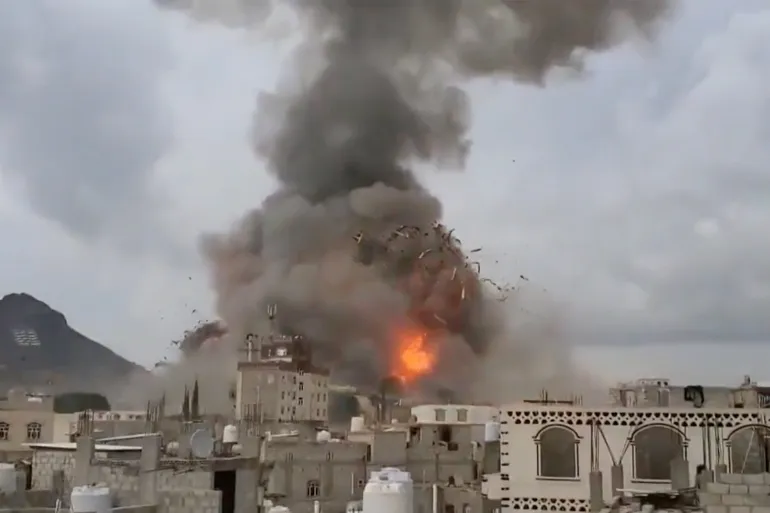
Israeli warplanes struck the Yemeni capital Sana and the Al Jawf Governorate with 30 bombs killing nine people and injuring 118 according to the Yemeni Health Ministry, Wednesday.
It was described as a massive attack in which 10 Israeli warplanes struck 15 Yemeni targets.
The aggression on Sana’a targeted a medical station on 60th Street, southwest of Sana’a, the Moral Guidance Dept., of the Defence Ministry and the headquarters of the “26 September” and “Al-Yaman” newspapers.
A senior official source said the attack on the “26 September” newspaper resulted in the death and injury of a number of male and female journalists.
In Al-Jawf, northeast of the country, the Israeli aggression targeted a government complex in Al-Hazm District.
Yemeni Armed Forces spokesman Brigadier General Yahya Saree stated, “Our air defenses were able to launch a number of surface-to-air missiles while confronting the Zionist aggression against our country.”
Sare’i added in a social media post some combat formations were forced to leave before carrying out their aggression, thwarting the bulk of the attack as reported in almayadeen.
Sare’i denied the Israeli occupation’s allegations of targeting missile launchers, asserting its raids targeted purely civilian targets.
He emphasized this brutal aggression will not pass without a military response.
An Israeli Air Force source told Israeli media that “the attack on Yemen involved more than 10 fighter jets, and more than 30 munitions were used against 15 sites.”
A senior Yemeni military source confirmed to Al-Mayadeen the aggression struck purely civilian targets, noting that the government complex in Al-Jawf is a building serving citizens and has no military connection.
The source emphasized that targeting civilian facilities will not “stop Yemen from fulfilling its role,” noting that the occupation’s targeting of the government complex is evidence of its incompetence and failure.
The aggression on Yemen “will not stop us from supporting Gaza and disciplining the Israeli entity,” he continued.
The Yemeni armed forces have continue their operations against Israel, directing strikes at various targets, including Ben Gurion Airport and imposing a ban on Israeli ports.
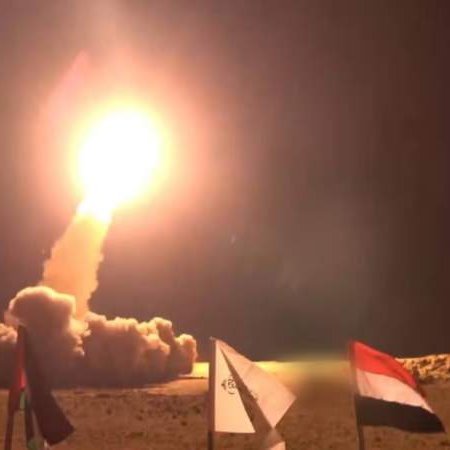
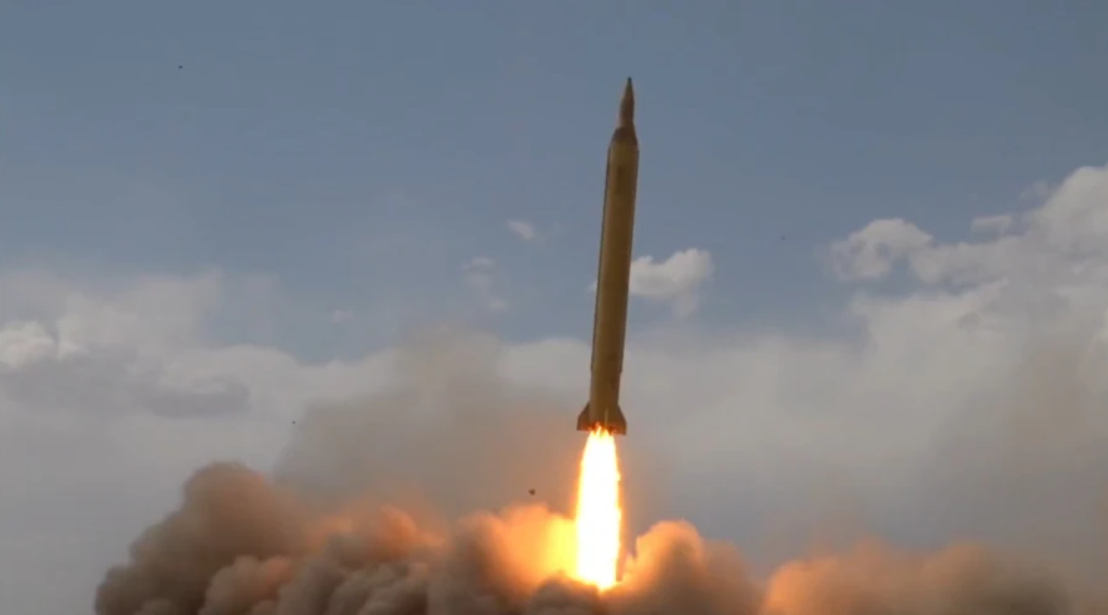
Air traffic at Tel Aviv’s Ben Gurion International Airport was suspended Friday following the launch of a missile from Yemen, according to Israeli Channel 12.
“Following the sirens that sounded a short while ago in several areas in Israel, a missile launched from Yemen was intercepted by the IAF,” the army said in a statement.
Alarms were sounded in various areas across the country, including in major cities such as Tel Aviv, Ramat Gan, Petah Tikva, Jerusalem, Holon, Rishon LeZion, Bnei Brak, Modi’in and Rehovot, the Yedioth Ahronoth newspaper reported.
The army and Israeli media did not note any damage from the missile but this was the third missile to have fired from Yemen since Wednesday and was intercepted by Israel’s Arrow-3 System according to the Jerusalem Post.
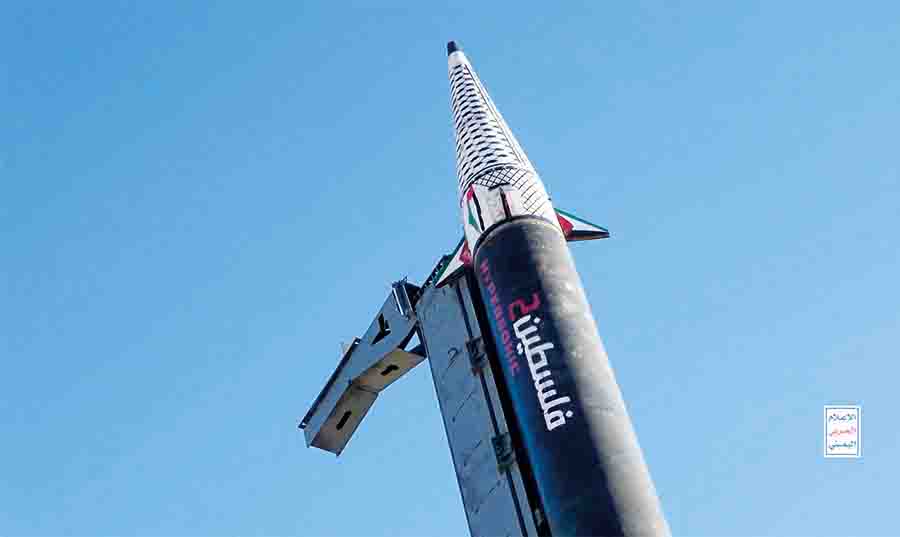
The Yemeni Houthi group announced it launched a military operation targeting the Ben Gurion Airport with a hypersonic ballistic missile.
Houthi military spokesperson Yahya Saree said the group carried out a “qualitative” military operation targeting the airport with a missile called “Palestine-2.”
“Our operations will continue until the aggression on the Gaza Strip stops and the siege is lifted,” Saree emphasized in a televised speech.
The Houthis have intensified missile and drone strikes on Israel since Israeli forces resumed attacks on the Gaza Strip in March after two months of a shaky ceasefire.
Since November 2023, the group has targeted commercial shipping in the Red Sea, the Gulf of Aden and the Arabian Sea in support of Palestinians in Gaza, where nearly 59,000 victims have been killed in an Israeli onslaught according to Anadolu.
After nearly six weeks of intensive US airstrikes on different areas and cities of Yemen the Houthi Ansar Allah continues to assert that its military operations in the Red Sea and against Israeli targets will not stop until the ongoing Israeli war on the Gaza Strip ends.
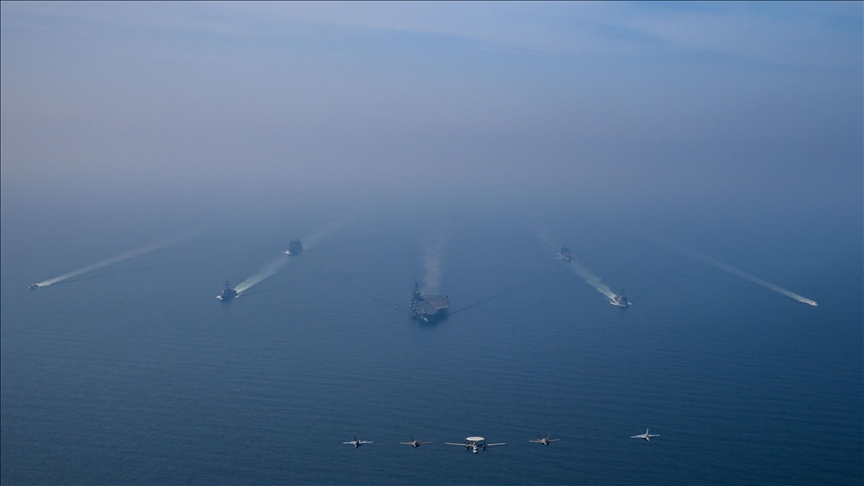
Houthi military spokesman Yahya Saree, Saturday, announced the targeting of the Israeli Nevatim Air Base in the Negev with a ballistic missile, as well as two other sites in the Tel Aviv and Ashkelon areas and the targeting of warships on the US aircraft carrier SS Harry Truman in the northern Red Sea are just part of the continuing ongoing military strikes.
However in response to these attacks the US aircraft launched two airstrikes last Friday night on the Ras Isa oil port in the coastal province of Al Hudaydah, which Washington considers a major source of fuel used to finance the Ansar Allah group’s activities.
According to Dr Liqaa Makki, senior researcher at the Al Jazeera Center for Studies, the USA has failed miserably in its strikes against the Houthis because of its inability to move to the second phase. He said that as a result they are discussing an alternative scenario for this military campaign against the Houthis.
Makki believes that US President Donald Trump has reached a dead end, and that the ceiling he set regarding the Houthis is proven unrealistic, pointing out the United States, despite its military strength, is failing in Yemen because it is fighting a group, not a state.
On the other hand, military and strategic expert Brigadier-General Elias Hanna, believes that both sides are losing, whilst the image of the United States is being damaged, given the scale of the US military campaign and Trump’s engagement with the Houthis, who previously declared that “we [US] will withdraw from all the world’s wars.”
Reports estimate the cost of the airstrikes carried out by the US military on Houthi positions amounted to approximately $1 billion in the first three weeks of the military campaign alone.
The Associated Press reported the value of the seven downed American drones made by the Houthis exceed $200 million, and the continued loss of American drones makes it difficult for the US leadership to accurately determine the extent of the damage to the Houthis’ weapons stockpiles.
Brigadier-General Hanna said that Washington lacks a comprehensive strategy in its dealings with the Houthis, and that the political goal it announced—restoring deterrence and opening shipping lanes—has not been achieved.
He also pointed out the US military is targeting the centers of gravity within the Houthi military system to disrupt it, a strategy Israel has used with the Palestinian resistance but has failed to achieve.
AppeasingtheHouthis
In light of Washington’s inability to achieve its goals against the Houthis, Brigadier-General Hanna believes the pressure being exerted on Israeli Prime Minister Benjamin Netanyahu regarding the entry of aid into the Gaza Strip is part of an effort to appease the Houthis so that they will halt their operations in the Red Sea and against Israeli targets.
Trump’s upcoming visit to the region also requires a de-escalation. According to the military and strategic expert, the US president cannot arrive while the Houthis are launching missiles.
In the same context, the senior Al Jazeera’s Makki expects that a Gaza ceasefire will soon be reached before Trump’s visit, allowing the Houthis to halt their operations as they have initially linked the cessation of their operations to an end to the war on Gaza and to the cessation of US strikes against them.
American officials have previously revealed to CNN that the US military has struck more than 700 Houthi targets and carried out 300 airstrikes since the campaign began in mid-March, “forcing them underground and creating confusion and chaos within their ranks.”
The Yemeni Houthis announced, Sunday, they targeted an Israeli power station south of Haifa with a hypersonic missile, while their media outlets said the US-British coalition carried out raids in northern Yemen.
The Houthis issued a statement on the hypersonic missile hours after the Israeli army announced its defenses intercepted a missile coming from Yemen.
Houthi military spokesman Yahya Saree said their forces carried out a military operation targeting the “Orot Rabin” power station with a Palestine 2 hypersonic missile, stressing the operation successfully achieved its goal.
Saree added the military operations supporting Gaza will continue in conjunction with the continuous development of the Houthi movement military capabilities.
He continued that the Houthi “armed forces” are working to develop their military capabilities to meet the requirements of forcing Israel to stop its aggression and lift the siege on Gaza.
As of late, Houthi attacks on Israel with ballistic missiles and drones have been frequent, despite the four Israeli airstrikes Yemen was subjected to in weeks.
Explosions in Israel
Early Sunday, the Israeli army announced the interception of a missile launched from Yemen towards Israel.
The Israeli army said in a statement that sirens sounded in the Hadera area, and that the explosions heard in the central area were caused by the launch of interceptor missiles to intercept the Yemeni missile.
Israeli media reported that eyewitnesses heard successive explosions in large areas of central Israel.
For its part, the Israeli Home Front Command reported that sirens sounded in the greater Tel Aviv area.
During previous missile attacks, millions of Israelis fled to shelters and dozens of them were injured while fleeing.
The recent Israeli strikes on Yemen focused on infrastructure, especially electricity and oil facilities in Sanaa and in Hodeidah (west), which includes a strategic port.
Tel Aviv threatened to intensify its attacks on Yemen and target Houthi leaders.
Since late last year, the Houthis have been launching attacks in the Red Sea targeting ships linked to Israel in support of the Palestinian resistance in Gaza, which has had a significant impact on commercial activity in the Israeli port of Eilat and other countries in the region.
Raids on Saada
Meanwhile, Houthi-affiliated media reported that US and British aircraft launched three raids east of the northern Yemeni city of Saada.
The nature of the targets bombed by the aircraft was not clear, and Washington and London say their air operations in Yemen aim to weaken the capabilities of the Houthis.
Last Tuesday, US and British aircraft carried out 10 raids on the May 22 Complex and the Al-Urdi Complex in Sanaa.
Earlier this year, the United States, Britain and other countries formed the “Guardian of Prosperity” coalition to confront Houthi attacks in the Red Sea according to Al Jazeera.
What are the options Israel and America’s has to confront the continuing Yemeni drones and hypersonic missiles? Is it bombing Tehran and/or implementing the latest Syrian case in Sanaa? Why not rule both out?
The Israeli occupation, government and settlers, are today in a state of hysterical panic due to the never-ending hypersonic ballistic missile attacks and the advanced drones bombing the heart of Tel Aviv and causing serious human casualties and huge fires.
This state of hysteria is reflected in four distinguishing signs:
First: Threats by more than one Israeli official to launch a massive attack on Yemen similar to that on Gaza whilst carring out assassination campaigns targeting the political and military leaders of Ansar Allah, especially Abdul-Malik al-Houthi.
Second: More than two million Israeli settlers took refuge in shelters, and sirens sounded in more than 80 locations in occupied Palestine over the past four days.
Third: Closing the airspace of Ben Gurion Airport to air traffic, which created confusion, chaos, isolation, and moral collapse.
Fourth: Failure of Israeli celebrations of two major successes achieved according to Hebrew newspapers, namely: In Imposing a ceasefire in Lebanon, stopping attacks from the southern Lebanese border, and the second by toppling the Syrian regime, the jewel of the resistance axis as boasted by Netanyahu that it was he who played the biggest role in achieving this.
Israeli Minister of War Yisrael Katz broke with all established Israeli norms by officially acknowledging, for the first time, responsibility for the assassination of the Ismail Haniyeh in Tehran, Hassan Nasrallah in Lebanon, and Yahya Sinwar in Rafah.
Katz threatened the Houthis leaders that they would face the same fate, and that the destruction that occurred in Gaza and Beirut would be repeated in Sanaa and Hodeidah.
But what terrifies the Israelis most, and worries their leadership is the arrival of the incessant Yemeni missiles and drones to the heart of major Zionist cities, like Tel Aviv, Haifa, Ashkelon, and Eilat with millions of settlers descending into shelters.
Indeed, this points to the failure of Israel’s highly advanced air defense systems to intercept these missiles, prevent them from reaching their targets, and inability to provide security and protection for the settlers in these major cities.
Perhaps the threats of Israeli officials to launch attacks on Yemeni cities reflect the extent of the pain they are suffering as a result of these incoming deadly projectiles.
These, and before them the Israeli, American and British air strikes on Sana’a and Hodeidah, have not achieved the goals of deterring Yemeni missile attacks and stopping their bombing of the Israeli depth.
On the contrary, they gave completely opposite results with their continual launching of hypersonic missiles and drones, and more dangerously, the downing of the advanced US F-18 jet, and the damaging of American aircraft carrier Harry Truman in the Red Sea and its escape to the north to prepare to leave the region, like its predecessors, the Eisenhower, the Lincoln, and many other naval destroyers.
The Yemeni military statements by Brigadier-General Yahya Saree in the past three days confirmed the bombing of Tel Aviv, Ashdod and Ashkelon deep inside Israel will continue as long as the extermination war on Gaza continues.
These statements were backed by the launch of more hypersonic missiles and drones in quick and direct responses to the Israeli threats, which means Yemen is not afraid and is responding in kind, has patience, and is ready to sacrifice.
Yemen has become the spearhead of the axis of resistance, and main front after the situation in Lebanon calmed down following the ceasefire agreement, and the commitment of the Islamic resistance there despite the violations. It is not unlikely that the Israeli occupation state, with American support, and perhaps Arab support as well, will present two main military options in the coming few days:
First: Going to the head of the octopus, i.e. Iran, as described by the Israelis, by launching an expanded tripartite Israeli-American-British attack to destroy it, according to the recommendation of Mossad Chief David Barnea as targeting Sana’a and Hodeidah again will not stop the Yemeni attacks with missiles and drones from reaching the occupied Palestinian depth.
Second: Repeating the Syrian scenario in Sana’a, i.e. an attempt to undermine and exhaust the Houthis by supporting the other Yemeni military groups and movements hostile to it by supplying them with modern weapons, providing air cover for their attacking forces, and mobilizing regional support for this step.
Launching a large tripartite aggression on Yemen may fail and give adverse results, and the same can be said about the expected attack on Iran, and it will be the occupying state and its military bases that may be exposed to bombing with thousands of ballistic and supersonic missiles, because the loss of the resistance axis of its last, most powerful and effective arena (Yemen) means its end and its Iranian leadership, and the creation of a new Middle East led by a “Greater Israel”.
However great Yemen will not surrender, and will not be defeated, as history tells of its victory over all previous invaders. Its steadfastness for more than eight years in the US-backed Gulf War against it confirms it will withstand any new Israeli-American-British targeting it, as its internal incubator is strong and solid and difficult to break due to the rallying of people around its leadership, which is embodied in the massive million-person demonstrations every Friday now for several months in solidarity with our people in the Gaza Strip.

 CrossFireArabia