Trending News:Israel Kills 6 in Gaza, TuesdayIt Was The Largest Kite Flying in Gaza. The Year 2011The Boy, The Flag and The DronesSlieman Mansour: Eye on PalestineGaza: Bringing the Dead Home From Beneath the RubbleSliman Mansour: The Artist Who Carried Palestine on His CanvasMorocco-Israel: Normalization Stops at The TopAlbanese Calls For World Force to Protect Civilians in Gaza, West Bank40 Million Tons of Rubble: Gaza Ministry Faces Challenges in Removing itJoin The Queue For The Drops‘My Way Out of Insanity’The Child, Tree and The DarkPalestinian Dr Held Over Social Media Posts Suffers Heart Attack in Israeli DetentionIsrael Violated The Ceasefire 4379 Times in 315 DaysGaza’s Kites Return — and Israel Katz Threatens RevengeLiving With The Dead: Gazan Families Forced to Make Homes Among The GravesFormer Jewish PM: Israel Has ‘Lost The United States…’Palestine in Color DressesKhan al-Sultan Stands Proud in JerusalemChristian Wedding in Beit Jala 1940Palestinian Photographer Khalil Raad With Family in Early 20th CenturyThe Day Al Aqsa Was Set on FireIsrael Finally Admits to Killing Little HindSunset in Gaza‘Israel Killed My Dad on His Farm,’ Says Daughter ZeinabThe Gaza MermaidGaza by The Sea“There is no country on the planet that is crueler and more deadly than Israel,” – MearsheimerPalestine: Heritage, FolkloreGaza: Only 3% of Land Safe to Grow FoodGaza: Lolo Heriz Finally Buried After 975 Days57th Year of Al Aqsa Burning: ‘The Fire Continues’ Ekrima Sabri WarnsRemember Hind RajabA ‘Palestinian’ Palace in JerusalemIsrael Bombs Police Station, Kills Group of OfficersDon’t Forget Dier YassinIsraeli Army, Settlers Trap Three Palestinian Families in Their Homes for 11 DaysIsraeli Strikes Gaza Port Café, Leaves 6 Dead, a Child and 14 WoundedYour Ben Gurion! RevelationsGaza’s Face of DestructionSad Woman of PalestineItamar Ben Gvir: ‘We Should Kill 30 to 40 in Gaza Each Night’Gaza Health Ministry States 1266 Killed Since The Ceasefire‘We Think of Hanan Ashrawi Only as a Palestinian’Tied to a Chair in ChainsIn The Line of Fire: Gaza Families Fear The ‘Yellow Line’Kushner Tells Netanyahu Not to Move ‘Westwards’ in GazaA Middle East Whirlpool! View From AmmanPrisoner Mohammad Arab Hadn’t Seen His Face in 2 Years!UN: 3000 Settler Attacks on West Bank Palestinians Since 2025Four Days in Cairo: A Journey Into The Faces of EgyptClick in GazaHisham Sharabi: Embers and AshesIndependent: Israeli Settlers Set Fire to a Home With a Child InsideJerusalem Under The StarsJabal Al-Weibdeh: An AI Art StoryJaffa Oranges in Jerusalem, 1937Gaza Begins to Restore Its Mosques12 Bodies Uncovered in Gaza CityDr. Mark Perlmutter recounts amputating the leg of a five-year-old girl in Gaza with no anesthesia available beyond an anesthesiologist singing to her.Herman Melville, Palestine, 1857Sea of Tragedy and LifeUN: Humanitarian Access Blocked by 900 Israeli Checkpoints70,000 Perform The Friday Prayers in Al Aqsa90% of Gazans Displaced in Tattered Tents, Living on RubbleGlorious YemenSay Cheese!Israel Vessels Fire at Three Fishermen in GazaPalestine in the Olive HarvestSmiles and Embroidery‘No Need For Your Crocodile Tears’Reem Arkan’s ‘Red Homeland’Israeli Army Seizes 16 Homes in The West BankIsrael Arrest Palestinian Journalist and Drop Site Contributor Mohammed AwadPalestinian School Year Starts 6 SeptemberTel al-Zaater: 50 Years On! Memory of a MassacreTo Evelyn: The Baramki Home in JerusalemPalestinian House, Palestinian ArchitectureUN Reports Grave Israeli Violations of Gaza ReturneesThe Gaza InfernoEhud Olmert: Gaza Belongs to The Palestinians300 Israeli Soldiers Call For an End of ‘Settler Terrorism’Reshida Tlaib Sweeps in Polls‘We Are Still Here – Gaza’The Mecca Agreement: Is This The Beginning?Thinking of Hind TaherYafa Train Station 1910Palestine EmbroideredBalfour in The Unholy TrinityIsrael Breaks The Ceasefire 12 Times‘They Can’t Take The Sea From US’Gaza: 13 Bodies Recovered From The RubbleUS Soldier Commits Suicide After Serving in GazaWaiting For TomorrowStealing Moments of JoyOliver Stone: Israel’s Policy on Palestine Will be Judge by History as One of The Darkest…Gaza: No Trucks, No Aid, Israeli-styleIsraeli Holds 1700 Palestinian Remains For BargainingView of The Abu Taha Family in Yafa, 1940Mojtaba Khamenei in ‘Full Physical Health’
About 30 Israeli settlers were injured by a supersonic missile fired from Yemen that landed in Tel Aviv, early Saturday morning.
Israel’s Hebrew Radio said 30 Israelis were injured by a rocket fired from Yemen on Tel Aviv, while dozens panicked as they fled to underground shelters.
Direct hit in Tel Aviv – and quite a massive explosion. The missile appears to be landing at an amazing speed: 5 (state-of-the-art) interceptors failed to pinpoint it.
This is not only a Houthi achievement (hypersonic missiles? That's cutting-edge technology); Every such…
The missile is being described as a direct hit which the Israeli air defences such as David’s Sling and the Cardboard Dome failed to intercept as admitted by the Israeli army in much commentary on the social media
Israeli army spokesman Avichay Adraee confirmed that attempts failed to stop the incoming ballistic missile and the impact activated the alarm bells across central Israel.
Meanwhile the Israeli Haaretz newspaper reported that ambulance teams transferred more than 20 injured settlers to the Wolfson and Ichilov hospitals after a rocket from Yemen fell in Tel Aviv as reported in Quds Press.
The Israeli police confirmed as well that “damage” occurred to a number of homes as a result of the rocket explosion in the Bnei Brak area to the east of Tel Aviv.
Houthi military spokesperson Yahya Saree announced, in a statement, that their fighters carried out “a military operation targeting a military site of the Israeli enemy in the occupied Jaffa area with a hypersonic ballistic missile.”
The announcement was made after the Houthis struck central and southern Israel with multiple drones on Friday and Thursday in response to the Israeli airstrikes on Sana’a and Al Hudaydah in Yemen.
Since the war on Gaza was launched soon after 7 October, 2023, the Houthis struck Israel with 200 missiles and more than 170 explosive drones.
New footage appears to show FAILED INTERCEPTION of Houthi missile over Tel Aviv
IDF has now CONFIRMED that its air defenses were not able to stop the Yemen-launched ballistic missile from making a direct hit pic.twitter.com/K4E1j5Xg9m
Dr. Marwan Asmar holds a PhD from Leeds University and is a freelance writer specializing on the Middle East. He has worked as a journalist since the early 1990s in Jordan and the Gulf countries, and been widely published, including at Albawaba, Gulf News, Al Ghad, World Press Review and others.
In 2011, the children of Gaza broke the world record for the largest kite flying event.
I remember that day clearly. We used to attend UNRWA summer camps during the school holidays. Before the event, we made our kites at school, and I was incredibly excited for the moment we would finally fly them.
The next day, we went to the camp held at our school, then boarded buses heading to the beach. It was a day that felt like normal life.. children running around, kites filling the sky, and biscuits and juice being handed out to us. We were just children who wanted nothing more than a few hours of joy.
Today, everything has changed.
In Gaza, a kite is no longer simply a toy in a child’s hands، in Israel’s eyes, it has been described as a “weapon of war.”
A four-year-old child was killed while flying a kite.
Think about the absurdity and brutality of that sentence.. a four year old child… a kite… and a bombing.
Years ago, children in Gaza made kites to fill the sky with joy.
Today, a child who looks up at the sky to watch his kite must fear that the very sky above him could become the source of his death.
This is how childhood is stolen in Gaza..
A child is not allowed to play, to run, to dream, or even to fly a kite without his joy being turned into a crime, his toy into a pretext, and his sky into a target.
This is not a war against kites.
It is a war against children’s right to simply be children.
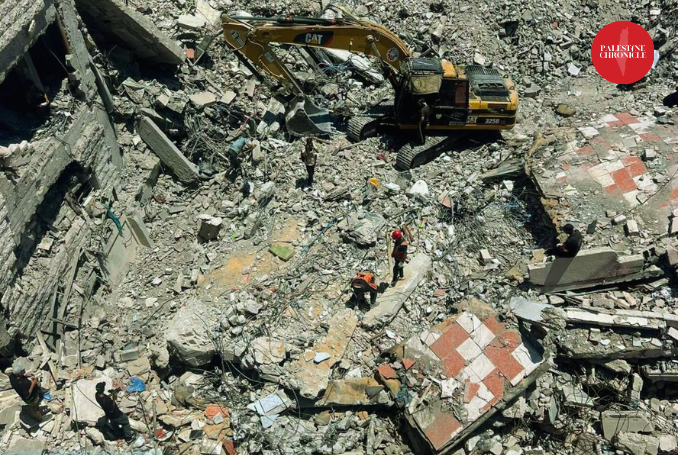
GAZA — Almost three years after Israeli airstrikes brought apartment blocks and family homes crashing down across the Gaza Strip, another kind of rescue operation is taking place among the ruins.
This time, the Civil Defense teams are not searching for survivors.They are searching for the dead.
Day after day, crews move from one shattered house to another, lifting concrete, cutting through twisted reinforcing bars and carefully searching through layers of debris for bodies and human remains that have lain there since the earliest months of the war.
For thousands of Palestinian families, the war has therefore never quite reached an ending. There has been no funeral, no grave to visit and, in some cases, no certainty about what happened to a husband, a wife, a parent or a child.
The Palestinian Information Center reported on August 20 that about 8,000 Palestinian bodies were still believed to be beneath the rubble across Gaza. Earlier, in late June, Gaza Civil Defense spokesman Mahmoud Basal put the figure at approximately 8,500 bodies and remains, illustrating the difficulty of establishing a definitive number amid the scale of destruction and the thousands still officially regarded as missing.
And the bodies are still coming out.
On August 24, Civil Defense recovery official Mohammed Abu Dan said teams had recovered the remains of nine members of the Salmi family from their destroyed home in Gaza City’s Zeitoun neighborhood. The house had been struck on November 20, 2023. Seventeen members of the family were believed to have been inside.
A day earlier, Abu Dan reported another operation in Zeitoun in which crews recovered four sets of remains from the Abu Shamala family home after two days of searching, before moving to another destroyed house where five more bodies were found.
These are not isolated searches. They have become a grim routine.
One Excavator Against a City of Rubble
The scale of the task bears little relationship to the equipment available to carry it out.
Civil Defense said in July that one phase of the recovery project was operating with essentially one excavator, one loader and one truck, with support from the International Committee of the Red Cross. The teams were trying to work their way through neighbourhoods containing thousands of missing people.
PIC reported in June that a single excavator could be seen working in Gaza City while crews searched for thousands of bodies. Basal warned that, at such a pace, completing the operation could take years.
Civil Defense says the shortage is not simply a question of damage to its own fleet. Palestinian officials repeatedly say Israel has prevented the entry of the heavy machinery, specialist equipment and replacement vehicles required to remove massive slabs of reinforced concrete safely and quickly. PIC reported again on August 20 that restrictions on bringing heavy equipment into Gaza remained one of the principal obstacles to reaching those buried beneath destroyed homes.
So men trained for rescue frequently find themselves doing work that should require cranes, excavators and specialist recovery machinery with hand tools and limited mechanical assistance.
The result is painfully slow progress.
In February, the Sanad News Agency followed Civil Defense crews into Sheikh Radwan after the search resumed at the ruins of a home bombed in December 2023.
More than 120 displaced people had reportedly been sheltering there.
For survivor Ramzi Salem, the arrival of Civil Defense came after more than two years of appeals for machinery.
There was still only limited equipment.
Much of the digging had to be done manually.
Eventually, 56 bodies were recovered from the site
Salem described each recovery as reopening the original trauma.
“Every body that comes out, it is as if the bombing happens again,” he told Sanad.
But there was another emotion alongside the pain: Relief that the dead could finally be buried.
For families such as Salem’s, recovery does not reverse the loss. It gives the loss a place.
Waiting Beside the House
Perhaps that is why families continue returning to the rubble.
Twelve-year-old Muhammad Riyadh Ghaboun stood beside what remained of his family’s house in the Sabra neighbourhood of Gaza City while Civil Defense teams worked nearby.
PIC described the boy as waiting not for his home to be rebuilt, but for the remains of family members buried beneath it for months.
What he wanted was much simpler: for them finally to have graves.
Across Gaza, similar families have lived through a peculiar form of bereavement in which death is understood but burial remains suspended.
Some know exactly where their relatives died. They can point towards a particular room beneath a collapsed ceiling or identify approximately where someone had been sleeping when the building was hit.
Others do not know whether the missing person lies beneath rubble, was killed elsewhere or was detained.
In February, Civil Defense spokesman Mahmoud Basal said that besides the thousands of bodies thought to be trapped beneath destroyed buildings, more than 3,000 people remained missing without confirmed information about their fate.
That uncertainty changes mourning itself.
A grave normally confirms death. In Gaza, thousands of families have been denied even that confirmation.
Digging For His Own Family
Few accounts reveal the psychological cost as starkly as that of Mahmoud Khalla.
His family home was struck on December 21, 2023.
According to his testimony to the Palestinian Safa news agency, around 39 relatives were killed: His mother and father, his wife and children, siblings, their spouses and children, as well as members of his extended family.
When the heavy equipment he had hoped would arrive still had not materialised, he and neighbours began digging themselves with shovels, hammers and other basic tools.
They had to break through four collapsed ceilings.
With every blow, Khalla said, he felt himself getting physically closer to his children and siblings while knowing that what he might eventually find would no longer resemble the people he remembered.
The recovered remains included his uncle. Bones believed to belong to children could not immediately be identified and were recorded as unidentified remains.
His experience exposes another agonising stage of the process.
Finding human remains does not necessarily mean knowing whose remains they are.
When A Body No Longer Has A Face
After months or years beneath rubble, heat, dust and moisture, Civil Defense teams frequently recover skeletonised remains, fragmented bones or incomplete bodies.
Identification can therefore become extraordinarily difficult.
Mahmoud Ashour, spokesman for Gaza’s forensic evidence department, said in January that many recovered bodies had deteriorated into skeletal remains or decomposed fragments.
The most important tool needed to resolve uncertain identities—DNA testing—is severely restricted by the absence of the necessary laboratory equipment, according to Ashour.
This means identification may begin with whatever information survives.
Relatives can sometimes recognise clothing.
They may identify jewellery, a personal item or a distinctive physical feature.
Safa reported in April that some families had managed to identify recovered relatives through physical characteristics or clothing after decomposition made ordinary visual recognition impossible.
Where identification is possible, the remains are transferred through the appropriate medical and forensic procedures before burial.
In one November recovery operation at the destroyed Abu Hamada family home in Maghazi refugee camp, Civil Defense reported recovering the remains of 14 people, including women and children. Relatives identified them and the remains were transferred to the forensic medicine department at Al-Aqsa Martyrs Hospital before burial.
Where families cannot identify the remains, the process becomes more complicated.
Forensic personnel document what they can. Earlier Gaza procedures have included photographing distinguishing characteristics, assigning identification numbers and preserving available information so relatives may eventually be able to make a match.
But DNA testing would offer a far more reliable answer.
Ashour has called for equipment as well as a database containing genetic information from families of missing people so recovered remains can be matched scientifically.
Without it, some families may finally receive bones from beneath a house and still not know whether those bones belong to the person they have spent years waiting for.
The Men Who Must Keep Looking
There is another side to these operations that receives less attention: The Civil Defense officers themselves.
Their work once centred on pulling people alive from collapsed buildings.
Now they are regularly required to dismantle the physical remains of destroyed homes while recovering decomposed bodies, skeletons and fragments belonging to children, women and entire families.
The recovery crews know that relatives are often standing only metres away.
A piece of fabric or a bone fragment can suddenly become the answer to a question a family has been asking for two or three years.
Civil Defense official Abdullah Al-Majdalawi described the difficulty after remains recovered from Sheikh Radwan cemetery had become mixed following destruction and bulldozing. Many of those recovered were reduced to skeletal remains and fragments.
He summed up the human problem behind forensic identification with a stark question:
“How do names turn into numbers?”
That is, in many ways, the dilemma confronting Gaza’s recovery teams.
They work among numbers—eight bodies here, nine there, 47 from one house, 50 collected at Al-Shifa Medical Complex.
But every number belongs to somebody.
In July, Civil Defense recovered 47 bodies and sets of remains from the Al-Hassaina family home in Sabra. Another 36 people were still believed to be somewhere beneath the ruined structure, and officials said the force of the explosion might even have displaced remains into neighbouring properties.
That makes the work forensic as much as mechanical.
Crews cannot simply drive an excavator through a pile of concrete.
Each layer may conceal remains. Each fragment has potential meaning. Each discovery must be handled carefully enough that identification is still possible afterwards.
Speed matters.
But so does dignity.
Fifty Funerals, Nearly Three Years Late
On August 20, Palestinians gathered in Gaza City to bury the remains of 50 people recovered from beneath demolished homes in neighbourhoods including Tal Al-Hawa, Zeitoun, Sabra, Sheikh Radwan and Al-Shati.
Some belonged to the Sawafiri, Batniji and Gharbiya families.
Many had been beneath the debris since 2023.
PIC reported that much of what was recovered was no longer complete bodies but bone fragments, remains and personal belongings. Civil Defense officials said many were women and children.
For those families, the funerals came almost three years late.
For thousands more, there is still no funeral.
There is only the house.
The rubble.
And the waiting.
Parents wait for children. Children wait for fathers and mothers. Husbands and wives live with a loss that is simultaneously certain and unfinished.
Some return repeatedly to the place where they believe a relative lies.
Some ask Civil Defense when their street will finally appear on the recovery schedule.
Some search themselves.
And Civil Defense teams continue moving through Gaza’s destroyed neighbourhoods, one house at a time.
Their progress is measurable in bodies brought home—but against an estimated 8,000 still beneath the wreckage, each recovery also shows how immense the task remains.
The operation is therefore no longer simply a search through rubble.
It is a race to restore identities before time erases more of them.
For the families standing beside Gaza’s ruins, finding the dead does not bring the people they love back.
But after years of looking towards a collapsed house and knowing someone is still beneath it, recovery offers something that war has denied them for far too long: