Memorizing The 1967 War Defeat!

By Dr Khairi Janbek

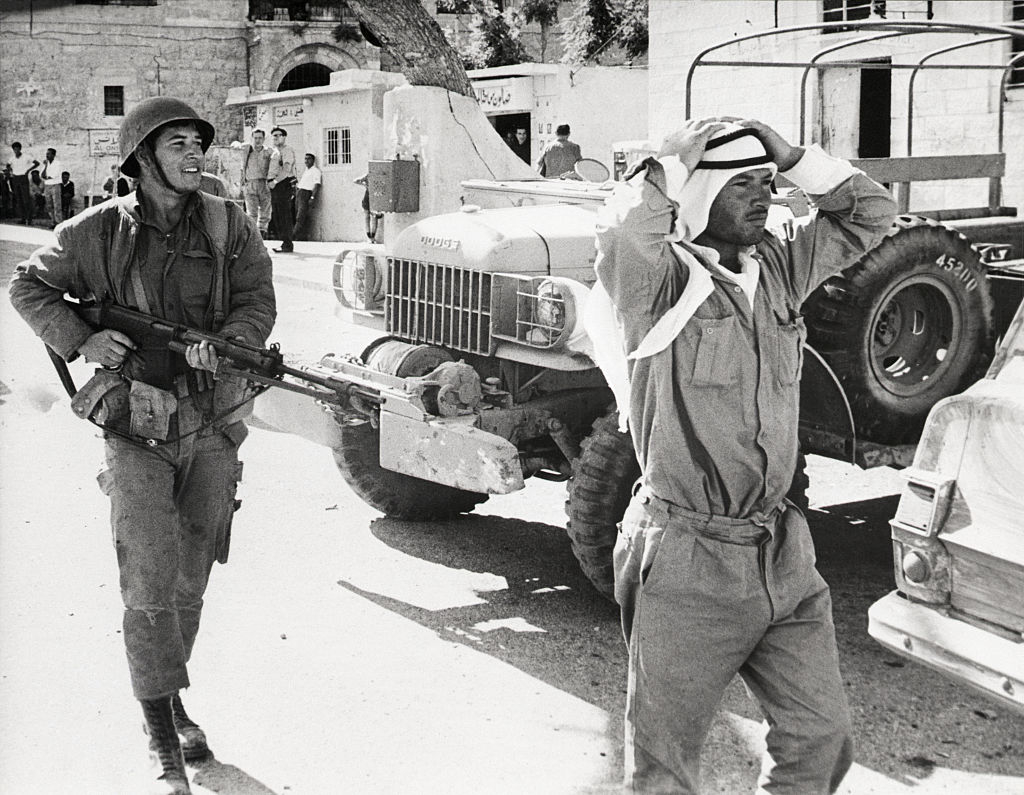
What can one say about the defeat of 1967 war, more than what the experts, the memoirs, and the active participants in it have said and written already, save from the eyes and ears of a child; for after all one was a child at the time and one must admit that growing up with defeat did have profound effect on one’s developing personality.

As it happened, in fact we were on a family holiday driving to Turkey when we heard the first actions in the war. By the time we crossed Damascus towards the north, the car radio was blasting with the advances made by the Arab armies on the path towards liberating Palestine.

However, by the time we reached an area close to the Syrian-Turkish border somewhere near Jabla in Syria, we discovered the the border was closed on the Syrian side and people including my late father were stuck around the big radio in the small roadside hotel talking about the destruction of the Israeli military forces, and the remarks that in a couple of days, Israel will cease to exist,

But low and behold, after a few days and by the time the border was opened, Egypt had lost Sinai, Syria, the Golan Heights, and Jordan the West Bank and Jerusalem; the jewel in the crown.

The car was tense, and for the first time I was disappointed, not because of the news of defeat rather, rather because I was no longer the centre of attraction for the family. As we entered Iskenderun in Turkey, a couple of young men crossing the streets, seeing our car number plate in Arabic, spat on the ground and said in Turkish; Pis Arap, meaning dirty Arab.

I didn’t undrestand Turkish at the time, until my father smiled bitterly and said, so we have just become dirty Arabs. In the small hotel in Iskenderun owned by a generous Armenian family, they brought us their transistor which could catch Syrian broadcasts and heard my father saying Nasser has resigned, and I was wondering how could he do that. For me, Nasser’s image was a cross between a king and an idol football player.

By the time we reached Ankara, it was all over. We were nothing in the eyes of the Turks at the time, but lying impotent Arabs. As the years passed, maturity set in as a strong slap in the face, with my childhood’s main scar left inside me, engulfing me with doubt, and disbelief, not only regarding what I now hear but also in what I see: with Arab politics to me, becoming just a mixture of cynicism, blatant lies, and regimes self-preservation.

The disaster from top to bottom was, unqualified military officers in Egypt, only accustomed to internal security and privileges were punching above their weight and carrying ranks which were above their undrestanding of warfare. Their ignorance was stark obvious when they knew about the attack and opted for absorbing the first blow before counter-attacking, not knowing they’ll have nothing left to counter with.

Jordan was squeezed between the hammer and the anvil diplomatically, though there were voices among the statesmen at the time urging not to participate in the impending whilst recognizing the perils, yet the decision to participate in the war and opening the Jordanian couldn’t be avoided because first of all the belief in Nasser’s victory held sway among the people, and secondly, to imagine an Arab defeat would not spare Jordan who will be blamed for this defeat due to the lack of giving support in the war.

In the case of Syria, how could an army in which the first officer who wakes up before the others and carries out a coup d’état, fight a war; and how could an army in which a general has to walk behind the coup d’état lower ranks whom are only concerned about preserving their own hold on power, conduct warfare? In fact the fall of the Golan Heights was declared by the Syria representative in the UN, 36 hours before it actually fell. And why was this? All in aid for withdrawing the army to protect Damascus.

Has anything changed? Everything has changed so that nothing changes!

Dr Janbek is a Jordanian writer based in Paris, France

CrossFireArabia

CrossFireArabia

Dr. Marwan Asmar holds a PhD from Leeds University and is a freelance writer specializing on the Middle East. He has worked as a journalist since the early 1990s in Jordan and the Gulf countries, and been widely published, including at Albawaba, Gulf News, Al Ghad, World Press Review and others.

Related Posts

For South Lebanon, All You Need is Few Miracles!

The fourth round of negotiations between representatives of the Lebanese Government, in the person of the Lebanese Ambassador to Washington, and representatives of the Israeli government, under the cuddling attitude of the State Department, to reach some kind of agreement between the two odd neighbors in the Middle East, look like a friendly, yet an absurd endeavor of witch-hunting, that can only render the caterers and planners of the event, happy! For each team are supposed to ask their counterparts to agree to things that are beyond their jurisdiction or authority, to say yes or no, under the current circumstances!


Israel wants the government of Lebanon to agree to a peace accord with it like the ones concluded, long time ago, with Egypt, PLO and Jordan, just to give a finger to Iran and its Shia active and militarily strong allies in Lebanon. For their part, the Lebanese delegation would be shyly telling the Israeli negotiators that before any other item is considered, Israeli forces have to be out of Lebanese territories first.

Official Israel and Lebanon are fully aware that such meetings will lead to nowhere, as long as back home and on the ground, where the real cooking is taking place, ‘chefs’ are having good time doing their best to burn the food further!


But as hopeful amateurs, certain individuals in Washington DC who are probably not educated enough or familiar with Middle Eastern zig-zags, or just pretending to be up to something, seem to be rehearsing for
future similar events!


A special tailored ceasefire in Lebanon now will be absolutely not useful for the Israelis. But it could be arranged with American urging and blessing, just to give the impression that something can be done. It will be a message to the Iranians and the world that, yes we can have a ceasefire in Lebanon now, it is your turn to be flexible on the Hormuz entanglement! While the original story was a complete reverse, meaning we can have a ceasefire around Hormuz, only if we had one in south Lebanon! But here is the real picture on the ground.


Israel is holding the whole area of south Lebanon and its nearly 400 villages as a hostage, thanks to its ability to hit any spot in Lebanon and in Beirut in particular. It is a bargaining chip to pressure the Lebanese government to submit to an official deal that would by-pass Hezbollah and the Shia component in the Lebanese Parliament. While Hezbollah and their local allies refuse to concede their arms to the central government in Beirut, claiming that such a move would be interpreted as a concession to Israel.


So, if I were to advice the Israelis on how to outsmart their opponents in Lebanon, I would tell them, you can stop your absurd war in Lebanon immediately, and start withdrawing your soldiers from areas they entered after the last ceasefire announced between Iran and the US and Israel, and wait for their reaction to that!


And if I were to advice Hezbollah, I would tell them do not target villages or civilians within Israel international borders and make clear that you only target Israeli military presence within Lebanese international borders, and wait for a reaction!

And finally, if I were to advice the Americans on this particular issue, which looks actually like a replicate of their other similar moves and initiatives in the region, since June 2025, when President Trump, willingly swallowed the pill prescribed to him by Dr. Netanyahu, to end the Iranian headache, I would say this: Might, like cash, is not the answer to all problems! It is only a temporary remedy, like the cash that cannot buy you happiness, but the delusion that you are experiencing
it!


The entanglement in south Lebanon will not be solved by apprentices in history and geography meeting in air-conditioned elegant rooms in Washington DC, but there on the grounds of south Lebanon, where valleys, trees, rivers, mountains, villages and people have long time ago, concluded among themselves, without external interference, an eternal verbal memorandum of understanding, that they were doomed to live or perish there in rotation, exactly like the four seasons of the
year!


It all worked out smoothly there since, without miracles!

Continue reading
Iran is Writing The Final Chapter!

By Ziyad Farhan Al-Majali

In major wars, results are not always measured by the ‘noise volume’, number of airstrikes, or the extent of the military maps displayed on TV screens. Sometimes the noise is louder than the decisive action, and the roar is stronger than the ability to end the battle.

From this perspective, the Israeli-American war on Iran can be read as a tumultuous moment in the history of regional conflict. Here however, it was not the final moment which Israel desired and was looking for.

Tel Aviv wanted to present the war as its declaration of its superiority, one that would be final. It wanted to say that its reach could penetrate deep inside Iran, that the old balance of deterrence was broken, and that the aftermath of the strike would not be the same as it was before.

Therefore, Israel’s “lion roar” was to be loud from the very beginning: Threatening rhetoric, painful strikes, psychological warfare — a clear attempt to portray Iran as a state exposed to Israeli and American power.

But the roar by itself, however loud it boomed, was not enough to bring about a political end. True, Iran suffered heavy blows, with sensitive facilities, infrastructure and sites sustained significant damage, finding itself facing a broad economic, military, and psychological siege and pressure.

Yet, despite all this, the war did not topple the Iranian government, nor did it remove the state from the regional equation, nor did it end its nuclear program as a negotiating issue, nor did it break its deterrent and maneuvering capabilities.

Herein lies the central paradox of this war. Israel raised the stakes to their highest points, but it did not achieve a decisive victory. Israel sought to eliminate the so-called Iranian threat with a single strike or a series of blows, only to discover that Iran is not a military site that can be wiped off the map, nor a single facility whose destruction would end the conflict.

Rather, it is a deep-rooted, expansive state with multiple levers of pressure: From the Strait of Hormuz to Lebanon, from missiles to air corridors, from allies to the capacity for long-term patience. Iran is a tough nut!

Perhaps the most dangerous revelation of the war is that it did not produce a definitive answer, but rather raised even greater questions. Can military force alone reshape Iran? Can bombing impose a stable political settlement? Will weakening Tehran lead to its expulsion from the region, or will it push it to rebuild its influence more cautiously and covertly? Was the war the beginning of the end, or the start of a new phase of a postponed conflict?

Iran emerged from the war wounded, but it didn’t exit the negotiating table. It appeared battered, but it did not collapse. Maybe besieged but it is still holding cards. Whilst today Iran might be in a predicament, but it has not lost its ability to negotiate, to threaten, and wait for the next move.

This is precisely is what is making the outcome far more complex than what Israel has tried to portray: The war may have succeeded in inflicting pain on Iran, but it did not  eliminating the Iranian state and its apparatus.

While Israel may have achieved a significant show of force, it did not achieve an outright and decisive victory. The decisive outcome it sought remained incomplete, and the deterrence it aimed to restore remained contingent on what would follow after the war: Would Iran back down? Would it retaliate? Would it accept American terms? Would it open the Strait of Hormuz according to Washington’s wishes? And would the Lebanese front be detached from Tehran’s calculations, or would it remain part of the long-term equation of retaliation?

Therefore, the war does not appear to be the end of the conflict with Iran, but rather a new chapter in a broader, protracted struggle. In this chapter, Israel raised its voice to the maximum, but it could not write the final chapter. States do not fall through mere bluster, regional projects do not end with a single blow, and conflicts that have accumulated over decades are not resolved in days, no matter how intense the fighting is.

In short, Israel’s “roar” was loud, perhaps painful, and perhaps unprecedented in some aspects, but it was not enough to topple Iran or remove it from the scene. The din of war has risen, the region has been shaken, and calculations have shifted, but Iran remains on the precipice, not outside history.

Therefore, the most accurate description of this phase is not a complete Israeli victory, nor an Iranian resistance without cost, but rather a war whose end is not yet in sight: A war in which Israel roared loudly, but was not able to bring down Iran.

This article was reproduced from the Jo24 Arabic website in Jordan and appears in the www.crossfirearabia.com.

Continue reading

Leave a Reply

Your email address will not be published. Required fields are marked *

You Missed

Memorizing The 1967 War Defeat!

Memorizing The 1967 War Defeat!

Open War: 1967 Naksa Remembered

Open War: 1967 Naksa Remembered

Israeli Soldiers: ‘…We Had to Kill Arabs’

Israeli Soldiers: ‘…We Had to Kill Arabs’

Stories From Hell: Food at Gun-point

Stories From Hell: Food at Gun-point

Aid Flotilla: Activists Subjected to Torture

Aid Flotilla: Activists Subjected to Torture

9 Killed, Dozens Injured in Israeli Strikes on Flats in Gaza

9 Killed, Dozens Injured in Israeli Strikes on Flats in Gaza