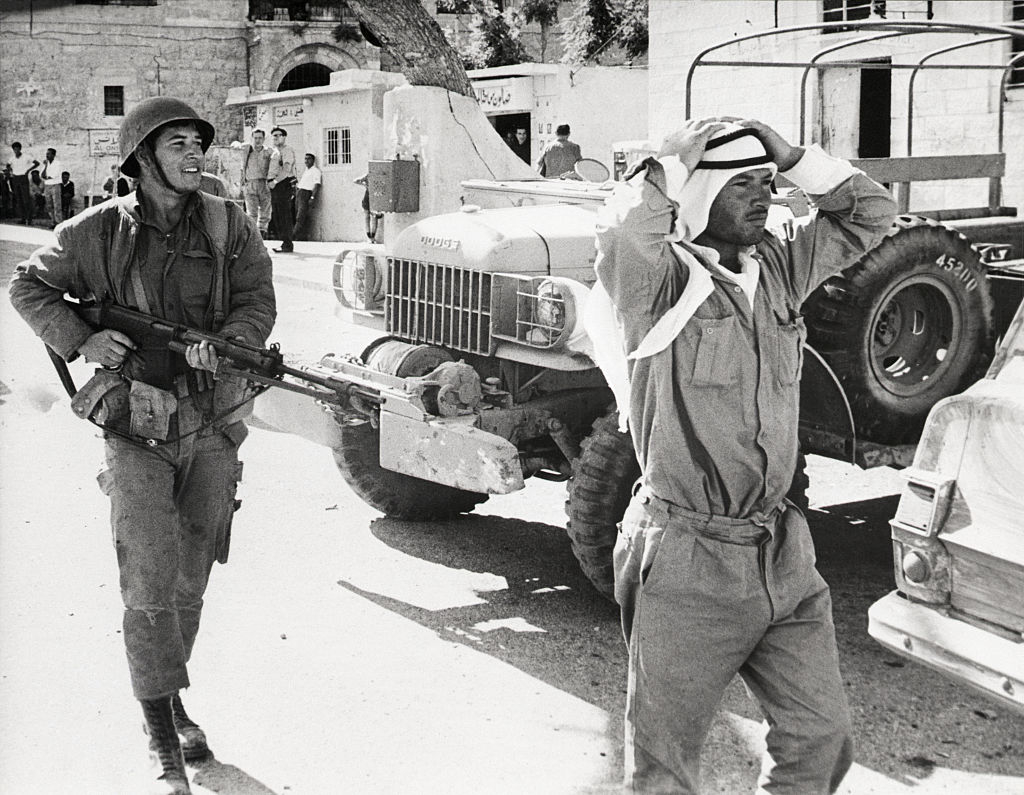
Memorizing The 1967 War Defeat!

By Dr Khairi Janbek

What can one say about the defeat of 1967 war, more than what the experts, the memoirs, and the active participants in it have said and written already, save from the eyes and ears of a child; for after all one was a child at the time and one must admit that growing up with defeat did have profound effect on one’s developing personality.

As it happened, in fact we were on a family holiday driving to Turkey when we heard the first actions in the war. By the time we crossed Damascus towards the north, the car radio was blasting with the advances made by the Arab armies on the path towards liberating Palestine.

However, by the time we reached an area close to the Syrian-Turkish border somewhere near Jabla in Syria, we discovered the the border was closed on the Syrian side and people including my late father were stuck around the big radio in the small roadside hotel talking about the destruction of the Israeli military forces, and the remarks that in a couple of days, Israel will cease to exist,

But low and behold, after a few days and by the time the border was opened, Egypt had lost Sinai, Syria, the Golan Heights, and Jordan the West Bank and Jerusalem; the jewel in the crown.

The car was tense, and for the first time I was disappointed, not because of the news of defeat rather, rather because I was no longer the centre of attraction for the family. As we entered Iskenderun in Turkey, a couple of young men crossing the streets, seeing our car number plate in Arabic, spat on the ground and said in Turkish; Pis Arap, meaning dirty Arab.

I didn’t undrestand Turkish at the time, until my father smiled bitterly and said, so we have just become dirty Arabs. In the small hotel in Iskenderun owned by a generous Armenian family, they brought us their transistor which could catch Syrian broadcasts and heard my father saying Nasser has resigned, and I was wondering how could he do that. For me, Nasser’s image was a cross between a king and an idol football player.

By the time we reached Ankara, it was all over. We were nothing in the eyes of the Turks at the time, but lying impotent Arabs. As the years passed, maturity set in as a strong slap in the face, with my childhood’s main scar left inside me, engulfing me with doubt, and disbelief, not only regarding what I now hear but also in what I see: with Arab politics to me, becoming just a mixture of cynicism, blatant lies, and regimes self-preservation.

The disaster from top to bottom was, unqualified military officers in Egypt, only accustomed to internal security and privileges were punching above their weight and carrying ranks which were above their undrestanding of warfare. Their ignorance was stark obvious when they knew about the attack and opted for absorbing the first blow before counter-attacking, not knowing they’ll have nothing left to counter with.

Jordan was squeezed between the hammer and the anvil diplomatically, though there were voices among the statesmen at the time urging not to participate in the impending whilst recognizing the perils, yet the decision to participate in the war and opening the Jordanian couldn’t be avoided because first of all the belief in Nasser’s victory held sway among the people, and secondly, to imagine an Arab defeat would not spare Jordan who will be blamed for this defeat due to the lack of giving support in the war.

In the case of Syria, how could an army in which the first officer who wakes up before the others and carries out a coup d’état, fight a war; and how could an army in which a general has to walk behind the coup d’état lower ranks whom are only concerned about preserving their own hold on power, conduct warfare? In fact the fall of the Golan Heights was declared by the Syria representative in the UN, 36 hours before it actually fell. And why was this? All in aid for withdrawing the army to protect Damascus.

Has anything changed? Everything has changed so that nothing changes!

Dr Janbek is a Jordanian writer based in Paris, France
Continue reading
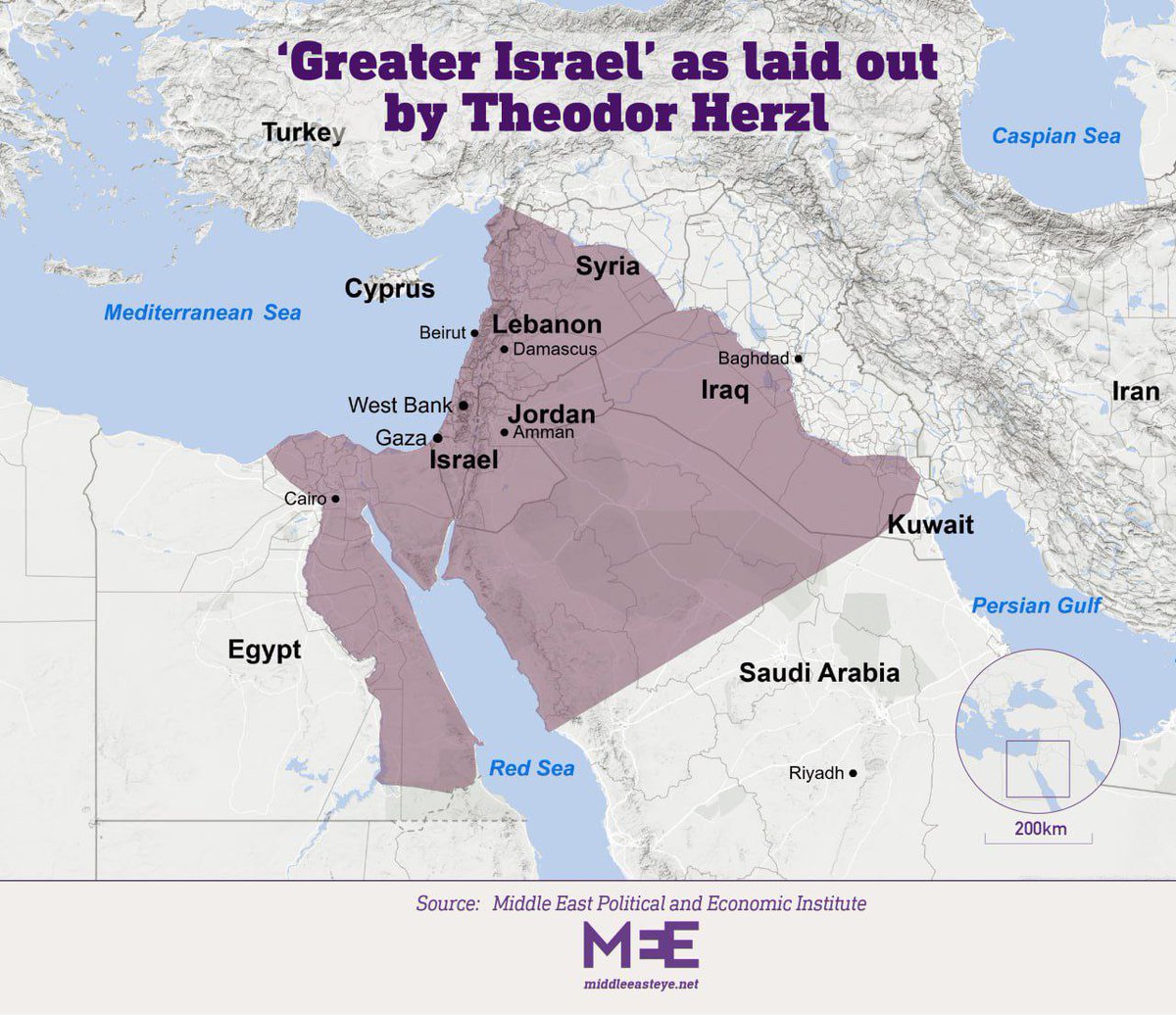
Greater Israel – A Confused Concept

Dr Khairi Janbek

The question of Greater Israel had always been there, swinging between Jewish religion and Zionist politics. Essentially it is a vague concept and interpreted according to the inclination of different groups inside Israel.

When Theodore Herzl talked about the land of Israel he defined it as being between the brook of the Nile and the Euphrates, with the debate being at the time, whether and area between the two rivers or actually all the way to both rivers.

Even when the state of Israel was established, its borders were not defined. It was the 1967 war which ignited the Greater Israel concept among the various Jewish groups with Israel occupying the West Bank, Sinai and the Golan Heights.

However, the recent pronouncements made by the Israeli government regarding this issue, started to ring bells of danger and awakened Arab fears especially, when the world sees Israeli military operations to retake Gaza, putting plans to annex the West Bank of Jordan and occupying territories in South Lebanon, annexing the Golan Heights and moving the Golan Heights and moving further into Syrian territories.

But where did the notion of Greater Israel originally came from, the idea which the father of Zionism Herzl defined? In fact it was taken from the book of Genesis in the Hebrew bible the Tanakh, where God grants Abraham and his descendants a vast expanse of land stretching from the brook of Egypt to the Euphrates. 

Some Israelis refer to a narrower vision mentioned in the Book of Deutronomy, where God instructs Moses to lead the Israelites in taking possession of Palestine, Lebanon, and parts of Egypt, Jordan and Syria.

Others invoke the Book of Samuel which describes lands secured by Kings Saul and David, including Palestine, Lebanon, and sections of Jordan and Syria. In fact those whom hold those beliefs, the pursuit of Greater Israel, is not merely political, it is the fulfillment of divine mandate, a reclamation of land they see as rightfully theirs.

At the same time, some Zionist currents have used the concept of Greater Israel to advocate for political territorial expansion of the state of Israel maintaining control over the West Bank, claim Gaza and the Golan Heights, parts of south Lebanon as being part of Israel and so on.

Essentially the term Greater Israel can refer to several different concepts depending on the ideological, religious or political context.

Dr Janbek is a Jordanian writer based in Paris, France

Continue reading
‘All Attempts at Displacing Gazans Failed’ – A Historical Outline

By Ismael Al Sharif

One of the most widely circulated press items in the Gaza War was a photo in Al-Dustour daily in its 11 March, 1971 edition under an “Evacuation of the Gaza Strip Begins,” headline. This image traveled around the world, confirming the importance of print journalism and its continued role as a primary source of information for documenting events, and its enduring presence despite digital developments.

Al-Dustour witnessed pivotal moments in the repeated attempts to empty Gaza of its population. The idea of ​​displacing the residents of the Strip began in the early 1950s, when a number of military personnel, bureaucrats, and senior UNRWA officials met and took out old maps to discuss possible displacement destinations. After lengthy discussions, it was decided to push Gaza’s residents toward the vast, sparsely populated Sinai Desert.

The plan targeted the displacement of approximately 60,000 people, equivalent to a quarter of Gaza’s population at the time. Despite the start of preparations, the idea was met with categorical rejection by the residents of the Gaza Strip, who clung to their land and refused to leave.

In 1956, the Zionists occupied the Gaza Strip during the Tripartite Aggression against Egypt. David Ben-Gurion, along with senior military commanders, attempted to forcibly displace the population of the Strip to the West Bank and Sinai. However, pressure from the United States prevented the plan from being implemented and the attempt was foiled. A year later, the occupation was forced to withdraw from Gaza.

In 1967, Moshe Dayan devised a plan aimed at forcing as many residents of the Gaza Strip as possible to emigrate to the West Bank and Egypt. Some residents were eventually deported to the West Bank, but the plan did not achieve the desired results, as relatively few residents left Gaza.

In 1971, while the late Yitzhak Shamir was serving as military governor of the Gaza Strip, he decided to forcibly displace the population. He bulldozed thousands of homes and forced a number of residents onto buses and transported them to the city of Al-Arish. But the plan failed, as the population quickly returned to Gaza, supported by pressure from Arab countries and major powers, which prevented the plan from being fully implemented.

With all attempts at direct displacement having failed, the Zionists found themselves in a predicament; neither killing nor enticement persuaded the people of Gaza to leave their homeland. The occupation then changed its strategy, devising a plan to systematically and slowly destroy Gaza through siege, starvation, and repeated military escalation. Once again, however, the Gazans foiled the plan and held their ground, refusing to leave.

In 1992, the “Greater Gaza” project was proposed during the term of Yitzhak Rabin. Secret plans were drawn up to impoverish the Strip, making life there nearly impossible, and drive its residents to emigrate to Sinai. However, this plan, too, failed.

In 2004, then-Shin Bet chief Avi Dichter devised a plan bearing his name, believing he had found the ideal solution to displace the population of Gaza by encouraging what he called “voluntary migration,” particularly to European and Gulf countries. However, this plan also failed, and the people of Gaza remained steadfast in their land, refusing to leave.

In 2014, the Israeli occupation relaunched its first plan, seeking to remove the border between Egypt and the Gaza Strip and push the population of the Strip toward Egyptian territory. However, Egypt confronted and thwarted this plan, preventing it from achieving its goals.

Then came the Trump administration’s so-called “Deal of the Century,” which included unofficial clauses regarding the transfer of Palestinians from Gaza to Sinai. The US administration exerted pressure on Cairo to implement this plan, but Egypt categorically rejected it, also leading to its failure.

Then came the Al-Aqsa Intifada, which Israel exploited to carry out the largest genocide ever carried out, with the aim of displacing the people of Gaza. It practiced murder and siege, cutting off their basic necessities of life, hoping to force them to leave. However, despite the brutality of the aggression, Gaza stood firm, thwarted the plan, and emerged victorious with its unbreakable will.

Trump returned once again to revive his plan, this time attempting to displace the people of Gaza through what he called “soft displacement.” However, he clashed with a tough king who firmly confronted this plan and rejected it without hesitation.

The Zionist entity, with American support, failed to adhere to the temporary truce with Hamas, and the war of extermination resumed, amid a stifling siege, famine, and a scarcity of water and medical services.

Over the decades, the Zionist entity attempted to exterminate and displace the people of Gaza, sometimes by force and sometimes by enticement. But Gaza stood firm, and the banner of steadfastness was passed down from generation to generation. Just as this banner was passed down from generation to generation, so too was the banner of defending the holy sites, passed from one Hashemite king to the next.

The commandments of our forefathers became ingrained in our conscience: to always stand with Palestine. Over these long years, Al-Dustour newspaper has stood with the Palestinian cause, exposing the enemy’s schemes and mobilizing support and backing for justice. Al-Dustour has been a witness to history, conveying Gaza’s voice and echoing its steadfastness. At every critical moment, it was present, documenting, exposing, and defending the truth without hesitation.

A day will come, decades from now, when future generations will pass on images from Al-Dustour’s editions that documented this phase of the conflict with the enemy, testifying to Gaza’s steadfastness and the resilience of its people in the face of attempts at genocide and displacement. Just as Al-Dustour has always been present in the battles of steadfastness, Gaza will remain engraved in its conscience: An immortal story and an indelible symbol.

Ismael Al Sharif is a columnist in Ad Dustour newspaper in Jordan.

Continue reading