Trump, Netanyahu Rift Hits Rock Bottom: View From Amman

By Saleem Ayoub Quna

The Epic Fury Operation launched by the US against Iran in February 2026, will go down in modern history as the first open military conflict, where a superpower like the United States, has willingly and openly played the role of a war-proxy, on behalf of its smaller ally, Israel.

The difference of attitude between the two close allies, US and Israel, in relation to what they perceived as Iran’s threat, imminent or potential, was a key factor behind the gradual crumbling of the American-Israeli coordinated military and intelligence efforts, to bring down the regime in Tehran.


Israel under Benjamin Netanyahu’s extreme right-wing government, kept saying Iran posed an imminent existential threat to Israel, and therefore it must be brought down by force. While the US position was constrained by its previous international commitments on the issue of Iran’s nuclear ambitions, as stipulated in the 2015 Joint Comprehensive Plan of Action (JCPOA), signed between Iran and the P5+1 powers, during the administration of President Obama.


Since that moment Netanyahu kept vigorously urging, more likely lecturing the US and the West, on the dangers of the JCOPA agreement. When Donald Trump was elected President in 2017, things took an important and completely different turn. In the following year, he took the United States out of that internationally-backed deal as he had promised to do during his election campaign. He also kept his promises of moving the US Embassy to Occupied Jerusalem and recognize the occupied Syrian Golan Heights as part of Israel.


These symbolic and important gestures, whetted Netanyahu’s appetite for more American concessions to Israeli demands.


Netanyahu’s golden opportunity came when Trump was re-elected to his second term in 2023, the same year when Hamas launched its massive assault on the Israeli settlements in the so-called “Gaza enevlope”. Other militias connected and supported by Iran, including the Houthis in north Yemen, Hezbollah in south Lebanon, Syria under the previous regime and Shia factions in Iraq coordinated their efforts to stand by Hamas during that long and unprecedented confrontation with Israel.

For its part, Iran did not shy from making it clear that it helped create this “chain” of resistance factions to encircle Israel from three directions.

The second turning magical point in the US position on the issue of direct military intervention against Iran came about when Israel succeeded in serving Hezbollah, the severest military blow ever, in the pagers’ operation and the subsequent assassination of Hezbollah’s top leaders, including its charismatic Secretary-General Hassan Nasrallah on Sept 27, 2024.


Trump was very impressed with all of that Israeli action and Netanyahu gave himself the full credit for this unexpected success.


Accordingly, Netanyahu’s plan to Trump was simple. Based on the Israeli accumulated intelligence and expertise on the Iranian internal scene and emulating its operation against Hezbollah leaders in Lebanon, accompanied by massive American air strikes would provide both allies with the best chance to finish the Ayatollahs in Tehran once and for all!


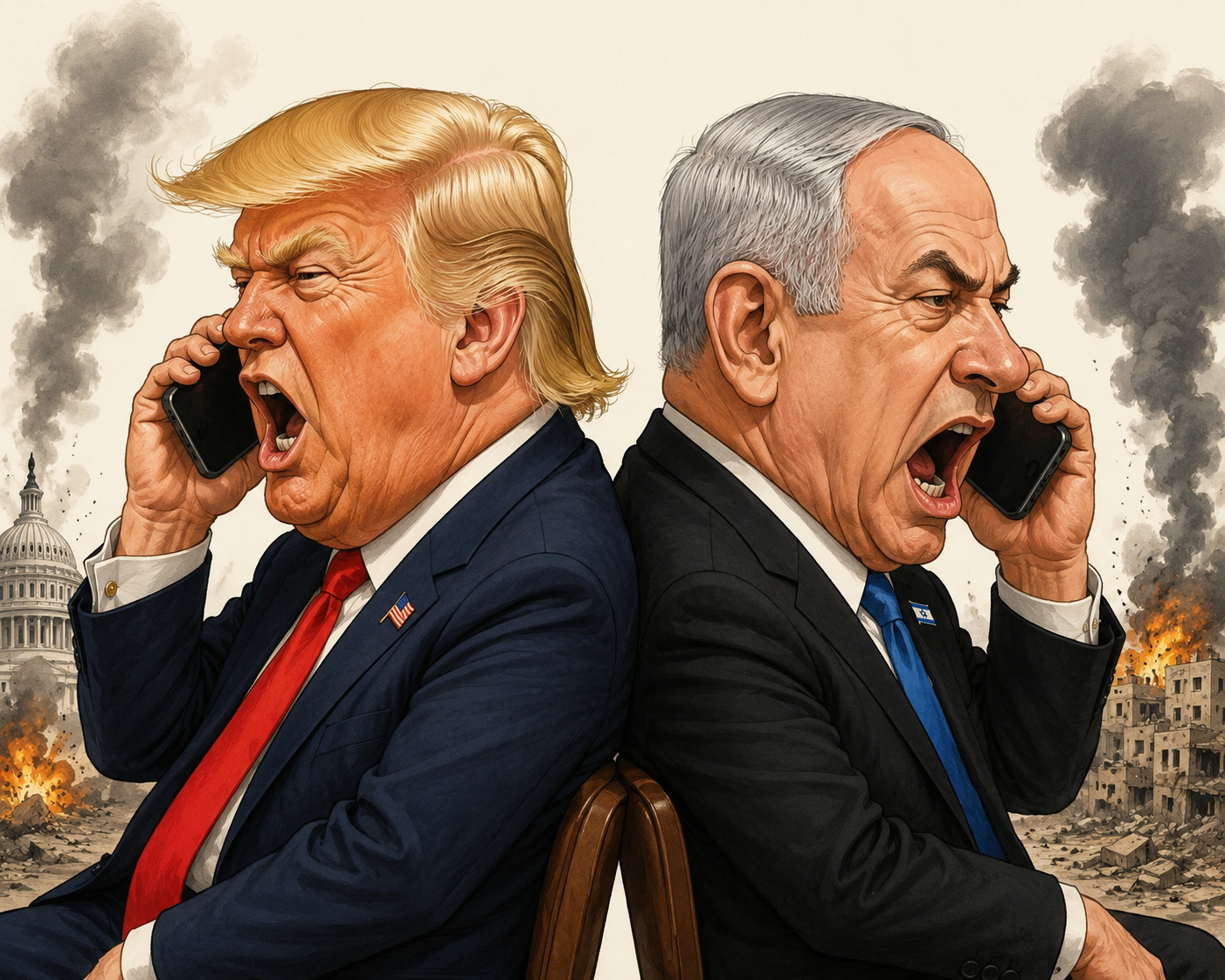
But as events unfolded, all of Netanyahu’s plans, personally and strongly endorsed by Trump and his military aides, suddenly started crumbling, one after the other. His relations with Trump slipped into stages of deterioration by the day and week as the closure of the Hormuz Strait by Iran, started hurting the world economy led by the US.


Here new red lights went on and the phone calls between the two men became more intense and vulgar. Then Trump decided to pass on the torch to his deputy, JD Vance, who seemed comfortable to tell Netanyahu what Trump avoided to do!


Conclusion: It is tricky to switch roles of allies in wars. A smaller entity can always stay safe as long as its leaders know the limits of their power and leverage. When people like Netanyahu think they have more power and clout than they actually have, versus their stronger ally, then irritation starts to brew, especially in the case of Trump who likes to show he is always in the driving seat. It also means that the leadership on the side of stronger partner has some problems of its own!


Whether it is a wrangle, rift, collision, divorce or worse between Trump and Netanyahu, we will not know for certain, until the negotiators in Switzerland close their files and head back home!

Continue reading
Memorizing The 1967 War Defeat!

By Dr Khairi Janbek

What can one say about the defeat of 1967 war, more than what the experts, the memoirs, and the active participants in it have said and written already, save from the eyes and ears of a child; for after all one was a child at the time and one must admit that growing up with defeat did have profound effect on one’s developing personality.

As it happened, in fact we were on a family holiday driving to Turkey when we heard the first actions in the war. By the time we crossed Damascus towards the north, the car radio was blasting with the advances made by the Arab armies on the path towards liberating Palestine.

However, by the time we reached an area close to the Syrian-Turkish border somewhere near Jabla in Syria, we discovered the the border was closed on the Syrian side and people including my late father were stuck around the big radio in the small roadside hotel talking about the destruction of the Israeli military forces, and the remarks that in a couple of days, Israel will cease to exist,

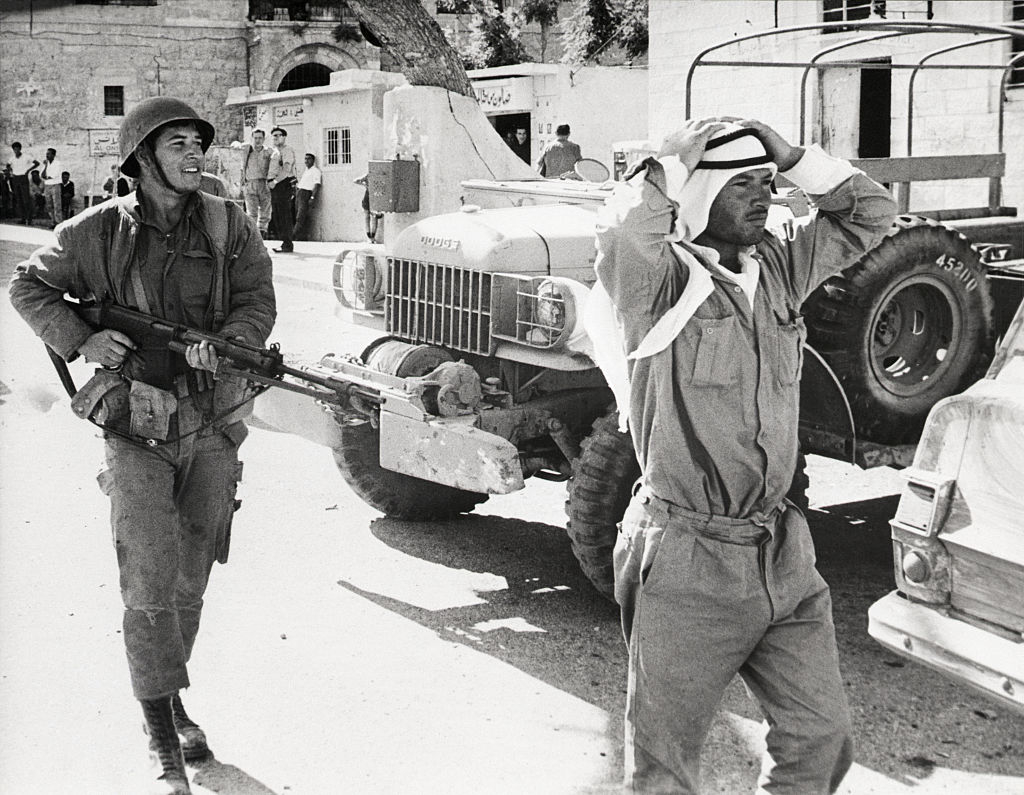
But low and behold, after a few days and by the time the border was opened, Egypt had lost Sinai, Syria, the Golan Heights, and Jordan the West Bank and Jerusalem; the jewel in the crown.

The car was tense, and for the first time I was disappointed, not because of the news of defeat rather, rather because I was no longer the centre of attraction for the family. As we entered Iskenderun in Turkey, a couple of young men crossing the streets, seeing our car number plate in Arabic, spat on the ground and said in Turkish; Pis Arap, meaning dirty Arab.

I didn’t undrestand Turkish at the time, until my father smiled bitterly and said, so we have just become dirty Arabs. In the small hotel in Iskenderun owned by a generous Armenian family, they brought us their transistor which could catch Syrian broadcasts and heard my father saying Nasser has resigned, and I was wondering how could he do that. For me, Nasser’s image was a cross between a king and an idol football player.

By the time we reached Ankara, it was all over. We were nothing in the eyes of the Turks at the time, but lying impotent Arabs. As the years passed, maturity set in as a strong slap in the face, with my childhood’s main scar left inside me, engulfing me with doubt, and disbelief, not only regarding what I now hear but also in what I see: with Arab politics to me, becoming just a mixture of cynicism, blatant lies, and regimes self-preservation.

The disaster from top to bottom was, unqualified military officers in Egypt, only accustomed to internal security and privileges were punching above their weight and carrying ranks which were above their undrestanding of warfare. Their ignorance was stark obvious when they knew about the attack and opted for absorbing the first blow before counter-attacking, not knowing they’ll have nothing left to counter with.

Jordan was squeezed between the hammer and the anvil diplomatically, though there were voices among the statesmen at the time urging not to participate in the impending whilst recognizing the perils, yet the decision to participate in the war and opening the Jordanian couldn’t be avoided because first of all the belief in Nasser’s victory held sway among the people, and secondly, to imagine an Arab defeat would not spare Jordan who will be blamed for this defeat due to the lack of giving support in the war.

In the case of Syria, how could an army in which the first officer who wakes up before the others and carries out a coup d’état, fight a war; and how could an army in which a general has to walk behind the coup d’état lower ranks whom are only concerned about preserving their own hold on power, conduct warfare? In fact the fall of the Golan Heights was declared by the Syria representative in the UN, 36 hours before it actually fell. And why was this? All in aid for withdrawing the army to protect Damascus.

Has anything changed? Everything has changed so that nothing changes!

Dr Janbek is a Jordanian writer based in Paris, France

Continue reading
Israeli Soldiers: ‘…We Had to Kill Arabs’

Newly disclosed testimonies by Israeli soldiers and archival documents published by Israeli newspaper Haaretz have shed new light on the displacement of Palestinians and Syrians during and after the 1967 Arab-Israeli war, with accounts describing killings, expulsions, destruction of villages and widespread looting.

The investigation, published ahead of the 59th anniversary of the war and authored by Adam Raz, a researcher at the Akevot Institute for Israeli-Palestinian Conflict Research, is based on previously unpublished soldiers’ testimonies, military records, government correspondence and archival material.

According to the report, approximately 300,000 Arabs were expelled or displaced from the West Bank, Gaza Strip and the occupied Syrian Golan Heights during and after the June 1967 war.

Haaretz said many of the testimonies originated from discussions held among Israeli soldiers in kibbutzim, Israel’s collective farming communities, shortly after the war. While some excerpts later appeared in the influential 1967 book, The Seventh Day: Soldiers Talk about the Six-Day War, numerous accounts describing alleged war crimes remained unpublished for decades.

Several testimonies cited by the newspaper describe killings of prisoners, civilians and refugees. One soldier was quoted as saying: “At first I wasn’t willing to execute Arabs who weren’t resisting. Then we came to the conclusion that we had to kill.”

Another soldier described operations in Gaza after the war, saying: “Human lives didn’t matter. You could kill, there was no law. No one would say a word to you.”

A third testimony referred to what the soldier described as “punitive expeditions” in Gaza’s refugee camps. “We caught guys, lined them up and eliminated them. In retrospect, it looks like murder,” he said.

Shoot-at-sight orders for West Bank returnees

The report also cites testimonies and archival documents alleging that Israeli forces were ordered to prevent Palestinians who had fled across the Jordan River from returning to the West Bank after the fighting ended.

According to Haaretz, soldiers received instructions to shoot people attempting to cross back into the territory.

The newspaper cited testimony later published by former Israeli lawmaker Uri Avnery, who quoted a soldier as saying troops had received orders to “shoot, to kill, without prior warning.”

Another soldier recalled questioning whether such orders applied even if families with children were crossing the river. According to the testimony, he asked: “If I hear babies crying, should I shoot then too?” and was told: “Don’t be a girl.”

Haaretz said military records indicated that by early September 1967, nearly 150 Palestinians had been killed while attempting to return from Jordan. The newspaper also cited statements by senior Israeli military officials acknowledging the existence of orders aimed at preventing refugee returns.

According to the investigation, displacement during the war was not solely the result of battlefield conditions. The report cites government discussions and military documents suggesting that senior Israeli political and military leaders viewed the departure of Arab residents as desirable and, in some cases, encouraged or facilitated it.

Among the most prominent examples highlighted by the report was the expulsion of residents from the Latrun villages of Imwas, Yalo and Beit Nuba west of Jerusalem. The villages were captured during the war and their approximately 8,000 residents were ordered to leave, according to the investigation.

Haaretz reported that the villages were subsequently demolished and their inhabitants prevented from returning. The area later became the site of Canada Park.

‘Population transfer’

The newspaper also cited testimony from Ishai Amrami, a deputy battalion commander during the war, who later described what he witnessed as “an attempt at massive population transfer.”

The investigation further details events in Qalqilya and other communities near the Green Line, where residents were allegedly encouraged or forced to leave through military pressure, loudspeaker announcements, transportation arrangements and destruction of homes.

According to the report, tens of thousands of Palestinians also fled or were displaced from refugee camps in the Jericho area and elsewhere in the West Bank. Many carried memories of the 1948 Nakba and feared another permanent displacement.

The report revisits events in Gaza as well, where soldiers described raids, arrests and killings in refugee camps after the war. One soldier was quoted as saying: “We would roam through refugee camps in Gaza and carry out purges.”

Another testimony stated: “Every man we saw was a combatant,” while acknowledging that civilians may also have been among those killed.

Beyond the Palestinian territories, Haaretz reported that approximately 120,000 Syrians left or were expelled from the Golan Heights after Israeli forces captured the territory from Syria.

The newspaper cited military documents and testimonies indicating that villages in the Golan Heights were later demolished to prevent residents from returning. According to the report, Israeli commander Elad Peled later described a decision to bring in bulldozers and destroy villages “so there would be nowhere to return.”

Haaretz also cited reports submitted by Syria to the United Nations and records from the International Committee of the Red Cross alleging intimidation, forced displacement, looting and destruction of civilian property in the occupied territory.

Israel warned of legal repercussions

The investigation further describes what it says was widespread looting in areas captured during the war. According to the report, soldiers, civilians and local authorities participated in the removal of property from Palestinian and Syrian homes, schools, businesses and public institutions.

Among the documents cited is a previously unpublished 1967 letter by Theodor Meron, then legal adviser to Israel’s Foreign Ministry. According to Haaretz, Meron warned that expulsions of civilians constituted “a serious violation of the Geneva Convention” and could create diplomatic complications for Israel.

The report says Israeli officials were aware of legal concerns surrounding the expulsions but nevertheless approved measures aimed at preventing displaced populations from returning and consolidating control over newly occupied territories.

The Six-Day War began on June 5, 1967, and ended with Israel capturing the West Bank, East Jerusalem, the Gaza Strip, the Sinai Peninsula and the Golan Heights. While Israel later returned Sinai to Egypt under the 1979 peace treaty, it continues to occupy the West Bank and the Golan Heights.

For Palestinians, the conflict is remembered as the Naksa, or setback, which triggered a new wave of displacement nearly two decades after the 1948 Nakba and remains a defining event in collective Palestinian memory. Anadolu

Continue reading
For Israel The ‘Yellow Line’ is Occupation

By Ismail Al Sharif

Two months after the signing of the ceasefire, that remains merely ink on paper, the region is yet to witness a fundamental shift to the second phase: A transition from a strategy of destruction to a withdrawal mechanism, and from the logic of military operations to a framework of international administration, paving the way for a political process to ultimately lead to the establishment of a sovereign Palestinian state.

However, the realities on the ground today proves this path is nothing more than a theoretical assumption quickly crumbling in the face of a complex reality.

Two months after the supposed ceasefire, a completely different truth emerges; Israel continues its ethnic cleansing of the Gaza Strip. Palestinian civilians are dying from the bitter cold, just as they previously perished from the bombardment, while unilateral decisions are being made whilst deepening the chasm of mistrust between the parties supposedly partnering in ending this humanitarian tragedy and implementing the Donald Trump plan, who claims to have ended a three-thousand-year-old war.

What was supposed to be a temporary withdrawal line for the Israeli army has, according to its generals, become a new de facto border called the “Yellow Line,” swallowing up more than half of the Gaza Strip.

Early this month, the army’s chief of staff Eyal Zamir addressed his troops, asserting Israel “now exercises effective control over vast areas of the Strip” and its military units “will maintain their positions on these defensive lines.” He explicitly declared “the Yellow Line represents a new border of an advanced line of defense to protect Israeli society, and serves as a framework for the ongoing military operational activity.”

From these comments it can be understood the ceasefire line is no longer a temporary, transitional measure, but has effectively become a forcibly-imposed border, a permanent defensive zone, and a legal framework that legitimizes a long-term Israeli military presence within territories that, until recently, were an integral part of the Palestinian territories.

These pronouncements are not merely political rhetoric. The “Yellow Line” is now embodied on the ground by massive, yellow-painted concrete blocks that bisect the Gaza Strip to a depth of between 1.5 and 6.5 kilometers. Before the recent escalation, the Strip extended about 41 kilometers in length and between 6 and 12 kilometers in width. As it stands however, Israel has tightened its grip on more than half of this area in one of the world’s most densely-populated regions. This has exacerbated overcrowding, drastically reduced usable land, and devastated the agricultural sector, thus intensifying the humanitarian catastrophe, entrenching mass forced displacement, deepening the destruction, and contributing to the complete collapse of the institutional infrastructure.

The Zamir statements cannot be separated from the context of the pronouncements of war criminal Benjamin Netanyahu, who, from northern occupied Palestine, spoke of the expansion of his northern and northeastern borders by establishing a demilitarized buffer zone from the Syrian capital, Damascus, to the occupied Golan Heights. This is being made with the advance of his military forces into the UN-monitored buffer zone and the occupation of the Syrian side of Mount Hermon (Jabal al-Sheikh). Also, Israel is presently establishing establishing a “buffer zone” in the territory of southern Lebanon, destroying border villages and/or leaving them completely depopulated and deploying military reinforcements at strategic border points to impose a new security and geopolitical reality by force.

According to the Trump’s plan the second phase was supposed to begin after Hamas fulfilled its commitment to release all Israeli captives, both alive and deceased, and after Netanyahu announced his readiness to move to this phase.

However, this transition was contingent on two fundamental conditions: The deployment of international peacekeeping forces and the complete disarmament of Hamas. Herein lies the complexity of the issue; Netanyahu has publicly expressed skepticism about the ability of any international force to carry out the disarmament mission and has categorically stated that Hamas’s disarmament will be achieved through coercive military means and under the direct supervision of Israeli forces.

In contrast, Hamas maintains its categorical refusal to disarm except within a comprehensive framework that includes the formation of a unified Palestinian ‘technocratic” government and a complete withdrawal of Israeli occupation forces. At a minimum, Hamas has expressed its willingness to store its weapons within an agreed-upon mechanism as part of a comprehensive political process, as confirmed by Bassem Naim, a member of the movement’s political bureau, in recent statements.

The current situation reveals that Israel is treating the existing circumstances as a strategic opportunity to expand its geographical borders and exert maximum pressure on the Palestinian people, paving the way for what it calls “voluntary displacement” under a humanitarian pretext—a pretext it itself created.

Simultaneously, it is deliberately and systematically obstructing the transition to the second phase of the Trump agreement by continuing its policies of occupation, killing, and destruction under the guise of a ceasefire.

It is clear this arrangement serves its strategic interests and intersects with broader Western interests, with the ultimate result being the aborting of any chance of establishing a sovereign Palestinian state, and keeping the Gaza Strip – as it has always been – a besieged enclave, which Israel exploits to achieve its political agenda and strengthen its internal cohesion, and turning it into a field laboratory in which various military weapons, biological tools and advanced technological techniques are tested, but with a reduction in the population, which allows it to continue what is strategically known as “managing the conflict” in the long term.

This article by Ismail Al Sharif was originally written in Arabic for the Addustour daily and published in Crossfirearabia.com.

Continue reading
Jordan’s PM: ‘Greater Israel’ Illusion

Jordanian Prime Minister Jafar Hassan on Tuesday called the so-called “Greater Israel” vision an “illusion,” stressing that Tel Aviv is “isolated” due to its “extremist” policies.

“We hear about visions and proposals that imply a perpetual war with no end, such as the illusion of Greater Israel entertained by extremist politicians in Israel,” Hassan said during a meeting in Amman with his Lebanese counterpart, Nawaf Salam, who arrived in the Jordanian capital early Tuesday for an unannounced visit.

He said Israel is “isolated and besieged because of its extremist policies.”

“The entire reality points to (Israeli) policies that deepen hatred and resentment as a result of ongoing massacres, and the peoples of the world and the region will not forgive them,” he added in his comments carried by the official Petra news agency.

On Monday, Jordanian government spokesman Mohammad al-Momani accused the far-right in Israel of “threatening the region and undermining prospects for a two-state solution.”

“Greater Israel” is a Biblical term used in Israeli politics to refer to the expansion of Israel’s territory to include the West Bank, Gaza, Syria’s Golan Heights, Egypt’s Sinai Peninsula, and parts of Jordan.

Last week, Israeli Prime Minister Benjamin Netanyahu told a news channel that he feels “very attached” to the vision of a Greater Israel. He said he considers himself “on a historic and spiritual mission” which “generations of Jews that dreamt of coming here and generations of Jews who will come after us,” according to Anadolu.

Israel has killed more than 62,000 Palestinians in Gaza since October 2023. The military campaign has devastated the enclave and brought it to the verge of famine.

Last November, the International Criminal Court issued arrest warrants for Netanyahu and his former Defense Minister Yoav Gallant for war crimes and crimes against humanity in Gaza.

Israel also faces a genocide case at the International Court of Justice for its war on the enclave.

Continue reading