CrossFireArabia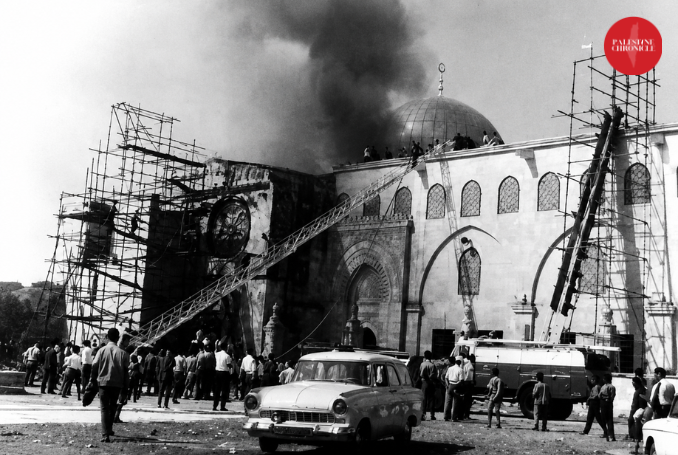
On the morning of August 21, 1969, flames erupted inside Al-Aqsa Mosque in occupied East Jerusalem, two years after Israel occupied the eastern part of the city.
The fire began at approximately 7:20 a.m. and burned for more than three hours.
By the time firefighters brought the blaze under control, large sections of the mosque had been damaged.
The southern portion of the roof was destroyed and walls and other architectural elements were severely affected. The main structure and dome, however, survived.
Among the losses was something irreplaceable: the historic pulpit known as the Minbar of Salah al-Din.
Its destruction would become one of the defining images and enduring symbols of the 1969 fire.
What Was the Minbar of Salah al-Din?
The minbar was a masterpiece of medieval Islamic craftsmanship dating to the 12th century.
It became associated with Salah al-Din al-Ayyubi and the restoration of Muslim rule in Jerusalem following the Crusader period.
For centuries, it stood inside Al-Aqsa Mosque as both a religious object and an extraordinary piece of Islamic heritage.
The 1969 blaze destroyed it completely.
Its loss therefore transformed the fire from an attack damaging a religious building into a major cultural and historical loss as well.
Who Started the Fire?
One day after the blaze, Israeli police arrested Denis Michael Rohan, an Australian national who had entered Jerusalem on a tourist visa.
Evidence provided by guards at the mosque contributed to his arrest, according to the historical account cited by Quds News Network.
Rohan subsequently admitted setting Al-Aqsa on fire.
During proceedings, he expressed extremist religious beliefs and said he believed burning the mosque was connected to a divine mission involving the rebuilding of the Jewish Temple in Jerusalem.
His lawyers argued that he was mentally ill.
In December 1969, an Israeli court found Rohan not criminally responsible for the act because of mental illness and ordered that he be confined to a psychiatric institution.
That explanation and the outcome of the case were met with widespread skepticism and criticism in the Arab and Muslim worlds, particularly given that the fire occurred only two years after Israel’s occupation of East Jerusalem.
How Much of Al-Aqsa Was Destroyed?
The fire caused extensive damage but did not destroy the entire mosque.
The southern section suffered heavily, including parts of the roof, walls and architectural elements.
The Minbar of Salah al-Din was completely destroyed.
Firefighters eventually contained the blaze before it consumed the principal structure and dome.
The scale of the damage nevertheless made the incident one of the most consequential events at Al-Aqsa in modern history.
How Did the World React?
News of the fire triggered demonstrations and widespread anger across Palestine and the Arab and Muslim worlds.
Several countries immediately brought the issue before the United Nations and demanded an investigation and international measures to protect Jerusalem’s holy sites.
On August 22, a group of Arab and Muslim states submitted a communication to the UN highlighting the damage and calling for measures to prevent similar incidents.
The repercussions ultimately reached the UN Security Council.
What Did the UN Security Council Do?
On September 15, 1969, less than a month after the fire, the Security Council adopted Resolution 271.
The resolution expressed grief over the extensive damage to Al-Aqsa and described the destruction as a loss to human culture.
It also warned that acts targeting Jerusalem’s holy places, religious buildings and sites could endanger international peace and security.
Crucially, the resolution situated the fire within the wider question of occupied Jerusalem.
It reaffirmed previous Security Council positions regarding the city and rejected measures designed to alter its status.
The fire was therefore treated not simply as an isolated act of arson, but against the political and legal backdrop created by Israel’s occupation of East Jerusalem in 1967.
What Happened to Al-Aqsa afterward?
Palestinians undertook extensive efforts to restore the damaged sections of the mosque.
Palestinian architect and engineer Ibrahim al-Daqqaq was among the prominent Jerusalem figures involved in Al-Aqsa’s reconstruction following the fire.
The destruction of the historic minbar presented a particularly difficult challenge because of the intricacy of its original craftsmanship.
Decades later, a meticulously reconstructed minbar was eventually installed at Al-Aqsa, replacing the one destroyed in 1969.
Why Does August 21 Still Matter?
The significance of the 1969 fire is not confined to history. For Palestinians, its memory is directly connected to contemporary fears over Al-Aqsa Mosque amid years of incitement, repeated incursions into the compound and an increasingly organized movement seeking to fundamentally change its religious and political status.
While the 1969 fire was attributed to Denis Michael Rohan, the decades since have witnessed the growth of Israeli religious-nationalist movements advocating greater Jewish control over the Al-Aqsa compound, known to Jews as the Temple Mount. Many Jewish activists and organizations ultimately seek the construction of a Third Temple at the site.
These movements have moved increasingly close to the political mainstream, with Israeli National Security Minister Itamar Ben-Gvir among the most prominent senior officials challenging the longstanding status quo governing the compound.
Ben-Gvir has repeatedly entered Al-Aqsa under heavy police protection and publicly advocated Jewish prayer there. In 2024, he declared that his policy was to permit such prayer and said that, if the decision were his, he would establish a synagogue at the compound.
In August 2025, Ben-Gvir went further, openly leading Jewish prayers at the compound — reportedly the first Israeli government minister to do so publicly — while calling for strengthened Israeli “sovereignty” over the site.
For Palestinians, therefore, remembering August 21, 1969, is not simply about commemorating a fire that occurred 57 years ago. It exists within a continuing struggle over the identity, administration and future of Al-Aqsa Mosque. Palestine Chronicle


 marwan