The Lebanese-Israeli Accord is War on The Resistance

Dr. Nassib Hateit

The announcement of the Lebanese-Israeli agreement, sponsored by the United States, constitutes a dangerous turning point in the war against the Lebanese resistance and its people. It is intended to compensate for the occupation army’s field failures in achieving its objectives of disarming and eliminating the resistance, after suffering significant moral and military losses and realizing its inability to achieve these illegitimate goals on its own.

The enemy’s impotence has driven it to resort to using the Lebanese government, whose legitimacy and constitutionality are still guaranteed by the resistance forces (in the dual alliance). This provides the government with a constitutional—albeit immoral—cover for cooperating with the enemy and legitimizing a comprehensive war against the resistance. It also involves assembling a US-led military coalition that includes Arab and international (multinational) parties, mirroring the “Desert Storm” coalition led by the United States against Iraq.

The aim is to support a beleaguered Israel and eliminate the resistance in all its cultural, economic, social, and health-related aspects, not just its military ones. This agreement confirms the beginning of a new phase of confrontation following the end of the “Hundred Days’ War,” in which Israel failed to achieve its objectives, despite the resistance suffering approximately 20,000 martyrs and wounded, the destruction of tens of thousands of homes, and the destruction and occupation of more than 50 villages and towns.

This shifts the war from a confrontation between Israel and the Lebanese resistance to a war between the resistance and an international coalition led by Washington, with the participation of Israel and the Lebanese government and opens the door for the involvement of Arab and foreign armies, most notably the new Syrian regime army, which US President Trump announced he would task with eliminating the resistance.

This will be facilitated by the Lebanese government’s initiative to formally request the support of Ahmed al-Sharaa’s government for the Lebanese army and will force the resistance to fight on three fronts:

Against the Israeli enemy in the south

Against the US military, multinational forces, and the Lebanese army within Lebanon

Against the Syrian army and takfiri groups in the Bekaa Valley. The US has effectively nullified the first clause of the Memorandum of Understanding with Iran through the Lebanese-Israeli negotiations in Washington, placing the memorandum in a precarious position that threatens its collapse. According to its terms, violating the first clause invalidates the remaining clauses. This precariousness is further evidenced by the timing of the agreement’s announcement, coinciding with the US airstrikes in the Strait of Hormuz. It reinforces concerns that the 60-day period the US needs to reassess its position might be shortened or canceled, or that it could be exploited to forcibly separate the Lebanese and Iranian tracks through the Lebanese government. The aim would be to break the military and political alliance between the resistance and Tehran, and to further fragment the axis, isolating its members and preventing them from uniting their forces to compensate for the imbalance of power.

This agreement grants the Israeli enemy a clean bill of health by the Lebanese government, implicitly acknowledging that the invasion was a response to threats from the resistance. It also includes a pledge not to file any complaints or seek compensation before international institutions and courts—a clever preemptive move by the enemy to shield its military and political officials from accountability and represents a complete surrender by the Lebanese government, which has become something akin to the “12th Division” of the occupation army.

The initial response to this surrender document should be as follows:

Restraining this government and ceasing the sin of granting it legitimacy and constitutionality. It must abandon its hesitation, ambiguity, and incompetence in ministerial representation, the latest glaring example of which is passing the agreement’s presentation to the cabinet without objection from the resistance ministers, who merely issued a statement that condemns them more than it exonerates them.

The Islamic Republic of Iran should take the initiative to freeze the implementation of the MoU with the United States, given that Washington is responsible for this agreement, which contradicts the memorandum’s first clause. The Resistance Axis (Lebanon, Iraq, Iran, and Yemen) has declared its complete readiness to engage in the new round of war, united and collectively, without delay, and to move from a state of “finger on trigger” to one of “fire.” Otherwise, the Axis’s fronts will fall one by one, as Israel and America plan.

The coming phase is the most dangerous since the outbreak of war in 2023 due to the expansion of the fronts and the multiplicity of parties participating against the Resistance. It comes after a war of attrition and exhaustion that has plagued the Resistance and its support base for three years, necessitating the formulation of a new defensive strategy. The Lebanese government must be considered an “unfriendly” entity, having made the Resistance a common enemy for itself and Israel. Participation in a government that collaborates with the enemy against the Resistance is unjustifiable, as experience has proven its futility.

We are not weak… the proof is the global mobilization against us, which cannot be countered with motorcycles and statements!

Manage the power you possess wisely! Take advantage of the enemy’s motto against you (kill first) and kill the government “politically” and bring it down to prevent it from carrying out its plans!

Dr Hateit  is a Lebanese writer. An architect by training from Nabatieh in south of Lebanon he teaches at the Institute of Fine Arts in the Lebanese University and is a political columnist contributing to different Lebanese newspapers. This article is published in the Arabic Al Rai Al Youm website and reprinted in crossfirearabia.com.

  • CrossFireArabia

    CrossFireArabia

    Dr. Marwan Asmar holds a PhD from Leeds University and is a freelance writer specializing on the Middle East. He has worked as a journalist since the early 1990s in Jordan and the Gulf countries, and been widely published, including at Albawaba, Gulf News, Al Ghad, World Press Review and others.

    Related Posts

    US-Israel Relations Toxic

    By Robert Inlakesh

    Zionists have now become so unpopular that the Vice President feels the need to appear critical of Israel.

    The recent comments made by US Vice President JD Vance to Joe Rogan are indicative of just how toxic the Israel brand has become. Yet his comments have been largely pulled out of context in order to invent an image of a totally different politician to the man who is actually operating as America’s second in command.

    In a recent episode of the Joe Rogan Experience, JD Vance made some notable comments on Israel when pushed on the topic – ranging from admitting an Israeli Mossad connection to the infamous Jeffrey Epstein to Israeli interference in the negotiation process he led with the Islamic Republic of Iran.

    Understanding the nature of these comments first requires a little background information on who JD Vance actually is. This is a man whose political rise has largely been attributed to Palantir co-founder Peter Thiel.

    Vance’s relationship with Thiel began to form back in 2011, when the German-American entrepreneur gave a speech at Yale Law School, which would lead to a relationship whereby Vance would be brought into the world of big tech and venture capital.

    The Palantir co-founder later granted Vance $15 million dollars – the largest single sum ever donated to a Senate candidate – to buy him into politics. While JD Vance had previously criticized US President Donald Trump’s character vociferously, Thiel is credited with having successfully convinced Trump to make him his VP.

    It is clear that Vance has broader political ambitions, including winning the Presidency in the future. Paramount to understanding his recent shift on the question of Israel is understanding all of this context. What has presented as a shift on the question of Israel began with the comments he previously made regarding Israeli opposition to the Memorandum of Understanding (MoU) the US briefly secured with Iran.

    At the time, the Vice President had stated that those Israelis who had become critical of Washington’s strategy needed to “wake up and smell the reality of the situation that country is in”, after noting that the US taxpayer had footed the bill for defending it and reminding those critics that Donald Trump was their last true ally.

    Again, on the Joe Rogan Podcast, he attempted to replicate this sentiment, but was subjected to follow-up questions which ended up making what he was trying to pull off fall flat.

    While Vance has proven capable of questioning some Israelis and their supporters, he is deliberately ambiguous. This is because he is siding with Israeli Prime Minister Benjamin Netanyahu and trying to criticize the current Israeli opposition, without actually going as far as naming anyone consequential.

    He even told Joe Rogan that Jeffrey Epstein was connected to both the CIA and Mossad, but made it clear that former Israeli Prime Minister Ehud Barrack was responsible for coordinating with the convicted sex trafficker. The American official then tries to pass off the situation as if Netanyahu is an opponent of Epstein’s affiliates.

    When discussing Israeli influence on the United States, he does not deny that it exists, but instead argues that this is normal and even tries to compare it to Qatar’s limited role in influencing Washington. 

    All this being said, it is clear that JD Vance is not making radical critiques of Israel; it is a strategy that hopes to put him on the record as having been a voice within the Trump administration who has pushed back against the disastrous pro-Tel Aviv policy choices.

    What is significant about this, however, is that a politician like him feels it to be necessary to present himself as critical of the Israelis. It reflects a substantial shift in American politics across the board, especially amongst voters 35 years old and younger.

    In the Democratic Party, the base has become so incredibly pro-Palestinian that taking contributions from AIPAC and stating a pro-Israel position has gone from being a net positive to now being a position that could even lose an establishment Democrat their position in Congress.

    On the Republican side, there is still remaining support for Israel amongst its base, but the vast majority of these sentiments come from older voters. If you look at young Republicans, the picture is very different, and according to the polls, the 35-year-old and under bracket is gradually shifting more and more towards an anti-Israel position. There is, therefore, a need for even Republican candidates to begin treading a fine line on the issue.

    For a large segment of American voters, a politician’s position on Israel is a primary indicator of whether they are genuine actors or not. If they are seen to be identifying with the Israel Lobby, the assumption is that they are not going to prioritize their constituents and instead will work to please the donor class.

    It represents a radical change in US politics and is a major loss for the Zionists, who have now become so unpopular that the Vice President feels the need to appear critical of Israel in order to avoid committing political suicide.

    – Robert Inlakesh is a journalist, writer, and documentary filmmaker. He focuses on the Middle East, specializing in Palestine. He contributed this article to The Palestine Chronicle.

    Continue reading
    US-Israel: More Than a Crack in Relations

    By Mohammad Abu Rumman

    The significance of the recent vote in the U.S. House of Representatives does not lie in its immediate outcome. The amendment introduced by Republican Congressman Thomas Massie to suspend roughly $3.3 billion in annual U.S. military aid to Israel was defeated by a comfortable margin, 314 votes to 104. The real surprise, however, was that 103 Democratic lawmakers voted in favor of the proposal, representing more than half of the Democrats who cast either a “yes” or “no” vote. This is difficult to dismiss as a passing protest or as the position of the party’s progressive fringe alone.

    The more revealing development is that a number of those lawmakers had, until recently, been considered acceptable allies by the American Israel Public Affairs Committee (AIPAC), with several having previously received its endorsement and political support. Yet immediately after the vote, online fundraising for fifteen of those members seeking re-election quietly disappeared from AIPAC’s donation platform. Their names remained listed among “pro-Israel” legislators, but the financial pipeline had effectively been shut off.

    Against this backdrop, Vice President J.D. Vance’s recent remarks become particularly significant. Vance did not merely criticize specific Israeli policies. Speaking on Joe Rogan’s podcast, he accused elements within the Israeli government of attempting to derail U.S. negotiations with Iran and prolong the military campaign. He also referred to financial and political influence campaigns aimed at attacking American officials whose priority, in his view, was to place U.S. national interests above all else.

    The debate over Israel is therefore evolving from two seemingly opposite directions that ultimately converge on the same question. Progressive Democrats approach the issue through the lens of Gaza, human rights, and the costs of unconditional American support. At the same time, an emerging current within the Republican populist right approaches it through the doctrine of “America First,” skepticism toward endless wars, and growing reluctance to see the United States become the permanent financier and guarantor of conflicts largely shaped by its allies.

    This does not mean that either party is suddenly turning against Israel, nor does it suggest that the U.S.-Israel strategic alliance is on the verge of collapse. America’s military, intelligence, and institutional commitments remain deeply entrenched. What is changing, however, is the old bipartisan consensus.

    Within the Democratic Party, divisions have become increasingly visible. Minority Leader Hakeem Jeffries opposed the amendment, while senior Democratic figures, including Nancy Pelosi and Katherine Clark, voted in favor of it. Even J Street—the liberal pro-Israel organization that opposed the amendment itself—acknowledged that the vote represented a politically significant moment.

    Republicans, meanwhile, remain broadly supportive of Israel, particularly within the party’s traditional conservative and evangelical base. For precisely that reason, Vance’s comments provoked unusually fierce criticism from Republican politicians and conservative media, who viewed them as a departure from long-standing party orthodoxy. Yet the very existence of such a dispute suggests that Israel is no longer entirely beyond debate, even within the constituency historically regarded as its strongest American supporter.

    Here lies the central paradox of the current moment. Benjamin Netanyahu sought to use the Gaza war to reshape the Middle East while capitalizing on what had become an unprecedentedly close relationship with the Trump administration. Yet Israel’s successive wars—from Gaza to Lebanon and later Iran—have produced an unexpected consequence: they have triggered a broader American conversation about costs rather than strategic necessity.

    Increasingly, the central question in Washington is becoming less about Israel’s security and more about America’s own national interest. Why should the United States continue to bear the financial, military, political, and diplomatic costs of these conflicts? And who ultimately determines when America enters a war—or when it leaves one?

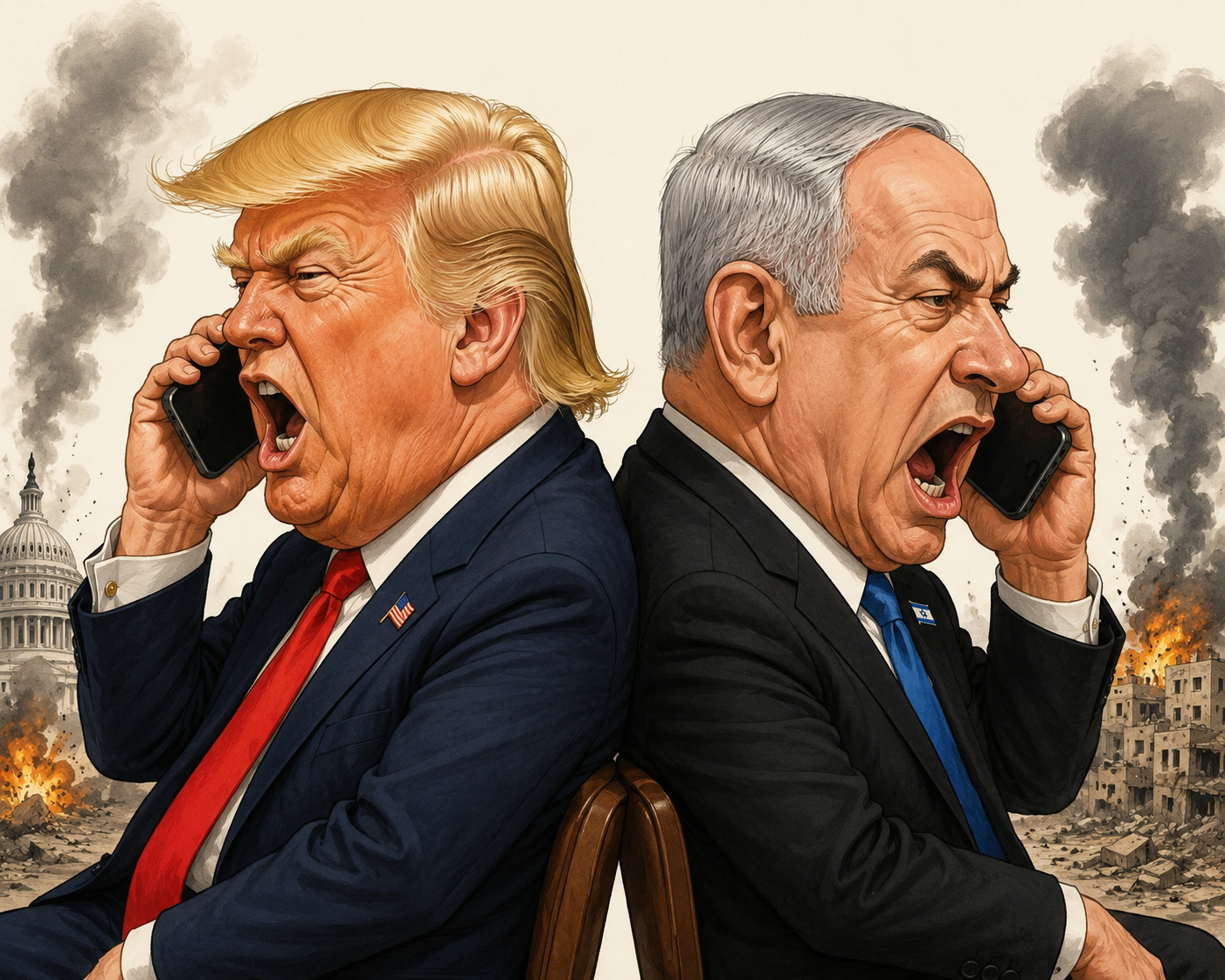
    Even the personal relationship between Donald Trump and Benjamin Netanyahu has not escaped these contradictions. After a period of remarkable military coordination, differences emerged as Trump sought negotiations with Iran and an end to the conflict, while Netanyahu’s government viewed continued military pressure as an opportunity to pursue broader strategic objectives. What had appeared to be an exceptionally close partnership gradually evolved into a more complicated relationship marked by disagreements over ceasefires, Lebanon, and the parameters of any future understanding with Tehran.

    Israel thus finds itself confronting a profound strategic paradox. It has reached perhaps the highest level of military integration with the United States in its history, while simultaneously experiencing one of the lowest levels of political acceptance among growing segments of the American public and political establishment.

    The first major war fought in such close strategic coordination between Washington and Tel Aviv may well have achieved important military objectives. Yet it also accelerated the erosion of the old bipartisan consensus, reopening fundamental questions about money, influence, and the independence of American decision-making. In that sense, Israel may have won battles on the battlefield while beginning to lose something far more consequential in Washington.

    The writer is a Jordan Times columnist

    Continue reading

    You Missed

    Ahmad The Japanese Remained a ‘Palestinian’ Till His Last Breath

    Ahmad The Japanese Remained a ‘Palestinian’ Till His Last Breath

    Jerusalem Stitches

    • By marwan
    • July 26, 2026
    • 6 views
    Jerusalem Stitches

    More Than 5400 Israeli Settlers Violate Al Aqsa Mosque

    • By marwan
    • July 26, 2026
    • 10 views
    More Than 5400 Israeli Settlers Violate Al Aqsa Mosque

    Israel Kills Palestinian Police Commander to Spread Chaos

    • By marwan
    • July 25, 2026
    • 12 views
    Israel Kills Palestinian Police Commander to Spread Chaos

    Yehia Nisman: Killed a Week Before His Tawjhi Results

    • By marwan
    • July 25, 2026
    • 11 views
    Yehia Nisman: Killed a Week Before His Tawjhi Results

    Israel Arrests 3,600 West Bank Palestinians Since The Start of 2026

    Israel Arrests 3,600 West Bank Palestinians Since The Start of 2026