Netanyahu Has Lost Against Iran and He Knows it!

By Abdel Bari Atwan

Benjamin Netanyahu must have been the most ardent observer, from a position of frustration, defeat, and helplessness—indeed, a sense of utter defeat—of the largest, longest, and most organized funeral procession for the martyred Imam Ali Khamenei. The assassination he had boasted about completely backfired.

Most notably, the Iranian regime emerged from the Israeli-American war of aggression stronger and more resilient, retaining its missiles, its nuclear program, and its stockpile. Even more importantly, more than one 100 international delegations participated in the funeral procession, in addition to tens of millions of Iranian citizens. Israel, along with the deceived and misled United States, had gambled on these millions joining a massive popular uprising in most Iranian cities to overthrow the ruling regime and install one subservient and loyal to the American-Israeli camp.

The fact that leading Iranian figures were at the forefront of the mourners on the first day, in an open space, with no aircraft in the sky and no tanks, armored vehicles, or missile launchers on the ground, confirms the falsehood claim of US President Donald Trump that he pledged to protect this funeral procession and prevent the Israeli occupation state from carrying out any assassination attempts against these figures, especially the two key negotiators, Parliament Speaker Mohammad Bagher Ghalibaf, and Foreign Minister Dr. Abbas Araqchi.

The appearance of General Ahmad Vahidi, commander of the Revolutionary Guard, at the forefront of the mourning procession for the first time, perhaps confirms that the decision was purely Iranian. The Iranian leadership has repeatedly affirmed, through numerous high-ranking officials, its complete distrust of its American adversary, and it is justified in this assessment. It possesses a long list of practical and on-the-ground evidence to support this, because the consequences of any attack on the funeral procession by Israel and the United States would be extremely costly—politically, militarily, and economically—and would drag the world and its security into a third world war, the course and end of which no one can predict.

Based on this logic, I am inclined to believe the denial issued by the office of Israeli Prime Minister Benjamin Netanyahu regarding a report published by The New York Times. The report stated that President Trump feared Israel might assassinate the Iranian negotiators Qalibaf and Araqchi, and therefore warned against such an action due to its repercussions on relations between the two countries.

The Israeli terrorist government, which specializes in assassinating Arab and Islamic political and military leaders—from the martyred Imam Ali Khamenei, through the martyred Sayyed Hassan Nasrallah, leader of Hezbollah, to the third Sayyed, Iranian President Ebrahim Raisi, and dozens of Iranian, Lebanese, and Palestinian military leaders—cannot be transformed overnight into a docile lamb.

The undeniable truth is that Israel today is not the Israel of yesterday. Today’s Israel is terrified and defeated. All its plans have failed against the rock of Iranian steadfastness and resistance. Most, if not all, of its strategies have been exposed, its falsehoods revealed, the latest being its bet on dragging America, the superpower, into a war against Iran to completely destroy it and its missile and future nuclear capabilities.

Israel, for whom the incursion into Lebanese territory and the direct aggression against Iran with hundreds of aircraft and seen as a walk in the park, cannot these days bomb the southern suburbs of the capital Beirut with a single missile, because it knows full well that the direct response with hundreds of precision missiles and highly advanced drones to destroy Tel Aviv, Haifa, and Dimona would be immediate.

This process of change, currently taking shape in the region, reveals and confirms a radical shift in the balance of power in the “West Asia” region—not the Middle East, the odious colonial term—and it is thanks to two key leaders and a group of brilliant minds surrounding them:

First: The martyred Imam Sayyid Ali Khamenei, the late Supreme Leader of Iran, who assumed leadership of the Iranian Revolution after the death of its founder, Ayatollah Khomeini. He combined the two best qualities: Political, military, and executive leadership, serving as president for many years, and spiritual leadership as the Supreme Leader and Ayatollah of the Islamic “Imamate.” He developed Iran’s nuclear capabilities, transforming it into a nuclear threshold power with a stockpile of 460 kg of highly enriched uranium.

He also established a missile power with hundreds of highly advanced missiles and drones. He was one of the most ardent supporters of the Palestinian cause, providing it and its resistance fighters with all the necessary weapons and equipment, and fostering unity among the various fronts. He firmly believed that America and Israel are the primary source of danger to the Islamic nation and must be confronted and defeated.

Second: The martyr Yahya Sinwar and his comrades, those geniuses who planned, engineered, and executed the 7 October, 2023, attack, or the “Al-Aqsa Flood,” which shattered the sanctity of Israeli cities and settlements. They breached the heavily fortified borders, equipped with cameras and electrified fences, in the largest military intelligence penetration operation in the region’s history, rivaled only by the Egyptian army’s storming of the Bar-Lev Line in Ramadan of October 1973.

***

Of course, I am not comparing the two men, nor of equating them. Rather, they are the sons of a single, integrated path, deeply-rooted in the faith and history of Islamic resistance and honor. This path leads to dignity and victory, and the second, deeper, and greater phase of resistance against colonialism. With it has begun the process of radical change that will redraw the maps of West Asia and Africa according to the Islamic and Arab vision.

As for Netanyahu, who was merely a figurehead when he threatened to undertake this task and vowed to establish Greater Israel just a few months ago, will be the first victim of this change and so will his entity, and he is currently searching for an “honorable” withdrawal without appearing defeated, but his fate is inevitably prison, if he survives… And time will tell.

Abdel Bari Atwan is the Chief Editor of the Arabic Al Rai Al Youm Arabic website. He is a prolific writer and commentator on the Middle East political scene and has several books to his name including The Islamic State: The Digital Caliphate (2015).  

CrossFireArabia

CrossFireArabia
Dr. Marwan Asmar holds a PhD from Leeds University and is a freelance writer specializing on the Middle East. He has worked as a journalist since the early 1990s in Jordan and the Gulf countries, and been widely published, including at Albawaba, Gulf News, Al Ghad, World Press Review and others.

Related Posts

US-Israel Relations Toxic

By Robert Inlakesh

Zionists have now become so unpopular that the Vice President feels the need to appear critical of Israel.

The recent comments made by US Vice President JD Vance to Joe Rogan are indicative of just how toxic the Israel brand has become. Yet his comments have been largely pulled out of context in order to invent an image of a totally different politician to the man who is actually operating as America’s second in command.

In a recent episode of the Joe Rogan Experience, JD Vance made some notable comments on Israel when pushed on the topic – ranging from admitting an Israeli Mossad connection to the infamous Jeffrey Epstein to Israeli interference in the negotiation process he led with the Islamic Republic of Iran.

Understanding the nature of these comments first requires a little background information on who JD Vance actually is. This is a man whose political rise has largely been attributed to Palantir co-founder Peter Thiel.

Vance’s relationship with Thiel began to form back in 2011, when the German-American entrepreneur gave a speech at Yale Law School, which would lead to a relationship whereby Vance would be brought into the world of big tech and venture capital.

The Palantir co-founder later granted Vance $15 million dollars – the largest single sum ever donated to a Senate candidate – to buy him into politics. While JD Vance had previously criticized US President Donald Trump’s character vociferously, Thiel is credited with having successfully convinced Trump to make him his VP.

It is clear that Vance has broader political ambitions, including winning the Presidency in the future. Paramount to understanding his recent shift on the question of Israel is understanding all of this context. What has presented as a shift on the question of Israel began with the comments he previously made regarding Israeli opposition to the Memorandum of Understanding (MoU) the US briefly secured with Iran.

At the time, the Vice President had stated that those Israelis who had become critical of Washington’s strategy needed to “wake up and smell the reality of the situation that country is in”, after noting that the US taxpayer had footed the bill for defending it and reminding those critics that Donald Trump was their last true ally.

Again, on the Joe Rogan Podcast, he attempted to replicate this sentiment, but was subjected to follow-up questions which ended up making what he was trying to pull off fall flat.

While Vance has proven capable of questioning some Israelis and their supporters, he is deliberately ambiguous. This is because he is siding with Israeli Prime Minister Benjamin Netanyahu and trying to criticize the current Israeli opposition, without actually going as far as naming anyone consequential.

He even told Joe Rogan that Jeffrey Epstein was connected to both the CIA and Mossad, but made it clear that former Israeli Prime Minister Ehud Barrack was responsible for coordinating with the convicted sex trafficker. The American official then tries to pass off the situation as if Netanyahu is an opponent of Epstein’s affiliates.

When discussing Israeli influence on the United States, he does not deny that it exists, but instead argues that this is normal and even tries to compare it to Qatar’s limited role in influencing Washington. 

All this being said, it is clear that JD Vance is not making radical critiques of Israel; it is a strategy that hopes to put him on the record as having been a voice within the Trump administration who has pushed back against the disastrous pro-Tel Aviv policy choices.

What is significant about this, however, is that a politician like him feels it to be necessary to present himself as critical of the Israelis. It reflects a substantial shift in American politics across the board, especially amongst voters 35 years old and younger.

In the Democratic Party, the base has become so incredibly pro-Palestinian that taking contributions from AIPAC and stating a pro-Israel position has gone from being a net positive to now being a position that could even lose an establishment Democrat their position in Congress.

On the Republican side, there is still remaining support for Israel amongst its base, but the vast majority of these sentiments come from older voters. If you look at young Republicans, the picture is very different, and according to the polls, the 35-year-old and under bracket is gradually shifting more and more towards an anti-Israel position. There is, therefore, a need for even Republican candidates to begin treading a fine line on the issue.

For a large segment of American voters, a politician’s position on Israel is a primary indicator of whether they are genuine actors or not. If they are seen to be identifying with the Israel Lobby, the assumption is that they are not going to prioritize their constituents and instead will work to please the donor class.

It represents a radical change in US politics and is a major loss for the Zionists, who have now become so unpopular that the Vice President feels the need to appear critical of Israel in order to avoid committing political suicide.

– Robert Inlakesh is a journalist, writer, and documentary filmmaker. He focuses on the Middle East, specializing in Palestine. He contributed this article to The Palestine Chronicle.

Continue reading
US-Israel: More Than a Crack in Relations

By Mohammad Abu Rumman

The significance of the recent vote in the U.S. House of Representatives does not lie in its immediate outcome. The amendment introduced by Republican Congressman Thomas Massie to suspend roughly $3.3 billion in annual U.S. military aid to Israel was defeated by a comfortable margin, 314 votes to 104. The real surprise, however, was that 103 Democratic lawmakers voted in favor of the proposal, representing more than half of the Democrats who cast either a “yes” or “no” vote. This is difficult to dismiss as a passing protest or as the position of the party’s progressive fringe alone.

The more revealing development is that a number of those lawmakers had, until recently, been considered acceptable allies by the American Israel Public Affairs Committee (AIPAC), with several having previously received its endorsement and political support. Yet immediately after the vote, online fundraising for fifteen of those members seeking re-election quietly disappeared from AIPAC’s donation platform. Their names remained listed among “pro-Israel” legislators, but the financial pipeline had effectively been shut off.

Against this backdrop, Vice President J.D. Vance’s recent remarks become particularly significant. Vance did not merely criticize specific Israeli policies. Speaking on Joe Rogan’s podcast, he accused elements within the Israeli government of attempting to derail U.S. negotiations with Iran and prolong the military campaign. He also referred to financial and political influence campaigns aimed at attacking American officials whose priority, in his view, was to place U.S. national interests above all else.

The debate over Israel is therefore evolving from two seemingly opposite directions that ultimately converge on the same question. Progressive Democrats approach the issue through the lens of Gaza, human rights, and the costs of unconditional American support. At the same time, an emerging current within the Republican populist right approaches it through the doctrine of “America First,” skepticism toward endless wars, and growing reluctance to see the United States become the permanent financier and guarantor of conflicts largely shaped by its allies.

This does not mean that either party is suddenly turning against Israel, nor does it suggest that the U.S.-Israel strategic alliance is on the verge of collapse. America’s military, intelligence, and institutional commitments remain deeply entrenched. What is changing, however, is the old bipartisan consensus.

Within the Democratic Party, divisions have become increasingly visible. Minority Leader Hakeem Jeffries opposed the amendment, while senior Democratic figures, including Nancy Pelosi and Katherine Clark, voted in favor of it. Even J Street—the liberal pro-Israel organization that opposed the amendment itself—acknowledged that the vote represented a politically significant moment.

Republicans, meanwhile, remain broadly supportive of Israel, particularly within the party’s traditional conservative and evangelical base. For precisely that reason, Vance’s comments provoked unusually fierce criticism from Republican politicians and conservative media, who viewed them as a departure from long-standing party orthodoxy. Yet the very existence of such a dispute suggests that Israel is no longer entirely beyond debate, even within the constituency historically regarded as its strongest American supporter.

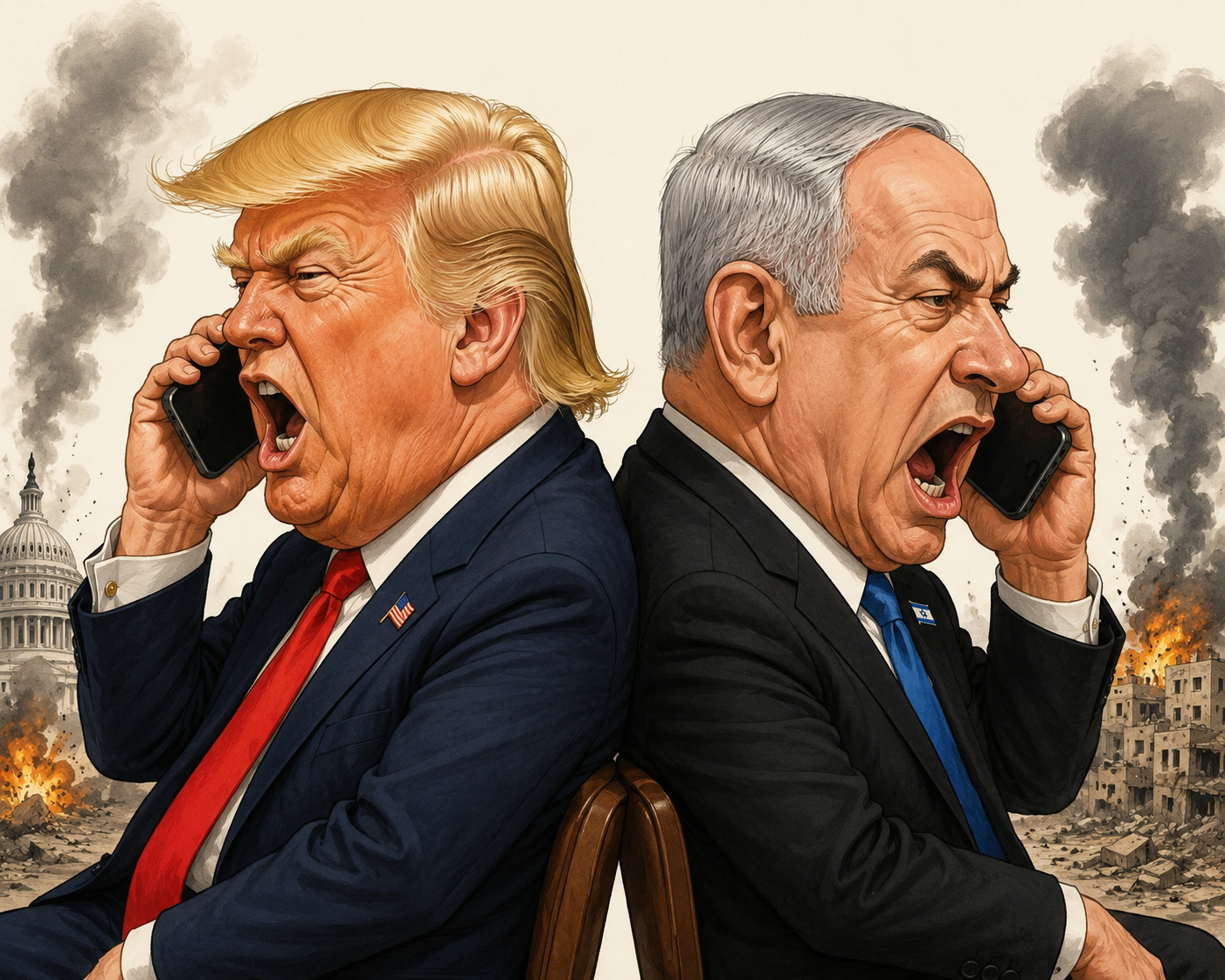
Here lies the central paradox of the current moment. Benjamin Netanyahu sought to use the Gaza war to reshape the Middle East while capitalizing on what had become an unprecedentedly close relationship with the Trump administration. Yet Israel’s successive wars—from Gaza to Lebanon and later Iran—have produced an unexpected consequence: they have triggered a broader American conversation about costs rather than strategic necessity.

Increasingly, the central question in Washington is becoming less about Israel’s security and more about America’s own national interest. Why should the United States continue to bear the financial, military, political, and diplomatic costs of these conflicts? And who ultimately determines when America enters a war—or when it leaves one?

Even the personal relationship between Donald Trump and Benjamin Netanyahu has not escaped these contradictions. After a period of remarkable military coordination, differences emerged as Trump sought negotiations with Iran and an end to the conflict, while Netanyahu’s government viewed continued military pressure as an opportunity to pursue broader strategic objectives. What had appeared to be an exceptionally close partnership gradually evolved into a more complicated relationship marked by disagreements over ceasefires, Lebanon, and the parameters of any future understanding with Tehran.

Israel thus finds itself confronting a profound strategic paradox. It has reached perhaps the highest level of military integration with the United States in its history, while simultaneously experiencing one of the lowest levels of political acceptance among growing segments of the American public and political establishment.

The first major war fought in such close strategic coordination between Washington and Tel Aviv may well have achieved important military objectives. Yet it also accelerated the erosion of the old bipartisan consensus, reopening fundamental questions about money, influence, and the independence of American decision-making. In that sense, Israel may have won battles on the battlefield while beginning to lose something far more consequential in Washington.

The writer is a Jordan Times columnist

Continue reading

You Missed

Only Palestinians Own The Key to Palestine

  • By marwan
  • July 26, 2026
  • 8 views
Only Palestinians Own The Key to Palestine

Israeli Forces Storm Downtown Nablus

  • By marwan
  • July 26, 2026
  • 4 views
Israeli Forces Storm Downtown Nablus

Looking Down on The World

  • By marwan
  • July 26, 2026
  • 7 views
Looking Down on The World

A Mosaic Palestine

A Mosaic Palestine

Guterres in Syria: ‘A Land of Possibilities’

  • By marwan
  • July 26, 2026
  • 7 views
Guterres in Syria: ‘A Land of Possibilities’

Beautiful Bethlehem

Beautiful Bethlehem