‘Our Miserable Life’

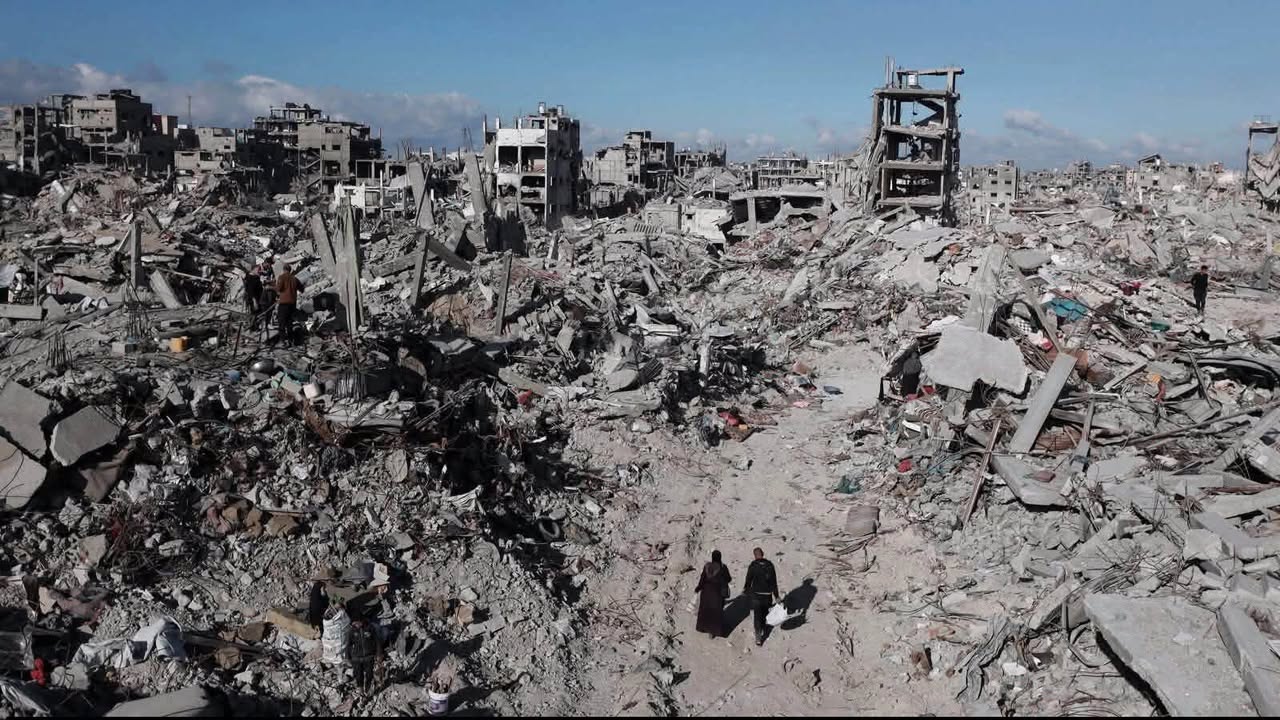
As the winter months approach many people in Gaza will likely continue to sleep in the wilderness and under the freezing air. Most of the Gazans at 2 million were displaced countless of times in this Israeli genocide with nowhere to go as their homes have been bombed multiple times.

Every family, individual, man, woman and child, have been affected. Everyone has become disparate to find a place, or just sleep anywhere

One such family, without a husband have found a street pavement as its abode among the noise of the traffic. Others, sleep in makeshift sheets and plastic, hastily hoisted to to at least try and cover their skin and bones.

…On the roadside

“Don’t worry it won’t fall down, shut up and sleep”, a mother tells her little one who found a ramshackle place on the roadside. “And the same goes for you,” she tells her other child.

But how can that be! “We are living on the pavement next to the road, among speeding cars, where people are constantly going up and down during the day and at nighttime,” she tells the Al Jazeera cameraman. Its pitch dark here. Only the passing cars provide a flicker of light.

“Our home has become the pavement. In the night we literally sleep between passing people, there is nothing to protect us. I try not to close my eyes because of the fear around us as men constantly roam up and down with the the stray dogs and other wild beast making an attempt on our shelter. I have to be alert to shoo them away.”

The skidding of cars never shops, she tells the cameraman. “I stay awake also because my child may suddenly get up and run to the road, and if a car hits him, it really wouldn’t be the fault of the driver. I do all I can to protect them,” she concludes.

The war made Gaza a downtrodden, chaotic world with wrecked homes and debris, estimated at 200 million that would take years to clear out.

Living in Plastic

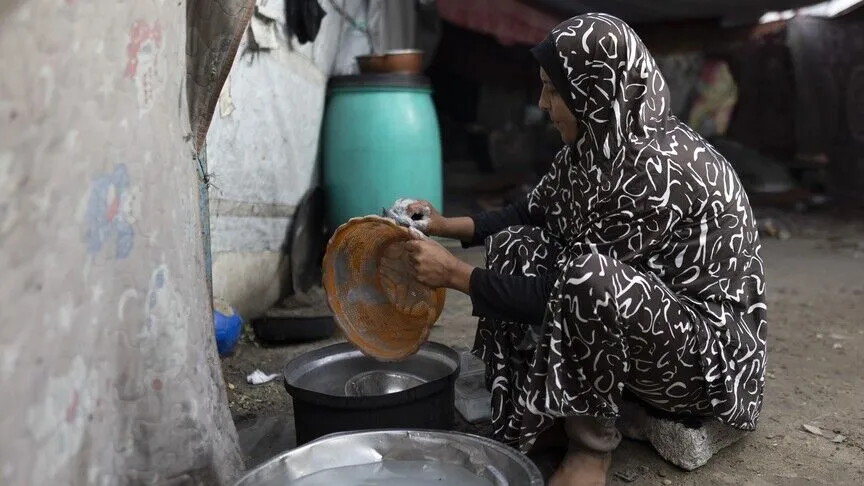
Next, the scene changes with many tents huddled one against each other, trying to do with the latest modern living the war has brought on. The Gaza Strip has become an amalgamation of tent cities, and with those labels, there are the underdogs – those who can’t offered the proper $1000-tent but have to sleep on the margins of rag-tag communities in derelict and tiny ‘holes” made of plastic sheets and/or light material that collapse at the sight of any gust of wind.

“It’s like living outside, you can’t call this a place of living,” another mother one says, referring to her small, plastic tent. Here there is no toilet, we have to ask other people’s living in proper tents to ‘do our business” and at times, forcing ourselves upon them but what can we do”, her voice can filter through the camera.

“At night we remain in fear because of the stray dogs who remain amongst us, howling between our tents. This is not to say anything about the snakes. At night I beg my neighbors to let my two grown up daughters sleep in their tent while I remain with my other small children here, but it’s a struggle.”

At night my children freeze because there are no blankets, we barely have thin sheets to use as cover, there are no clothes here, we simply don’t have anything, they have to go bare foot, there are no shoes, not even sandals or flip-flops for them to wear.

There is neither food, nor drinks, we stay hungry all day except for the one-day meal the kids bring from the food charities they queue for. After that one meal, we wait for the following day hoping to be fed.”

Dry bread Sprinkled With Salt

“How can I describe the place, it’s bad,” says a haggard old man with a beard that keeps getting longer. “We have no tent to sleep in, winter is setting in and the rain is likely to lead to our death, first it was the scorching sun, God only knows how we survived then, now the winter is upon us, we just wait for the worse, the drenching rains, life is a constant challenge,” he says amidst the dirt-soil.

Even the water is hard to come, and this is for everyone, the rugs you see here were given to us by people whose situation is really no better than us. In terms of food, as God is my witness, the bread I have here from my feed, I collected, it’s dry and hard that has been sprinkled with salt. When I am hungry, I wet it with the available water and eat.  This is how we try to survive in Gaza today.”

These are a few of the voices from Gaza. For them, life has long become miserable. Here, they speak out of their dreary lives that have become a constant struggle for survival.

  • CrossFireArabia

    CrossFireArabia

    Dr. Marwan Asmar holds a PhD from Leeds University and is a freelance writer specializing on the Middle East. He has worked as a journalist since the early 1990s in Jordan and the Gulf countries, and been widely published, including at Albawaba, Gulf News, Al Ghad, World Press Review and others.

    Related Posts

    Palestinians Remember The Eveil Nakba

    Dozens of Palestinian women at a displacement camp in central Gaza marked the 78th anniversary of the Nakba (Catastrophe) on Thursday, reliving scenes of displacement and loss they said continue to define Palestinian life decades after 1948.

    Held at the Refaat Alareer camp in the Al-Zawaida area, the event linked memories of the historic Palestinian displacement with the reality of the ongoing Israeli war on Gaza, as participants said the suffering of exile and forced displacement had never truly ended.

    The event was organized by the Sameer Project, a relief initiative led by Palestinians in the diaspora, and featured heritage performances, traditional dabke dancing and symbolic scenes highlighting Palestinian identity and the right of return.

    Women and children raised Palestinian flags, symbolic keys, and images reflecting displacement and attachment to the land. Several participants wore traditional Palestinian dresses and chanted songs and national hymns invoking Palestinian memory and what they described as an ongoing Nakba.

    Palestinians commemorate the Nakba every year on May 15 through marches, exhibitions and public events in the Palestinian territories and around the world, calling for rights, including the return of millions of refugees.

    The Nakba refers to the mass displacement of Palestinians in 1948 during the events surrounding the creation of Israel, when hundreds of Palestinian towns and villages were emptied and their residents forced to flee.​​​​​​​

    Reliving displacement

    Ibtisam Abu Muailiq, a displaced Palestinian now living in Al-Zawaida, said Palestinians are still living through the Nakba today.

    The current war, she told Anadolu, had brought back scenes of displacement and tent life that previous generations described after the events of 1948.

    “Our home was destroyed, and we lost loved ones, some killed and others still missing, but we remain steadfast on the land of Palestine,” she said.

    She called on people around the world to show compassion toward Palestinians and support them amid their suffering.

    For Umm Mohammed Abdullah, the Nakba never ended.

    Palestinians, she said, have endured repeated cycles of hunger, thirst, displacement and loss but continue to hold on to their land.

    “No matter how severe the suffering becomes, we will not leave our homeland,” she added.

    Steadfast despite war

    Event coordinator Iman Al-Khatib said holding the event inside a displacement camp carried a message that Palestinians remain steadfast despite wars and catastrophes.

    “We wanted to tell the world that Palestinians remain resilient and that the right of return will continue to live in the conscience of future generations,” she told Anadolu.

    The Israeli army has killed more than 72,000 people, mostly women and children, and injured over 172,000 in a two-year war on the Gaza Strip since October 2023.

    Despite a ceasefire that took effect on Oct. 10, 2025, the Israeli army has continued its attacks, killing at least 856 people and injuring 2,463 others, according to Gaza’s Health Ministry.

    Continue reading
    Palestinian Population Tops 15.5 Million

    The Palestinian Central Bureau of Statistics (PCBS) said Tuesday that the number of Palestinians worldwide has reached about 15.5 million, including 7.4 million living in historic Palestine.

    In a statement marking the 78th anniversary of the Nakba, a term used by Palestinians to mark Israel’s creation in 1948, the bureau said about 8.1 million Palestinians live in the diaspora.

    It said more than two million Palestinians are displaced inside Gaza and the occupied West Bank as a result of Israel’s war on Gaza and continued settlement expansion.

    Israel’s war on Gaza has displaced nearly two million Palestinians out of about 2.2 million who lived in the enclave on the eve of the war, the bureau said. Many now live in tents, shelters and schools.

    About 40,000 Palestinians have also been displaced from refugee camps in the northern West Bank because of the ongoing Israeli military operations, the bureau added.

    In the West Bank, illegal Israeli settlement activity continues to expand, the statement said, adding that the number of illegal settlements and military bases reached 645 by the end of 2025. The total includes 151 illegal settlements, 350 settlement outposts and 144 other sites.

    Official figures show that the number of Israeli occupiers in the West Bank reached about 778,567 by the end of 2024, with 42.8% concentrated in occupied East Jerusalem.

    The bureau said Israeli authorities seized more than 5,571 dunams (1,377 acres) of Palestinian land in 2025 through seizure orders, expropriation and declarations of “state land.”

    It also documented more than 61,000 attacks by Israeli forces and occupiers in the West Bank between 2022 and 2025, which led to the uprooting and bulldozing of more than 81,000 trees, most of them olive trees.

    Israeli authorities continue to impose strict restrictions on Palestinians through about 900 military checkpoints and gates across the West Bank, limiting residents’ movement and blocking access to large areas of agricultural and grazing land, the bureau said.

    In Gaza, the bureau said Israel’s war has completely destroyed more than 102,000 buildings and fully or partially damaged more than 330,000 housing units, along with widespread destruction of infrastructure, health facilities and schools according to Anadolu.

    The Israeli army has killed more than 72,000 Palestinians, mostly women and children, and injured over 172,000 others in a two-year offensive on Gaza since October 2023.

    Continue reading

    You Missed

    Giant Phillippines Volcano Shows no Rest!

    Giant Phillippines Volcano Shows no Rest!

    The Chinese Fortune Cookie and The “Thucydides Trap”! A  View From Amman

    The Chinese Fortune Cookie and The “Thucydides Trap”! A  View From Amman

    Israel Kills 200 Lebanese Children – UNICEF

    Israel Kills 200 Lebanese Children – UNICEF

    Nakba – 78 Years of Occupation Misery

    Nakba – 78 Years of Occupation Misery

    Palestinians Remember The Eveil Nakba

    Palestinians Remember The Eveil Nakba

    Nakba – 78 Years On

    Nakba – 78 Years On