
Israel Punishes Britain, a State that Led to its Creation

By Naela Alwaari

On 8 September 2026, the British government announced that it considers the continued Israeli occupation of the Palestinian territories to be illegal, and that it would prohibit the import of products from illegal settlements, ban the promotion of settlement properties in Britain, and take measures against individuals and companies that support, facilitate, or benefit from settlement activity. It also imposed sanctions on extremist settlers who supported or participated in acts of violence against Palestinians.

The British government went further than in its previous positions when it agreed to describe what is taking place in parts of the West Bank as the ethnic cleansing of Palestinians by settler groups, amid the silence of the Israeli government or the support of some of its members for acts of forced displacement.

This position, however, came after a long period of British silence and inconsistent positions toward Palestinian suffering, particularly during the war on Gaza, when British policies and measures failed to correspond to the scale of the killing, starvation, displacement, and destruction inflicted upon the Palestinian people. The significance of the current step therefore does not erase that history, nor does it absolve Britain of its political and moral responsibility for what has happened, and continues to happen, in Palestine.

Israel’s response was swift and angry. It announced the closure of the British Consulate-General in East Jerusalem and the termination of several forms of cooperation with Britain. The decision to close the consulate was not merely an administrative measure, but a clear political punishment for London’s move—albeit a partial one—from statements of condemnation to measures that directly affect the settlement project and the interests of those who support it.

The deeper irony is that Israel is today punishing the very country whose consulate historically played a role in protecting Jewish immigrants, before Britain, during the Mandate period, went on to sponsor the Zionist project and create the political and administrative conditions for its establishment in Palestine.

Yet the significance of this development goes beyond the fate of the consulate itself. Britain, together with other Western countries that contributed to the formulation and protection of the Zionist project, is beginning to confront the consequences that resulted from it. The entity whose establishment was celebrated as a solution to the Jewish question in Europe was created on the land of another people. Its successive policies subsequently revealed an expansionist settler-colonial character that did not stop at the borders of 1948 or 1967, but extended to the confiscation of land, demolition of homes, expansion of settlements, and displacement of the Palestinians—the owners of the land and its indigenous inhabitants.

To understand the significance of Britain’s present position, it is necessary to return to the beginnings of the British presence in Palestine. British interest in Palestine emerged during the first half of the nineteenth century, within the context of European competition over the Ottoman Empire and its possessions, particularly Greater Syria. The system of foreign privileges granted European powers opportunities to expand their commercial, religious, and political activities, while giving their consuls considerable scope to intervene and provide protection to individuals and communities associated with their respective countries.

On 11 November 1837, British Foreign Secretary Lord Palmerston sent a letter to the British ambassador in Istanbul, Lord Ponsonby, explaining the importance of appointing a British consul in Jerusalem. Following negotiations with the Ottoman Empire, an imperial decree was issued in 1838 establishing the consulate, and William Young was appointed Britain’s first consul in the city.

This occurred shortly before the London Conference of 1840 and the resulting changes in the regional balance of power, including the end of the rule of Muhammad Ali and Ibrahim Pasha in Greater Syria. From that period onward, European influence—and British influence in particular—expanded in Palestine through consulates and religious, commercial, and exploratory missions.

The choice of Jerusalem was not arbitrary. Britain sought a foothold in a city of exceptional religious and political importance, as well as a centre from which to protect its interests and receive its citizens and visitors, while supporting and expanding the Protestant presence. The activities of the consulate, however, went beyond these objectives to include the sponsorship and protection of Jews, particularly those arriving from Russia and Eastern Europe.

The documents on which I relied in my book, The Role of Foreign Consulates in Jewish Immigration and Settlement in Palestine, 1840–1914, reveal that British consuls in Jerusalem, during the period preceding the Balfour Declaration, received instructions to extend British protection to Jews, assist their immigration, and increase the number settling in Jerusalem.

British Consul James Finn expanded this policy even further. He received at the port of Haifa ships carrying immigrants from Europe. The consulate prepared special files on Russian Jews, counted their numbers, registered them in separate records, and worked to bring them under British consular protection.

This protection was not confined to legal matters. It extended to improving their living conditions, facilitating their permanent settlement, and granting some of them travel documents or a legal status connected with Britain. The consulate was therefore not simply a neutral observer of Jewish immigration; it played a role in providing political and legal cover for it.

The British presence assumed other forms as well. In the 1870s, Britain dispatched a technical mission that conducted an extensive survey of the territory of Palestine from north to south. These surveying and exploratory activities were not separate from colonial competition. They provided detailed knowledge of the land, population, roads, and resources—knowledge that subsequently acquired political, military, and settlement-related value.

The Balfour Declaration of 1917 was therefore not the sudden beginning of an entirely new British policy. Rather, it represented the culmination of a long trajectory that preceded the emergence of the Zionist movement as a global political organisation. The protection, encouragement, and facilitation of immigration undertaken by the British consulate during the 19th century helped prepare the political and legal ground for Britain’s subsequent position.

With Britain’s occupation of Palestine and the subsequent imposition of the Mandate, London no longer needed to pursue its policy through the window of a foreign consulate. Britain itself had become the ruling and administrative authority, and its role shifted from indirect consular protection to the official sponsorship of the Zionist project.

The Mandate for Palestine obliged Britain to create the conditions necessary for the establishment of the “Jewish national home.” Article 6 stipulated the facilitation of Jewish immigration and encouraged the settlement of Jews on the land, including state lands and lands not required for public purposes. The initiatives that had begun with consular protection were thus transformed into official policies implemented by the Mandate authorities through their administrative, legislative, and security institutions.

What Britain today describes as ethnic cleansing is not an event disconnected from the past. Rather, it is an extension of a logic that began with protected immigration and organised settlement, and subsequently developed into the continuing uprooting of the indigenous population and their replacement by settlers.

Nevertheless, Britain’s latest position should not be given more significance than it warrants, nor should it be regarded as a rupture with Israel or a complete reversal of British policy. The British Embassy remains in Tel Aviv, and political, commercial, and security relations between the two countries continue. This may be a positive political step, but it has not, so far, reached the level of a strategic transformation in British policy toward Israel and the Palestinian question.

The British government itself has stressed that its measures target settlements and the economic activities associated with them, rather than Israel itself, and that it remains committed to maintaining trade as well as academic, scientific, and investment relations with Israel. It has also declared its opposition to the Boycott, Divestment and Sanctions movement (BDS).

The step should therefore be viewed with both a degree of welcome and caution: Welcome because it moves opposition to settlement activity beyond words toward certain practical measures; caution because it does not mean that Britain has decided to sever its relationship with Israel or undertake a comprehensive reassessment of its historical policy.

We, as Palestinians and Arabs, are often quick to celebrate any international position that challenges Israel, because of our sense that the world has left the Palestinians alone for far too long. Experience, however, teaches us not to build great hopes upon a single step, and not to rely excessively on a position that may change with governments, elections, and in response to the crimes committed against the Palestinian people.

The real measure is not speeches or angry Israeli reactions, but whether these measures continue, expand, and are transformed into a permanent and binding policy that holds the occupation accountable for settlement activity, displacement, and crimes committed against the Palestinian people.

Any international shift derives its significance not from the degree of Israeli anger it provokes, but from the extent to which it provides genuine protection for the rights of the Palestinian people on their land.

This article was originally written in Arabic and appeared in Akhbar Al Baled in Jerusalem. Dr Naela Alwaari is a historian and an expert researcher on Palestinian affairs with particular focus on Jerusalem anf has written many books on the subject. This article appears in crossfirearabia.com

Related Posts

Palestinians Slam Adidas For Pro-Israel PR Campaign
  • HebaHeba
  • September 10, 2026

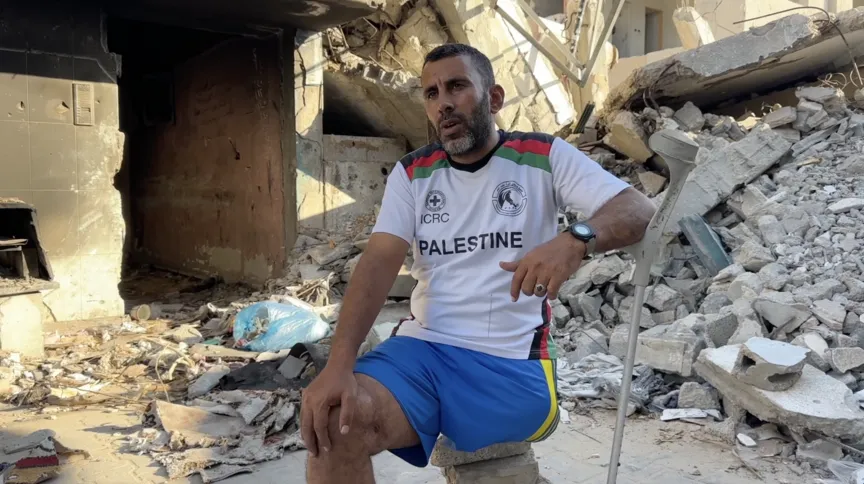
Two Palestinian amputee athletes from the Gaza Strip condemned the global sports equipment company Adidas for using an Israeli soldier as an advertising figure for its products, describing the move as “a blatant bias toward the Israeli killers and a whitewashing of the crimes of genocide.”

The two athletes, speaking to Anadolu, said they had decided on a “comprehensive boycott and abandonment of the company’s products” and called on the Arab and Muslim sporting community and free people around the world to support them and stop buying its products.

Former Israeli soldier Shalev Biton, who participated in the Israeli aggression against the Gaza Strip in 2021, appeared in a local campaign promoting the Single Shoe service launched by Adidas.

The service allows amputees, or those who need only one shoe, to purchase it for 50% of the price of a full pair.

The campaign sparked widespread international, Arab and Palestinian discontent, amid the suffering of thousands of amputees in the Gaza Strip due to a shortage of prosthetic limbs and the raw materials needed to manufacture them.

‘Whitewashing the image of the killers’

Ahmed Abu Nar, an amputee football player in Gaza, said that Adidas, a company of its size, using an Israeli sniper who participated in the war on the Strip was “a provocative act and a deliberate attempt to whitewash the image of those committing war crimes against civilians.”

Abu Nar, who lost his left leg as a result of direct fire from an Israeli sniper, expressed his astonishment at “using an Israeli soldier to advertise and market this shoe, at a time when it could have used many other people.”

He added: “The company has expertise and specialized teams to study every step, and what happened was not a mere coincidence, but a calculated decision to ignore the victims and celebrate the killer.”

Abu Nar criticized the company’s handling of the controversy and its decision to limit the apology and removal of the advertisement to pages directed only at the Middle East, noting that “the company’s global page did not address the matter.”

Under pressure and amid calls to boycott it, the German sportswear company Adidas apologized Monday through its Arabic-language Instagram account for launching an advertising campaign featuring an Israeli soldier.

The Adidas Arabia account has relatively limited reach, with only 1.4 million followers, a figure that is dwarfed by the more than 29.6 million followers of its global account.

Abu Nar confirmed that he had made a firm decision to boycott Adidas and dispose of all its sports equipment, saying: “This decision is irreversible for us as athletes in Gaza.”

He added: “The company applies double standards, between us being victims and being exposed to death, bombing and destruction at every moment, while on the other hand they said the war had stopped, and to this day it has not stopped. On our way to the field, we are at any moment afraid that a bombing may occur.”

Since Oct. 8, 2023, Israel has been committing genocide in Gaza, leaving more than 73,000 Palestinians dead, more than 174,000 wounded, and destruction affecting 90% of the infrastructure.

Bias toward the occupation

For his part, Hassan Abu Karim, 43, a board member of the Palestine Amputee Football Association, denounced what he described as “racial discrimination and double standards” practiced by global companies in their handling of the Palestinian issue.

Abu Karim, who lost his foot to an Israeli shell in 2006 during an incursion into the Maghazi area, said: “At a time when our association has struggled since its establishment in 2018 to provide the most basic necessities, including shoes and crutches for amputee athletes, we find the global company opening its doors and providing its capabilities and sponsorship to a soldier who participated in massacres against our people.”

“This greatly affects the sporting situation in Palestine, particularly people with amputations who had been waiting for international institutions and companies to sponsor them or stand by their side,” he added.

Abu Karim, a former player for Maghazi Services Club who participated in international sporting initiatives for amputees, explained that it would be more appropriate for global companies to show solidarity with victims living under siege and bombardment and to safeguard the rights of people with disabilities.

He continued: “As an athlete, when I saw this advertisement, it became clear to me that they had ignored the suffering of people with disabilities or amputees in Gaza.”

He considered the use of the Israeli soldier as an advertising figure to be “abhorrent racial discrimination,” calling on Adidas “not to be racist and not to side with the occupation and killing.”

Abu Karim called on Arab and Muslim athletes and sporting institutions around the world to stand alongside Palestinian athletes and confront what he described as “racist policies” through a broad boycott of the company’s products until it “complies with humanitarian values and justice.”

Days after the advertisement was published, criticism escalated across social media platforms as accounts supportive of the Palestinian cause republished images of the campaign, pointing out that Biton had lost his leg while participating in the Israeli aggression against the Gaza Strip in 2021.

Israel’s Channel 15 said posts that recirculated the advertisement received millions of views, while a hashtag calling for a boycott of Adidas spread, accompanied by thousands of calls to boycott the company.

Users compared the Israeli soldier with the thousands of Palestinians whose limbs had been amputated during the genocide, accusing Adidas of ignoring their suffering.

More than 5,000 amputation cases

The figures concerning amputees in the Gaza Strip reveal the extent of the contrast highlighted by Adidas’ critics.

According to World Health Organization estimates issued in May 2026, the Strip recorded between 5,161 and 6,710 limb amputations since October 2023.

The organization indicated that around 43,000 people in Gaza sustained injuries likely to permanently change their lives, including approximately 10,000 children.

It noted that the number of serious limb injuries had reached around 22,000 cases by May, while the total number of injuries at that time had reached approximately 172,000 since Oct. 8, 2023.

In a related context, figures reported by the UN Office for the Coordination of Humanitarian Affairs (OCHA) on Aug. 14, 2026, confirmed that children account for around 18% of amputation cases in Gaza, while specialized rehabilitation services for children are unavailable in the Strip.

The suffering of amputees does not end with the loss of their limbs, as it is followed by a long process of surgical operations, physical therapy, rehabilitation and the search for a suitable prosthetic limb. Anadolu

Continue reading
The Other Exodus: How War, Politics and Insecurity Are Driving Israelis Abroad

For a country built around the idea of immigration into Israel, the growing movement in the opposite direction has become an increasingly sensitive national issue. Since the upheaval surrounding the judicial overhaul in 2023 and, more dramatically, the Hamas attack of 7 October and the Gaza war that followed, tens of thousands of Israelis have established lives abroad for months or years at a time. Increasingly, those leaving are not simply backpackers, retirees or recent immigrants returning to their countries of origin. They include doctors, engineers, researchers, technology workers and young university graduates—the very groups Israel depends upon disproportionately for its hospitals, universities, military technology and export economy.

The exact scale is contested because Israeli institutions use several definitions of “leaving.” Someone who boards a plane is clearly not necessarily an emigrant. The Central Bureau of Statistics generally identifies longer-term emigrants retrospectively, once they have spent most of a year abroad, while researchers at Tel Aviv University have also examined people absent for three consecutive months as an early indicator of longer-term migration.

Using that broader measure, researchers Prof. Itai Ater, Prof. Nittai Bergman and Doron Zamir found that 268,509 Israeli citizens left Israel for at least three consecutive months during 2023–2025: 86,509 in 2023, 91,499 in 2024 and 90,922 in 2025. The comparable figure for 2013–2015 was only 183,219. The researchers estimate that 45,000–50,000 Israelis emigrated for at least a year in 2025 alone, indicating that what began during the upheaval of 2023 has not simply disappeared with time. 

That distinction matters. It would therefore be misleading to say that all 268,509 have “permanently left Israel.” Many may return. But the figures demonstrate something different and nevertheless important: Prolonged absence has reached levels substantially above those seen a decade earlier.

October 2023 as an accelerant

The migration story did not begin on 7 October.

Emigration had already risen sharply during 2022 and the first nine months of 2023, amid soaring living costs and a political confrontation over the Netanyahu government’s proposed judicial overhaul. Figures subsequently presented to the Knesset showed a pronounced increase in departures beginning in 2022. 

Then came 7 October.

An early CBS examination found an extraordinary spike among Israelis who left during October 2023 and had still not returned months later: roughly 12,300, compared with about 3,200 in the corresponding calculation a year earlier. 

Later statistics made the demographic impact clearer. Parliamentary hearings have repeatedly documented tens of thousands more Israelis leaving than returning. One 2026 Knesset presentation put 2024 emigration at approximately 69,500, compared with only 18,800 returnees, while earlier preliminary CBS releases had used a higher figure of about 82,700 because of different methodologies and reference periods. 

That apparent contradiction is important: Israeli migration statistics have been revised as enough time passes to determine whether somebody really remained overseas. They should not simply be added together.

What is much less disputable is the direction of travel. During the years surrounding the Gaza war, outward migration rose markedly while returns fell, producing a substantial negative migration balance among Israelis.

And those leaving are unusually young.

Knesset figures show that nearly half of emigrants were aged 20–44, even though this age group represents less than a third of the population. The average emigrant in 2023 was only about 32.5 years old

That is precisely the age at which professionals complete their training, form households, have children, establish companies and reach peak productive years.

“Should we stay?”

Emigration has consequently moved from being a marginal social discussion to a regular subject of Israeli opinion polling.

A major Israel Democracy Institute survey conducted in April 2025 found that roughly one quarter of Jewish Israelis and one third of Arab Israelis were considering living abroad either temporarily or permanently. Among secular Jews, the figure climbed to 39 percent, and among Jews aged 18–34 to approximately 36 percent

The findings are particularly revealing because the strongest desire to leave appears within segments of society heavily represented in academia, high technology and professional occupations.

The polling should nevertheless be interpreted carefully. “Considering” emigration is different from being certain of leaving. In fact, only around 10 percent of those considering departure told IDI that they definitely planned permanent emigration. About half of Jewish respondents considering departure did not yet know how long they would live abroad. 

A later KAN survey published in August 2026 found that 18 percent of Israelis said they had considered emigrating during the preceding two years, while one third said they personally knew somebody who had left. Twelve percent said the result of Israel’s coming election could influence whether they remained. 

Among university students the warning signs are stronger still. At a Knesset hearing in June 2026, the National Union of Israeli Students reported that 33 percent of students said they intended to leave Israel after completing their studies, principally because of housing costs and the general cost of living. 

Yet Israel is not witnessing universal rejection. In the 2025 Israeli Democracy Index, 72 percent of Jewish respondents and 82 percent of Arab respondents said they would prefer to remain in Israel even if they could obtain citizenship in the United States or another Western country

The country therefore faces something more complicated than a straightforward mass flight: a large majority still wants to stay, while a substantial, highly mobile minority is increasingly willing—and able—to leave.

Where are Israelis going?

There is no comprehensive official country-by-country database covering every Israeli who departed after 7 October. Dual citizenship makes tracking particularly difficult: an Israeli with a German, Portuguese or French passport may enter Europe as an EU national rather than being registered as an Israeli immigrant.

Still, destination data show a fairly clear geography.

Among Israeli citizens moving to OECD states in 2023, around 33 percent went to the United States, 18 percent to Germany and 9 percent to Canada, according to the OECD. 

More broadly, demographic research by the Institute for Jewish Policy Research estimates that about 630,000 Israeli-born expatriates already live abroad, with the largest established populations concentrated in the United States, Canada, Germany and Britain

But the post-7 October movement has added another geography: nearby European countries that allow Israelis to remain relatively close to home.

Cyprus has become one of the most visible examples.

Before 7 October, an estimated 2,000 Israeli families were living there. By late 2024, a local Jewish community estimate placed the number at roughly 3,500 families, or around 15,000 people. By August 2026, the Israeli Embassy in Nicosia was estimating 15,000–20,000 Israelis living in Cyprus

The attraction is obvious: Tel Aviv is less than an hour away by air, Europeans schools and property are accessible, and technology employees can often continue working remotely.

Greece has attracted similar interest, alongside Portugal and Spain. Germany—particularly Berlin—remains important, while English-speaking professionals disproportionately consider the United States, Canada and Britain.

Polls capture this orientation. Among Israelis contemplating emigration in the 2025 IDI survey, 43 percent preferred an EU country, versus 27 percent who preferred the United States or Canada

For many, then, emigration no longer necessarily means cutting ties with Israel. A family can live in Cyprus or Athens, retain Israeli employment, visit relatives frequently and postpone deciding whether the move is permanent.

Temporary relocation can gradually become migration.

The people Israel can least afford to lose

The most serious issue is not simply how many people leave.

It is who leaves.

Israel has always depended unusually heavily on human capital. It has few natural resources relative to the size of its economy, and technology accounts for a substantial share of exports, investment and tax receipts.

The Israel Innovation Authority has consequently raised alarms about long-term relocation by technology workers. It estimates that approximately 8,300 high-tech employees left Israel for a year or longer between October 2023 and July 2024, equivalent to about 2.1 percent of the country’s entire high-tech workforce

October 2023 was particularly dramatic: 1,207 high-tech employees began long-term stays abroad in that month alone, almost three times the number recorded in October 2022. 

That may look small against a country of roughly ten million people.

It is not small if those thousands include software architects, cybersecurity specialists, artificial-intelligence researchers, chip engineers and entrepreneurs.

Their economic contribution is far larger than their numerical share.

The Innovation Authority also reported that Israeli high-tech employment actually declined by about 5,000 workers in 2024, the first fall for at least a decade. Meanwhile Israeli technology companies now employ roughly 440,000 people overseas compared with about 400,000 inside Israel

That creates another risk. Companies do not necessarily have to leave Israel formally. They can simply place their next engineering team, research laboratory or management unit in New York, London, Lisbon or Berlin.

Human migration can therefore precede corporate migration.

Doctors on the move

Healthcare may face an even more immediate problem.

A Tel Aviv University study released in September 2026 found that approximately 1,370 physicians left Israel for more than one year during 2023–2025—a 94 percent increase compared with the equivalent three-year period a decade earlier.

The annual figures were approximately 416 doctors in 2023, 530 in 2024 and an estimated 419 in 2025

Two-thirds of the doctors who emigrated in 2024 had reportedly been trained in Israel itself. At the same time, the number of physicians returning has fallen. 

That represents more than a numerical shortage.

Training a specialist physician can require more than a decade of university education, residency and advanced specialization. Losing an experienced anesthesiologist, oncologist, radiologist or surgeon cannot be compensated for by recruiting an inexperienced graduate the following year.

The effects accumulate: Fewer specialists mean longer waiting lists, heavier workloads for remaining doctors and potentially another incentive for those doctors to leave.

It can become self-reinforcing.

Engineers, academics and researchers

The same pattern appears elsewhere.

Knesset discussions have reported an increase in engineers leaving combined with a fall in returning engineers. Israeli reporting based on parliamentary research has also pointed to thousands of graduates in science, technology and computing among recent emigrants. 

Academia presents a particular structural danger.

Universities rely on international research networks. Israeli scientists who complete fellowships at Harvard, Stanford, MIT, Oxford or European research institutes have always spent years abroad. Historically, Israel’s challenge was persuading them to return.

But when an academic already has an overseas post, citizenship rights and children integrated into foreign schools, war and political instability change the calculation.

Every professor who does not return affects more than one job. Laboratories train doctoral students. Senior scientists attract international grants. Engineering professors collaborate with defense industries. Medical researchers train clinicians.

The departure of one senior researcher can therefore dismantle a small ecosystem built over many years.

Why they leave

The Gaza war is an essential part of the explanation, but it is not the only one.

Polling repeatedly identifies a mixture of factors: personal security, the future of children, political polarization, the cost of housing, cost of living, professional opportunities and dissatisfaction with the direction of the country

For some, missiles and sirens were decisive.

For others, the crisis began before 7 October with the judicial overhaul and intensified after the war.

Long periods of reserve duty have disrupted careers and family life. Schools repeatedly closed during major escalations. International airlines suspended services during security crises. Families with young children have experienced repeated rounds of rocket and missile attacks.

And professionals possess something much of the population does not: exit options.

A software engineer can work in Berlin.

A doctor can seek certification in Canada.

A scientist can remain at an American university.

A startup founder can move headquarters to London.

An Israeli holding an EU passport can move to Lisbon or Athens with relatively little bureaucracy.

Thus the very skills that make someone valuable to Israel also make that person highly mobile.

An unequal demographic exchange

There is another uncomfortable dimension.

The Israelis most capable of leaving are not necessarily representative of Israeli society.

They are disproportionately young, educated and economically established. IDI’s research found particularly high consideration of emigration among secular Jews and younger adults. 

At the same time, groups with much lower emigration intentions—particularly the ultra-Orthodox—have some of Israel’s highest birth rates.

If those trends persisted for decades rather than years, emigration would not merely reduce population numbers. It could subtly alter Israel’s social composition.

A society losing disproportionate numbers of doctors, engineers, academics, entrepreneurs and secular professionals would ultimately lose some of the taxpayers financing the services upon which the larger population depends.

This is why Israeli policymakers increasingly describe emigration as an economic and national-security concern rather than simply a personal lifestyle choice.

In the IDI survey, 64 percent of Jewish Israelis and 73 percent of Arab Israelis said the departure of educated and economically established groups—a brain drain—posed a danger to Israel’s future

From “Start-Up Nation” to distributed nation?

Israel is unlikely to empty out.

Its family networks, Hebrew language, cultural identity and strong attachments to place remain extraordinarily powerful. Polling shows that family proximity is the single strongest reason Israelis give for staying. 

Some who left after 7 October will undoubtedly return.

Others will maintain lives in two countries.

But perhaps that is precisely what makes the present phenomenon important.

Emigration no longer requires a dramatic ideological rupture with Israel. A software engineer can live in Cyprus and code for an Israeli company. A scientist can retain collaborations with Tel Aviv while holding a laboratory position in Boston. A doctor can move to Toronto but return several times a year.

What begins as refuge can become relocation; what begins as relocation can become permanence.

And for a country whose military, economy, hospitals and universities depend unusually heavily upon a relatively small pool of highly trained people, even modest changes at the top of the skills pyramid can have consequences far larger than the headline migration figures suggest.

The central question, therefore, is not whether hundreds of thousands of Israelis are permanently abandoning their country. The evidence does not support such a simplistic claim.

The question is whether the Gaza war and Israel’s wider political crisis have pushed enough of its youngest and most internationally mobile professionals to establish alternatives abroad that returning is no longer automatic.

Three years after 7 October, the statistics increasingly suggest that this is the issue Israel has to confront.

Its most serious migration problem may ultimately be measured not by how many passports leave through Ben Gurion Airport, but by how much knowledge leaves with them

Continue reading

Leave a Reply

Your email address will not be published. Required fields are marked *

You Missed

Israel Punishes Britain, a State that Led to its Creation

  • By marwan
  • September 10, 2026
  • 13 views
Israel Punishes Britain, a State that Led to its Creation

Battle for Hormuz: How Iran Found America’s Achilles Heel

  • By Heba
  • September 10, 2026
  • 14 views
Battle for Hormuz: How Iran Found America’s Achilles Heel

Palestinians Slam Adidas For Pro-Israel PR Campaign

  • By Heba
  • September 10, 2026
  • 7 views
Palestinians Slam Adidas For Pro-Israel PR Campaign

The Other Exodus: How War, Politics and Insecurity Are Driving Israelis Abroad

The Other Exodus: How War, Politics and Insecurity Are Driving Israelis Abroad

Israel Strikes at House, Kills Family of Four

  • By Heba
  • September 10, 2026
  • 19 views
Israel Strikes at House, Kills Family of Four

A Morning Whisper

A Morning Whisper