Trending News:Gaza: Bringing the Dead Home From Beneath the RubbleSliman Mansour: The Artist Who Carried Palestine on His CanvasMorocco-Israel: Normalization Stops at The TopAlbanese Calls For World Force to Protect Civilians in Gaza, West Bank40 Million Tons of Rubble: Gaza Ministry Faces Challenges in Removing itJoin The Queue For The Drops‘My Way Out of Insanity’The Child, Tree and The DarkPalestinian Dr Held Over Social Media Posts Suffers Heart Attack in Israeli DetentionIsrael Violated The Ceasefire 4379 Times in 315 DaysGaza’s Kites Return — and Israel Katz Threatens RevengeLiving With The Dead: Gazan Families Forced to Make Homes Among The GravesFormer Jewish PM: Israel Has ‘Lost The United States…’Palestine in Color DressesKhan al-Sultan Stands Proud in JerusalemChristian Wedding in Beit Jala 1940Palestinian Photographer Khalil Raad With Family in Early 20th CenturyThe Day Al Aqsa Was Set on FireIsrael Finally Admits to Killing Little HindSunset in Gaza‘Israel Killed My Dad on His Farm,’ Says Daughter ZeinabThe Gaza MermaidGaza by The Sea“There is no country on the planet that is crueler and more deadly than Israel,” – MearsheimerPalestine: Heritage, FolkloreGaza: Only 3% of Land Safe to Grow FoodGaza: Lolo Heriz Finally Buried After 975 Days57th Year of Al Aqsa Burning: ‘The Fire Continues’ Ekrima Sabri WarnsRemember Hind RajabA ‘Palestinian’ Palace in JerusalemIsrael Bombs Police Station, Kills Group of OfficersDon’t Forget Dier YassinIsraeli Army, Settlers Trap Three Palestinian Families in Their Homes for 11 DaysIsraeli Strikes Gaza Port Café, Leaves 6 Dead, a Child and 14 WoundedYour Ben Gurion! RevelationsGaza’s Face of DestructionSad Woman of PalestineItamar Ben Gvir: ‘We Should Kill 30 to 40 in Gaza Each Night’Gaza Health Ministry States 1266 Killed Since The Ceasefire‘We Think of Hanan Ashrawi Only as a Palestinian’Tied to a Chair in ChainsIn The Line of Fire: Gaza Families Fear The ‘Yellow Line’Kushner Tells Netanyahu Not to Move ‘Westwards’ in GazaA Middle East Whirlpool! View From AmmanPrisoner Mohammad Arab Hadn’t Seen His Face in 2 Years!UN: 3000 Settler Attacks on West Bank Palestinians Since 2025Four Days in Cairo: A Journey Into The Faces of EgyptClick in GazaHisham Sharabi: Embers and AshesIndependent: Israeli Settlers Set Fire to a Home With a Child InsideJerusalem Under The StarsJabal Al-Weibdeh: An AI Art StoryJaffa Oranges in Jerusalem, 1937Gaza Begins to Restore Its Mosques12 Bodies Uncovered in Gaza CityDr. Mark Perlmutter recounts amputating the leg of a five-year-old girl in Gaza with no anesthesia available beyond an anesthesiologist singing to her.Herman Melville, Palestine, 1857Sea of Tragedy and LifeUN: Humanitarian Access Blocked by 900 Israeli Checkpoints70,000 Perform The Friday Prayers in Al Aqsa90% of Gazans Displaced in Tattered Tents, Living on RubbleGlorious YemenSay Cheese!Israel Vessels Fire at Three Fishermen in GazaPalestine in the Olive HarvestSmiles and Embroidery‘No Need For Your Crocodile Tears’Reem Arkan’s ‘Red Homeland’Israeli Army Seizes 16 Homes in The West BankIsrael Arrest Palestinian Journalist and Drop Site Contributor Mohammed AwadPalestinian School Year Starts 6 SeptemberTel al-Zaater: 50 Years On! Memory of a MassacreTo Evelyn: The Baramki Home in JerusalemPalestinian House, Palestinian ArchitectureUN Reports Grave Israeli Violations of Gaza ReturneesThe Gaza InfernoEhud Olmert: Gaza Belongs to The Palestinians300 Israeli Soldiers Call For an End of ‘Settler Terrorism’Reshida Tlaib Sweeps in Polls‘We Are Still Here – Gaza’The Mecca Agreement: Is This The Beginning?Thinking of Hind TaherYafa Train Station 1910Palestine EmbroideredBalfour in The Unholy TrinityIsrael Breaks The Ceasefire 12 Times‘They Can’t Take The Sea From US’Gaza: 13 Bodies Recovered From The RubbleUS Soldier Commits Suicide After Serving in GazaWaiting For TomorrowStealing Moments of JoyOliver Stone: Israel’s Policy on Palestine Will be Judge by History as One of The Darkest…Gaza: No Trucks, No Aid, Israeli-styleIsraeli Holds 1700 Palestinian Remains For BargainingView of The Abu Taha Family in Yafa, 1940Mojtaba Khamenei in ‘Full Physical Health’Melissa Barrera: ‘I am Not Afraid of Losing My Career…’The Face of InnocenceFacing The Israeli Gun: 108 Cases Against Journalists in JulyIs There a New Regional Order Emerging?
Trending News:Gaza: Bringing the Dead Home From Beneath the RubbleSliman Mansour: The Artist Who Carried Palestine on His CanvasMorocco-Israel: Normalization Stops at The TopAlbanese Calls For World Force to Protect Civilians in Gaza, West Bank40 Million Tons of Rubble: Gaza Ministry Faces Challenges in Removing itJoin The Queue For The Drops‘My Way Out of Insanity’The Child, Tree and The DarkPalestinian Dr Held Over Social Media Posts Suffers Heart Attack in Israeli DetentionIsrael Violated The Ceasefire 4379 Times in 315 DaysGaza’s Kites Return — and Israel Katz Threatens RevengeLiving With The Dead: Gazan Families Forced to Make Homes Among The GravesFormer Jewish PM: Israel Has ‘Lost The United States…’Palestine in Color DressesKhan al-Sultan Stands Proud in JerusalemChristian Wedding in Beit Jala 1940Palestinian Photographer Khalil Raad With Family in Early 20th CenturyThe Day Al Aqsa Was Set on FireIsrael Finally Admits to Killing Little HindSunset in Gaza‘Israel Killed My Dad on His Farm,’ Says Daughter ZeinabThe Gaza MermaidGaza by The Sea“There is no country on the planet that is crueler and more deadly than Israel,” – MearsheimerPalestine: Heritage, FolkloreGaza: Only 3% of Land Safe to Grow FoodGaza: Lolo Heriz Finally Buried After 975 Days57th Year of Al Aqsa Burning: ‘The Fire Continues’ Ekrima Sabri WarnsRemember Hind RajabA ‘Palestinian’ Palace in JerusalemIsrael Bombs Police Station, Kills Group of OfficersDon’t Forget Dier YassinIsraeli Army, Settlers Trap Three Palestinian Families in Their Homes for 11 DaysIsraeli Strikes Gaza Port Café, Leaves 6 Dead, a Child and 14 WoundedYour Ben Gurion! RevelationsGaza’s Face of DestructionSad Woman of PalestineItamar Ben Gvir: ‘We Should Kill 30 to 40 in Gaza Each Night’Gaza Health Ministry States 1266 Killed Since The Ceasefire‘We Think of Hanan Ashrawi Only as a Palestinian’Tied to a Chair in ChainsIn The Line of Fire: Gaza Families Fear The ‘Yellow Line’Kushner Tells Netanyahu Not to Move ‘Westwards’ in GazaA Middle East Whirlpool! View From AmmanPrisoner Mohammad Arab Hadn’t Seen His Face in 2 Years!UN: 3000 Settler Attacks on West Bank Palestinians Since 2025Four Days in Cairo: A Journey Into The Faces of EgyptClick in GazaHisham Sharabi: Embers and AshesIndependent: Israeli Settlers Set Fire to a Home With a Child InsideJerusalem Under The StarsJabal Al-Weibdeh: An AI Art StoryJaffa Oranges in Jerusalem, 1937Gaza Begins to Restore Its Mosques12 Bodies Uncovered in Gaza CityDr. Mark Perlmutter recounts amputating the leg of a five-year-old girl in Gaza with no anesthesia available beyond an anesthesiologist singing to her.Herman Melville, Palestine, 1857Sea of Tragedy and LifeUN: Humanitarian Access Blocked by 900 Israeli Checkpoints70,000 Perform The Friday Prayers in Al Aqsa90% of Gazans Displaced in Tattered Tents, Living on RubbleGlorious YemenSay Cheese!Israel Vessels Fire at Three Fishermen in GazaPalestine in the Olive HarvestSmiles and Embroidery‘No Need For Your Crocodile Tears’Reem Arkan’s ‘Red Homeland’Israeli Army Seizes 16 Homes in The West BankIsrael Arrest Palestinian Journalist and Drop Site Contributor Mohammed AwadPalestinian School Year Starts 6 SeptemberTel al-Zaater: 50 Years On! Memory of a MassacreTo Evelyn: The Baramki Home in JerusalemPalestinian House, Palestinian ArchitectureUN Reports Grave Israeli Violations of Gaza ReturneesThe Gaza InfernoEhud Olmert: Gaza Belongs to The Palestinians300 Israeli Soldiers Call For an End of ‘Settler Terrorism’Reshida Tlaib Sweeps in Polls‘We Are Still Here – Gaza’The Mecca Agreement: Is This The Beginning?Thinking of Hind TaherYafa Train Station 1910Palestine EmbroideredBalfour in The Unholy TrinityIsrael Breaks The Ceasefire 12 Times‘They Can’t Take The Sea From US’Gaza: 13 Bodies Recovered From The RubbleUS Soldier Commits Suicide After Serving in GazaWaiting For TomorrowStealing Moments of JoyOliver Stone: Israel’s Policy on Palestine Will be Judge by History as One of The Darkest…Gaza: No Trucks, No Aid, Israeli-styleIsraeli Holds 1700 Palestinian Remains For BargainingView of The Abu Taha Family in Yafa, 1940Mojtaba Khamenei in ‘Full Physical Health’Melissa Barrera: ‘I am Not Afraid of Losing My Career…’The Face of InnocenceFacing The Israeli Gun: 108 Cases Against Journalists in JulyIs There a New Regional Order Emerging?
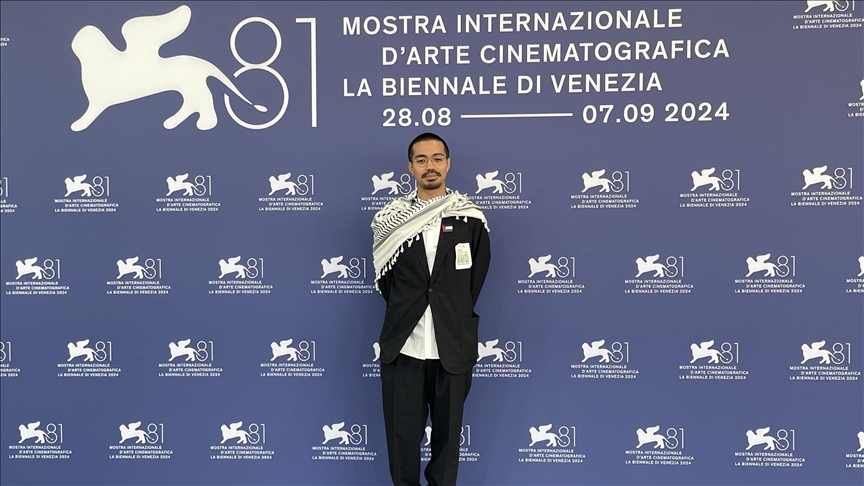
Japanese-American film director Neo Sora said the world of cinema has failed to adequately respond to the genocide in Gaza, stressing the need for a stronger reaction during his appearance at the 2024 Venice International Film Festival.
US-born Sora, who posed with a Palestinian keffiyeh and a flag reading “Free Palestine” at the festival, discussed the art world’s attitude towards Palestine with Anadolu.
Describing the positive response he received at the festival, Sora said: “In Venice, there was a resounding applause for the keffiyeh and the Palestinian flag. People were shouting from the audience, ‘Free Palestine,’ and I was responding by saying, ‘Free Palestine.’
“Making films and having the privilege to attend international festivals like Venice gives me a huge platform to have my voice heard by people globally, including Japanese audiences,” he said.
❝Sanat dünyası Gazze'deki soykırıma göz yumuyor❞
2024 Venedik Film Festivali'ne Filistin kefiyesi ve bayrağıyla katılan ABD doğumlu Japon yönetmen Neo Sora, sanat dünyasının Filistin konusundaki tutumunu eleştirdi 🇵🇸 pic.twitter.com/cWux6NYT9a
Sora also expressed disappointment with the festival’s programing, saying: “I was a little disappointed because you could tell they were trying to create an equivalency by including one Israeli film and one Palestinian film in the same section of Orizzonti, where my film was featured.”
Oct. 7 and reality of genocide
“I was in New York on Oct. 7, 2023, when it happened. It was really difficult to stay motivated to finish my film in the face of such extreme, livestreamed genocide, the likes of which I’ve never seen in my lifetime. I think it’s the worst genocide we’ve witnessed.
“I questioned whether I could continue making films because what’s the point of telling stories about human dignity when we’re witnessing such horrific violence that strips people of their humanity? After reflecting on the past year, I am 100% convinced that it is indeed genocide,” said Sora, recalling events from Oct. 7 last year.
Sora added that Israel’s settler colonialism isn’t just a Palestinian narrative. “It’s not something I’ve only been convinced of through Palestinian voices. Israelis themselves say it’s a settler colonial project. Look at the words of people like David Ben-Gurion or the founders of the Zionist movement; they called it a settler colonialist project.”
Palestinian culture being destroyed
Sora emphasized the importance of boycotting organizations that support Israel, saying: “As consumers, boycot is critical. We need to show these big corporations that if they make films like Wonder Woman, or Marvel featuring Gal Gadot, who’s basically a spokesperson for the IDF, they’ll lose money because we won’t support those projects.”
“We’re at the start of an AI dystopia. More concerning, though, is that the responsibility for these war crimes is being shifted to military AI systems created by Israeli military and software companies. This is a disastrous situation, especially given the environmental impact of these AI systems,” Sora said, highlighting Israel’s attempts to evade accountability.
‘We are at a historic turning point’
Sora pointed out that artists and others are not doing enough to stop the genocide in Gaza.
“The fact that this genocide has continued for 367 days and now these atrocities by Israel are spreading to other countries, like Lebanon, shows we’re not doing enough. We all need to do more, whether we’re filmmakers, businessmen, lawyers, or professionals in any other field,” he concluded.
Dr. Marwan Asmar holds a PhD from Leeds University and is a freelance writer specializing on the Middle East. He has worked as a journalist since the early 1990s in Jordan and the Gulf countries, and been widely published, including at Albawaba, Gulf News, Al Ghad, World Press Review and others.
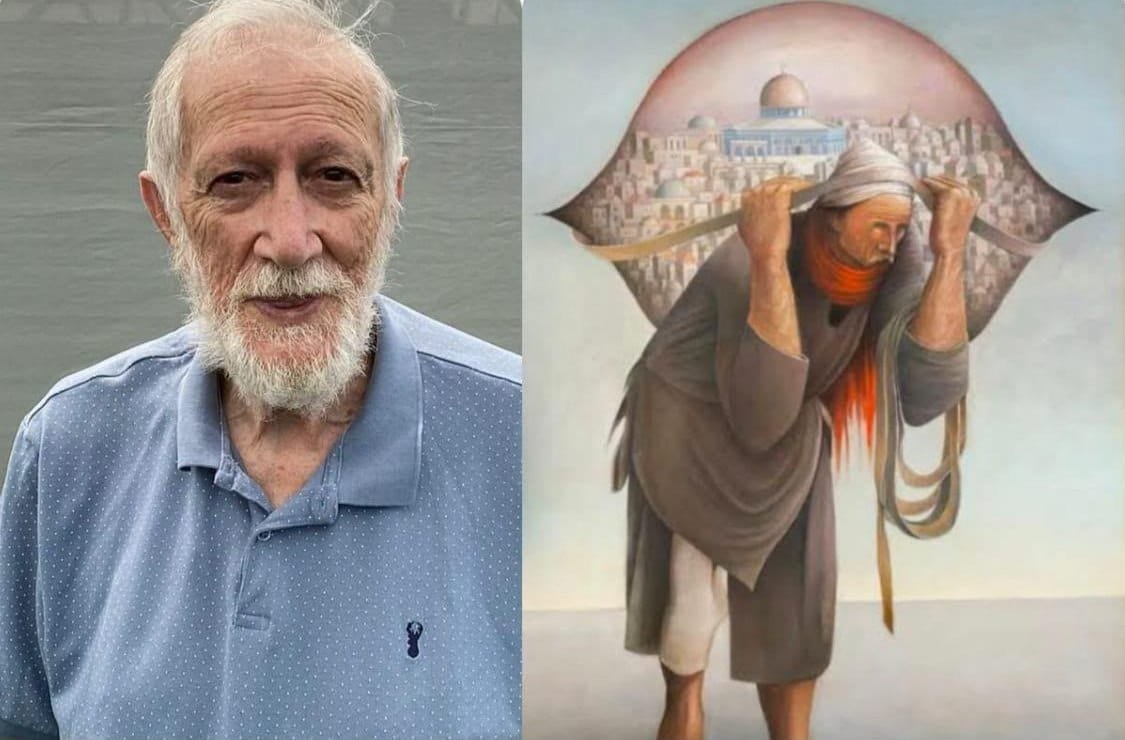
CROSSFIREARABIA – The old Palestinian bends forward beneath an almost impossible weight. His face is tired, his body appears exhausted and ropes cut across his shoulders. Yet what he carries is not an ordinary load.
On his back is Jerusalem.
For more than half a century, Palestinian artist Sliman Mansour painted variations of that same burden: A people carrying a homeland through occupation, dispossession, exile and war, yet refusing to put it down.
Mansour, one of the towering figures of Palestinian art, died on Monday, 24 August, at the age of 79. He leaves behind hundreds of works and an artistic language so deeply woven into Palestinian identity that some of his images long ago escaped the confines of galleries and became part of popular culture.
His best-known painting, Jamal al-Mahamel — “Camel of Hardships” or “Camel of Burdens” — became perhaps the defining image of his career.
Created in the early 1970s, it depicts an elderly Palestinian porter struggling forward with Jerusalem strapped to his back. The Dome of the Rock rises from the city he carries.
The image became enormously popular. It was reproduced as posters, cards and prints and appeared in Palestinian homes and refugee camps and far beyond Palestine. Its significance was immediately understandable: Palestinians might be separated from their homeland, but they continued to carry it with them.
It was an extraordinary achievement for a painter.
Mansour had transformed a political argument into an image.
Painting Palestine Into Existence
Born in Birzeit in 1947, Mansour belonged to the generation whose lives unfolded alongside the great ruptures of modern Palestinian history.
He studied art in Jerusalem and emerged as a significant artist after the 1967 war, when questions of land, identity, occupation and displacement increasingly dominated Palestinian cultural life. From the 1970s onward, his paintings helped establish what became a recognisable visual language of Palestinian resistance and identity.
Look closely at Mansour’s paintings and the same symbols repeatedly emerge.
There are olive trees.
There are orange trees.
There are Palestinian women wearing elaborately embroidered traditional dresses.
There are peasants, villages, stone terraces and agricultural landscapes.
And there is Jerusalem.
None of these elements were accidental.
The orange tree could evoke the Palestinian lands and communities lost during the Nakba of 1948. The olive tree represented rootedness and attachment to land and became associated in Mansour’s visual vocabulary with the territories occupied in 1967. Traditional embroidery carried memory, place and identity. Palestinian women frequently appeared as almost maternal representations of Palestine itself according to the Routledge Encyclopaedia of Modernism.
Mansour therefore rarely needed to paint politicians.
He painted Palestine instead.
And that was political enough.
When Paint Itself Became Political
Perhaps the clearest example of how completely Mansour intertwined politics and art came during the First Intifada.
Palestinians were being encouraged to boycott Israeli products. Mansour and fellow artists Vera Tamari, Tayseer Barakat and Nabil Anani developed the artistic movement known as New Visions.
Their response was remarkable.
Why, they asked in effect, should Palestinian artists resisting occupation paint their resistance using materials purchased from the occupying economy?
They began rejecting imported and Israeli art supplies and experimenting instead with materials taken from the Palestinian environment — mud, clay, coffee, henna, straw and other locally available substances.
The politics had moved beyond the subject of the painting.
Now it was inside the painting itself.
Palestinian earth was no longer merely something Mansour depicted.
Palestinian earth became the material with which he made art.
The Palestinian Museum has described the New Visions artists as responding directly to the Intifada’s boycott campaign by using natural Palestinian materials. The movement became an important episode in the development of contemporary Palestinian art as highlighted in The Palestinian Museum.
For Mansour, this was not simply artistic experimentation. It represented an extraordinary merging of culture, economics, resistance and national identity.
A painting made from Palestinian soil carried a meaning that imported paint could not.
Art Under Occupation
There was another reason Mansour understood art politically: Palestinian artists themselves encountered the mechanisms of occupation.
Mansour recalled that exhibitions were censored, artworks confiscated and artists imprisoned. He said Israeli authorities even prohibited Palestinian artists from using the four colours associated with the Palestinian flag — red, green, black and white as per the Jerusalem Story.
That experience helped transform art into another contested Palestinian space.
A painting could be seized.
A poster could be forbidden.
Colours could become political.
An olive tree could represent resistance.
Jerusalem could be carried on an old man’s shoulders.
And a traditional Palestinian dress could become an assertion that a culture threatened by displacement remained alive.
That is where Mansour’s importance extends beyond painting.
He helped make memory itself a form of resistance.
The Art of Sumud
One word repeatedly associated with Mansour’s work is sumud — steadfastness.
It is difficult to find a better description.
His Palestinians are not usually superheroes. They are villagers, mothers, labourers and elderly people. They can appear tired, contemplative or burdened.
But they remain.
The olive tree remains.
The village remains.
The embroidered dress remains.
Jerusalem remains.
And even when Palestinians themselves have been displaced, Mansour’s paintings insist that their relationship with the land has not disappeared.
That explains why Jamal al-Mahamel became so powerful.
The elderly man is visibly exhausted. Jerusalem is almost impossibly heavy.
Yet he does not drop it.
The United Nations has described Mansour’s work as providing a visual translation of sumud, while his imagery became part of Palestinian collective identity and a cornerstone of the country’s visual culture as per United Nations Digital Library.
More Than One Famous Painting
The enormous popularity of Jamal al-Mahamel sometimes obscured the breadth of Mansour’s work.
His paintings repeatedly returned to Palestinian women, rural communities, Jerusalem, dispossession and the landscape.
In Jerusalem in the Heart, the city is held close to the body of a Palestinian woman, with the golden Dome of the Rock forming the visual centre of the composition.
Elsewhere, olive trees stand almost like human witnesses.
His women wear Palestinian embroidery not merely because it is beautiful but because embroidery itself carries geography and memory. Patterns traditionally associated with particular towns and villages become declarations of origin.
The land, meanwhile, is rarely simply background scenery.
Terraces, hills, villages and trees demonstrate human attachment to place.
For a population repeatedly confronted with displacement, Mansour’s landscapes effectively say:
We were here. We worked this land. We remember it. We belong to it.
An Artist Who Helped Build an Art Movement
Mansour’s contribution was also institutional.
He helped establish and develop organisations that gave Palestinian artists spaces in which to work, exhibit and teach. He was associated with the League of Palestinian Artists, later helped establish the Al-Wasiti Art Center in East Jerusalem, taught generations of younger artists and participated in the development of Palestinian artistic institutions. His work was exhibited internationally and received major Arab and international recognition.
His importance, therefore, cannot be measured by Jamal al-Mahamel alone.
He belonged to a generation that helped establish modern Palestinian visual culture under extraordinarily difficult political circumstances.
There was another dimension to this achievement.
Palestinian art was doing something that politics alone could not always accomplish.
It could cross borders.
A painting required no passport.
A poster could travel where its creator could not.
An image of an old man carrying Jerusalem could be understood in Ramallah, Amman, Beirut, Cairo, London or New York.
Mansour helped turn Palestinian art into a vehicle through which Palestinians could tell their own story.
Palestine Without a Speech
Perhaps that is the secret of Sliman Mansour’s longevity.
His paintings are unmistakably political, yet many do not resemble conventional political art.
There are no lengthy manifestos written across his canvases.
Instead there is an old man.
A woman.
A tree.
A village.
A dress.
A handful of Palestinian soil.
And Jerusalem.
The politics comes from what these things have been forced to mean.
When a people fear losing their land, painting an olive tree becomes political.
When villages have disappeared, painting the old landscape becomes political.
When displacement threatens memory, painting traditional Palestinian dress becomes political.
And when sovereignty over Jerusalem remains at the centre of one of the world’s longest conflicts, painting an elderly Palestinian carrying the entire city upon his shoulders becomes intensely political.
That was Mansour’s particular genius.
He did not merely paint Palestinian politics.
He painted the human weight of being Palestinian.
The Palestinian Ministry of Culture, announcing his death, said Mansour’s work had become part of the Palestinian people’s visual and national memory and described his paintings as witnesses to Palestinian history and guardians of identity.
It is difficult to imagine a more appropriate description.
Sliman Mansour spent more than half a century painting a people determined not to disappear.
Now Palestine says goodbye to the painter.
But the old man in Jamal al-Mahamel continues walking.
Bent beneath the weight, exhausted perhaps, but still carrying Jerusalem.

 CrossFireArabia