‘I am Mahasen from Gaza and I am trying to stay alive’

Words that didn’t last for long because of the pounding Israeli warplanes that seeks to end anything called Gaza, Palestine and Palestinians.

The young woman always tried to stay cheery and alive. But her death was always to be expected as she was killed by an Israeli missile that pulverized her home.

She finally become a martyr with her family in indiscriminate Israeli military strikes on the Jabalia Camp, northern Gaza on 18 October, 2024. The camp has been under constant bombardment for the last two week. This is the third time the Israelis tried to enter the camp in a year-long onslaught.

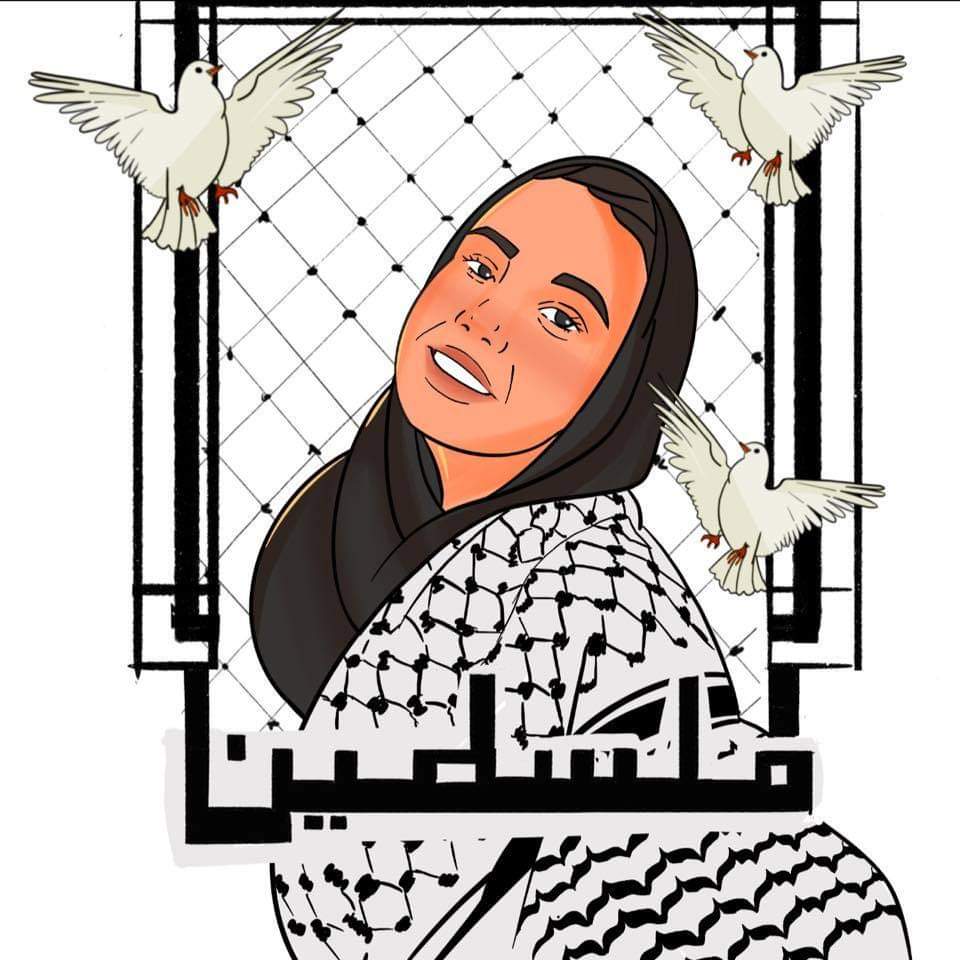
Artist and painter Mahasen Al Khatib life was cut too short by a merciless, blinded Israeli war on defenseless civilians while world leaders look on with hands tied behind their backs.

Today she stands as the owner of the “famous chicken” videoclip in which she documented the happiness of her brother when they managed to get a chicken after months of eating leaves on a starvation diet.

She watches her brother playing with the dead naked, meat, laughs and asks:

“How are we going to cook it…?”

“Magloba…[Arabic dish with rice and vegetables,” comes the reply.

“How about roasting yet,” she interjects.

“Yes, that would be great too.”

Oh, I know, how about boiling it,” she wounders as if this is a great festive occasion.

“Yes, that too would be nice,” with the eyes of her little brother lighting up.  

‘Or, what about cutting it, or even stuffing it?”

She made the videoclip on 9 August, 2024. Little did she know would be at the end of an Israeli two months later.

Mahsen drew with her pencils the heinous  conditions of the people of Gaza that have been unrelenting in an Israeli genocide of death and destruction.

Her last post was on Facebook of a youth being burnt alive. His name was Shabaan Al Dalo.

He was burnt alive in a tent outside the Al Aqsa Martyrs Hospital on 14 October, 2024.

“How do feel when you see any person burned alive,” she wryly commented a few days later.

Mahasen Al Khatib established Rawasi Palestine Foundation for Culture, Art and Media.

Palestine and Gaza lost a creative personality. She sought to communicate the merciless, ungodly heartache of the people whose lives have long been turned upside down. She wanted to send a message to the world in a clever way about the tragedies of Gazans through her artistic works.

Mahasen left us with a creative, national heritage that sought to fight ethnic cleansing and presented us with immense digital works that expressed our wounds, devastation and hopes for an end to the massacres and killing.

The artist was firm against people leaving their homes. She and her family stood against displacement and fought it tirelessly through her works that depicted the harsh realities in a caricaturist, funny manner which she published on her social media accounts.

“God sends us a chicken after long months…thanks be to God, she says….It was a chicken for eight people and I ate a part of it,” she emphasized.

The social media became alert when news of her martyrdom was announced.

Mohammad Saeed wrote: “The martyr Mahasen Al Khatib documented for us the moment the flour arrived at their home after months of hunger and eating tree leaves. She also documented the arrival of the first chicken for her entire family after many months of absence. She stood firm in Jabalia and didn’t move. Mahasen was martyred tonight in a violent shelling in Jabalia camp. Remember her in your prayers…”

In another post that included a video of the fire, Mahasen wrote, “We saw people burning, we saw people with no one helping, we saw people dying in front of our eyes… May God have mercy on us.”

From Joy to Martyrdom

Over the past years, Mahasen Al-Khatib has spread joy through her artwork. Even in the darkest moments, she would draw a smile by publishing her family’s daily life under the bombing and harsh conditions of war. However, the last thing the Palestinian artist published before her martyrdom carried a lot of pain, which she described as “difficult nights,” according to Al Jazeera.

CrossFireArabia

CrossFireArabia
Dr. Marwan Asmar holds a PhD from Leeds University and is a freelance writer specializing on the Middle East. He has worked as a journalist since the early 1990s in Jordan and the Gulf countries, and been widely published, including at Albawaba, Gulf News, Al Ghad, World Press Review and others.

Related Posts

Beirut Weeps For a Poet

Lebanon mourns Khatoun Salma, a Lebanese national poet who was killed along with her husband in an Israeli airstrike that targeted their home in the Tallet al-Khayat neighborhood of Beirut Wednesday, 8 April.

Rasha al-Amir, publisher of Dar al-Jadeed, announced that the bodies of Khatoun and her husband were recovered from the rubble, Thursday morning.

Lebanese journalist Maha Salma also mourned her sister Khatoun on her Instagram account, writing: “My dear sister is in God’s care. May God grant me patience in the pain of her loss and the burning of my heart and soul.”

Poet and playwright Yahya Jaber wrote a tribute to Khatoun on Facebook, saying: “Yesterday, the Israeli airstrike cut down a poet with its sharp scissors, a poet of delicate Arabic.” Under the rubble, the conjunction “waw,” the plural “waw,” the feminine plural “nun,” the feminine suffix “ta,” the definite article “al-“: a massacre of language at the hands of language. Jaber attached a picture of the building where Khatoun lived to his post, saying:

“Here is the Khayat Hill building, and here on one of these balconies, we used to stay up late with Khatoun and her husband, Muhammad Karsht, in the late 198s, spinning yarns of laughter and sewing memories. We would recite poetry and remember our city, Tyre, and love Beirut, the capital.”

Lebanese poet Majida Dagher wrote on her Facebook page in mourning for Khatoun: “Under the rubble of her house in Khayat Hill, they found a poet lying among her shattered rhymes. The death of a poet in an airstrike on Beirut makes you feel that war is very, very close. The sound of bones breaking has become louder, and the smell of blood deeper.

Salma fell from the heights of poetry before she could bid farewell to ‘the last inhabitant of the moon.'” She thought Beirut was her tent, Beirut the roof of her poem, where she would hide, “embracing a woman waiting” for the dust to settle. But the dust became the tent of a new Beirut, a Beirut weeping, broken, martyred.

Salma, who studied Arabic literature at the American University of Beirut, published two collections of poetry, “I Embraced a Woman Waiting” in 2009 and “The Last Inhabitants of the Moon” in 2012, both with the Lebanese publishing house Dar Al-Jadeed. She first gained recognition in the 1970s, during her secondary school years, when she won a poetry prize. Later, at the beginning of this century, she became known in cultural circles for her relatively small but distinguished poetic output and her academic pursuits, which included studies in Sufism and Sufi mystics.

She combined profound knowledge with poetic sensitivity. She left her mark on the Lebanese cultural scene with a unique poetic voice, manifested in her literary works that carried the pain of humanity, exile, and memory. With her tragic passing, Lebanon loses a literary and human figure who wrote of the wound in a language that resembled nothing but truth.

Continue reading
Al Bahri: The Man Who Set Palestinian Theater

He is a playwright and author of 12 plays, nearly 20 novels, and numerous translations. Jamil Habib Afara (al-Bahri) was known as the “Father of Theater.” He was born in 1895 in Haifa and his family name dates back to the mid-18th century, as his ancestor owned a merchant fleet that sailed the Mediterranean between Haifa, Acre, and Tripoli. This is where his family name originated.

He showed early interest in literature and writing. He and his brother, Hanna, were keen to revitalize the literary and intellectual scene in Haifa, establishing the National Library there in 1922. He first published the “Zahrat al-Jamil” (The Beautiful Flower) and later “al-Zahra” (The Flower) which was initially a weekly publication that later became a bi-weekly and continued publication for about nine months after his death in 1931. His last piece was

a journalistic investigation into the execution of the three martyrs: Muhammad Jamjoum, Fuad Hijazi, and Ata al-Zeer, in the city of Acre in 1930. He dedicated his time and his newspaper that day to the souls of these martyrs, leading with: “The terrible hour in Haifa and all of Palestine: Let us commemorate those who gave their lives for the homeland.” A large funeral was held for him, and poems and eulogies were recited and published in the Palestinian press, such as the “Al-Karmel” and “Falastin,” newspapers.

The Department of Culture of the Palestine Liberation Organization posthumously awarded him the Jerusalem Medal for Culture and Arts in 1990, and the Palestinian Ministry of Culture reprinted his first book, “The History of Haifa,” in 2022.

Continue reading

You Missed

Trump: Tunes, Ceasefire and Hormuz

Trump: Tunes, Ceasefire and Hormuz

Israeli Looters in Lebanon

  • By marwan
  • April 23, 2026
  • 18 views

Ayat, Qamar Bid Farwell to Their Martyr Dad

Ayat, Qamar Bid Farwell to Their Martyr Dad

‘We Killed Our Own Then Blamed Hamas’

‘We Killed Our Own Then Blamed Hamas’

An Unholy War!

An Unholy War!

‘Journalist Khalil Trapped Under Rubble Left to Die’

‘Journalist Khalil Trapped Under Rubble Left to Die’