Abdul Salam Haniyeh: ‘My Father Was an Educator, Leader, a Friend’
Abdul Salam Haniyeh, the son of slain Hamas Political Bureau chief Ismail Haniyeh, said more than 75 members of his immediate family and 250 members of the wider Al-Hajj clan have been killed during Israel’s war on the Gaza Strip.
In an interview with Anadolu marking the second year of his father’s assassination, Abdul Salam described Türkiye as “a political supporter of the Palestinian people,” praised President Recep Tayyip Erdogan’s backing of the Palestinian cause and expressed hope that mediation efforts by Egypt, Qatar and Türkiye would succeed in securing implementation of the Gaza ceasefire agreement.
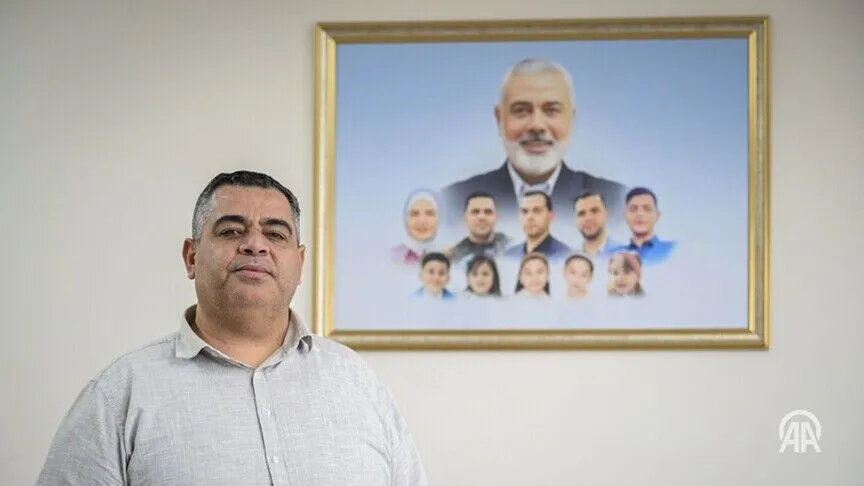
Family portrait bears scars of war
Standing before a large family portrait hanging on the wall, Abdul Salam pointed to the faces of relatives killed during the war.
He identified Ismail Haniyeh’s three sons — Mohammed, Hazem and Amir — along with several grandchildren who were killed in an Israeli strike April 10, 2024, the first day of Eid al-Fitr, the Muslim holiday at the end of the holy month of Ramadan.
“More than 75 members of the Haniyeh family have been martyred during the war,” he said, adding that 250 members of the broader Al-Hajj clan had also been killed.
‘Teacher, mentor and caring father’
Abdul Salam described his father as a man who combined the roles of father, educator, leader and friend.
“At home, my father was a teacher, mentor, leader, caring father and friend,” he said.
He said Ismail Haniyeh treated his children as friends, regularly sought their opinions and remained closely connected to his extended family.
“We miss his beautiful voice, his warm presence, our meetings with him and our Quran recitation sessions at home,” he said.
Quoting Arabic poetry, he added, “In the darkest night, the full moon is most missed.”
‘Remain among the people’
One of his father’s most important pieces of advice was never to become detached from ordinary people or from Gaza City’s Beach refugee camp, where the family was raised, according to Abdul Salam.
“He always advised us to remain among the people, for the people, and close to our family, neighbors and mosque, because the people are one’s greatest asset in this life,” he said.
He said his father urged his children to stay humble, preserve family ties, serve their community, maintain their prayers and Quran recitation, and support people in times of grief and joy.
“He always reminded us that he could leave this world at any moment and that we should uphold these values after his death,” he added.
‘Still present in our people’s lives’
Abdul Salam said his father continues to occupy a prominent place in Palestinian public life two years after his assassination.
“He remains present in every aspect of our people’s lives,” he said, citing continued public, political and media commemoration of his legacy.
He argued that remembering Palestinian leaders who were killed reinforces the message that the Palestinian struggle will continue.
Ismail Haniyeh was assassinated July 31, 2024, at his residence in Tehran after attending the inauguration ceremony of Iranian President Masoud Pezeshkian. Israeli Defense Minister Israel Katz acknowledged Israel’s responsibility for the assassination in December 2024.
‘Türkiye is a political supporter’
Abdul Salam said Türkiye hosts thousands of Palestinians and has consistently provided political and humanitarian support.
He praised Erdogan’s stance on Gaza and his support for the Palestinian cause.
“Türkiye stands with the Palestinian people under President Erdogan and is making every effort to end the occupation of Palestinian land, in accordance with international law and UN resolutions, and to establish a Palestinian state,” he said. “There is a feeling that we have political support from Türkiye under President Erdogan.”
He highlighted Türkiye’s diplomatic efforts at the UN Security Council, the UN General Assembly and in contacts with the US administration.
Public solidarity should influence leaders
Abdul Salam welcomed growing international public support for the Palestinian cause, including recognition of the State of Palestine by several European countries.
But he argued that popular solidarity must translate into political action.
“The message of the people must reach the tables of international political leaders so that the conflict ends, the occupation ends and the Palestinian state is established,” he said.
He urged European countries and the broader international community to work toward ending the war, ending the Israeli occupation of Gaza and the occupied West Bank, and stopping settler attacks.
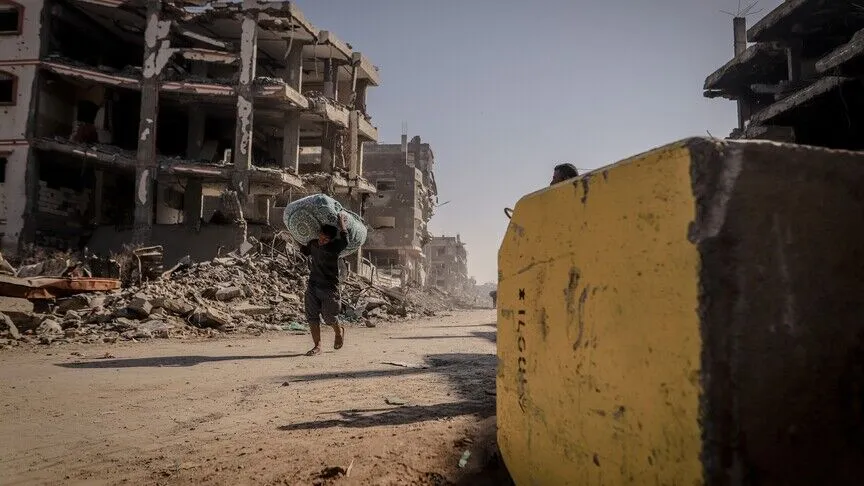
He said more than 1.8 million Palestinians are living in tents while Israel controls more than 70% of the Gaza Strip and much of the enclave’s infrastructure has been destroyed.
Hope for Egypt-Qatar-Türkiye mediation
Abdul Salam expressed hope that mediation efforts by Egypt, Qatar and Türkiye would lead to implementation of the ceasefire agreement.
“We are in the midst of mediation by Egypt, Qatar and Türkiye, and we hope there will soon be implementation of the agreement and that Israel will abide by it,” he said.
He praised the role played by the three countries and said he hoped the agreement would restore hope, reconstruction and normal life to Gaza and lead to a full Israeli withdrawal.
His remarks come as Egypt, Qatar and Türkiye continue efforts to implement the second phase of the Gaza ceasefire roadmap after consultations with Hamas and other Palestinian factions.
The Board of Peace and US President Donald Trump announced an agreement Friday on implementing the next phase of the ceasefire, with the board saying Hamas had approved a detailed roadmap.
‘Gaza’s children deserve to live’
Abdul Salam addressed the people of Gaza. “We are from you, and you are from us,” he said.
He said Gaza’s children are appealing to the world to stop the violence after more than 30,000 children have been killed during the war.
“The children of Gaza and Palestine deserve to live like children everywhere else, to build their future, receive an education, and live with hope and stability,” he said.
Despite the ceasefire that took effect Oct. 10, 2025, Palestinian authorities said Israel has continued to violate the agreement, with Gaza’s Health Ministry reporting 1,222 people have since been killed and 4,053 injured.
The ministry said the overall death toll since October 2023 has reached 73,349, with 174,162 injured. Anadolu

 CrossFireArabia


 marwan