Israeli Maariv: There is no Alternative to Hamas in Gaza

Any alternative to the Islamic Resistance Movement (Hamas) is not realistic, as it has sovereignty and rule over the Gaza Strip, Israeli daily newspaper Maariv wrote about  Israel’s options for the so-call “day after” in the enclave.

The newspaper stated Gaza is not the West Bank, explaining years after the Israeli invasion of the West Bank in 2002, the Israeli army is still waging ongoing battles with the Palestinians there.

The big difference is according to Maariv the military cells in the Palestinian Authority areas are not the party that controls security and civil affairs there; nor is it the “lions’ den,” nor even any other organization responsible for the daily life of the population.

It added unlike the cities and villages in the West Bank, the synergy between the military and civilian sides of Hamas in Gaza not only did it not disappear, but was not even dented, neither during the air aggression attack phase nor even after in the ground operation Israel waged on the Strip.

The daily referred to the issue of distributing aid in Gaza, which the Israeli government has repeatedly discussed but with no results. Israel does not want Hamas to be responsible for such aid but at the same time, it has no alternatives Maariv stated.

Maariv  explained Prime Minister Benjamin Netanyahu does not have any answer or plan for a civilian alternative for the residents of the Gaza Strip, he never had! “Netanyahu only knows he does not want the Palestinian Authority to be in Gaza, because that mean embarking on the path that  would directly lead to a political process based on the two-state solution.”

The daily pointed out “no force, body or state will agree to set foot in Gaza, neither physically nor with a commitment on paper, as long as Hamas remains in the field, alive, sovereign and actively distributing food to the tents of the displaced.”

There is no alternative for Hamas,  the newspaper stated, adding Israel stands in confusion regarding the day after plan and “there is no better way to describe the current situation than to say it’s a ‘dead end’. Hamas controls Gaza, because there is no alternative.”

Maariv  quoted an anonymous senior Israeli officer as saying in one of the closed hearings of the Foreign Affairs and Defense Committee in the Knesset that eElections will be held in Israel before Netanyahu present to the public an alternative plan to controlling Gaza.

The Hebrew daily called on him to admit  the truth, say it out loud that there is no realistic alternative, and Hamas will remain in Gaza.

It added even if Netanyahu loudly announces he is withdrawing his opposition to the Palestinian Authority as part of an alternative solution to Gaza, this would not change the reality.

The newspaper concluded Hamas leaders are pinning their hope on a prisoner exchange deal that will allow them to expel the Israeli army from the enclave, so that the movement will have sovereignty and rule, as it was before the war began.

CrossFireArabia

CrossFireArabia

Dr. Marwan Asmar holds a PhD from Leeds University and is a freelance writer specializing on the Middle East. He has worked as a journalist since the early 1990s in Jordan and the Gulf countries, and been widely published, including at Albawaba, Gulf News, Al Ghad, World Press Review and others.

Related Posts

‘This War is Not Hours’

By Dr Hasan Al Dajah

Events in the Middle East are accelerating, foreshadowing a comprehensive regional explosion. However, a deeper reading of the situation transcends the traditional narrative that attempts to portray the conflict as an “Arab-Iranian” or sectarian one that transcends borders. The reality emerging today from the rubble of burning military bases and oil facilities is clear: this war is not ours; it is a major strategic war led by Washington with direct Israeli planning, aimed at reshaping the region to serve absolute Western hegemony, even if the price is turning Arab capitals into arenas of destruction and settling scores in which we have no stake.

For years, the United States promoted the concept of “deterrence” and providing protection to allied countries in exchange for billions of dollars in arms deals and a massive military presence. However, Operation “True Promise 5” and the subsequent precise Iranian strikes have stripped away the fig leaf from these claims. Field reports indicate that US bases, once described as “impregnable fortresses,” have become vulnerable targets themselves, requiring protection. At Al Udeid Air Base in Qatar, damage to the AN/FPS-132 early warning radar and the AN/TPY-2 facility resulted in a near-total paralysis of surveillance capabilities.

In Bahrain, home to the Fifth Fleet, the destruction of satellite communications stations led to a loss of centralized control over naval vessels. In Kuwait and the UAE, the casualties and the destruction of F-15 fighter jets revealed that advanced US technology was incapable of countering waves of drones and missiles that disrupted even civilian air traffic and struck vital facilities at Jebel Ali Port, reducing military installations and oil depots to ashes.

This resounding failure raises a fundamental question about the viability of relying on a “security umbrella” that has failed to protect its own perimeter and has become a security burden, attracting attacks rather than repelling them. This is no longer mere political analysis; it has become a public admission emanating from the corridors of Washington. What Senator Lindsey Graham recently revealed represents the pinnacle of terrifying candor. He confirmed that the true agenda is not about spreading “democracy” or protecting allies, but rather about embroiling the Gulf States as the military front and human cannon fodder in a direct confrontation with Iran. This is a prelude to seizing oil wells and managing the region’s wealth for Washington’s benefit, thus paying the price for the American presence, while simultaneously imposing full normalization and strangling China’s energy lifeline.

The United States’ recent attempt to seek refuge in French bases in the UAE, such as Al Dhafra Air Base and Camp de la Paix, is nothing more than a desperate effort to spread losses and hide behind the European umbrella after the deterioration of the original American bases. However, even these shared bases have not been immune to attack.

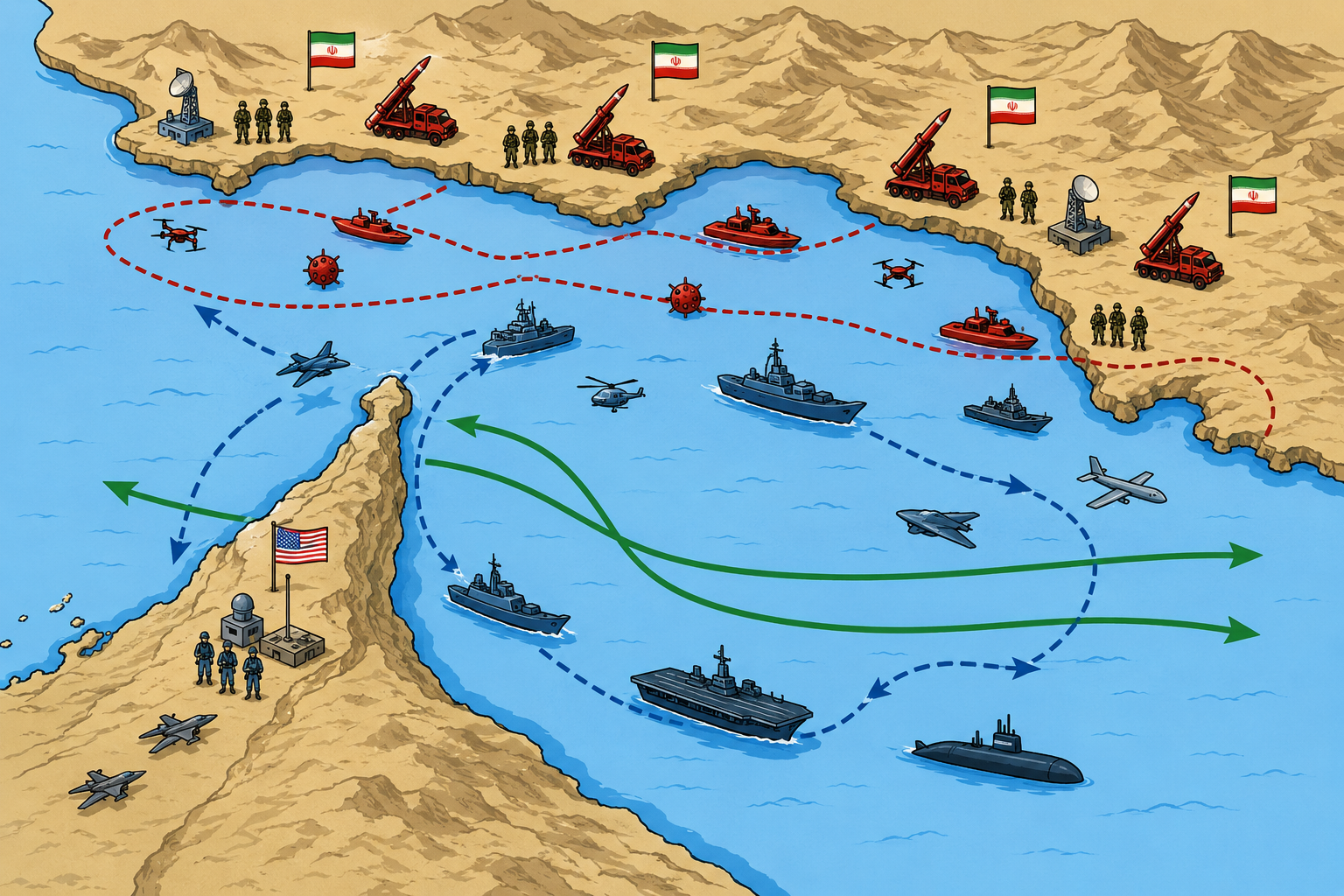
The strikes have proven that any facility supporting Western operations is a legitimate target in this zero-sum confrontation. The effects of this war extend beyond the military arena, striking at the very heart of daily life. The threat to the Strait of Hormuz has triggered seismic repercussions in global markets. The price of a barrel of oil jumped to around $116, an increase of more than $38, while gas prices in Europe rose by more than €25, and oil shipping costs soared by over 90 per cent, foreshadowing an uncontrollable wave of global inflation.

The United States, which today expresses its “displeasure” at Israel exceeding expectations in striking Iranian fuel depots, is not acting out of a desire for peace, but rather out of fear that the economic game will backfire on it and on oil markets, which cannot withstand the loss of Gulf supplies, especially given the 11 per cent increase in gasoline prices in America and the 70 per cent increase in jet fuel prices. What is happening in Jebel Ali, Manama, Doha, and Kuwait is not a struggle to defend Arab sovereignty, but rather a settling of scores between major powers that want to use Arab land as a chessboard.

The American bases that are groaning today under the weight of the strikes have proven to be a “paper tiger” when it comes to protecting allies, and that their presence is nothing but a magnet for crises that drains Arab capabilities for the benefit of foreign agendas that do not take into account Arab national security.

Arab capitals must realize, before it’s too late, that the “illusion of protection” has completely evaporated under the weight of missiles and drones. To be drawn into Israel’s desire to destroy the region, and to accommodate American ambitions to seize energy resources to finance its expansionist policies, is strategic suicide by any measure.

This raging war is not our war, and staying out of the inferno of this manufactured conflict is the only way to ensure that our wealth and the future of our generations do not become fuel for the schemes of Netanyahu, Trump, and the war profiteers behind them.

The time has come to seriously seek a self-reliant regional security system, one that originates from within the continent and is based on the shared interests of the region’s countries, far removed from foreign bases that today lack even the most basic military effectiveness and have become a strategic burden that itself needs protection after its defensive vulnerabilities have been exposed.

False American promises only increase our subservience and dependence on a modern colonial project that sees Arabs as nothing more than insignificant figures on its debt list, or mere cheap tools in its proxy wars. The true protection of homelands begins today with disengaging from these destructive agendas, and with the explicit acknowledgment that bases that have failed to protect their own walls and platforms will never be a shield for others.

Hasan Al-Dajah, a Professor of Strategic Studies at Al-Hussein Bin Talal University, is a columnist in the Jordan Times.

Continue reading
The US General Who Swallowed His Own Truth

By Jassem Al-Azzawi

General Dan Kaine, Chairman of the Joint Chiefs of Staff, delivered a confidential warning to President Trump with the utmost candor—the kind of candor that democracies rely on and empires routinely ignore. He said: “We don’t have enough ammunition to win this war. It’s not going to be pretty.” This warning wasn’t born of cowardice; it was the last vestige of institutional integrity that still flickers within the halls of American military power.

Trump’s response was that of a circus clown, not a commander-in-chief. Through his “Truth Social” platform—that distorted mirror of American political life—he dismissed the warning with the arrogance of a street vendor, saying: “Oh, no, no, no. If we do it, we’ll win easily.” Thus, a sober assessment became mere publicity, and caution a lie.

But the biggest lie came later. When Kaine’s warning leaked, Trump not only rejected it but completely reversed it. With the confidence of a man who has never been held accountable for anything, he told the American public the general had said the exact opposite—that the United States had plenty of missiles, munitions, and everything else. “That’s not what he said at all,” Trump declared, putting words of false victory in the mouth of a man who had offered only warnings.

And General Cain remained silent

This silence is not just a footnote in this story; it is the story itself. By remaining silent, Cain allowed the American public to absorb the falsehood as truth. He did not say: “No, Mr. President, that’s not what I said.” He did not invoke his oath, nor the soldiers who would pay with their lives for the gap between political rhetoric and logistical reality. He chose the safety of silence over the danger of truth, and in doing so, he betrayed not only himself but the Republic. This is the rot at the heart of American militarism.

As historian Andrew Bacevich has long warned, the professional military has become more of an instrument of imperial ambition than a defender of democratic values, with senior officers more concerned with their next post than with the Constitution they swore to uphold. Kaine’s silence was not a mere slip of the tongue; it was a symptom of a deeper malaise.

The logistical picture Kaine described in private was not theoretical; the calculations were unforgiving.

Current stockpiles of interceptor missiles and precision munitions could not sustain a prolonged air campaign against a country three times the size of Iraq. The Wall Street Journal documented a “worrying gap” in U.S. missile stockpiles, noting that reserves were “far below” the requirements of intensive and sustained operations. Pentagon contractors were instructed to “double or even quadruple” production of Patriot, SM-6, and precision-strike missiles—a tacit admission that the arsenal built for Cold War scenarios is inadequate for the war being fought today.

Consider Gaza: Israel, the most heavily armed military power in the Middle East, with complete air and naval dominance, has turned a tiny coastal strip into a moon-like landscape of devastation over two and a half years, yet it has not broken Hamas. Gaza is only 37 kilometers long. Iran, on the other hand, is a nation of 90 million people, with mountainous terrain, strategic depth, fortified infrastructure, and a combat-hardened Revolutionary Guard. The idea that it will collapse under a few weeks of American airstrikes is not strategy; it is wishful thinking. “God help us if this continues, if it gets to four weeks,” Colonel Daniel Davis warned on the Deep Dive podcast. He was speaking in military terms, and the same prayer applies. Politically.

When Trump now raises the prospect of sending ground troops, he is not escalating from a position of strength, but rather improvising from a position of denial. Admitting that air power and missiles alone cannot achieve the political objective is an admission that the original objective was never honestly assessed. This is the pattern of American wars at the end of an empire: Glittering promises, disastrous calculations, and then a grim and horrific reckoning paid in blood by those who had no seat at the table where the lies were told.


The costs are already piling up—not just in the currency of munitions and riches, but in the currency that empires always ultimately spend and regret most: credibility. America’s word, already devalued by two decades of contrived justifications for war, is getting cheaper by the day.

Democracies can tolerate miscalculations, and they can tolerate bad presidents, but what they cannot long tolerate is the institutionalization of a culture where the truth is whispered behind closed doors and swallowed whole in front of cameras. When the chairman of the Joint Chiefs of Staff allows his words to be weaponized for propaganda — when the man in charge of counting missiles refuses to correct a president who pretends they are plentiful — something far greater than military credibility collapses.

What is crumbling is the social contract between the governed and those who send them to their deaths.

Caine’s silence was not cautious; it was complicity. And in an imperial machine suffering from a shortage of ammunition and a shortage of truth, complicity is the only resource that seems inexhaustible, because when the missiles finally run out, slogans won’t replace them.

Reality will.

Al-Azzawi is an Iraqi writer who contributed this piece to Al Rai Al Youm which was translated and appeared in crossfire.com

Continue reading

You Missed

Israeli Official: ‘Life in The North is Dead’

Israeli Official: ‘Life in The North is Dead’

White House Economic Council Head Says The Iran War May End in 6 Weeks, Wont Stay Months

White House Economic Council Head Says The Iran War May End in 6 Weeks, Wont Stay Months

At Day 16 of The War The Israeli Air Force Say The Dropped 10,000 Bombs on Iran

At Day 16 of The War The Israeli Air Force Say The Dropped 10,000 Bombs on Iran

IRGC Spokesman: Most of The Missiles Produced After The 12-Day War Are Yet to be Used

IRGC Spokesman: Most of The Missiles Produced After The 12-Day War Are Yet to be Used

IRGC Spokesman: Most the Missiles Launched in This War Were Produced 10 Years Ago

IRGC Spokesman: Most the Missiles Launched in This War Were Produced 10 Years Ago

Al Bahri: The Man Who Set Palestinian Theater

Al Bahri: The Man Who Set Palestinian Theater