Genocidal Maniacs: A Story of a Massacre

As part of Israel’s ongoing genocide against Palestinians in the Gaza Strip since October 2023, the Israeli army targeted the Juha family’s home without warning or military necessity. The attack resulted in a massacre that killed approximately 90 civilians – including 71 women and children – and injured dozens more.

According to a Euro-Med Monitor investigation, the Israeli military launched a massive assault against Palestinian civilians in the eastern parts of Gaza City shortly after the first truce ended in early December 2023. This assault included an attack on the Juha family building located in the densely populated Sha’af area, which, along with the Shuja’iyya neighbourhood, was a focus of the offensive.

https://twitter.com/EuroMedHR/status/1894041270512656660

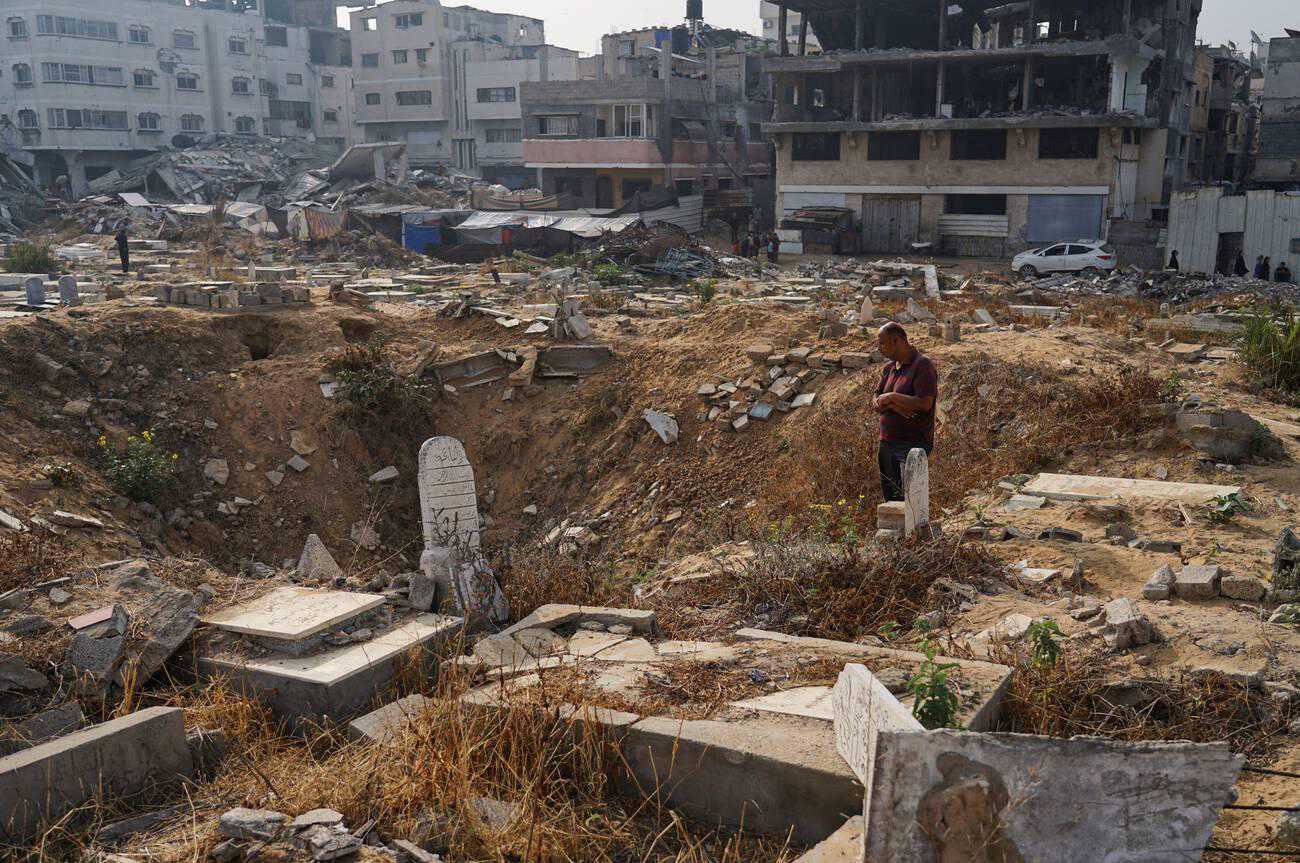
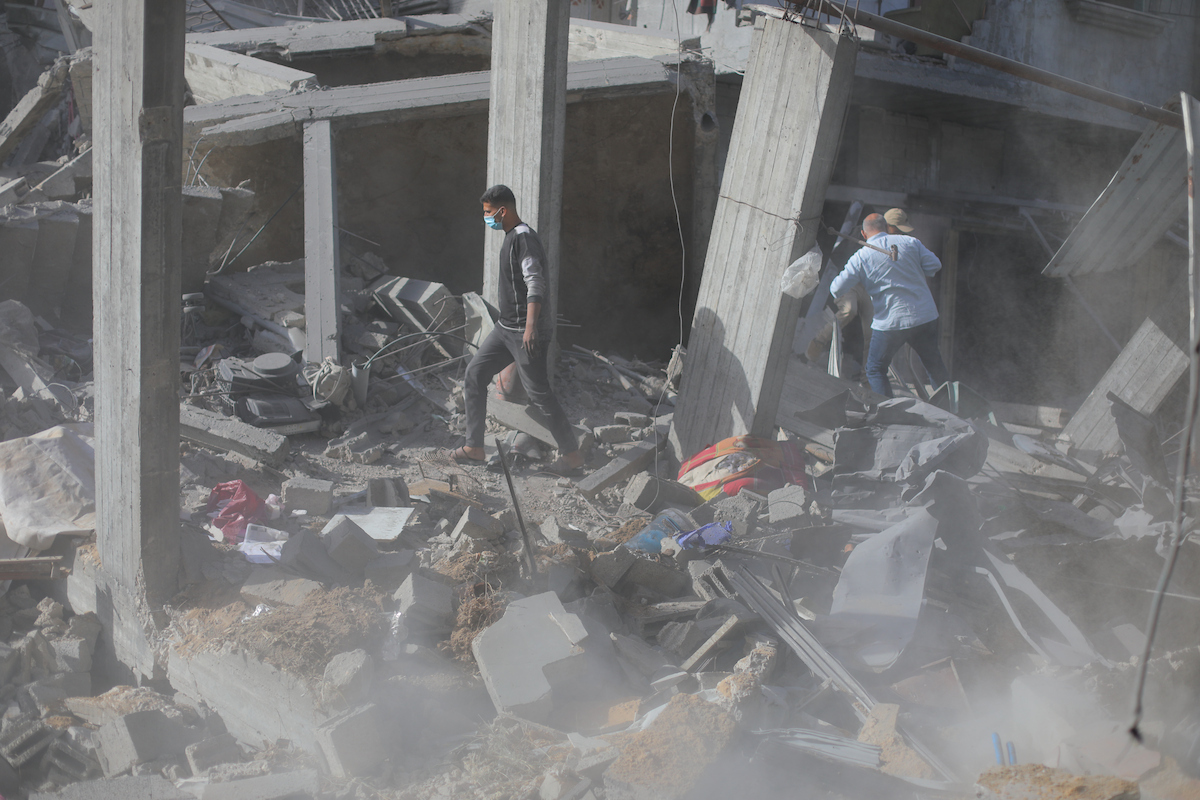
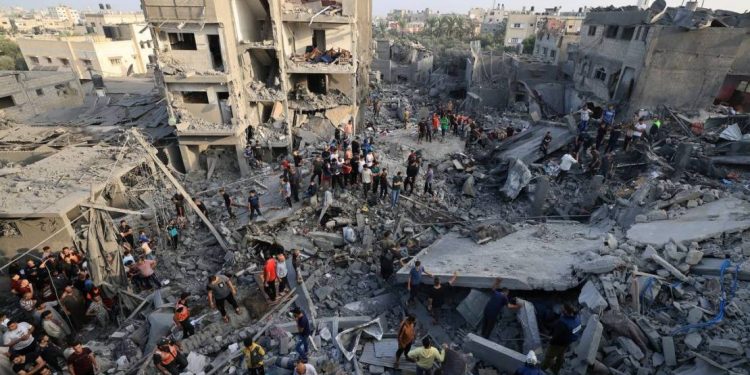
In one of the most horrifying massacres carried out by Israel during its genocidal campaign against the Palestinians in the Strip, Israeli warplanes targeted the Juha family’s home in the Tuffah neighbourhood east of Gaza City on the morning of 6 December 2023. At least one bomb was dropped on the house – a compound consisting of two adjacent buildings. The unexpected attack completely destroyed the building, killing all of its occupants.

Investigations revealed that 117 people were living in the building at the time of the attack, with women, children, and the elderly comprising the majority. This count included both the primary occupants and several relatives who had been forcibly relocated from the Zeitoun neighbourhood.

I couldn’t feel anything and found myself buried under the rubble, surrounded by a raging fire. The ceiling was collapsing on us, and they were only able to dig a small hole to reach us   

Liali Juha, a survivor of the massacre who was pulled from under the rubble

Most occupants died as a result of the bombing, while others were injured—some were dragged out from under the debris, and others were thrown outside by the force of the explosion. At least 17 people suffered burns, wounds, and fractures, with some experiencing limb amputations.

The explosion ripped apart the bodies of many victims, leaving their remains lying across the street and even on the roofs of buildings nearby. Over 34 bodies remain buried beneath the debris, while the bodies of approximately 56 people were recovered from beneath it.

During rescue efforts, residents faced significant challenges, particularly because communication with ambulances or civil defence teams was nearly impossible due to disruptions in internet and communications services. With no official response, the Juha family and local residents took it upon themselves to rescue victims using only manpower and basic tools.

The Euro-Med Monitor team conducted multiple field surveys of the main site. The investigations involved gathering testimonies from witnesses and survivors, documenting the extent of the destruction and the types of weapons used, and analyzing the attack in relation to other incidents in the area.

For accurate information, the team interviewed local residents who were eyewitnesses and nine survivors of the massacre. The Euro-Med Monitor team reviewed satellite images and aerial photos that documented the state of the building and the surrounding area before and after the attack, as well as photographs and video clips provided by eyewitnesses. The team found no evidence of military presence, such as military installations or armed elements, inside or near the Juha family home before or during the attack.

Since the publication of the investigation, Israel has not issued any public statements about the targeting or provided proof that there were any military targets within the building when it was bombed.

https://twitter.com/EuroMedHR/status/1893977539531485628

The report concludes that the principles of distinction, proportionality, and the duty to take necessary precautions – standards that Israel is legally required to uphold – were seriously violated. The timing of the attack, the types of munitions used, and the widespread indiscriminate destruction are deemed unjustifiable.

Euro-Med Monitor asserts that the targeting of the Juha family represents a grave violation of international humanitarian law, constituting multiple war crimes against civilians and civilian property. These actions are described not only as fully-fledged crimes against humanity but also as part of a large-scale, organised military assault on the civilian population of the Gaza Strip that began in October 2023.

The report further highlights that, in addition to the systematic and large-scale destruction of homes and shelters, the targeting of the Juha family home is emblematic of a broader pattern. This pattern includes the partial or complete destruction of 436,000 homes (roughly 92% of the homes in the Gaza Strip) and the killing of over 54,000 Palestinians, most of whom were inside their homes – indicating a deliberate strategy to target Palestinian civilians and infrastructure.

These events show a pattern of systematic and recurrent military attacks that are based on a plan that cannot be justified by any military necessity. This pattern indicates that there is a deliberate strategy to attack Palestinian civilians directly and collectively, while simultaneously destroying large numbers of homes and shelters, as two complementary strategies to accomplish a single goal: the elimination of the Palestinian population in the Strip.

Liali Raid Zaki Juha, 14, a survivor of the massacre who was pulled from under the rubble, recounted to the Euro-Med Monitor team: “I was talking with my uncle’s family when, suddenly, I couldn’t feel anything and found myself buried under the rubble, surrounded by a raging fire.”

“The fire was so intense that my uncle’s family melted before me, and there was no one to rescue us. My uncle’s family kept screaming for help—‘Get us out, Dad, get us out!’—with my uncle replying that he couldn’t,” she said. “The ceiling was collapsing on us, and they were only able to dig a small hole to reach us. They began smashing through with a heavy hammer to pull us from under the rubble, and after a lot of struggle, they managed to do it.”

“My mother, Manal Talat Muhammad Juha, 40, lost her leg,” Juha added, “I lost my brother, the family members of my uncle Iyad Zaki Atta Juha and the family members of my grandfather Zaki Atta Saleh Juha, 67, as well as my grandmother, Hadaya Nuzhat Saleh Juha, 51.”

Based on its findings, the Euro-Med Human Rights Monitor urged the relevant international parties to pressure Israel to allow international and UN investigation and inquiry committees into the Gaza Strip, in compliance with international law and the rulings of the International Court of Justice.  The report calls for prompt, independent, and unbiased investigations into the targeting of civilians in the Juha family massacre and all other crimes committed by Israel against Palestinian civilians in the Gaza Strip.

The investigation also urged the International Criminal Court to examine all of Israel’s crimes in the Gaza Strip, including the murder of the Juha family. It also called for the extension of criminal responsibility to all perpetrators, the issuance of arrest warrants, and trials in compliance with international law and the Rome Statute.

In accordance with Article 6 of the Rome Statute, the report called on the International Court to recognise the events in the Gaza Strip as a crime of genocide and to treat Israel’s actions with the seriousness they warrant.

https://twitter.com/NourNaim88/status/1831538877162520783

The report further demands that all nations cooperate with the International Criminal Court’s investigations by providing specialised factual and legal memoranda on the crimes committed by Israel, refraining from interfering with its work, and assisting in executing arrest warrants against Israeli officials, including Prime Minister Benjamin Netanyahu and former Defence Minister Yoav Galant.

Finally, the report calls for political and economic sanctions against Israel, an immediate halt to all arms sales, exports,  and military and intelligence assistance, and the termination of all licences and agreements related to the import and export of weapons – including dual-use materials and technology – that could be used against the Palestinian people.

EuroMed Human Rights Monitor

CrossFireArabia

CrossFireArabia
Dr. Marwan Asmar holds a PhD from Leeds University and is a freelance writer specializing on the Middle East. He has worked as a journalist since the early 1990s in Jordan and the Gulf countries, and been widely published, including at Albawaba, Gulf News, Al Ghad, World Press Review and others.

Related Posts

Hormuz: Mines, Strategy or Business?

By Ismail Al Sharif

The US thought that assassinating senior Iranian leaders would bring down the regime, but this did not happen.

Iran’s inability to match American military and technological superiority led it to adopt a number of strategies, most notably what is known in the military literature as the Mosaic Defense Doctrine. This doctrine is based on dismantling its military central command into small, independent units, each operating autonomously and making its own decisions without consulting the higher command.

From Day 1 of the war, Iran adopted this approach. However, the lack of coordination and the disintegration of the military hierarchy led to chaos and confusion which affected the management of its operations. The situation became contradictory; the politicians were declaring one thing and military commanders acting in a completely different manner and direction.

This was reflected on the ground through extremely dangerous behavior. Military units, using small boats, indiscriminately laid naval mines to deter enemy ships. However, the lack of coordination here backfired resulting in the Iranian navy officers losing their ability to pinpoint the coordinates of the mines they planted in the Hormuz Strait with no accurate maps or reliable records. Some of these mines may have been completely displaced by the currents of the sea. This was further complicated by the fact that these mines were not primitive but far from it; they were sophisticated and able to detect sound and pressure, and thus able to track the passage of large ships and submarines, and detonate automatically upon approach.

However, mine removal is not easy task, as history shows. Even today, news reports continue to surface of mines in various parts of the Kingdom, half a century after the last war. Indeed, mines from World War II are still being discovered on land and at sea.

Even with Britain’s pledge to remove mines after the war, and despite possessing the latest specialized technologies in this field, the task remains arduous, protracted, and uncertain. The specter of a sudden explosion looms, reminding us that the danger of mines is not easily eliminated.

But the decisive factor in weakening navigation in the Hormuz Strait is not primarily military, but rather material. Commercial ships are massive investments, with some vessels valued at around $150 million and their cargoes potentially worth hundreds of millions of dollars. Therefore, a single mine explosion can cause catastrophic losses to both the ship and its cargo. Consequently, no ship sails without insurance; ports, banks, and shipping companies refuse to deal with uninsured vessels, and without insurance, global shipping grinds to a halt.

Herein lies the real surprise: the fate of the Strait is no longer dependent on Iran’s pronouncements regarding its opening or closure, but has effectively fallen into the hands of insurance companies. With the escalating risks, insurance costs have skyrocketed; “war risk” premiums have jumped from approximately 0.25% of the ship’s value to nearly 1% or more, exceeding a massive $1 million per voyage. And it doesnt stop there; seven major insurance companies announced their complete withdrawal, issuing notices of coverage cancellation just within just 72 hours.

And here comes the decisive turning point: Once the insurance coverage is lost, maritime traffic ground to a halt. During this 39-war, ships have effectively ceased sailing with the number of vessels transiting the Strait plummeting by more than 80%. Around 150 oil tankers remain anchored offshore, and major shipping companies suspended their operations, as if this vital artery of global trade had been frozen by a financial, rather than a military decision.

The US government attempted to provide alternative insurance coverage, but this effort failed and US President Trump’s pronouncements regarding mine removal were inconsistent with the reality.

The issue of reopening the Strait has once again become a prominent topic, but the deeper truth is that its fate is no longer determined by political statements or military actions, but rather by the decisions of insurance experts. Even if the war were to end immediately, ships would not resume sailing right away. Insurance companies need time to reassess the level of risk, and they base their decisions not on political logic, but on cold, hard numbers and rigorous data.

This article was originally published in Arabic in Addustour daily newspaper and republished in English in crossfirearabia.com.

Continue reading
Analysis: Middle East in Iranian Eyes

CROSSFIREARABIA – During the Israeli Genocide on Gaza Benjamin Netanyahu used to stand up and say with a smirk: ‘We are changing the face of the Middle East’.

Upbeat about murdering the women and children of Gaza from the late 2023 onwards, he was talking about the further normalization of the Arab world as established by the Abraham Accords, establish an economic order under Israel’s hegemony and end Hamas, Hezbollah and Houthis while clipping the wings of Iran.

Of course, Netanyahu’s face soon changed, albeit two-and-a-half years later, when Iran and Hezbollah were forced into a war generated by Israel and the USA on 29 February, 2026. While Iran got a battering, in the next 39 days, US ships and military bases in the Gulf and Jordan received such a hammering that soon forced US President Donald Trump to plead for a ceasefire.

In this war, Israel received a great shock, being attacked literally on an hourly and daily basis with its buildings, military basis and infrastructure taking directs hits while its millions of people living in underground shelters around-the-clock. 

To use a metaphor Tel Aviv’s nose was being rubbed in the sand in a way that has never been imagined by Netanyahu nor his ilk of extremist right wing fascist politicians who started calling for the expulsion of Gaza Palestinians from their homeland ever since the Israeli genocide on them since 7 October, 2023. 

Today’s Netanyahu’s vision of a new Middle East has been drastically changed, thrown in his face in fact! Iran’s political stances and its missiles have changed things around. The US and Israel were not able to change the current Iranian government in Iran despite killing the country’s spiritual leader Ali Khameini, have not ended the country’s nuclear program nor ended its ballistic missiles. 

So what is Netanyahu talking about? Yes, today there is clearly a new Middle East emerging but it is not according to Netanyahu’s eyes nor his wishful thinking. If anybody should be ‘celebrating’ it is clearly Iran, it’s government, revolutionary guard, its Generals, officers and soldiers who are very probably changing the face of the Middle East and may even be setting the map of how the region should look like in form from now on. 

From day one of the war, Trump started running scared despite his outlandish mutterings! He came to realize quickly that Netanyahu and the Mossad pushed him against Iran, convincing him it would be an easy fight and the government there would fall like a pack of cards. Trump since, started kicking himself as he finally fell to Netanyahu’s squinted prism to go after that country. Netanyahu kept pushing for this wild step since the 1990s through previous US presidents from Bill Clinton, George W Bush, Barack Obama and Joe Biden.

But they did not listen to him however, Trump fell into the trap and maybe this is why he is now privately kicking himself because he basically sent the globe into an economic tailspin and soaring exorbitant oil prices, a potentially deep recession and financial chaos.

In this war Netanyahu may have shot himself in the foot. His alliance with the USA  juxtaposed by Hezbollah whose fighters laid dormant since November 2024 when it stopped firing at Tel Aviv was a big surprise to the latter. Israel had previously thought that Hezbollah agreed to a ceasefire out of weakness and thus their entry into military action was unexpected. Hezbollah kept the military pressure on for six more days after Washington signed off with Iran and beating the Israeli army into submission.

On day 46 Trump intervened calling on the Israeli army to stop fighting Hezbollah. He had ulterior motive, he wanted to extract a normalization agreement between the Lebanese government and Israel; their ambassadors had just started meeting in Washington at the invitation of the US State Department in an upbeat atmosphere and inline for a final agreement to establish an accord between Tel Aviv and Beirut alongside the ones signed between Israel and four Arab states, the UAE, Bahrain, Sudan and Morocco starting September 2020. 

Thus a normalization agreement would be a feather in Trump’s cap, a sort of prestige move for the US president. But his pressure may have been seen as a life-saving formula. Trump was saving Israel from Netanyahu’s insistence that his army to keep fighting in southern Lebanon. Its fight has already cost Israel at least 13 soldiers who were killed, more than 500 injured and more than 100 topnotch Merkava tanks destroyed. Israeli towns and cities were being hammered from the north.

Israel was being beaten from the north. Its towns, cities and military bases again were wide-open to incoming rockets from Lebanon and were not being deflected. It was a war that had to be stopped. This time Trump insisted. If a ceasefire with Iran was going to stick, then Netanyahu had to be forced to make his soldiers stop their fight in Lebanon. 

Thus for the time being Netanyahu’s hand lie in check. Yet in the long run his dream for a new Middle East with Israel playing a central part in it may have been halted. After all, no Gulf or even Arab states now would think of normalizing with Israel despite the fact that Lebanon is being forced into it, but even for then its early days.

Netanyahu can kiss goodbye his long-life attempt to sign a normalization accord with Saudi Arabia for instance, a kingdom which is seen as a “major puller” in the Arab and Muslim world. It has already said that normalization is off the table with Israel. The Gulf has been disappointed in this war because it showed that America were not able to protect them from Iranian missiles that targeted their infrastructure as well the US military bases strewn across the region.

Netanyahu has lost on the economic level as well. His country stands economically devastated, army in ruins as admitted to by the Israeli chief of staff Eyal Zamir, and the dream of opening an ‘economic Middle East’ is definitely dashed for the time being.

America, as Trump knows, is left to pick up the pieces of a tattered world caused by war any choas in a region that is vital to the global system.

Continue reading

You Missed

US-Iran: Who Will Blink First!

US-Iran: Who Will Blink First!

Trump: Tunes, Ceasefire and Hormuz

Trump: Tunes, Ceasefire and Hormuz

Israeli Looters in Lebanon

  • By marwan
  • April 23, 2026
  • 28 views

Ayat, Qamar Bid Farwell to Their Martyr Dad

Ayat, Qamar Bid Farwell to Their Martyr Dad

‘We Killed Our Own Then Blamed Hamas’

‘We Killed Our Own Then Blamed Hamas’

An Unholy War!

An Unholy War!