A Year on: Remembering Late Poet of Gaza

If I Must Die, Let it Bring Hope’ – Remembering Professor Refaat Alareer

Refaat Alareer’s daughter was killed by Israel in Gaza. (Design: Palestine Chronicle)

By Nurah Tape – The Palestine Chronicle  

“Sometimes a homeland becomes a tale. We love the story because it is about our homeland and we love our homeland even more because of the story.”

On Day 3 of Israel’s genocidal assault on the Gaza Strip, intellectual and writer Professor Refaat Alareer said in a live interview from the besieged enclave “I’m an academic. Probably the toughest thing I have at home is an Expo marker. But if the Israelis invade … I’m going to use that marker to throw it at the Israeli soldiers, even if that is the last thing that I would be able to do.”

Nearly three months later, on 6 December, 2023, Alareer was killed in an Israeli airstrike on his sister’s home in northern Gaza. The activist’s sister, Asmaa, along with three of her children, and his brother Salah, with his son Mohammed, were among those also killed in the attack.

As a professor, poet and writer, Alareer’s pen was his weapon. And it continues to defend and tell the story of his people.

Iconic Poem

His poem, If I Must Die, written in 2011 and shared on X a month before his death, has become an iconic reminder of the Palestinian struggle for liberation from Israeli occupation and oppression.

“If I must die, you must live, to tell my story, to sell my things, to buy a piece of cloth and some strings…If I must die, let it bring hope, let it be a tale” the actor Brian Cox delivered a passionate rendition of the poem published by the Palestine Festival of Literature.

On December 4, two days before his death, Alareer wrote in a post on X: “I wish I were a freedom fighter so I die fighting back those invading Israeli genocidal maniacs invading my neighborhood and city.”

“The building is shaking,” he added. “The debris and shrapnel are hitting the walls and flying in the streets. Israel has not stopped bombing, shelling, and shooting. Pray for us. Pray for Gaza.”

Over a year later, his words echo as the bombing, shelling, and shooting continue unabated.

To date, a total of 44,612 Palestinians have been killed, and 105,834 wounded, according to Gaza’s Ministry of Health.

We Are Not Numbers

As the beloved professor of Literature and Creative Writing at the Islamic University of Gaza and co-founder of the We Are Not Numbers project, Alareer inspired a myriad of young people in the enclave to own their narrative and tell the story of Palestine based on their experiences.

In a TED talk delivered in 2015, Alareer impressed upon preserving oral history and how “stories make us.”

“I realize I am the person I am today because of the stories” told to him by his mother and grandmother, he said, “because my mum was teaching me values, etiquette, to love people, to love my life, to love my country at the same time.”

“Stories are also important in our lives as Palestinians, as people under occupation, as native peoples on this land,  not only because they make us, they shape us,  they make us the people we are but also because they connect us with our past, they connect us with our present, and they prepare us to the future,” shared Alareer.

He said his grandmother “told us stories (about) when she was a kid, when she was a newly married wife who would spend months plowing her land, harvesting the crops, the land that now we don’t own because it was occupied.

“Although the land is physically occupied, it still lives in our memories, still lives in our hearts, because we can easily visualize this.”

‘Tell Us Stories’

Concluding his talk, Alareer encouraged the audience to “beg” their parents and grandparents to “tell us stories” and share them with “our kids.”

“Because if we don’t do that, if the story stops there, we’re betraying ourselves, we’re betraying the story, we’re betraying our parents and grandparents, and we’re betraying our homeland,” he emphasized.

https://www.palestinechronicle.com/let-it-be-a-tale-israel-kills-the-storytellers-of-gaza-but-will-not-kill-the-story/embed/#?secret=A1GEdoACO7#?secret=0ulwRI8zTr

Born on September 23, 1979, in Shejaiya in Gaza City, Alareer said in a media interview that “every move I took and every decision I made were influenced (usually negatively) by the Israeli occupation”.

“As a kid, I grew up throwing stones at Israeli military Jeeps, flying kites, and reading,” he also said.

‘Gaza Writes Back’

Alareer edited several books, including ‘Gaza Writes Back’ and ‘Gaza Unsilenced’, which according to Palestine Chronicle editor, Ramzy Baroud, “allowed him to take the message of other Palestinian intellectuals in Gaza to the rest of the world.”

“Sometimes a homeland becomes a tale. We love the story because it is about our homeland and we love our homeland even more because of the story,” he wrote in ‘Gaza Writes Back’.

The Geneva-based group, Euro-Med Human Rights Monitor, said Alareer’s killing was “apparently deliberate” and called for an investigation into his death.

“The apartment where Refaat and his family were sheltering was surgically bombed out of the entire building where it’s located, according to corroborated eyewitness and family accounts,” the organization said in a statement.

This came after weeks of death threats that Refaat received “online and by phone from Israeli accounts.”

His Legacy

Husband to Nusayba, Alareer was also a father of six, who had their home bombed previously by Israel in 2014, killing over 30 of his and his wife’s family members, according to Euro-Med Monitor.

Not long after her father’s death, Alareer’s eldest daughter, Shaymaa, gave birth to her first child.

https://www.palestinechronicle.com/do-you-know-o-dad-after-murdering-her-father-daughter-of-refaat-alareer-killed-in-gaza/embed/#?secret=rRVGG1V8cH#?secret=tKEZQfH3l5

She wrote a note to her deceased father, as conveyed by the Resistance News Network through their Telegram channel:

“I have wonderful news for you, and I wished I could convey it to you face-to-face, handing your first grandson to you… This is your grandson Abdul Rahman, whom I have always imagined you holding. But I never thought that I might lose you too soon, even before you could meet him.”

In April, Shaymaa was killed in an airstrike on her family’s apartment in Gaza City along with her husband and infant son.

‘Haunted by Horrors’

As with many Palestinians who fought and died fighting for a liberated Palestine in which ever manner they could, Alareer’s contribution to that struggle lives on.

In honor of his memory, and to mark the first anniversary of Alareer’s killing, Shahd Ahmad Alnaami, a contributor to We Are Not Numbers writes:

So many of us still
hold our phones, read
your poems — not
losing hope, but

we’re tired of sleeping
in fear, tired
of being displaced,
living in tents,

haunted by horrors
that linger in our minds.
A missile pierced the silence,
burning all the tents —

including you. I have
not forgotten. Nights
become nightmares, children
cry from the cold,

their laughter, once bright,
now a distant echo.
We yearn to return,
free from fear. When

will these bloody nights end?
When will this tragedy stop?
When will our normal lives return,
and our distant dreams come true?

We keep asking, “Will this pass?”
And remember how you
used to say, “It shall pass…
I keep hoping it shall pass…”

Still, we wait for the day
peace will dawn,
and a new chapter
open its bleary eyes.

(The Palestine Chronicle)

– Nurah Tape is a South Africa-based journalist. She is an editor with The Palestine Chronicle.

CrossFireArabia

CrossFireArabia
Dr. Marwan Asmar holds a PhD from Leeds University and is a freelance writer specializing on the Middle East. He has worked as a journalist since the early 1990s in Jordan and the Gulf countries, and been widely published, including at Albawaba, Gulf News, Al Ghad, World Press Review and others.

Related Posts

Top Writer Says ‘No’ to Berlinale

Top Indian writer Arundhati Roy has pulled out of the Berlin International Film Festival (Berlinale) after criticizing “unconscionable statements” by members of the festival jury, who said that art should not be political when asked about the Israeli genocide in Gaza.

Roy had been scheduled to attend a screening of her 1989 film In Which Annie Gives It Those Ones in the Classics section of Berlinale 2026.

In a strongly worded statement, Roy said the selection of the film had initially filled her with warmth and nostalgia. She noted that she had long felt disturbed by the positions of the German government and several cultural institutions on Palestine. Still, she said she had consistently received solidarity from German audiences when speaking about Gaza, which encouraged her to consider attending the festival.

However, Roy said she changed her decision after hearing comments from members of the Berlinale jury earlier that day.

“Like millions of people across the world, I heard the unconscionable statements made by members of the jury of the Berlin film festival when they were asked to comment about the genocide in Gaza,” Roy wrote.

She described labeling the genocide a political issue then insisting that art should remain separate from politics as “jaw-dropping.” She added that such framing shuts down urgent conversations about a crime against humanity.

Roy stated clearly in her message that she believes events in Gaza amount to genocide against Palestinians by Israel. She further added that the United States and Germany, along with several European governments, support and fund Israel and therefore share responsibility.

“If the greatest film makers and artists of our time cannot stand up and say so, they should know that history will judge them,” she wrote, adding that she felt “shocked and disgusted.”

Roy concluded her statement by confirming that, “with deep regret,” she would not attend the Berlinale.

The controversy emerged after journalists asked Berlinale jury members to comment on the genocide in Gaza and Germany’s support for Israel, which also funds the festival.

Polish producer Ewa Puszczyńska, a member of the jury, refused to answer.

“There are many other wars where genocide is committed, and we do not talk about that,” Puszczyńska said. She described the issue as “complex” and claimed that it was unfair to ask jury members to comment on government policies.

Roy’s withdrawal adds to rising tensions within European cultural spaces over the Israeli genocide in Gaza. Artists, writers, and filmmakers have increasingly debated whether cultural platforms should take political positions. – Quds News Network

Continue reading
Gaza Radio Station Returns to The Airwaves

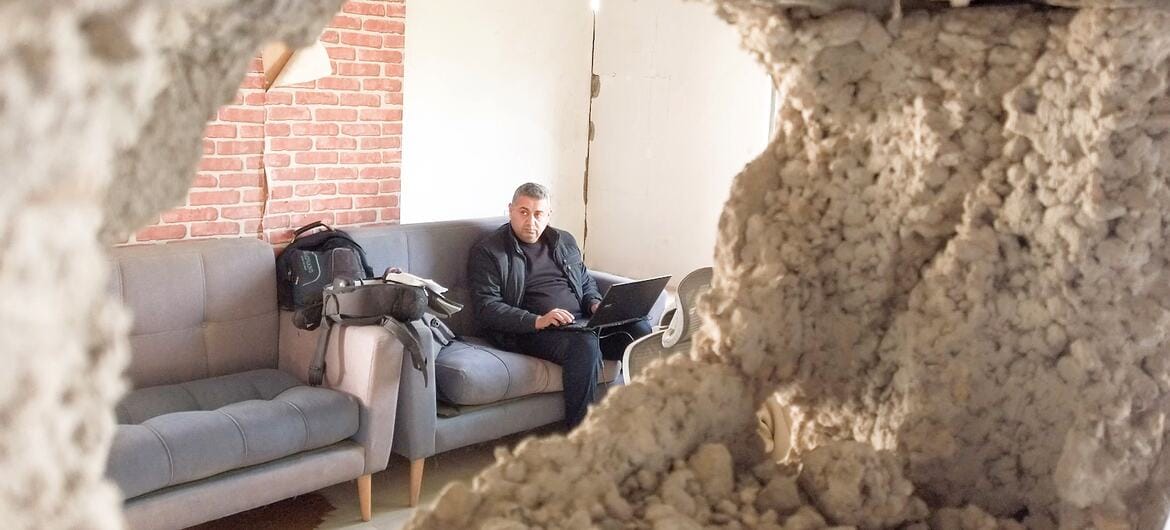
Broadcaster Rami Al-Sharafi works on a laptop inside the damaged Zaman FM radio station building in Gaza, marking what may seem an unlikely return to the airwaves amid the rubble of the deadly two-year Israel-Hamas war.

While 23 local radio stations were operating in Gaza before the conflict erupted, they were all destroyed and ceased broadcasting, he told UN News.

“Today, we are the only radio station broadcasting on FM from within Gaza after this widespread destruction,” he said. “We hope that other local radio stations will resume broadcasting, thus allowing competition in providing media services to the people of the Gaza Strip.”

Ahead of World Radio Day, observed on 13 February, the resumption of broadcasting comes at a time when Gaza’s media infrastructure still faces significant challenges amid local and international calls to support journalism as part of broader recovery and reconstruction efforts in the sector.

A journalist works at a desk in a damaged office in Gaza, viewed through broken pillars. Another person uses a laptop in the background.

UN News

A journalist works in the damaged office of Zaman 90.60 FM radio station in Gaza City.

Digging through the rubble

After a hiatus of nearly two years due to the war, some local radio stations in the Gaza Strip are transmitting again, in a move showing gradual efforts to revive the media landscape in the war-ravaged Strip – much of which has suffered widespread destruction of infrastructure and civilian institutions from Israeli attacks.

Zaman FM operates in the Tel al-Hawa neighbourhood of Gaza City, where Israeli attacks triggered a famine and left mountains of debris in the streets.

The cracked walls of the station’s building tell a story of immense destruction and the scene inside is unlike any other radio studio in the world. 

Employees dig through the rubble to keep the station broadcasting, working with minimal technical resources while behind them, awareness posters warn people of the dangers of dilapidated buildings.

On-air messages of hope

Local radio remains vital in Gaza as humanitarian crises persist, power outages continue and access to other media remains limited. This makes radio one of the most effective ways of getting key messages out to the public, along with health guidance and information about other services.

Gaza is in dire need of professional local radio stations capable of broadcasting awareness messages and guidance bulletins in light of the spread of diseases, the deterioration of the education system and the disruption of many basic services, said Mr. Al-Sharafi, director of the radio station and host of the morning programme, An Hour of Time.

“We need to deliver information to the population and guide them to the services that have stopped and are gradually being resumed,” he said, “especially in light of the difficult health conditions and the spread of epidemics.”

Amid the destruction all around, Mr. Al-Sharafi sits behind his dust-covered microphone and does just that. 

He sends morning greetings to Gaza residents and provides them with important information and updates, bringing some much-needed hope to the airwaves across a devastated landscape that has only just begun to recover – UN News

Continue reading

You Missed

IRGC says Iran started its Operation True Promise 26 by launching missiles and drones against Israel

IRGC says Iran started its Operation True Promise  26 by launching missiles and drones against Israel

Iran Halts Attacks on Neighboring States Unless…

Iran Halts Attacks on Neighboring States Unless…

Iranian govt spokesman: 30% of victims are children; 165 of them killed among 1300 civilians who died by US/Israeli bombing

Iranian govt spokesman: 30% of victims are children; 165 of them killed among 1300 civilians who died by US/Israeli bombing

White House: ‘We destroyed more than 30 Iranian ships and are moving to destroying the navy completely’

White House: ‘We destroyed more than 30 Iranian ships and are moving to destroying the navy completely’

White House: ‘We Have 4 to 6 Weeks to End The Military Operations in Iran’

White House: ‘We Have 4 to 6 Weeks to End The Military Operations in Iran’

IRGC: Iran Has Not Closed The Hormuz Strait Except to Ships Linked to Israel/USA

IRGC: Iran Has Not Closed The Hormuz Strait Except to Ships Linked to Israel/USA