Beware! Qusra and The Next Nakba
  • HebaHeba
  • August 26, 2026

By Ramzi Baroud

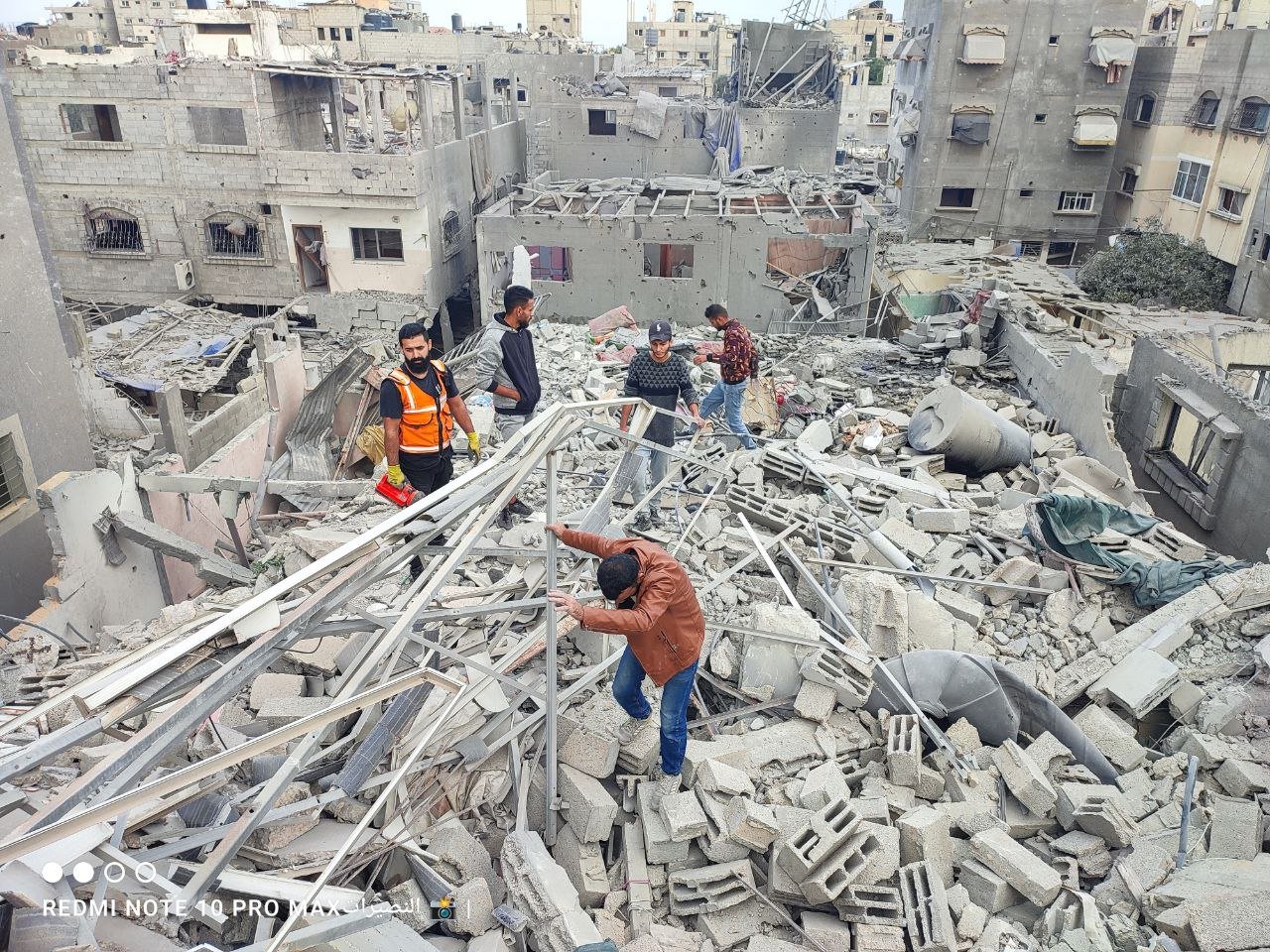
If you want to understand the bleak future awaiting the occupied West Bank, do not look away. Just pay attention to the events unfolding in the small Palestinian town of Qusra, south of Nablus.

The story of the future of the West Bank begins here.

While much of the media is treating reports emerging from the area as simply another episode of “settler violence,” it is not. Qusra represents something far more consequential: a glimpse into the new Plan Dalet that Israel has in store for Palestinians.

Plan Dalet was the military blueprint through which Zionist forces conquered much of historic Palestine, village by village, during the Nakba.

The plan did not suddenly emerge in 1948. It built on military schemes dating back to 1945, developing into a strategy for conquering Palestinian towns and villages, destroying communities and expelling their inhabitants.

The significance of this history today is not merely symbolic. The Nakba was a process, implemented in stages. So, too, is the annexation of the West Bank.

Nor is this merely an intellectual argument. Israeli officials have openly invoked a new Nakba as an intended outcome. In November 2023, Avi Dichter declared: “We are now rolling out the Gaza Nakba,” adding, “Gaza Nakba 2023. That’s how it’ll end.”

True to form, this new Nakba carries many of the characteristics of the old one: coordinated violence, massacres, ethnic cleansing, forced displacement and land confiscation.

The genocide in Gaza represents the zenith of this violence — a more devastating manifestation, but a continuation of the original sin upon which the Israeli state was established.

While all eyes were on Gaza beginning on October 7, 2023, the West Bank was largely ignored, allowing Israel the space to escalate violence in all its forms to levels unseen in decades.

The result has been staggering. Since October 7, 2023, Israeli forces and settlers have killed more than 1,100 Palestinians in the West Bank, including over 240 children, and wounded thousands more. Tens of thousands have been detained, while more than 33,000 Palestinians remain displaced from the Jenin, Tulkarem and Nur Shams refugee camps alone.

Now, back to Qusra.

Beginning on August 9, armed Israeli settlers surrounded three Palestinian homes in the Ras al-Ain area on the outskirts of the town.

They blocked access to the houses, erected tents outside them and cut water and electricity supplies. Families, including young children, were effectively trapped inside.

The Israeli military subsequently declared the surrounding area a closed military zone, restricting access by Palestinians, activists and journalists.

What emerged was not simply settler violence but a division of labor: settlers create the crisis; the army imposes the restrictions; Palestinian movement is curtailed; and the victims themselves are pressured to leave.

And the siege continued. As I write these words, the siege of the Qusra homes has concluded its second week.

Qusra is not incidental to this strategy. Israel has already confiscated its land for the settlement of Migdalim, while nearby outposts including Esh Kodesh have long been associated with attacks and attempts to seize Palestinian agricultural land.

Control of such areas is essential to the larger project of connecting settlement blocs, fragmenting Palestinian territory and transforming Palestinian communities into isolated enclaves.

A few years ago, the Israeli government behaved as though its plan to formally annex large swathes of the West Bank had been placed on hold. Yet, since October 7, annexation has moved from aspiration to obsession — in both words and action.

National Security Minister Itamar Ben-Gvir oversawthe mass distribution of weapons after October 7, arming thousands of civilian security-squad members with rifles amid an already heavily armed settler population.

Meanwhile, Finance Minister Bezalel Smotrich has systematically worked to transfer powers over the West Bank from military administration to Israeli civilian authorities — one of the clearest institutional mechanisms of annexation.

And now another piece is falling into place: Defense Minister Israel Katz has ordered preparations to transfer law-enforcement responsibility over Israeli settlers in the West Bank from the military to the Israeli police, another critical legal step toward annexation.

The picture is becoming complete: settler militias, government funding, weapons, the army, police, civilian bureaucracies, courts and political decisions originating at the highest levels of the Israeli state.

Seen in this wider context, Qusra becomes a microcosm — and potentially a testing ground — for the mechanisms through which larger-scale annexation can be implemented. These realities echo the past. The Nakba did not simply ‘happen,’ but followed years of planning and incremental military schemes. That is why Qusra matters.

Some governments are warning of accelerating annexation; others sanction individual settlers, as though targeting a few extremists could reverse a blueprint implemented by an entire state apparatus.

Palestinians in the West Bank are fully aware of the challenge awaiting them. Urging the Palestinian Authority, which maintains security coordination with Israel, to suddenly devise a ‘strategy’ is painfully redundant.

But for the rest of us who understand the horrors of the Nakba — and the reverberations of that catastrophe from Deir Yassin to the genocide in Gaza — recognition is no longer enough.

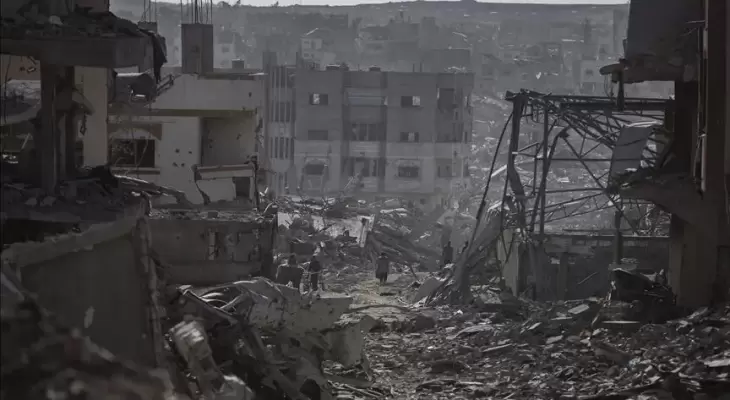
The price of silence is already being paid by every Gazan living among the ruins of the Strip and every Palestinian in the West Bank confronting the violence of settlers and their military partners.

It needs to end now, before Qusra becomes the blueprint for what comes next: today, Qusra; tomorrow, the whole of the West Bank.

Ramzy Baroud is a journalist, author and the Editor of The Palestine Chronicle. He is the author of eight books. His latest book, ‘Before the Flood,’ was published by Seven Stories Press. His other books include ‘Our Vision for Liberation’, ‘My Father was a Freedom Fighter’ and ‘The Last Earth’. Baroud is a Non-resident Senior Research Fellow at the Center for Islam and Global Affairs (CIGA). He contributed this article to The Jordan Times.
Continue reading
A Year on: Remembering Late Poet of Gaza

If I Must Die, Let it Bring Hope’ – Remembering Professor Refaat Alareer

Refaat Alareer’s daughter was killed by Israel in Gaza. (Design: Palestine Chronicle)

By Nurah Tape – The Palestine Chronicle  

“Sometimes a homeland becomes a tale. We love the story because it is about our homeland and we love our homeland even more because of the story.”

On Day 3 of Israel’s genocidal assault on the Gaza Strip, intellectual and writer Professor Refaat Alareer said in a live interview from the besieged enclave “I’m an academic. Probably the toughest thing I have at home is an Expo marker. But if the Israelis invade … I’m going to use that marker to throw it at the Israeli soldiers, even if that is the last thing that I would be able to do.”

Nearly three months later, on 6 December, 2023, Alareer was killed in an Israeli airstrike on his sister’s home in northern Gaza. The activist’s sister, Asmaa, along with three of her children, and his brother Salah, with his son Mohammed, were among those also killed in the attack.

As a professor, poet and writer, Alareer’s pen was his weapon. And it continues to defend and tell the story of his people.

Iconic Poem

His poem, If I Must Die, written in 2011 and shared on X a month before his death, has become an iconic reminder of the Palestinian struggle for liberation from Israeli occupation and oppression.

“If I must die, you must live, to tell my story, to sell my things, to buy a piece of cloth and some strings…If I must die, let it bring hope, let it be a tale” the actor Brian Cox delivered a passionate rendition of the poem published by the Palestine Festival of Literature.

On December 4, two days before his death, Alareer wrote in a post on X: “I wish I were a freedom fighter so I die fighting back those invading Israeli genocidal maniacs invading my neighborhood and city.”

“The building is shaking,” he added. “The debris and shrapnel are hitting the walls and flying in the streets. Israel has not stopped bombing, shelling, and shooting. Pray for us. Pray for Gaza.”

Over a year later, his words echo as the bombing, shelling, and shooting continue unabated.

To date, a total of 44,612 Palestinians have been killed, and 105,834 wounded, according to Gaza’s Ministry of Health.

We Are Not Numbers

As the beloved professor of Literature and Creative Writing at the Islamic University of Gaza and co-founder of the We Are Not Numbers project, Alareer inspired a myriad of young people in the enclave to own their narrative and tell the story of Palestine based on their experiences.

In a TED talk delivered in 2015, Alareer impressed upon preserving oral history and how “stories make us.”

“I realize I am the person I am today because of the stories” told to him by his mother and grandmother, he said, “because my mum was teaching me values, etiquette, to love people, to love my life, to love my country at the same time.”

“Stories are also important in our lives as Palestinians, as people under occupation, as native peoples on this land,  not only because they make us, they shape us,  they make us the people we are but also because they connect us with our past, they connect us with our present, and they prepare us to the future,” shared Alareer.

He said his grandmother “told us stories (about) when she was a kid, when she was a newly married wife who would spend months plowing her land, harvesting the crops, the land that now we don’t own because it was occupied.

“Although the land is physically occupied, it still lives in our memories, still lives in our hearts, because we can easily visualize this.”

‘Tell Us Stories’

Concluding his talk, Alareer encouraged the audience to “beg” their parents and grandparents to “tell us stories” and share them with “our kids.”

“Because if we don’t do that, if the story stops there, we’re betraying ourselves, we’re betraying the story, we’re betraying our parents and grandparents, and we’re betraying our homeland,” he emphasized.

https://www.palestinechronicle.com/let-it-be-a-tale-israel-kills-the-storytellers-of-gaza-but-will-not-kill-the-story/embed/#?secret=A1GEdoACO7#?secret=0ulwRI8zTr

Born on September 23, 1979, in Shejaiya in Gaza City, Alareer said in a media interview that “every move I took and every decision I made were influenced (usually negatively) by the Israeli occupation”.

“As a kid, I grew up throwing stones at Israeli military Jeeps, flying kites, and reading,” he also said.

‘Gaza Writes Back’

Alareer edited several books, including ‘Gaza Writes Back’ and ‘Gaza Unsilenced’, which according to Palestine Chronicle editor, Ramzy Baroud, “allowed him to take the message of other Palestinian intellectuals in Gaza to the rest of the world.”

“Sometimes a homeland becomes a tale. We love the story because it is about our homeland and we love our homeland even more because of the story,” he wrote in ‘Gaza Writes Back’.

The Geneva-based group, Euro-Med Human Rights Monitor, said Alareer’s killing was “apparently deliberate” and called for an investigation into his death.

“The apartment where Refaat and his family were sheltering was surgically bombed out of the entire building where it’s located, according to corroborated eyewitness and family accounts,” the organization said in a statement.

This came after weeks of death threats that Refaat received “online and by phone from Israeli accounts.”

His Legacy

Husband to Nusayba, Alareer was also a father of six, who had their home bombed previously by Israel in 2014, killing over 30 of his and his wife’s family members, according to Euro-Med Monitor.

Not long after her father’s death, Alareer’s eldest daughter, Shaymaa, gave birth to her first child.

https://www.palestinechronicle.com/do-you-know-o-dad-after-murdering-her-father-daughter-of-refaat-alareer-killed-in-gaza/embed/#?secret=rRVGG1V8cH#?secret=tKEZQfH3l5

She wrote a note to her deceased father, as conveyed by the Resistance News Network through their Telegram channel:

“I have wonderful news for you, and I wished I could convey it to you face-to-face, handing your first grandson to you… This is your grandson Abdul Rahman, whom I have always imagined you holding. But I never thought that I might lose you too soon, even before you could meet him.”

In April, Shaymaa was killed in an airstrike on her family’s apartment in Gaza City along with her husband and infant son.

‘Haunted by Horrors’

As with many Palestinians who fought and died fighting for a liberated Palestine in which ever manner they could, Alareer’s contribution to that struggle lives on.

In honor of his memory, and to mark the first anniversary of Alareer’s killing, Shahd Ahmad Alnaami, a contributor to We Are Not Numbers writes:

So many of us still
hold our phones, read
your poems — not
losing hope, but

we’re tired of sleeping
in fear, tired
of being displaced,
living in tents,

haunted by horrors
that linger in our minds.
A missile pierced the silence,
burning all the tents —

including you. I have
not forgotten. Nights
become nightmares, children
cry from the cold,

their laughter, once bright,
now a distant echo.
We yearn to return,
free from fear. When

will these bloody nights end?
When will this tragedy stop?
When will our normal lives return,
and our distant dreams come true?

We keep asking, “Will this pass?”
And remember how you
used to say, “It shall pass…
I keep hoping it shall pass…”

Still, we wait for the day
peace will dawn,
and a new chapter
open its bleary eyes.

(The Palestine Chronicle)

– Nurah Tape is a South Africa-based journalist. She is an editor with The Palestine Chronicle.

Continue reading
Israeli Fantasy and its Genocidal War

The paradoxical phrase, ‘running away forward’ is one of the most apt descriptions that illustrates the state of Israeli affairs now.

It seems that everything that Israel has done in the past year or so is a mere attempt to deny, distract from or escape imminent future scenarios – all of which are bleak.

Indeed, the last year has repeatedly proven that Israel’s military supremacy is no longer able to win wars or decide political outcomes. 

https://twitter.com/RamzyBaroud/status/1858961626839580713

Moreover, the genocide in Gaza and the rapid theft of Palestinian land in the West Bank have exposed, like never before, the ugly face of Zionist settler-colonialism. Only those who are wholly indoctrinated or are paying no attention still argue that Israel stands for any kind of moral ideals or is a “light unto the nations”.

Also, incessant attempts by Israeli Prime Minister Benjamin Netanyahu to marginalise, if not entirely erase the Palestinian cause have completely failed. The suffering, resistance and pride of the Palestinian people have made their cause a global one, and, this time around, irreversibly so.

Yet, despite all of this, Israeli leaders continue to drag their people into endless quests toward arbitrary destinations, making promises of ‘total victory’ and the like.

Monitoring statements by Israeli leaders and media conversations in rightwing Israeli press would leave one bewildered.

While over 55,000 Israeli soldiers have tried, but failed, over the course of several weeks to finally subdue northern Gaza, Israeli settler leaders are busy making plans to auction real estate, envisaging new settlements and beach resorts inside the destroyed Strip.

The Israeli newspaper Haaretz reported on October 21 that Israel wants to build several settlement blocks inside Gaza. But how is Israel to protect these areas over the course of months and years when they could not protect southern Israel itself just one year ago? 

In the West Bank, where an armed rebellion has been brewing, but is yet to actualize on a mass scale due to the ‘security coordination’ between Israel and the Palestinian Authority, Netanyahu’s rightwing government is speaking of full annexation. 

“The year 2025 will, with God’s help, be the year of sovereignty in Judea and Samaria,” said Finance Minister Bezalel Smotrich, referring to the occupied West Bank. Whether Israel turns its de-facto annexation of the West Bank into a de jure annexation or not, it will alter little of the legal status of the West Bank under international law, as an illegally occupied Palestinian territory. The same applies to the Palestinian city of East Jerusalem, which was officially annexed by the Israeli Knesset in 1980, under the so-called ‘Jerusalem Law’.

Not many in the international community are willing to accept Israel’s scheme in the West Bank, anyway, as they, save Washington, still refuse to recognise Israel’s sovereignty over Jerusalem. In fact, the opposite is true, as determined by the International Court of Justice on July 19. The ruling, which was backed by international consensus, resolved that “the State of Israel is under the obligation to bring an end to its unlawful presence in the Occupied Palestinian Territory as rapidly as possible”. On September 17, the United Nations fully embraced the ICJ’s decision.

That aside, by annexing the West Bank, Israel would have fired the mercy shot at the PA, thus turning the entire West Bank into a platform of Palestinian popular resistance. How could Israel withstand that new war front, when it is already struggling, if not outright failing, to secure any victories in Gaza and South Lebanon?

In a recent article, Israeli historian Ilan Pappe wrote about ‘Fantasy Israel’, a decades-long political construct that believed that the “West supports Israel because it adheres to a Western ‘value system’ based on democracy and liberalism.”

That fictional Israel has been collapsing for years, long before the current war on Gaza – though the genocidal war accelerated that process. The collapse of Fantasy Israel “has exposed cracks in the social cohesion, and in the readiness of many Israelis to devote as much time and energy to military service as they did in the past,” Pappe argues.

Israel is now under the control of a different breed of politicians, who are armed with a massive and growing super-structure of an equally close-minded and extremist intellectual base. This group is struggling with a whole different set of illusions, as they continue to convince themselves that they are winning, when they are not; that they can impose their will on the Palestinians, and the rest of the world, when they cannot; that the continuation of the war would allow them to finish a job that, in their minds, should have been finished a long time ago: the total destruction of the Palestinian people.

Since this crowd is motivated by extremist religious ideologies, they are unable to abide by any form of rational thinking, even that emanating from well-regarded Zionist figures inside Israel itself.

“This war lacks a clear objective, and it’s evident that we’re unequivocally losing it,” Former Mossad deputy chief Ram Ben-Barak said during an interview with the Israeli public radio on May 18.

None of this matters to Netanyahu and his rightwing ministers, of course. They continue to reference and recycle old religious dogmas, while fervently praying for miracles. In doing so, they insist on reconstructing a new ‘Fantasy Israel’, which, of course, is set to collapse, as fantasies often do.

Ramzy Baroud is a journalist, author and the Editor of The Palestine Chronicle. He is the author of six books. His latest book, co-edited with Ilan Pappé, is ‘Our Vision for Liberation: Engaged Palestinian Leaders and Intellectuals Speak Out’. His other books include ‘My Father was a Freedom Fighter’ and ‘The Last Earth’. Baroud is a Non-resident Senior Research Fellow at the Center for Islam and Global Affairs (CIGA). His website is www.ramzybaroud.net

Continue reading