Hanthala Outlasts Naji Al Ali as He Predicted

By the time he died on August 29, 1987, he had a collection of 40,000 cartoons. Naji Al Ali, the famous Palestinian cartoonist, had been in a coma for five weeks after being shot in the head by a gunman outside the London offices of Al Qabas newspaper on July 22.

Although till now nobody is certain of who killed him, Al Ali’s death was a result of decades of rebelliousness against the Arab status quo, his longing for change in Arab society, and the introduction of democracy.

He felt this would be translated into political strength to fight for the return of Palestine. Al Ali had the knack of weaving politics and culture together. His drawings had distinct messages: they were contextual, fighting against injustice and oppression in the Arab world.

Naji Al Ali was one of a kind. In few simple lines, he could depict the drama of a whole population and convey messages sometimes so sharp and rich in symbols that the viewer’s attention was effortlessly drawn to understanding the hidden meanings.

Though his messages were politically-driven, he always maintained he was apolitical and that politics did nothing for him.

This is despite the fact that his life had come to be dictated by a series of political actions. His expulsion, along with his family, to Lebanon in 1948, and ending up in Ain Al Hilweh camp, was but the first of these actions. Al Ali was only 10 or 11 when he was forced out of Shajara, a village of 400 that were destroyed by Israel.

Given a chance

In the 1950s, before being given the chance to go to Kuwait, his life was immersed in politics. He took part in demonstrations and served time in Lebanese jails. During this time, he started drawing on the walls of the camp and in prison.

“I felt within me a need for a different medium to express what I was going through,” he used to say. He often said he felt it was harder to censor a cartoon than an article. Al Ali’s talent was first discovered by Ghassan Kanafani, the Palestinian writer and activist killed by the Israelis in the early 1970s. He was visiting the camp at the time, came upon Al Ali’s work, took a sample and latter published them in Al Hurriya, the magazine he was working for.

This may have given Al Ali the opportunity to work in Kuwait in 1964 at the Al Talieh magazine, a now well-established weekly, representing the voice of the nationalists. There, he made his professional career as a cartoonist, though he did other things as well. In 1971 he returned to Lebanon where he worked in the well-respected Al Saffir.

It was in Lebanon he found the best and most productive years of his life, he would later write. “There, surrounded by the violence of many an army, and finally by the Israeli invasion (1982), I stood facing it all with my pen every day, I never felt fear, failure or despair, and I didn’t surrender. I faced armies with cartoons and drawings of hope and flowers, hope and bullets.”

But, contrary to this cheerful attitude, one also felt there was a degree of anger, mixed with cynicism and despair within Naji Al Ali that always prompted him in his cartoons; it was the failure of action, of ineptitude and the lack of Arab resolve.

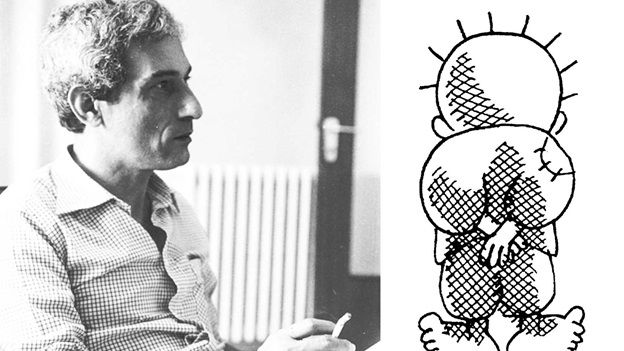
That’s why he may have created the Hanthala cartoon that always came to appear in his sketches from the 1960s onwards. In fact, in an almost perceptive vision of his death, Ali would say Hanthala would outlast him and would live long after he was was dead.

Hanthala, whose name means bitterness in Arabic , represents the aspirations of the camp refugees and the right of return. We never see his face as he is never shown facing the reader.

Naji Al Ali described him as a bare-footed child with spiky hair, with his hands firmly clasped behind his back as a symbol of rejection to what happened to the Palestinians. He will only turn his head, when Palestine is regained. Hanthala will remain 10 years old until he returns to the homeland, when he will start growing up again.

After 1982, Naji Al Ali went back to Kuwait to work in Al Qabas, but there was no let down in his political message. In 1985, he was expelled, but continued to work in the newspaper’s London office.

His cartoons continued to appear in many daily newspapers across the region in Kuwait, United Arab Emirates, Egypt, Tunisia and Lebanon.

Did Al Ali’s untimely death at the age of 51, mean Hanthala will never turn his head, or will he wait for someone to redraw him.

Whichever the case, and in the spirit of his creator, he will continue with his back to the audience until Palestine is liberated.

This article, written by me, is reprinted here from the archives of Gulf News.
Continue reading
Ziad Al Rahbani: Musical Icon

Ziad Al Rahbani, dubbed as the soul of Lebanon dies at the age of 69.

Sondoss Al Asaad wrote:

He was a revolutionary artist who combined musical and theatrical genius, boldly addressing themes of identity, politics, and resistance.  His first literary work was published at the age of 12 in the late 1970s. 

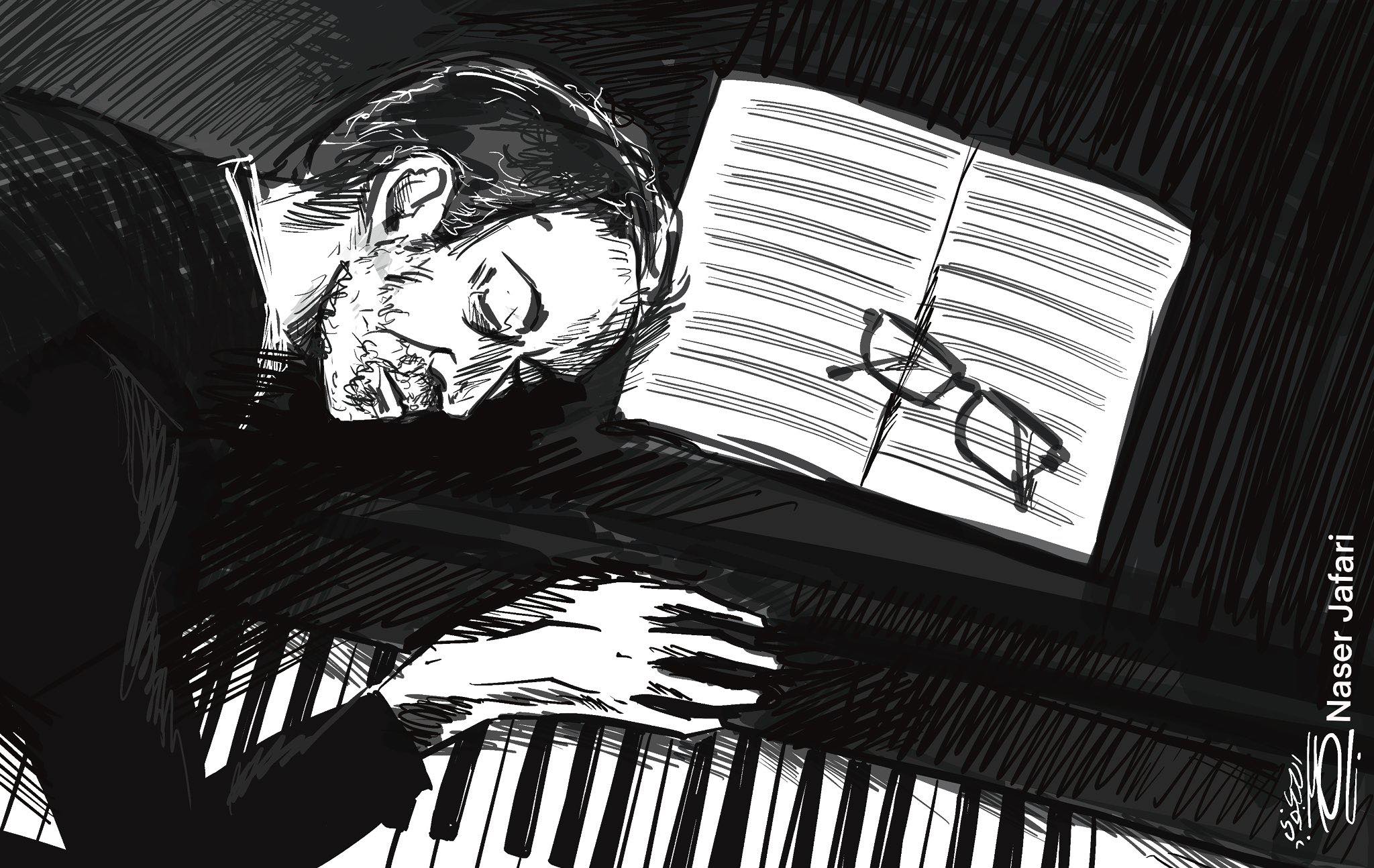
Jordanian Cartoonist Nasser Al Jafari sketched out this cartoon in the honor of the late artist.

“This is what musician , researcher Louis Brehony wrote about him in the Palestine Chronicle: It is with shock at the earliness of his departure Lebanon bids farewell to Ziad al-Rahbani, a pillar of radical musicianship, at the age of 69. A committed communist who aligned himself with the Palestinian cause, Ziad left his indelible musical fingerprints on a wide region. An essential influence to generations of listeners, musicians and activists, Ziad ruffled the feathers of the wealthy, embarrassed conservatives and irritated liberals. Son of Lebanese icons Fairuz and Assi Rahbani, his musical tenacity and critique of a system in crisis demanded that others sing for its downfall.

Born into relative privilege among Maronite Christians and well-known musicians, Ziad understandably trod a creative path from an early age. His composer father Assi and uncle Mansour were the famous Rahbani brothers, writing epochal works for his mother Fairuz, to this day Lebanon’s most renowned vocalist. Ziad grew up sitting in on rehearsals and met huge figures in Arab music, including Egyptian composer Mohammed Abdel Wahab and Palestinian Sabri Sherif, who produced Fairuz’s albums dedicated to Palestine. Ziad eventually inherited the Rahbani mantle and, from the 1980s, became Fairuz’s main songwriter.

As a teenager, Ziad joined Rahbani brothers’ productions and quietly applied his skills as a composer and keyboardist. Though his approach towards his parents’ legacy was not the scorched earth policy some describe, Ziad began to forge his own path. Attracted to leftist politics at a time when the Lebanese Communist Party (LCP) allied itself to Palestinian resistance, Ziad’s empathy with the poor and downtrodden quickly expressed itself through music. He found his raison d’être in musical theatre, and works like Film Amriki Tawil (Long American Film, 1980) and Shi Fashil (Failure, 1983) broke social taboos, sharply attacking class discrimination and spotlighting characters from the working class…’

Continue reading
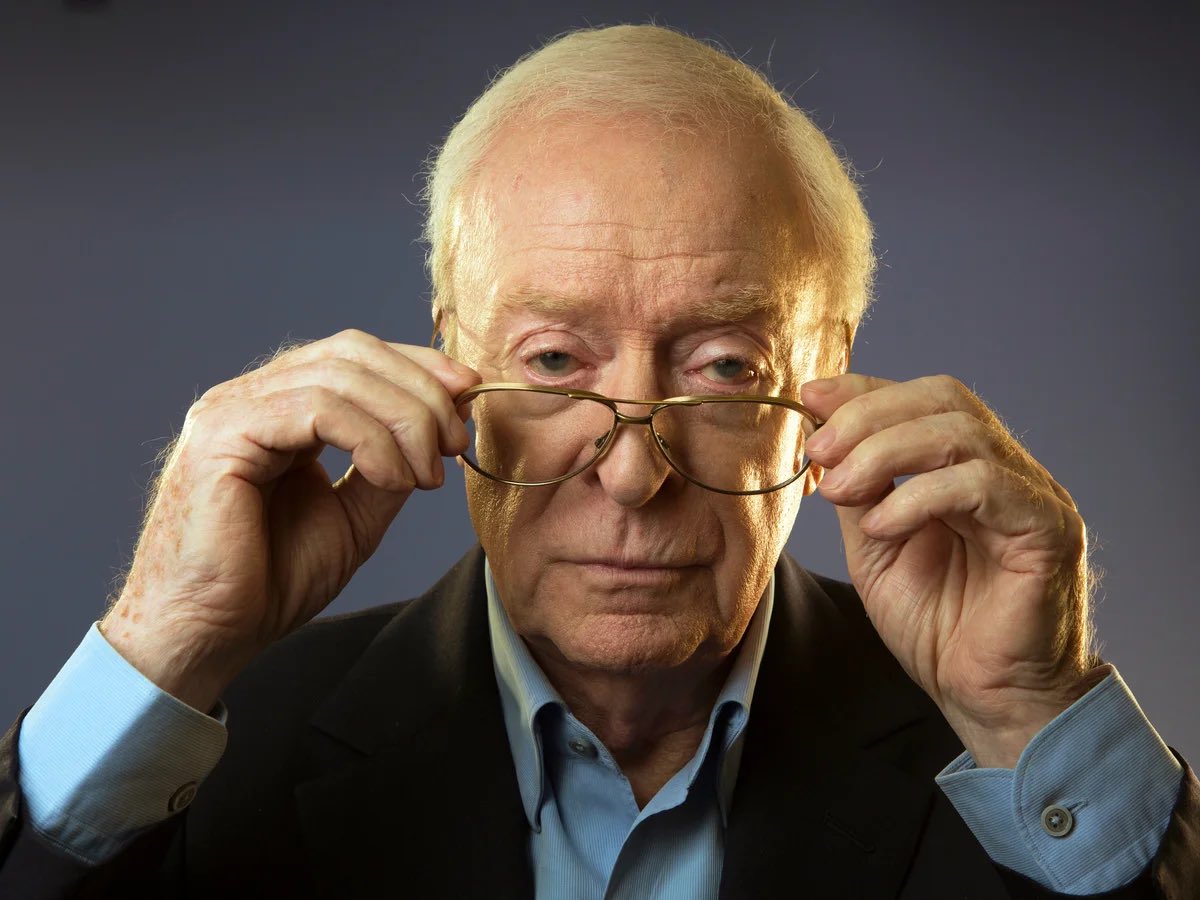
Israel Loses Michael Cane

Well-known English actor Michael Caine finally cuts through the silence, showing sympathy for the children of Gaza who are being starved to death due to the ongoing, crippling Israeli siege on the Strip.

“Feed the children of Gaza, no child should be starving,” he rebukes Israel.

https://x.com/andres20ad/status/1948757483477958735

Continue reading
Rome Fountain Dim Lights For Gaza

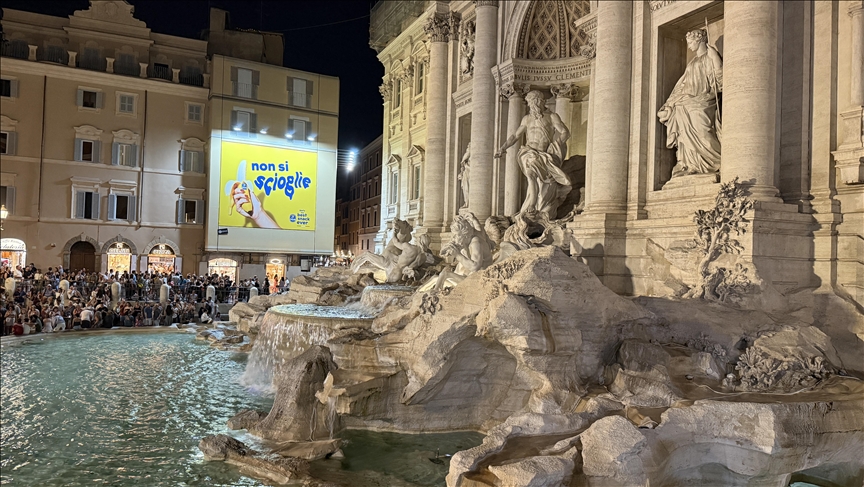
Rome dimmed the lights of the iconic Trevi Fountain for one hour Friday night in a symbolic call for a ceasefire in the Gaza Strip, following a city council resolution last month that was titled, “Rome will not remain silent.”

“Let’s stop the war in Gaza” was also projected onto the front facade of the historic Palazzo Poli, which is behind the fountain, in a symbolic demand for a ceasefire.

A group of pro-Palestinian demonstrators gathered in front of the fountain and waved Palestinian flags in protest of what they described as genocide by Israel in Gaza.

The projected message referenced “war,” but demonstrators held signs that read: “What’s happening in Gaza is not a war, it’s genocide.”

Some chanted slogans accusing Israel of committing atrocities against Palestinians worse than those perpetrated by Nazi Germany against Jews during World War II.

They also criticized the US and the EU for being complicit in their silence.

The group shouted “Free Palestine”, “Stop the genocide” and “From the river to the sea, Palestine will be free.”

The demonstration drew attention from tourists, with some showing support with the pro-Palestinian group according to Anadolu.

Continue reading
Murder in a Beach Cafe

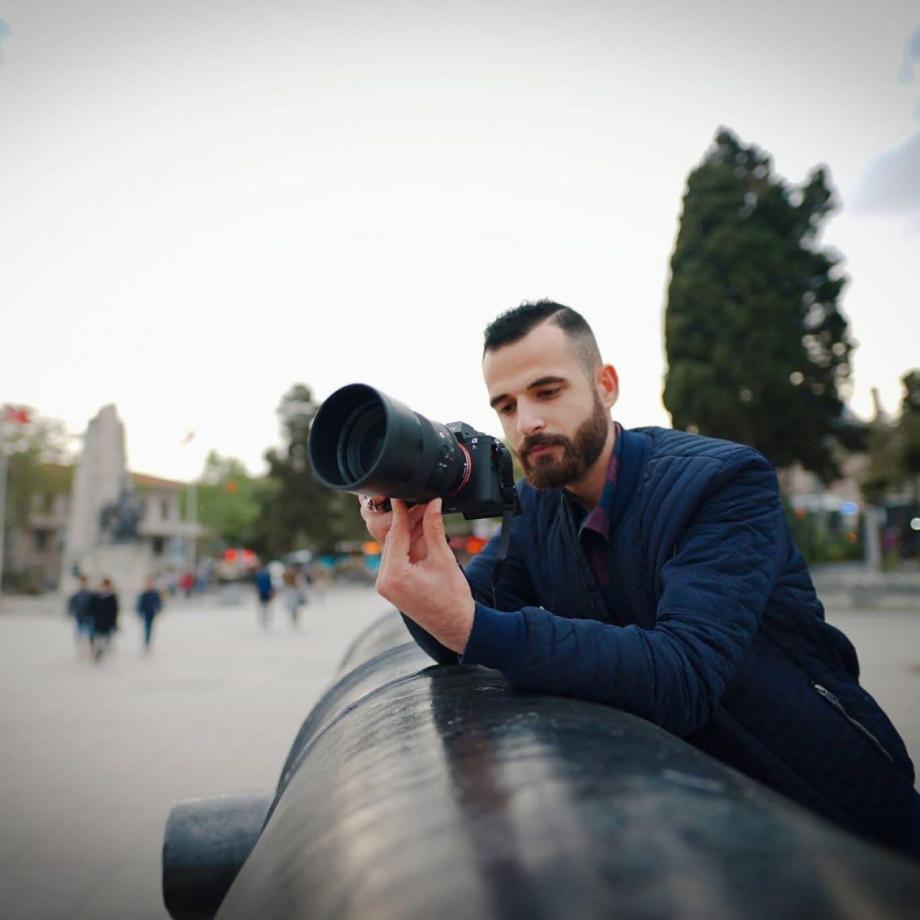
In a place that gazes over the horizons and links the sky with the sea, Ismael Abu Al Hattub was martyred. He wasn’t killed in battle but in a simple café on a Gaza beach. It was the place that he was planning to hold his photography exhibition, but failed to see the light.

This beach which he loved, wrote about and photographed under fire and siege, stamped his final existence and obituary.

He once saw a temporary retreat in the place snatched by the gray strikes made by Israeli raids. Abu Al Hattub saw the beach as mirroring the new disdain life has become…a platform for death, blood and mayhem.

He wasn’t merely a journalist but a witness, holding his camera, as if it was open to the world for a life stage in which reality had become a goal to strike. He led his visual project from the ruins of Gaza and made his picture image an “ambassador” to be narrated to the world.

At the height of the military strikes and bombing, with the homes brought to the ground, Abu Al Huttab used to document not only through his lens but by his heartbeat writing on World Press Day that “in Gaza the camera is targeted, the word is struck down and the vest is dammed by the thudding missiles.

These words were not poetic descriptions but a stark reality his body lived through. Last November 2024 he escaped from certain death while he was photographing the Al Ghafari Tower that was viciously struck.

He came back after a year of hardship and pain to continue what he started, to become a voice in the era of silence and the eye in the stage of blindness.

Between the skies and the sea

Between the tents, the debris and wreckage and between the displaced people on roads Abu Al Hattub collected his photographs refusing to tuck away his camera till the strange sounds of death.

And as a result, he sent his photos to be seen in a joint Palestinian platform exhibit in Los Angeles. However, this wasn’t an ordinary exhibition but an echo dangling on western walls narrating the heinous situation of Gaza.

“From the middle of Gaza under the airstrikes, displacement and starvation I was determined to hold this exhibition from afar to tell the story of our people who have no refuge but the beach,” he wrote.

He would say in every “image there is a soul” and the photos are able to defeat the walls and penetrate the thick international silence.

A dream buried in the sand

He was supposed to train, this week, digital security to a group of journalists in Gaza, he had a date with the interested generation of the future. However, his fate with death was sealed. It was a cruel moment by an even cruellest pretending-to-be master race.

His life passed before our eyes after his face was changed into a collective presence as the tent he was living in became his platform, the sea a sanctuary and the lens resistance.

Journalist Muthana Al Najjar wrote: “The owner of the tent exhibition in the middle of Los Angeles, ascended to the heavens after joining the martyrs after a raid on a makeshift café…he tried to show the Gaza tragedy to the world through an exhibition titled in between the sky and the sea and was made absent in an air strike on the beach he loved so much.”

He departed but his pictures remain, and the narrative is there for all to see. He added the youths of Gaza continue to dare to live despite all the odds stacked against them. The Israeli war machine will not win.

He is not the last number to be killed but one of 228 journalists Israeli warplanes targeted during this genocide. Their pens were broken, but their messages remain and whilst the photo lens has dropped in silence the picture will continue to echo.

What Abu Hattub presented was not only a painful picture but a stubborn visual language that doesn’t submit to the American-made bombs and missiles or the continuing siege. He realized that the camera was not objective but rather biased to the truth, justice and people.

Today as the smoke towers above the Gaza Sea, his words remain, his narratives fly over depicting that Gazans are determined to live and stay on their land in the face of extraordinary adversary.

Continue reading