Erdogan: Starvation in Gaza ‘Worse Than Nazi Camps’

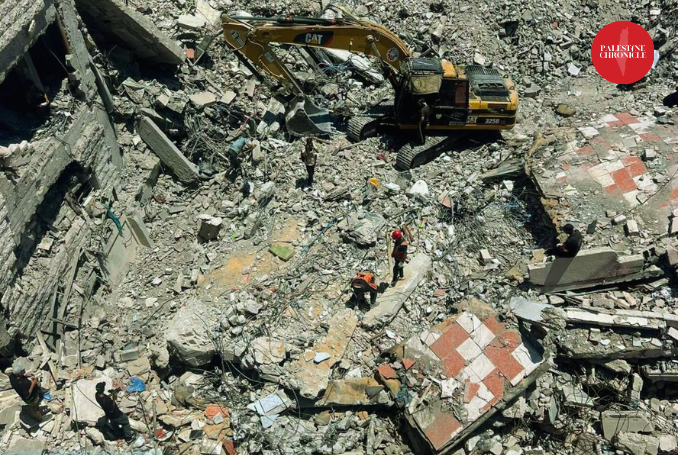
After months of relentless Israeli attacks, scenes in famine-wracked Gaza are now “worse than Nazi camps,” with people being starved and deprived of water before the eyes of the world, said the Turkish president on Tuesday.

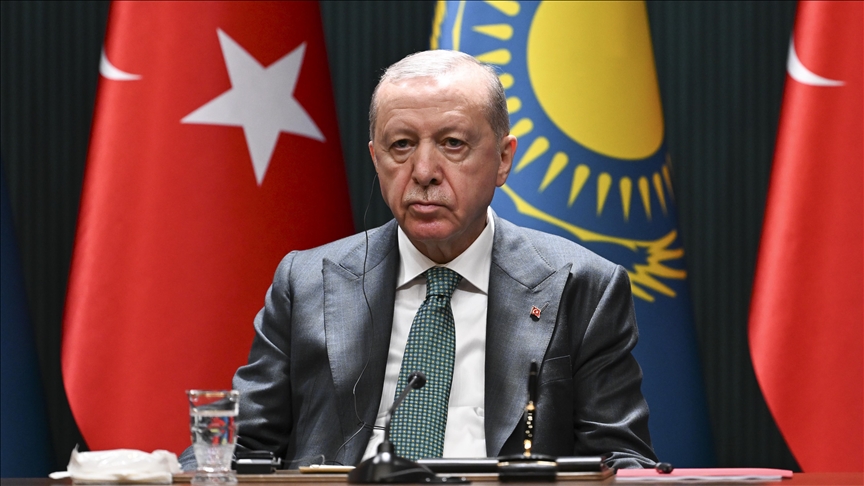
“The terrorist state of Israel has been committing genocide against our brothers in Gaza, brutally massacring them for 22 months in an area of 360 square kilometers (139 square miles),” Erdogan told a news conference alongside his Kazakh counterpart Kassym-Jomart Tokayev, in Ankara.

“Israel’s use of hunger as a weapon against Palestinians is the clearest indication that they have no humanity,” he added.

Calling the humanitarian situation in Gaza catastrophic, Erdogan urged all countries “with a conscience, especially Islamic nations, and all peoples” to raise their voices loudly to counter Israel’s attacks, which cause innocent children to be killed either from hunger or from bullets fired by occupation forces.

“We will continue to do whatever is necessary in this regard. God willing, we will also see the days when those committing genocide against the people of Gaza are held accountable before the law and history,” Erdogan added.


Relations with Kazakhstan

On ties between Türkiye and Kazakhstan, Erdogan said he and Tokayev discussed projects that will take Turkish-Kazakh military and defense industry cooperation to the next level.

Noting that the level of relations between Türkiye and Kazakhstan was elevated to an Enhanced Strategic Partnership, Erdogan said Kazakhstan is the largest economy in the region and also Ankara’s biggest trade partner there.

“We are continuing our path to reach a trade volume of $15 billion,” he added according to Anadolu.

Emphasizing that Turkish investments in Kazakhstan have reached the level of $5 billion, while Kazakh investments in Türkiye are approaching $1.5 billion, Erdogan said that they discussed a wide range of topics, from defense to energy, from transportation to science and technology.

“As a result, we signed 20 documents, which you just witnessed. We explored opportunities for cooperation in sectors such as mining and rare earth elements. We discussed ways to transport larger volumes of Kazakh oil to global markets via our country. We also consulted on what can be done to utilize and further develop the Middle Corridor, which is the modern-day counterpart of the Silk Road and passes through the Caspian Sea,” Erdogan added.

Stating that cooperation on security and the fight against terrorist groups, especially the Fetullah Terrorist Organization (FETO) – responsible for a deadly failed coup in 2016 – were also discussed, Erdogan said cooperation in education was also part of their talks.

“Now, I would like to share the good news that, with the support of President Tokayev, the Turkish Maarif (Education) Foundation has begun efforts to open one school each in (the capital) Astana and Almaty,” he said.

“We are working together to strengthen the Turkic world, both through our bilateral relations and within the framework of our family council, the Organization of Turkic States,” he added.

Touching on the Turkish Cypriots, “who are an essential and inseparable part of the Turkic world,” Erdogan said that in the joint statement they adopted, they specifically discussed the importance of respecting the equal and inherent rights of the Turkish Cypriots.

CrossFireArabia

CrossFireArabia
Dr. Marwan Asmar holds a PhD from Leeds University and is a freelance writer specializing on the Middle East. He has worked as a journalist since the early 1990s in Jordan and the Gulf countries, and been widely published, including at Albawaba, Gulf News, Al Ghad, World Press Review and others.

Related Posts

Israel Kills 200 Lebanese Children – UNICEF

More than four children have been killed or injured every day on average in Lebanon in the first 25 days of a temporary ceasefire with families still unable to return to their homes, said Save the Children.

New data from Lebanon’s Ministry of Health on Tuesday showed that 22 children have been killed and 89 injured since the temporary ceasefire started on 17 April. This brings the number of children killed in Israeli strikes since renewed escalation in hostilities in Lebanon on 2 March to almost 200 with about 2,900 people killed.

The violence and renewed displacement orders have forced more than one million people – or one in six of the population – from their homes with many now living with relatives, in host communities or in collective shelters.

The number of families living in collective shelters has increased 5% since the conditional ceasefire due to renewed displacement orders by Israeli forces and as families return home to find destroyed houses and damaged farmland so move back the collective shelters. There are now 44,800 children among about 125,000 people in collective shelters.

Thousands of children have been living in collective shelters for over two months in overcrowded conditions with inadequate water, sanitation and hygiene facilities leading to reports of scabies and growing health concerns.

Parents are reporting widespread behavioural changes among children living in collective shelters due to a lack of routine and reduced school engagement including loss of appetite and trouble sleeping. Many children are struggling to continue learning with some schools used as collective shelters and also difficulties accessing online learning due to limited electricity, and poor connectivity.

Tala*, 10, has been living in a collective shelter after being displaced from southern Lebanon, said:

“I just want the war to end so I can go home to my village and sleep in my own bed. I really miss school, I want to see my teachers and be with my friends, and study and play again.”

Nora Ingdal, Save the Children’s Lebanon Country Director, said:

“This ‘so called’ ceasefire that still sees more than four children killed or injured every day is not a ceasefire for children. Attacks on civilians have not stopped – it has simply continued under another name. Colleagues have told me that the airstrikes feel more intense in some areas than they ever did before. Children are not safe until there is a permanent and definitive ceasefire with no violations.”

With further peace talks set to take place on Thursday to determine next steps between Lebanon and Israel, Save the Children is calling on the international community to urgently work toward a permanent and definitive ceasefire and ensure flexible and sustained funding to protect children and allow families to return home to resume their lives.

Save the Children has worked in Lebanon since 1953. In collaboration with partners and local authorities, we are distributing essential items in hard-to-reach areas in the south, provide psychosocial support for children, educate families and children about the risks of unexploded ordnance, ensure access to safe water and sanitation facilities, and distribute essential items for those displaced.

ENDS:

Sources:

Lebanon Ministry of Health

Israeli strikes have killed 380 in Lebanon since truce: Health ministry

Lebanon Ministry of Health

Lebanon-Emergency-Sitrep-23-2026.pdf

Continue reading

You Missed

Israel Kills 200 Lebanese Children – UNICEF

Israel Kills 200 Lebanese Children – UNICEF

Nakba – 78 Years of Occupation Misery

Nakba – 78 Years of Occupation Misery

Palestinians Remember The Eveil Nakba

Palestinians Remember The Eveil Nakba

Nakba – 78 Years On

Nakba – 78 Years On

An Egyptian House in a German Town

An Egyptian House in a German Town

Nakba Art

Nakba Art