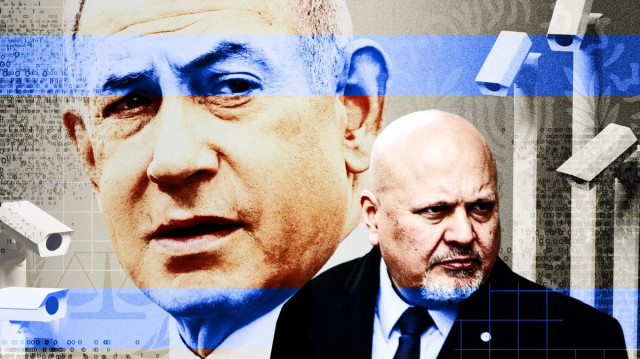
Experts: ICC Arrest Warrants is Start For More Israeli Sanctions

The International Criminal Court’s (ICC) arrest warrants against Israeli Prime Minister Benjamin Netanyahu and former Defense Minister Yoav Gallant could open the floodgates for more legal challenges for other Israeli officials, as well as Western nations supporting the ongoing genocide in Gaza, experts say.

On Nov. 21, ICC Pre-Trial Chamber 1 issued warrants for Netanyahu and Gallant accusing them of using starvation as a method of warfare in Gaza, along with the crimes against humanity of murder, persecution and other inhumane acts.

Israeli academic and law professor Neve Gordon believes this could be the tip of an iceberg of cases and warrants against other top Israeli military officials and leaders.

“It is clear that while Netanyahu and Gallant were at the very top of the decision-making and policymaking apparatus, but there are several other high-ranking politicians and military personnel that are implicated in the starvation and in the systematic attacks on health care,” Gordon, an international law professor at Queen Mary University of London, told Anadolu.

“I will not be surprised if in the coming months or even coming years, there will be warrants against the chief of staff, maybe some other generals, the current defense minister, and maybe other ministers.”

Legal expert Michael Becker pointed to ICC Prosecutor Karim Khan’s statement and reference to ongoing lines of inquiry as an indicator of what could come next.

“It could mean additional charges sought against Netanyahu and Gallant. It could also mean new requests for arrest warrants against other potential defendants,” he said.

“There’s probably no shortage of possible candidates that the court might be interested in pursuing.”

For the initial stage, he said the ICC made “a concerted effort to focus their efforts on the leadership, and those people most responsible for making policy decisions about how to conduct the operation in Gaza.”

“It is, of course, possible that other people could end up being the target or the subject of arrest warrants,” Becker, assistant professor of international human rights law at Trinity College Dublin, told Anadolu.

Also, he added, the warrants issued do not cover all the charges sought by the prosecutor, most notably the crime against humanity of extermination.

“We might see the prosecutor try to challenge that determination as the process goes on, in order to get that charge included,” he explained.


Legal troubles for Israel’s allies

Experts say the ICC warrants could also lead to legal troubles for Western governments that are selling arms to Israel and supporting it militarily.

“The pre-trial chamber has opened an avenue for a whole series of other legal petitions in domestic courts, particularly in Europe, where countries continue to send arms to Israel,” said Gordon.

Given the ICC’s charges against the Israeli leaders, these countries are violating their own laws because most of them have a memorandum of arms trade setting out certain conditions, he explained.

Each country “legally restricts itself from trading arms with entities that carry out serious violations of international humanitarian law.”

“There is a high possibility, according to the ruling by the pre-trial chamber, that Israel has carried out crimes against humanity,” he continued.

“Therefore, by continuing to trade arms with Israel, these countries are in danger of being complicit with crimes against humanity, and that is against their own laws.”

This gives human rights organizations and NGOs in these countries the space to file cases against their governments in domestic courts, he said.

“This can actually lead to an arms embargo on Israel, not by the US, but by Germany, Italy, UK, Spain and France, which are the major European countries that trade arms with Israel,” said Gordon.

As opposed to the US and Israel itself, most of Tel Aviv’s European allies are members of the ICC, part of 124 countries around the world that are now legally obliged to arrest Netanyahu and Gallant should they set foot on their territory.

Most of Israel’s European allies, such as France and Italy, have said they would uphold international law and execute the warrants. Other European nations that have said the same include Ireland, Sweden, Switzerland, the Netherlands, and Belgium.

The UK has also vowed to “always comply with its legal obligations as set out by domestic law and indeed international law,” but has not explicitly said it would arrest the duo.

Germany has pledged continued support for Israel, with a government spokesperson saying the country generally supports the ICC, but it has not yet decided whether it would actually implement the arrest warrant for Netanyahu and Gallant.


Parallel investigations in West Bank, East Jerusalem

In his statement on the warrants, ICC Prosecutor Khan said his office is also “taking forward additional lines of inquiry in areas under the Court’s jurisdiction, which include Gaza and the West Bank, including East Jerusalem.”

Palestinians in the occupied West Bank have been subjected to ever-escalating Israeli violence and repression in parallel to the genocide in Gaza, with at least 797 killed and more than 6,000 wounded since last October. According to the Israeli advocacy group Peace Now, there are more than 720,000 illegal settlers in the occupied West Bank, including East Jerusalem.

“I think that one of the things that we have been witnessing particularly since October 2023 is the kind of efforts to displace communities in the West Bank from their ancestral lands, particularly in the South Hebron Hills and in the Jordan Valley, not far from Ramallah,” said Gordon.

“I think there is a chance that the prosecutor will look at the kinds of efforts to displace Palestinians and replace them with Jewish settlers, which is part of the settler colonial logic of cleaning the land from its indigenous inhabitants.”

Earlier this month, Israel’s far-right Finance Minister Bezalel Smotrich openly called for annexation of the occupied West Bank, drawing worldwide condemnation.

Smotrich, defying international law, declared that “the only way to remove the threat of a Palestinian state from the agenda is to apply Israeli sovereignty over the settlements in Judea and Samaria (West Bank),” vowing that 2025 will be the year for Israeli sovereignty over the occupied Palestinian territory.


Impact on ICJ case

Becker, a former staffer at the International Court of Justice (ICJ), pointed out the interplay between the ICC charges and those in South Africa’s genocide case against Israel at the ICJ.

He said the ICC prosecutor’s decision to focus on the war crime of starvation when he filed for warrants in May arguably was encouraged or facilitated by the ICJ’s provisional measures order in March.

“Out of the three different provisional measures, the risk of starvation and famine was really the focus of that March order. So, it was interesting to see that was what the prosecutors seem to be focused on,” he said, adding that starvation was again a focal point in the warrants.

While any concrete progress at both courts could take years, the ICC warrants could impact the ICJ case in other ways, he said.

The language used in the pre-trial chamber’s decision to justify the warrants “tracks exactly some of the language from the Genocide Convention, even though the charges that the prosecutor has sought are not charges of genocide,” he explained.

“That’s important in the sense that it might give the ICJ further grounds, or the ICJ might find themselves operating on firmer ground, if they also find that Israel’s actions in Gaza have created conditions of life intended to destroy a part of the population, because that’s the language we see in the pre-trial chamber and that tracks language from Article II of the Genocide Convention.”


‘Disincentive for Israel to de-escalate’

On the question of whether the ICC warrants or threat of more legal troubles could stop Israel’s assault on Gaza, Becker fears it could end up having an “opposite effect.”

“If Israel’s defense all along, as it has been, is that we’re not doing anything wrong and we are complying with international law, Israeli officials might say we actually now have no incentive to change our tactics,” he said.

The thinking there could be that if they do make changes, they would “risk that being framed as some kind of admission that what we were doing before was wrong.”

“So, perversely, I think that the ICC arrest warrants might actually be a disincentive for Israel to de-escalate,” he added.

Since last Thursday, Israel has killed at least 150 Palestinians as it continues its relentless attacks on Gaza, raising the overall death toll to nearly 44,200, most of them women and children.

More than 105,000 Palestinians have also been wounded in Israeli attacks, while a crippling siege on water, power, fuel, and all humanitarian essentials has left more than 2 million Palestinians facing death and starvation.

CrossFireArabia

CrossFireArabia
Dr. Marwan Asmar holds a PhD from Leeds University and is a freelance writer specializing on the Middle East. He has worked as a journalist since the early 1990s in Jordan and the Gulf countries, and been widely published, including at Albawaba, Gulf News, Al Ghad, World Press Review and others.

Related Posts

Hormuz: Mines, Strategy or Business?

By Ismail Al Sharif

The US thought that assassinating senior Iranian leaders would bring down the regime, but this did not happen.

Iran’s inability to match American military and technological superiority led it to adopt a number of strategies, most notably what is known in the military literature as the Mosaic Defense Doctrine. This doctrine is based on dismantling its military central command into small, independent units, each operating autonomously and making its own decisions without consulting the higher command.

From Day 1 of the war, Iran adopted this approach. However, the lack of coordination and the disintegration of the military hierarchy led to chaos and confusion which affected the management of its operations. The situation became contradictory; the politicians were declaring one thing and military commanders acting in a completely different manner and direction.

This was reflected on the ground through extremely dangerous behavior. Military units, using small boats, indiscriminately laid naval mines to deter enemy ships. However, the lack of coordination here backfired resulting in the Iranian navy officers losing their ability to pinpoint the coordinates of the mines they planted in the Hormuz Strait with no accurate maps or reliable records. Some of these mines may have been completely displaced by the currents of the sea. This was further complicated by the fact that these mines were not primitive but far from it; they were sophisticated and able to detect sound and pressure, and thus able to track the passage of large ships and submarines, and detonate automatically upon approach.

However, mine removal is not easy task, as history shows. Even today, news reports continue to surface of mines in various parts of the Kingdom, half a century after the last war. Indeed, mines from World War II are still being discovered on land and at sea.

Even with Britain’s pledge to remove mines after the war, and despite possessing the latest specialized technologies in this field, the task remains arduous, protracted, and uncertain. The specter of a sudden explosion looms, reminding us that the danger of mines is not easily eliminated.

But the decisive factor in weakening navigation in the Hormuz Strait is not primarily military, but rather material. Commercial ships are massive investments, with some vessels valued at around $150 million and their cargoes potentially worth hundreds of millions of dollars. Therefore, a single mine explosion can cause catastrophic losses to both the ship and its cargo. Consequently, no ship sails without insurance; ports, banks, and shipping companies refuse to deal with uninsured vessels, and without insurance, global shipping grinds to a halt.

Herein lies the real surprise: the fate of the Strait is no longer dependent on Iran’s pronouncements regarding its opening or closure, but has effectively fallen into the hands of insurance companies. With the escalating risks, insurance costs have skyrocketed; “war risk” premiums have jumped from approximately 0.25% of the ship’s value to nearly 1% or more, exceeding a massive $1 million per voyage. And it doesnt stop there; seven major insurance companies announced their complete withdrawal, issuing notices of coverage cancellation just within just 72 hours.

And here comes the decisive turning point: Once the insurance coverage is lost, maritime traffic ground to a halt. During this 39-war, ships have effectively ceased sailing with the number of vessels transiting the Strait plummeting by more than 80%. Around 150 oil tankers remain anchored offshore, and major shipping companies suspended their operations, as if this vital artery of global trade had been frozen by a financial, rather than a military decision.

The US government attempted to provide alternative insurance coverage, but this effort failed and US President Trump’s pronouncements regarding mine removal were inconsistent with the reality.

The issue of reopening the Strait has once again become a prominent topic, but the deeper truth is that its fate is no longer determined by political statements or military actions, but rather by the decisions of insurance experts. Even if the war were to end immediately, ships would not resume sailing right away. Insurance companies need time to reassess the level of risk, and they base their decisions not on political logic, but on cold, hard numbers and rigorous data.

This article was originally published in Arabic in Addustour daily newspaper and republished in English in crossfirearabia.com.

Continue reading
Analysis: Middle East in Iranian Eyes

CROSSFIREARABIA – During the Israeli Genocide on Gaza Benjamin Netanyahu used to stand up and say with a smirk: ‘We are changing the face of the Middle East’.

Upbeat about murdering the women and children of Gaza from the late 2023 onwards, he was talking about the further normalization of the Arab world as established by the Abraham Accords, establish an economic order under Israel’s hegemony and end Hamas, Hezbollah and Houthis while clipping the wings of Iran.

Of course, Netanyahu’s face soon changed, albeit two-and-a-half years later, when Iran and Hezbollah were forced into a war generated by Israel and the USA on 29 February, 2026. While Iran got a battering, in the next 39 days, US ships and military bases in the Gulf and Jordan received such a hammering that soon forced US President Donald Trump to plead for a ceasefire.

In this war, Israel received a great shock, being attacked literally on an hourly and daily basis with its buildings, military basis and infrastructure taking directs hits while its millions of people living in underground shelters around-the-clock. 

To use a metaphor Tel Aviv’s nose was being rubbed in the sand in a way that has never been imagined by Netanyahu nor his ilk of extremist right wing fascist politicians who started calling for the expulsion of Gaza Palestinians from their homeland ever since the Israeli genocide on them since 7 October, 2023. 

Today’s Netanyahu’s vision of a new Middle East has been drastically changed, thrown in his face in fact! Iran’s political stances and its missiles have changed things around. The US and Israel were not able to change the current Iranian government in Iran despite killing the country’s spiritual leader Ali Khameini, have not ended the country’s nuclear program nor ended its ballistic missiles. 

So what is Netanyahu talking about? Yes, today there is clearly a new Middle East emerging but it is not according to Netanyahu’s eyes nor his wishful thinking. If anybody should be ‘celebrating’ it is clearly Iran, it’s government, revolutionary guard, its Generals, officers and soldiers who are very probably changing the face of the Middle East and may even be setting the map of how the region should look like in form from now on. 

From day one of the war, Trump started running scared despite his outlandish mutterings! He came to realize quickly that Netanyahu and the Mossad pushed him against Iran, convincing him it would be an easy fight and the government there would fall like a pack of cards. Trump since, started kicking himself as he finally fell to Netanyahu’s squinted prism to go after that country. Netanyahu kept pushing for this wild step since the 1990s through previous US presidents from Bill Clinton, George W Bush, Barack Obama and Joe Biden.

But they did not listen to him however, Trump fell into the trap and maybe this is why he is now privately kicking himself because he basically sent the globe into an economic tailspin and soaring exorbitant oil prices, a potentially deep recession and financial chaos.

In this war Netanyahu may have shot himself in the foot. His alliance with the USA  juxtaposed by Hezbollah whose fighters laid dormant since November 2024 when it stopped firing at Tel Aviv was a big surprise to the latter. Israel had previously thought that Hezbollah agreed to a ceasefire out of weakness and thus their entry into military action was unexpected. Hezbollah kept the military pressure on for six more days after Washington signed off with Iran and beating the Israeli army into submission.

On day 46 Trump intervened calling on the Israeli army to stop fighting Hezbollah. He had ulterior motive, he wanted to extract a normalization agreement between the Lebanese government and Israel; their ambassadors had just started meeting in Washington at the invitation of the US State Department in an upbeat atmosphere and inline for a final agreement to establish an accord between Tel Aviv and Beirut alongside the ones signed between Israel and four Arab states, the UAE, Bahrain, Sudan and Morocco starting September 2020. 

Thus a normalization agreement would be a feather in Trump’s cap, a sort of prestige move for the US president. But his pressure may have been seen as a life-saving formula. Trump was saving Israel from Netanyahu’s insistence that his army to keep fighting in southern Lebanon. Its fight has already cost Israel at least 13 soldiers who were killed, more than 500 injured and more than 100 topnotch Merkava tanks destroyed. Israeli towns and cities were being hammered from the north.

Israel was being beaten from the north. Its towns, cities and military bases again were wide-open to incoming rockets from Lebanon and were not being deflected. It was a war that had to be stopped. This time Trump insisted. If a ceasefire with Iran was going to stick, then Netanyahu had to be forced to make his soldiers stop their fight in Lebanon. 

Thus for the time being Netanyahu’s hand lie in check. Yet in the long run his dream for a new Middle East with Israel playing a central part in it may have been halted. After all, no Gulf or even Arab states now would think of normalizing with Israel despite the fact that Lebanon is being forced into it, but even for then its early days.

Netanyahu can kiss goodbye his long-life attempt to sign a normalization accord with Saudi Arabia for instance, a kingdom which is seen as a “major puller” in the Arab and Muslim world. It has already said that normalization is off the table with Israel. The Gulf has been disappointed in this war because it showed that America were not able to protect them from Iranian missiles that targeted their infrastructure as well the US military bases strewn across the region.

Netanyahu has lost on the economic level as well. His country stands economically devastated, army in ruins as admitted to by the Israeli chief of staff Eyal Zamir, and the dream of opening an ‘economic Middle East’ is definitely dashed for the time being.

America, as Trump knows, is left to pick up the pieces of a tattered world caused by war any choas in a region that is vital to the global system.

Continue reading

You Missed

Trump: Tunes, Ceasefire and Hormuz

Trump: Tunes, Ceasefire and Hormuz

Israeli Looters in Lebanon

  • By marwan
  • April 23, 2026
  • 17 views

Ayat, Qamar Bid Farwell to Their Martyr Dad

Ayat, Qamar Bid Farwell to Their Martyr Dad

‘We Killed Our Own Then Blamed Hamas’

‘We Killed Our Own Then Blamed Hamas’

An Unholy War!

An Unholy War!

‘Journalist Khalil Trapped Under Rubble Left to Die’

‘Journalist Khalil Trapped Under Rubble Left to Die’