Gaza: A Painter’s Tragedy Toolkit

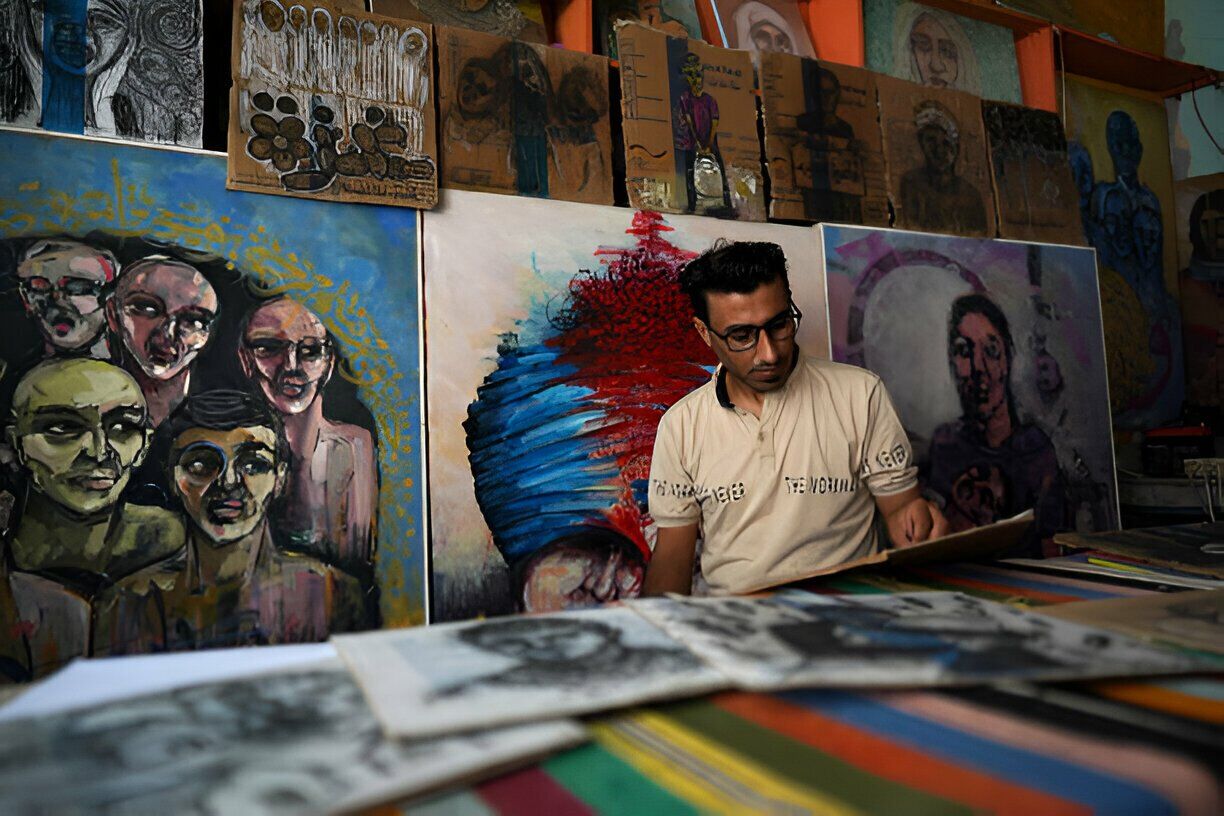
As if his works were from distant crumbling past, Gaza artist Ahmad Mahna documents the aggression on his little enclave. He uses the aid boxes dropped from the parachuted air to feed the starved to draw on and tell a painter’s story of the ongoing Israeli genocide.

Mahna says the goal of drawing is not only to document Israeli crimes but to send a message to the world, there are people in Gaza who love life and have needs beyond food and drink and want to tell the world of the need to stop the criminal actions against them meted by Israel and their forced forced displacement while the world looks on in silence as narrated in Al Mayadeen.

As a citizen living in a besieged enclave, Mahna has always been accustomed to difficult circumstances and never felt bound by the routine methods followed by world artists to see their creations come to light.

When he does not find the appropriate tools, he turns to whatever is available to him. Such may include paper, pencil, wall, piece of cloth, glass and even an old, neglected wooden board. In the artist’s eyes, these “worn-out” things can be transformed into inspiring artworks.

“Being across from an UNRWA school is a major incentive to draw,” Mahna pointing to the scenes of displaced people running to shelters as the aggression thickens combined with people fleeing guns and bombs thrown on displacement camps, queues to obtain water, bread and firewood, and scenes of the wounded carried on shoulders.

These tragedies become sad but rich material for Mahna to transfer such oppression and grief onto paper and from there on pass to the world.

Today the Gazan artist left his mark everywhere through his works and murals, saying it was difficult to stand idly by amidst the horrors he was witnessing, so he armed himself with his charcoal pen, and divided the “carton” into four paintings beginning with “A Four-Year-Old Girl Carrying a 16-Liter Gallon of Water”, and published it on the social media.

It became an instant hit, generating much and unexpected interest with many asking him to draw more about the sufferings of the displaced. Today,  Mahna is a “beacon” for many artists, and the owner of dozens artistic pieces which tell the world, through simple lines, the meaning of the ethnic cleansing that is taking place in Gaza, through such titles as “Escape from Death”, ” Last Embrace” and others.

Mahna says the painting comes out of a “first-time situation I experience” with emotions flooding whether its love, fear, anger or sadness. He fills his painting with details that convey a reality of interconnected circuits surrounding the lives of residents including death to provide basic needs daily, movement of passersby to and from hospitals that has become a daily routine due to the bombs and air-raids, and the incessant spread of diseases that is everywhere.

Because the tent has become the main “hero” in the story of Palestinian displacement, Mahna transfers the canvas into a painting with rich details, focusing on the scorching temperatures that melt the people inside, the insects, scorpions, and snakes that surround them like a barbaric army from every direction, and the sounds they hear from every corner, nullifying the individual privacy and the human need for rest and calm.

Coffee and Painting

“There is no one left who has not been affected by the war,” says Mahna, a former employee in one of the art institutions in Gaza. He lost his job and had to look for an alternative to provide him with his daily bread, so he opened a tea and coffee kiosk whilst making wall paintings where passersby would stop not only for the coffee but contemplate the paintings with respect for the skilled maker, as if directing words of thanks to him for what he conveys for their suffering.

Like others, Mahna did not comprehend the ongoing war of extermination till three months after the massacres when he shook off the cloak of despair and decided to stand up again. Thus, he opened his own studio under his downtrodden house. Only then did he feel he returned to the world he belonged to, amidst the looks of children escaping the boredom of the shelter that now surround him from every direction, reminding him of his societal role in managing workshops to relieve their psychological stress through art.

Mahna describes himself as a street artist because his drawings express the state of society and its conditions. From drawing destroyed homes and the color of the rubble, Mahna gives passersby hope in a city reduced to ruins. He has plenty to draw from images of corpses, limbs, mass graves, grief of bereaved mothers over their sons and their screams over those who remained under the rubble to the depiction of the ungodly famine in north Gaza.

Mahna faces difficulty in obtaining drawing materials. Charcoal pencils can run out at any time. Aid boxes have also become difficult to obtain in light of the increasing gas crisis, as residents prefer to burn them to prepare food instead of producing several paintings to look at while they are starving. He pointed out he faces the same problem that forced him to set fire to the wood that supports his paintings, but he is still trying to keep art alive in Gaza despite everything.

CrossFireArabia

CrossFireArabia
Dr. Marwan Asmar holds a PhD from Leeds University and is a freelance writer specializing on the Middle East. He has worked as a journalist since the early 1990s in Jordan and the Gulf countries, and been widely published, including at Albawaba, Gulf News, Al Ghad, World Press Review and others.

Related Posts

Beirut Weeps For a Poet

Lebanon mourns Khatoun Salma, a Lebanese national poet who was killed along with her husband in an Israeli airstrike that targeted their home in the Tallet al-Khayat neighborhood of Beirut Wednesday, 8 April.

Rasha al-Amir, publisher of Dar al-Jadeed, announced that the bodies of Khatoun and her husband were recovered from the rubble, Thursday morning.

Lebanese journalist Maha Salma also mourned her sister Khatoun on her Instagram account, writing: “My dear sister is in God’s care. May God grant me patience in the pain of her loss and the burning of my heart and soul.”

Poet and playwright Yahya Jaber wrote a tribute to Khatoun on Facebook, saying: “Yesterday, the Israeli airstrike cut down a poet with its sharp scissors, a poet of delicate Arabic.” Under the rubble, the conjunction “waw,” the plural “waw,” the feminine plural “nun,” the feminine suffix “ta,” the definite article “al-“: a massacre of language at the hands of language. Jaber attached a picture of the building where Khatoun lived to his post, saying:

“Here is the Khayat Hill building, and here on one of these balconies, we used to stay up late with Khatoun and her husband, Muhammad Karsht, in the late 198s, spinning yarns of laughter and sewing memories. We would recite poetry and remember our city, Tyre, and love Beirut, the capital.”

Lebanese poet Majida Dagher wrote on her Facebook page in mourning for Khatoun: “Under the rubble of her house in Khayat Hill, they found a poet lying among her shattered rhymes. The death of a poet in an airstrike on Beirut makes you feel that war is very, very close. The sound of bones breaking has become louder, and the smell of blood deeper.

Salma fell from the heights of poetry before she could bid farewell to ‘the last inhabitant of the moon.'” She thought Beirut was her tent, Beirut the roof of her poem, where she would hide, “embracing a woman waiting” for the dust to settle. But the dust became the tent of a new Beirut, a Beirut weeping, broken, martyred.

Salma, who studied Arabic literature at the American University of Beirut, published two collections of poetry, “I Embraced a Woman Waiting” in 2009 and “The Last Inhabitants of the Moon” in 2012, both with the Lebanese publishing house Dar Al-Jadeed. She first gained recognition in the 1970s, during her secondary school years, when she won a poetry prize. Later, at the beginning of this century, she became known in cultural circles for her relatively small but distinguished poetic output and her academic pursuits, which included studies in Sufism and Sufi mystics.

She combined profound knowledge with poetic sensitivity. She left her mark on the Lebanese cultural scene with a unique poetic voice, manifested in her literary works that carried the pain of humanity, exile, and memory. With her tragic passing, Lebanon loses a literary and human figure who wrote of the wound in a language that resembled nothing but truth.

Continue reading
Al Bahri: The Man Who Set Palestinian Theater

He is a playwright and author of 12 plays, nearly 20 novels, and numerous translations. Jamil Habib Afara (al-Bahri) was known as the “Father of Theater.” He was born in 1895 in Haifa and his family name dates back to the mid-18th century, as his ancestor owned a merchant fleet that sailed the Mediterranean between Haifa, Acre, and Tripoli. This is where his family name originated.

He showed early interest in literature and writing. He and his brother, Hanna, were keen to revitalize the literary and intellectual scene in Haifa, establishing the National Library there in 1922. He first published the “Zahrat al-Jamil” (The Beautiful Flower) and later “al-Zahra” (The Flower) which was initially a weekly publication that later became a bi-weekly and continued publication for about nine months after his death in 1931. His last piece was

a journalistic investigation into the execution of the three martyrs: Muhammad Jamjoum, Fuad Hijazi, and Ata al-Zeer, in the city of Acre in 1930. He dedicated his time and his newspaper that day to the souls of these martyrs, leading with: “The terrible hour in Haifa and all of Palestine: Let us commemorate those who gave their lives for the homeland.” A large funeral was held for him, and poems and eulogies were recited and published in the Palestinian press, such as the “Al-Karmel” and “Falastin,” newspapers.

The Department of Culture of the Palestine Liberation Organization posthumously awarded him the Jerusalem Medal for Culture and Arts in 1990, and the Palestinian Ministry of Culture reprinted his first book, “The History of Haifa,” in 2022.

Continue reading

You Missed

Trump: Tunes, Ceasefire and Hormuz

Trump: Tunes, Ceasefire and Hormuz

Israeli Looters in Lebanon

  • By marwan
  • April 23, 2026
  • 17 views

Ayat, Qamar Bid Farwell to Their Martyr Dad

Ayat, Qamar Bid Farwell to Their Martyr Dad

‘We Killed Our Own Then Blamed Hamas’

‘We Killed Our Own Then Blamed Hamas’

An Unholy War!

An Unholy War!

‘Journalist Khalil Trapped Under Rubble Left to Die’

‘Journalist Khalil Trapped Under Rubble Left to Die’