CrossFireArabia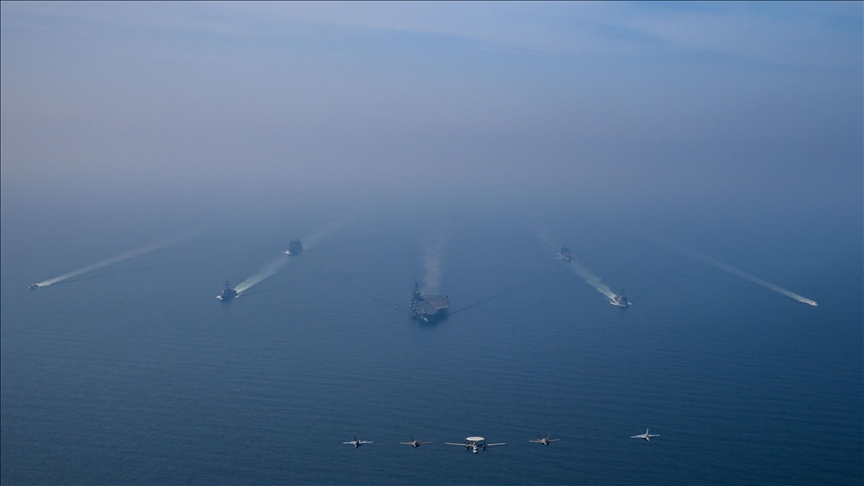
By Ismail Al-Sharif
“Nations that believe themselves to be eternal are often the first to be surprised by history.” – Charles de Gaulle
In May 1949, the Chinese Civil War was nearing its conclusion in favor of the Communists under Mao Zedong. At that time, Great Britain, the world’s most powerful nation, maintained warships on the Yangtze River to protect its citizens and commercial interests in cities like Shanghai and Nanjing. Among these ships was the British frigate HMS Amethyst.
On April 20, 1949, the frigate sailed up the Yangtze River toward Nanjing, but the Communist forces, who controlled the northern bank of the river, considered the ship’s presence a foreign intervention in the war. Suddenly, Chinese artillery began bombarding the ship, inflicting direct hits. Its captain and several crew members were killed, and its navigation system was disabled before it finally ran aground in the mud near the shore.
Other British ships attempted to come to its aid, but they too were fired upon by Chinese artillery and forced to retreat. The ship remained trapped for four months under fire from communist forces, amidst tense negotiations between Great Britain and the communist leadership.
On the night of July 30, 1949, the ship’s new captain, John Cairns, decided to execute a daring plan. He waited for a merchant ship to pass, then moved behind it in the darkness, taking advantage of its cover. His plan succeeded; the ship managed to escape and reach open waters.
This incident is considered a symbol of the end of the era of British imperial dominance and a harbinger of its decline. Many historians cite it as the moment when the great powers realized that the world had changed and that the balance of power was no longer what it once was. This story is repeating itself today, but it’s not about a single ship; it extends to the American destroyers that patrol our seas.
Half a century ago, missile production was prohibitively expensive, and the technology for precise guidance systems was unavailable. Therefore, the American navy was designed according to the realities of that era. Then came the 21st century, when electronic technology and computers became accessible to everyone, and precision guidance systems became readily available, whether in a sophisticated missile or a simple drone.
The Ukrainian war revealed that the era of tanks is over; they became easy targets for drones that cost only a few thousand dollars each. Similarly, the Iranian war reveals that warships at sea are like tanks on land: Easy targets for drones and missiles.
Consider the crown jewel of the American navy, the aircraft carrier USS Eisenhower, which resembles a floating city with an area of approximately 18,900 square meters. It is accompanied by other highly advanced destroyers possessing immense destructive power. However, no destroyer carries an equal number of interceptor missiles and drones to those possessed by its adversaries.
This is why Iran continues to defy this presence and close the Strait of Hormuz. This scenario is reminiscent of the Houthis’ actions when a group from one of the world’s poorest countries challenged the world’s most powerful nations and managed to disrupt shipping in the Bab el-Mandeb Strait last year.
Iran controls the northern coast of the Strait of Hormuz and possesses a diverse arsenal that includes land-based missiles, submarines, drones, fast attack craft, and sea mines. In contrast, US warships have only a limited number of defense systems compared to the size of Iran’s arsenal in this region.
Military strategists have formulated a simple equation called the “fire-off equation.” This equation posits that a ship’s survival depends less on its destructive power and more on the ratio of threats directed at it to the number of interceptor missiles it possesses to counter them. When Iran or the Houthis launch a salvo of 50 drones at a destroyer with a limited stockpile of interceptor missiles—a stockpile that cannot be replenished in combat—the objective is not necessarily to sink the ship directly, but rather to exhaust its defenses. Once the interceptor missiles are depleted, these destroyers are reduced to approximately 9000 tons of scrap metal adrift at sea.
In late 2023 and throughout 2024, the Houthis targeted ships in the Red Sea, placing the US Navy in a precarious position. Unable to forcibly reopen the Bab el-Mandeb Strait, commercial shipping was rerouted around the Cape of Good Hope, a detour of approximately 19,000 kilometers. This added weeks to each voyage and incurred additional costs estimated at thousands of dollars. Thus, the most powerful navy in history found itself unable to secure the Bab el-Mandeb Strait.
For 80 years, the global economy has been built on the assumption that US ships can keep shipping lanes open. However, recent conflicts demonstrate that this assumption is beginning to crumble. Naval power can still destroy the largest fleets on the high seas, but on coastlines and in narrow waterways, it appears less decisive.
It’s a story reminiscent of the British frigate HMS Amethyst; a moment when superpowers discover their power is no longer what it once was, and that the era of absolute dominance is drawing to a close.
This article by Ismail Al Sharif was originally written in Arabic for the Addustour daily and reprinted here in crossfirearabia.com